Construction site security in Melbourne should be re-scoped at every build-stage boundary, not locked into one guard roster from mobilisation to handover. The correct mix of guards, patrols, fencing and detection shifts as risk moves from a bare perimeter and plant to vertical access, fit-out value and final keys.
Most sites I audit still buy security once, often after the first theft or near miss, then renew the same coverage without checking the programme. That works until the risk profile moves. Early works on a Melbourne site might have no power, open trenches and expensive plant behind temporary fencing. Structure changes the problem to vertical access, crane and hoist control, and costly equipment on multiple levels. Fit-out moves the value inside, where multiple trades hold keys. Handover adds insurance, key control and final handover risk. WorkSafe Victoria’s October 2026 enforcement activity is a reminder that site controls attract scrutiny, though it does not prescribe security coverage.
This guide maps the changing risk profile to the right mix at each stage, from early works through structure, fit-out and handover. You will also get a stage comparison table and a re-scoping rule to apply on programme dates, not invoice dates.
Short Answer: Coverage Should Change at Every Stage Boundary
Match site security to the project stage, not the contract date. Perimeter and plant protection suits early works, gate control and static presence suit structure, internal detection and key control suit fit-out, and documented handover cover closes it out. Re-scope coverage at each stage boundary instead of renewing one fixed guard roster from mobilisation to handover.
The value at risk moves as the build progresses: a static post suited to an empty block is the wrong spend once the building is sealed and full of fittings. In my experience the mismatch rarely shows as an obvious incident. It shows as a guard watching an empty compound while tool theft happens three levels up.
Treat each stage below as a scoping prompt and your programme dates as your re-scope dates. Lock in the scope and contract terms before each boundary, and tighten guard shift handover as coverage changes.
Early Works: Bare Perimeter, Plant and No Power
With nothing built yet, your exposure is plant, diesel, copper and site offices on an open block. Losses here are opportunistic and overwhelmingly after hours.
No mains power means lighting, CCTV and alarm monitoring cannot be relied on, so coverage leans on physical presence and unpredictable attendance. Fit temporary mesh or hoarding at the perimeter, a lockable compound for plant and fuel, and mobile patrols on randomised visits rather than a fixed hourly circuit thieves can time.
A 24/7 static post is overkill. I have watched developers spend more on guards in month one than the plant was insured for. Qualified construction security guards belong where the value is, not simply where the fence is.
WorkSafe Victoria was enforcing across Melbourne sites through October 2026, so keep access and contractor sign-in records in order from day one.
Structure: Vertical Access and Expensive Plant
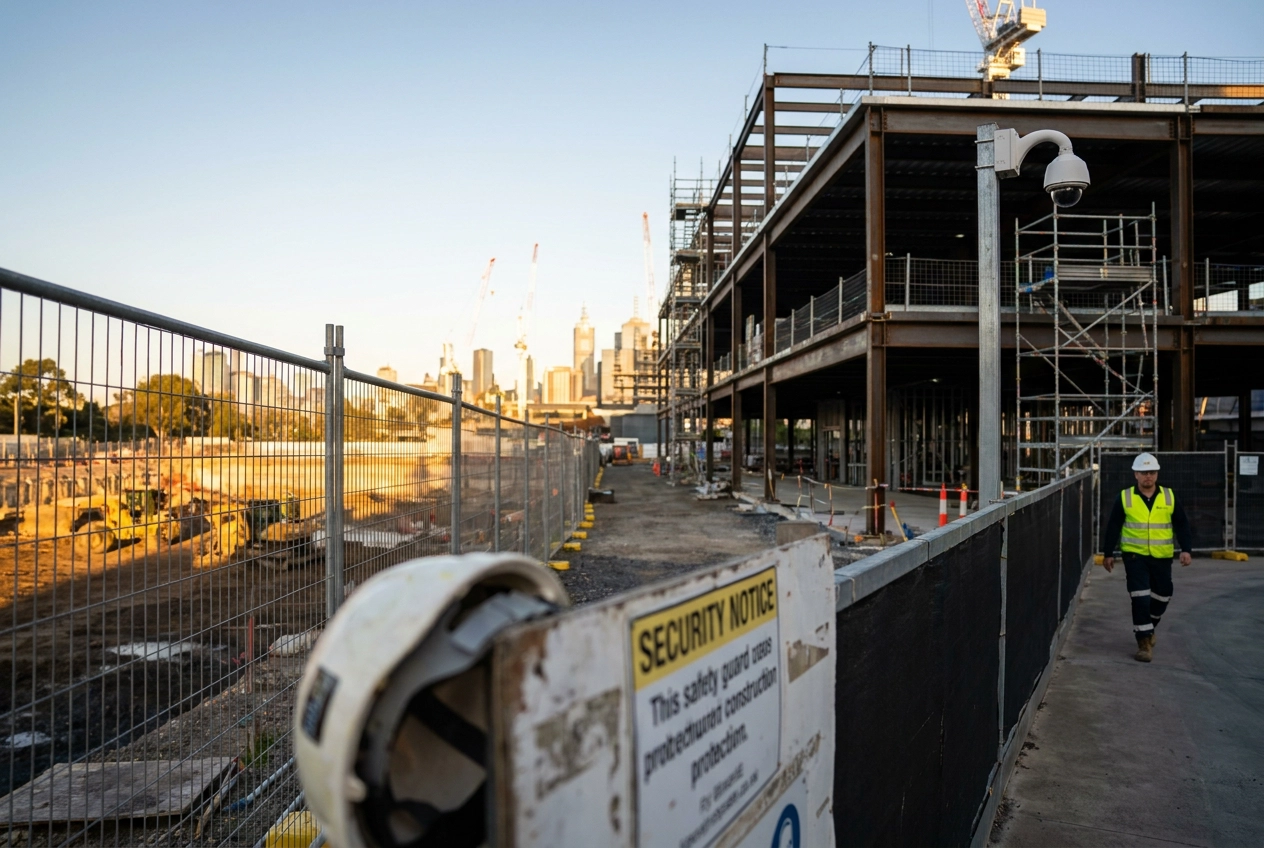
The risk flips here. With the shell up, two or three usable entry points, and every visitor in hi-vis, no one stands out. Cranes, formwork, scissor lifts, cabling, switchboards and fixings mean site value peaks, and cable is the classic mid-build loss on Melbourne jobs.
What fits: a guardhouse or static guard on the main gate, controlled pedestrian and vehicle entry, hoarding locked at close of trade, and after-hours patrols on the rear perimeter where temporary fencing is weakest. Pair that presence with physical hardening tactics to slow anyone who slips past the gate.
Why static guards earn their keep: they verify who is on site before a loss happens, not after. Detection alone lets the cable walk.
The failure point I see most often is the secondary gate nobody watches. Walk the perimeter at night yourself before you approve the roster.
Fit-Out: The Value Moves Inside the Building
Perimeter coverage that was right for early works and structure is the wrong spend now. Once the envelope closes, almost everything worth stealing sits inside it.
Risk shifts to portable, resellable items: power tools, tapware, sanitaryware, appliances, AV, lift components and fixings. Multiple trades hold keys or codes, and after-hours access is routine.

What fits:
- Internal detection across floors, store rooms and risers, with alarm monitoring that alerts someone who will attend
- Lockable material cages per trade
- A single accountable key and code register, the discipline behind good fitting room security
Manned presence still belongs here, just at the right point: a concierge-style post or static guard on the loading dock during active hours, not a perimeter circuit after dark.
Most people overlook key control. If five trades share one code and nobody logs its use, you cannot investigate a loss, or narrow it down.

Handover: Keys, Insurance and Final Value
Handover is the gap. The building sits at full finished value, certificates, keys, appliances and final cleans on site, before the owner’s insurer takes over cover. Risk shifts from bulk theft to targeted loss, works defects, and liability if an unauthorised person is injured in a space you still control. That duty extends to everyone affected by the work, including the public.
What fits: a documented lock-up and key handover regime with signed access records, monitoring left live until the client’s system is commissioned, and short-term guard presence around settlement or open inspections.
Agree the end date in writing. A roster rolling past practical completion is waste and muddies who controlled the site when. In my experience the last fortnight is when trailers of fittings disappear, every trade assuming someone else is watching. Price this scope into your construction site security plan.

Stage Comparison: Risk, Wrong Spend and Right Mix
Final fortnight: scope mapped, not felt.
| Stage | Primary risk | Wrong spend | Right mix |
|---|---|---|---|
| Early works | Plant/fuel/copper, open block | 24/7 static guard, nothing to protect | Fencing, locked compound, randomised mobile patrols |
| Structure | Unauthorised access, cable/plant theft | Roving guard, no gate control | Guardhouse/static gate, monitored entry, after-hours perimeter patrols |
| Fit-out | Portable tools/fittings, key misuse | Perimeter-only patrols | Internal detection, alarm monitoring, key register, dock presence |
| Handover | Targeted finished-goods loss, liability | Roster past completion | Documented lock-up/key handover, monitoring live until commissioning |
Re-scope at each programme milestone, not fixed annual arrangement. Check postcode: Victoria Police crime data; building industry bodies show comparable losses. Re-scope stage mixes; guards on a mismatched scope are not the fix. How do you decide which service mix you need?
Pro Tip: Re-Scope on the Programme Date, Not the Invoice Date
The trigger for changing coverage is the stage boundary, not the invoice date. Put the four programme dates in your provider’s calendar on day one and re-scope on those dates. Same lesson as Corporate Event Security in Melbourne: How to Scale Guard Numbers as Headcount Grows: locking a fixed guard count early is expensive. Common pitfall: renewing the mobilisation roster straight through to handover. You keep paying perimeter rates to protect internal value, and the mix never touches the live risk. Second pitfall: cutting coverage entirely between stages. No window in a construction programme is both unattended and safe. Ask for a stage-by-stage scope at tender so the switch is priced and documented before you need it. If your provider cannot tell you what changes at fit-out, that is your answer. Start with a scoped construction security plan and re-check it at every stage boundary.
Conclusion
Stage-based security is not a set-and-forget cost. Early works need perimeter control, structure needs vertical access and plant protection, fit-out shifts value inside, and handover demands key control plus monitoring until commissioning. Re-scope at every programme milestone, not the invoice date. Keep coverage live between stages; no construction window is safe unattended. Ask for a stage-by-stage scope at tender so switches are priced and documented before you need them. Start with a construction security plan, then adjust with mobile patrol or electronic monitoring as risk moves. The right mix protects the asset, the programme, and your budget. Pro tip: map the four programme dates with your provider this week and re-scope before the next invoice locks in a stale mix.
about
avada factory
Sempery ultricies nibh at dolor cras urna eleifend nec. Atiam efficitur tempor.