Most event planners in Melbourne lock in a security quote early, breathe a sigh of relief, and move on. Then the RSVPs keep rolling in. By the time the final headcount is confirmed, that original guard number is nowhere near sufficient, yet the budget has already been allocated elsewhere. This is the single most common procurement mistake in event security Melbourne planners make, and it can turn a manageable line item into a costly, last-minute scramble.
Scaling security resourcing to match actual attendance is not guesswork. It follows predictable ratios, licensing thresholds, and trigger points that experienced planners build into their contracts from the start. The problem is that most guidance on this topic is either too generic or too jurisdictionally vague to be useful in a Victorian context.
This post changes that. You will find practical crowd-to-guard ratios, a ready-to-use scaling table, advice on when licensed security becomes a legal requirement, and a framework for building a variable security budget that stays proportionate as your confirmed headcount grows. Whether you are planning in the Melbourne CBD or at a suburban venue, the principles here apply directly to your event.

Scale Security to Confirmed Attendance, Not an Early Estimate
The correct guard count for any Melbourne corporate event is not fixed at booking. It must be re-scoped at each RSVP milestone, using a tiered crowd-to-guard ratio applied to confirmed attendance, not projected headcount.
A variable security budget tied to attendance milestones removes that pressure, eliminating the choice between under-resourcing a larger crowd or absorbing last-minute guard costs at premium rates. Attendance often grows substantially as RSVPs accumulate, and no one who locks in a guard number at initial quote should be surprised when the crowd outgrows its security scope before doors open.
This applies across Melbourne CBD hotel ballrooms, suburban conference centres, and outdoor event spaces. Ratios shift slightly by venue type, but the scaling logic is identical. The guide to hiring event security the right way in Melbourne covers Victorian licensing rules and vetting criteria before you engage any provider.
Professional event security should be scoped as a living brief, not a fixed document.
Why a Fixed Initial Quote Is a Budget Liability
Most security firms quote against a single headcount figure provided weeks before the event, almost always an optimistic early estimate rather than a confirmed one.
Confirmed attendance routinely outstrips the figure in the original security brief. The quote never updates to reflect it.
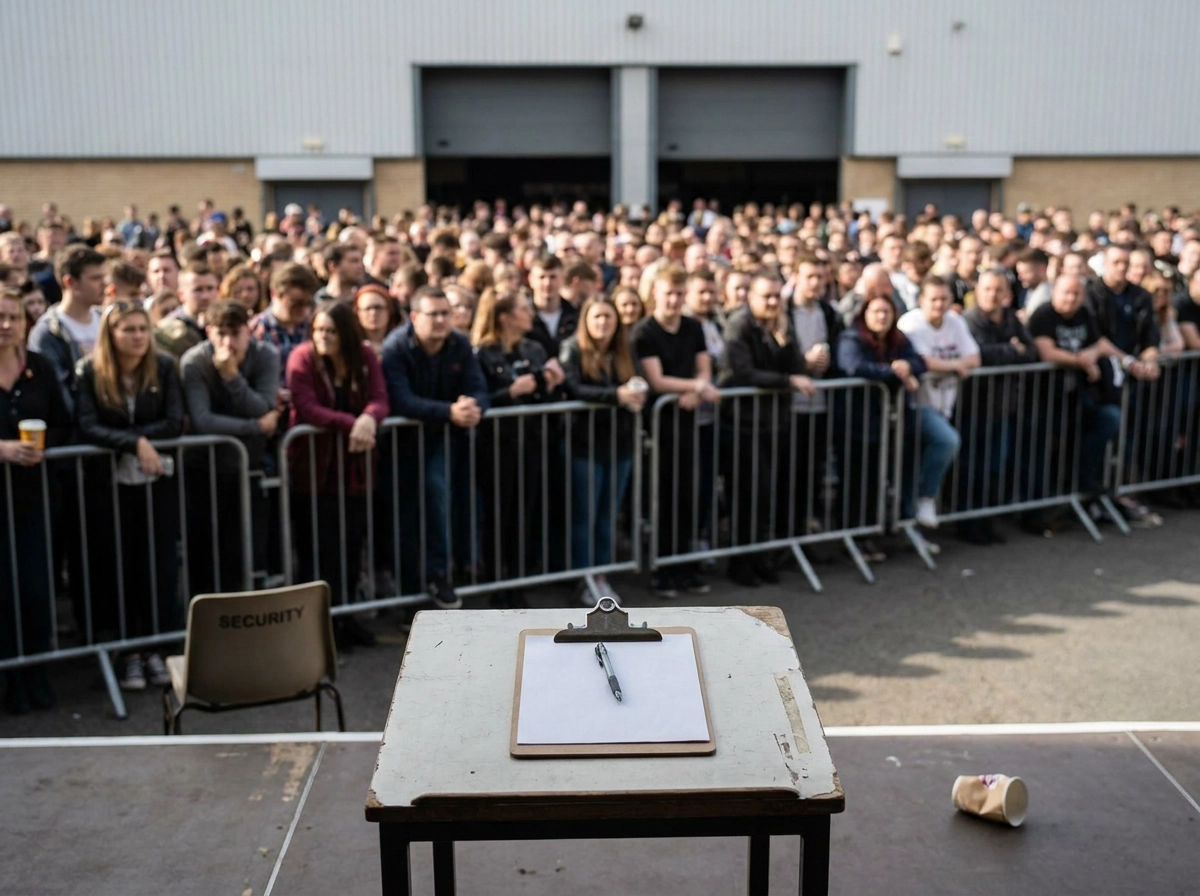
When attendance overshoots the scoped guard count, planners face three bad options:
- Absorb emergency last-minute guard hire at significant rate premiums
- Redeploy existing guards and create coverage gaps elsewhere
- Accept elevated crowd control risk
Emergency guard hire within 48 to 72 hours typically carries a higher rate than planned deployments, the exact premium varies by provider, which is why asking for it in writing at booking matters. That cost exposure disappears when re-scoping is built into procurement from day one.
Re-scoping is a contractual right, not a favour. Professional providers should offer staged pricing tied to confirmed attendance milestones. A useful starting point is understanding how to choose the right event security guard services before committing to any fixed-quote arrangement.
Crowd-to-Guard Ratios: The Working Numbers
As a working starting point used across professional Melbourne event deployments, many providers apply a baseline of roughly 1 guard per 75–100 attendees for low-risk indoor events, tightening to around 1 guard per 50 attendees where alcohol, high-profile speakers, or public access are involved. These are practitioner reference points, not statutory minima, your provider should confirm the ratio appropriate to your specific venue and risk profile.
Outdoor events and multi-zone venues require an additional layer: 1 dedicated guard per distinct access point, regardless of headcount, though again, treat this as a practitioner reference point and confirm the appropriate number with your provider. Planners consistently undercount these. A hotel ballroom with a foyer, two fire exits used as smoking points, and a loading bay needs 4 positional guards before the crowd ratio is applied. Understanding what event security guards actually do at each position helps planners assign roles accurately.
The full scaling table in the next section applies these ratios across common Melbourne event configurations.
The venue multiplier, not the headcount, is where most security briefs go wrong.
A Practical Scaling Table for Melbourne Events

Use this table as your working reference when re-scoping at each RSVP milestone. Figures below are indicative starting points based on common practitioner guidance; your specific venue, council permit conditions, and liquor licensing requirements may impose higher minimums. Confirm figures with your licensed provider.
| Confirmed Attendance | Event Type | Minimum Guards | Recommended Guards | Notes |
|---|---|---|---|---|
| Up to 100 | Low-risk indoor, no alcohol | 1 | 2 | One at entry, one roving |
| Up to 100 | Indoor with alcohol service | 2 | 3 | Entry control and floor presence mandatory |
| 101–250 | Indoor corporate, no alcohol | 2 | 3 | Dedicated entry plus roving coverage |
| 101–250 | Indoor with alcohol or outdoor | 4 | 5 | Entry, perimeter, floor, and supervisor |
| 251–500 | Any event type | 5 | 7–8 | A security supervisor on-site is non-negotiable at this scale |
| 500+ | Any event type | Bespoke scoping required | Site-walk recommended | Static guards, mobile patrol support, and CCTV monitoring all become relevant here |
These figures reflect what professional event security deployment looks like in practice. Venue-specific conditions, including council permits, liquor licensing, and access point configurations, can push requirements above these minimums. Treat this table as a starting floor, not a ceiling.
When Licensed Security Becomes Non-Negotiable
Under the Private Security Act 2004 (Vic), anyone performing crowd control or security work at a licensed premises or public event must hold a current Security Industry licence issued by Victoria Police. This is a statutory requirement. Amendments under the Private Security and County Court Amendment Act 2024, effective June 2025, have hardened these obligations with no exemptions remaining.
Most Melbourne hotel ballrooms, function centres, and rooftop spaces operate under a liquor licence, meaning the majority of corporate events trigger the requirement for licensed crowd controllers by default. Cross-check any provider’s credentials against the Victoria Police public register. Understanding essential qualifications and licensing in Australia before briefing a provider will protect you from accepting an unqualified team.
A common planning trap: adding a cash bar late in the process can alter the event’s licensing profile and its security requirements. The venue will not notify you automatically.
The obligation sits with the event organiser, not the venue. Confirm your security provider’s licensing status in writing before the event date.
Build Escalation Triggers Into Your Security Contract
Once licensing obligations are confirmed, make sure your guard count keeps pace with RSVP numbers as they grow.
An escalation trigger is a pre-agreed attendance milestone at which you and your security provider review and adjust the guard count. It belongs in the contract at booking, not a last-minute call two days out.
A common practitioner approach is to set review points at roughly 50%, 75%, and 95% of venue capacity, comparing confirmed RSVPs against the scoped guard count at each point.
A practical three-review structure for most corporate timelines:
- 8 weeks out: initial scoping against projected attendance
- 3 weeks out: early RSVP close, adjust to confirmed numbers
- 72 hours out: final door count review
The 72-hour review is the most frequently skipped and the most consequential. Providers vary on where standard-rate additions cut off, so ask your provider explicitly.
Ask your provider directly: “What is your rate structure for additions made at 72 hours, 48 hours, and day-of?” A clear answer indicates an operationally mature provider. Hesitation is a meaningful signal.
For events exceeding 500 guests, mobile patrol support during arrival and departure windows can supplement fixed guard positions, discuss cost-effectiveness with your provider for your specific configuration, covering car parks and external perimeters without additional static posts.
Melbourne CBD vs. Suburban Venues: What Changes
Venue type shifts the security brief significantly even when headcount is identical.
CBD hotel ballrooms and conference centres often have fixed CCTV and controlled entry points; where in-house security staff are present, confirm their licensing before including them in your deployment count, do not assume venue staff automatically satisfy your crowd-controller obligations under Victoria’s Private Security Act 2004.
Suburban and outer-Melbourne venues present a different problem. Warehouses, function farms, and outdoor marquee sites have no fixed security infrastructure. Access points are undefined, car parks uncontrolled, and as guest numbers grow, perimeter management at outdoor sites becomes a genuine operational concern.
Some council permits for outdoor events include conditions that affect security staffing, check permit conditions early in planning.
The gap between a CBD brief and a suburban outdoor brief for identical headcount often means a meaningfully different deployment model and additional guards.
Request a site walk before locking in the brief. A 20-minute walkthrough identifies access point ambiguities that would otherwise produce an under-resourced deployment or unnecessary overspend.
How to Build a Variable Security Budget That Stays Proportionate
A variable security budget has three components:
- Base cost: the minimum guard count the venue requires regardless of attendance
- Per-head rate: an additional cost increment for every 50 guests above the base
- Contingency buffer: a pre-funded reserve for late additions, held separately from the base security allocation
Always request itemised quotes separating guard hire, supervisor fees, equipment costs, and after-midnight penalties. A lump-sum quote cannot be re-scoped when attendance shifts.
The contingency buffer is the pre-funded offset for emergency premiums absorbed at 48-hour notice, not padding.
For multi-day events, scope day-by-day. A 500-person conference and a 150-person workshop carry different guard requirements; blending them overcharges the lighter day.
For larger events, combining physical guards with CCTV and access control can deliver broader coverage than additional static guards alone, discuss the trade-offs with your provider. The same logic applies when scoping executive security solutions for Melbourne businesses, where layered physical and electronic measures outperform single-measure deployments.
Frequently Asked Questions
Q: How many security guards do I need for a 100-person corporate event in Melbourne? For a low-risk indoor event with no alcohol, 2 guards is the working minimum: one at entry control, one roving. Add a third if alcohol is served.
Q: At what point does a Melbourne event legally require licensed security? Under the Private Security Act 2004 (Vic), all crowd control and security work is a licensed activity. From 19 June 2025, this scope expanded under the Private Security and County Court Amendment Act 2024. If your venue holds a liquor licence, assume licensed guards are required and verify credentials against the Victorian Police public register before the event date.
Q: What is the typical cost difference between planned and last-minute event security in Melbourne? Emergency guard hire within 48 hours typically carries a higher rate, ask your provider for their specific structure in writing. Building escalation triggers into your contract at 8 weeks, 3 weeks, and 72 hours is the most effective way to reduce that exposure.
Q: Does crowd control security for outdoor Melbourne events differ from indoor? Yes. Outdoor sites introduce undefined access points and perimeter management requirements that indoor venues do not. A site walk with your provider is essential before finalising any outdoor security brief.
Q: Can I use the same security quote if guest numbers increase after booking? Only if your contract includes pre-agreed escalation triggers. A quote issued against an early headcount estimate is not automatically valid for a larger crowd. Re-scope at each RSVP milestone using the ratios covered above.
Common Pitfall to Avoid
Beyond the FAQs, three mistakes account for most budget blowouts across Melbourne event deployments.
Locking in the initial quote as a ceiling (covered in detail above) is the most expensive mistake, at every RSVP milestone, re-scope.
Verify every guard’s licence against Victoria Police’s public register before the event date, late additions carry real risk given multi-month processing times for new applications.
At booking, confirm three things in writing: a site walk, itemised pricing, and pre-agreed escalation triggers.
Pro Tip: Ask your security provider to confirm their 72-hour addition rate in writing at initial booking. If they cannot give you a clear answer, keep sourcing. A professional provider has this figured out before you ask.
Conclusion
Corporate event security in Melbourne is not a fixed line item; it is a variable that must move with your confirmed headcount. The key takeaways are straightforward: base your guard numbers on real RSVP data, not early estimates; apply proven crowd-to-guard ratios at every milestone; build escalation triggers into your contract before you need them; and verify every licence before the event date.
Getting these steps right protects your budget, your guests, and your legal compliance under Victorian law.
Start your next event brief by requesting itemised pricing, a site walk, and written escalation terms from your security provider. If they hesitate on any of these, find a provider who does not.
A well-secured event runs without incident precisely because the planning was thorough. Lock in the right framework now, and the night takes care of itself.
about
avada factory
Sempery ultricies nibh at dolor cras urna eleifend nec. Atiam efficitur tempor.