The safest approach to crowd control is a proactive, risk based management plan that combines site design, trained staff, monitoring and medical readiness. Headline tactics include staged ingress and egress, the right mix of soft and load bearing barriers, licensed crowd controllers briefed on clear roles, a working communications loop, and a medical plan matched to the crowd you expect. Every section below builds one of these into something you can put in a plan.
TL;DR:
- Effective crowd control relies on pre-event site zoning, staged ingress and egress, and barriers tailored to crowd energy levels to prevent density issues.
- Monitoring crowd density in real-time, especially at transition points, and maintaining alternative routes can significantly reduce crush risks.
- Regulatory expectations demand an emergency plan, clear evacuation procedures, command structure, and show stop triggers at least a week before large or alcohol-serving events.
- Proper staffing should be based on risk assessments, licensing requirements, and structured briefings, with on-site controllers equipped with role cards and fatigue mitigation measures.
- Combining visual surveillance, fixed observation points, and communication protocols ensures a proactive response to early signs of crowd trouble.
Table of Contents
- Crowd management versus crowd control: why the difference matters
- Key crowd control strategies you can implement before doors open
- How crowd density turns into a safety problem
- Planning and risk assessment: what regulators expect to see
- Site design: getting ingress, egress and barriers right
- Staffing, licensing and briefings that actually reduce risk
- Monitoring, communications and staying ahead of trouble
- Medical, first aid and incident response planning
- A working checklist you can adapt on site
- Crowd safety is a reputation asset, not just a compliance box
- How ABCO Security supports your event crowd plan
- Authoritative guidance to attach to your event plan
- Sources
- FAQ
Crowd management versus crowd control: why the difference matters
Crowd management is the proactive side: planning flow, designing space and building trust with attendees so people move and behave the way the event needs them to. Crowd control is the reactive side, the interventions and physical containment used once a problem is already developing. Organisers who lean on management rather than control see fewer incidents and less regulatory exposure, because most crowd failures start as a planning gap rather than a behaviour problem. The AIDR Safe and healthy crowded places handbook and state event guides exist for exactly this reason: they push organisers towards design and communication first, containment second.
Key crowd control strategies you can implement before doors open
Good crowd control is mostly decided before the gates open. The tactics below form the core of most working event plans.
- Zone the site into pods, with a defined front of stage pit and clear separation between high energy and low energy areas.
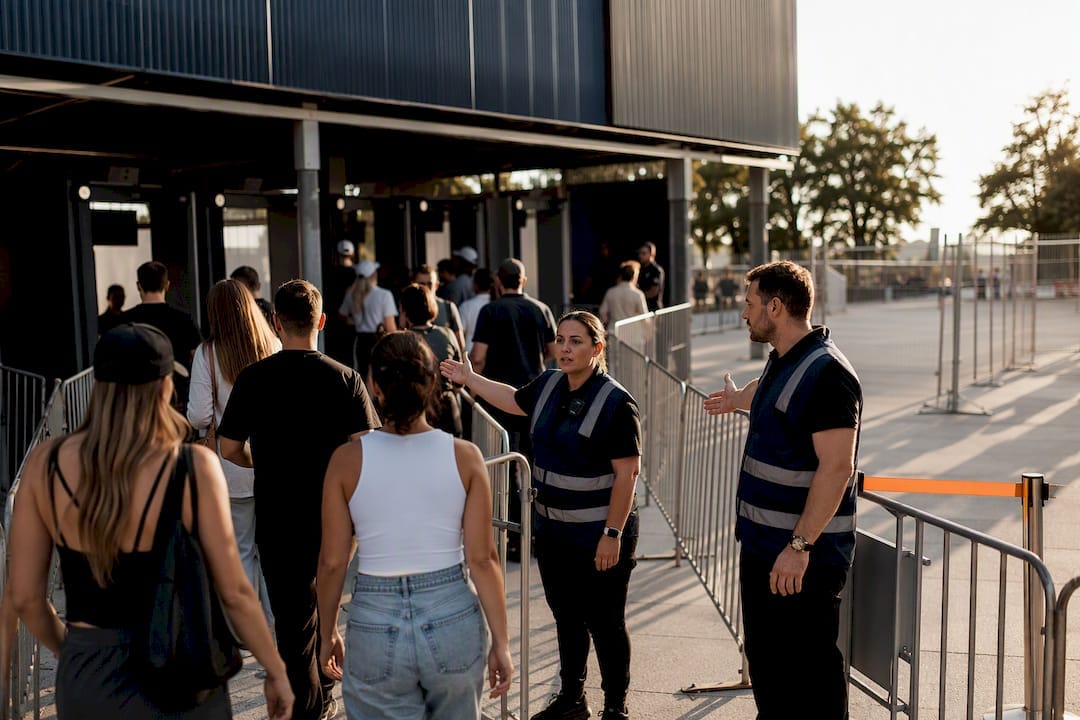
- Plan ingress and egress separately, with staggered entry times and queue lanes that avoid cross flows.
- Choose barrier type by crowd energy: psychological barriers for orderly, seated or low intensity crowds, rigid load bearing barriers wherever surge or crush risk exists.
- Use signage and pre-event messaging to set expectations on entry times, prohibited items and exit routes before people arrive.
- Deploy staff in fixed roles with scheduled relief, keeping visibility high and fatigue low across long shifts.
Ticketing platforms that manage timed entry, such as NITEPASS, can reduce physical queue length and take pressure off ingress points before your own staff even get involved.
Pro Tip: Walk your own ingress route as a patron would, at the time you expect peak arrival, before the event: bottlenecks are obvious on foot in a way they never are on a site map.
How crowd density turns into a safety problem
Density is the single best predictor of crowd risk, and it is measurable well before anything goes wrong. Mobility becomes severely compromised at around 0.5 square metres per standing person, and densities above a high threshold are considered extreme risk, according to background crowd safety guidance. Rather than tracking a single venue-wide average, map the site into a grid and monitor each cell separately, because a safe overall average can hide a dangerous pocket near a stage barrier or a narrow gate.
- Watch transition points such as doors, stairs and the moments right after a headline act finishes, since these carry the highest density risk of the event.
- Keep at least one open gate or alternate route near every high density zone so flow can be redirected without stopping people entirely.
- Pre-assign extraction corridors to each grid cell rather than relying on a single central exit.
A critical density near 0.5 m² per person severely limits movement, which is why organisers plan interventions such as opening extra gates well before a zone reaches that point.
Planning and risk assessment: what regulators expect to see
For larger events or events serving alcohol, an emergency management plan is typically prepared and submitted at least seven days before the event, with thresholds often applied around 5,000 patrons, according to Western Australian event guidance. That plan needs to hold up under questioning, not just satisfy a checklist.
- Set out evacuation routes, assembly areas and confirmed emergency services access points.
- Define a command structure with named decision makers and clear lines of authority.
- Write a show stop procedure that assigns tasks to crowd controllers and medical teams and can be executed in under five minutes.
- Build the plan around briefings and exercises, not just a document for regulator sign off.
An event risk assessment template gives you a structure to work from rather than starting from a blank page.
Site design: getting ingress, egress and barriers right
Good site design keeps people moving in one direction and gives every zone more than one way out. Cross flows, where entering and exiting crowds meet, are one of the most common causes of localised crush.
- Design for continuous, one way movement wherever possible, with alternative exit routes built in from the start.
- Reserve rigid, load bearing barriers for high energy events or anywhere a physical surge is plausible, and use lighter psychological barriers for calmer crowds, following AIDR barrier guidance.
- Keep a clear 1.5 metre extraction zone at the front of stage pit and check that doors and stairs meet the throughput figures set out in state crowded places checklists.
Staffing, licensing and briefings that actually reduce risk
Fixed staff-to-patron ratios are a poor substitute for a proper assessment. A risk-based staffing model that weighs alcohol service, crowd demographics, venue layout and the draw of a headline act will land on very different numbers for two events of the same size.
- Confirm every crowd controller holds the licence and competency required in your state, including ongoing refresher training.
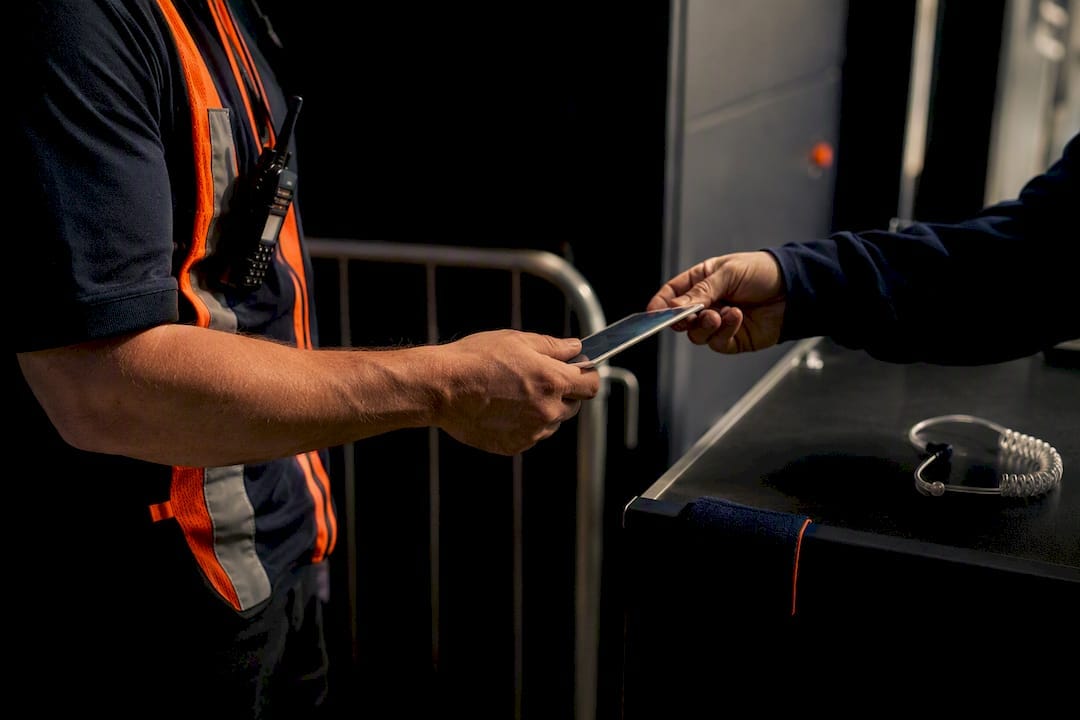
- Run a pre-shift briefing that covers role cards, radio channels, rotation times and show stop responsibilities.
- Build fatigue mitigation into the roster rather than hoping shifts run to plan.
An event security staffing guide covers rostering models in more depth if you are building this from scratch.
Pro Tip: Give every controller a laminated role card with their zone, radio channel and show stop task written on it: verbal briefings get forgotten by hour three of a shift.
Monitoring, communications and staying ahead of trouble
A common operating picture only works if CCTV, static observers and roving patrols feed into the same place. Radio discipline matters as much as the equipment itself.
- Combine CCTV coverage of high density zones with static observation posts and roving patrols reporting into one command post.
- Set clear escalation triggers, so a controller knows exactly when a density or behaviour observation becomes a command post call.
- Track queue length and throughput at gates as an early trigger for opening extra lanes or slowing entry.
Medical, first aid and incident response planning
Medical resourcing should match the event type and the crowd behaviour you expect, not a generic formula. A high energy standing event with alcohol service needs a different first aid footprint to a seated family event of the same size.
Place first aid posts with clear signage and a dedicated extraction corridor separate from general crowd flow, so an injured patron or a stretcher team is never fighting the crowd to get out. After any incident, run a structured report and give affected staff and patrons access to psychosocial support as part of recovery, not as an afterthought once the event has closed.

A working checklist you can adapt on site
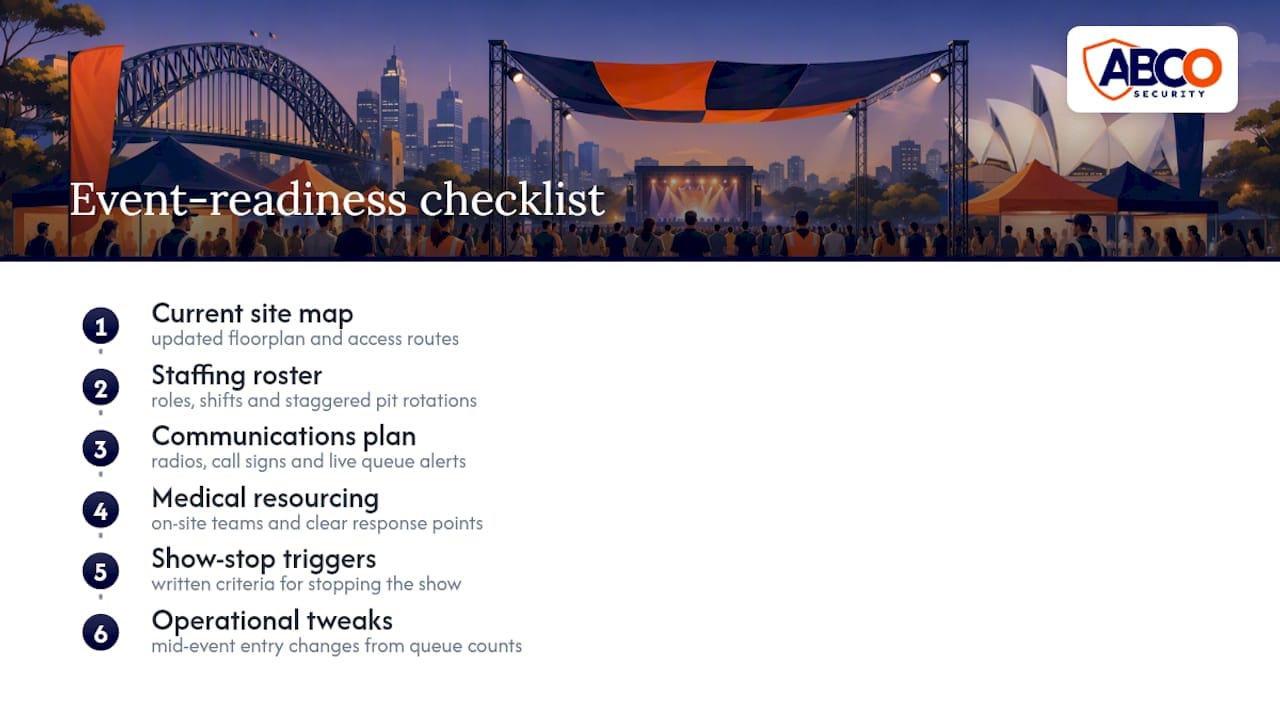
A tight organiser checklist covers a current site map, staffing roster, communications plan, medical resourcing and written show stop triggers. In ABCO Security’s own event work, staggered pit rotations and mid-event entry adjustments based on live queue counts are two of the simplest changes that reduce pressure on front of stage teams. ABCO’s crowd management techniques guide and event security staffing page carry more detail for teams building their own version.
Crowd safety is a reputation asset, not just a compliance box
Treating safety as a quality measure, not a minimum standard, changes how attendees experience an event and how insurers view it. Structured debriefs turn each event into evidence for the next, and that evidence is worth more to an organiser’s reputation than any single compliance certificate.
— Abco
How ABCO Security supports your event crowd plan
Running your own risk assessment is one thing. Having licensed controllers, mobile patrols and monitoring on the ground on the day is another. ABCO Security’s Events Security service pairs trained crowd controllers with mobile patrol coverage and monitoring, built on ISO 9001 and ISO 30000 aligned processes and more than 15 years in the security industry.

If you want a second set of eyes on your plan or a quote for event day staffing, get in touch through the Night Owl service page to discuss templates and coverage for your next event.
Authoritative guidance to attach to your event plan
- AIDR Safe and healthy crowded places handbook
- MHC WA events guidance
- State crowded places checklists and licensing pages relevant to your jurisdiction
Sources
- AIDR — Safe and healthy crowded places handbook
- Events guidance — MHC WA
- Australian Institute of Criminology — crowd management insights
- Safe and healthy crowded places checklists — Whitehorse / AIDR extract
FAQ
What are some effective tactics for crowd control?
Staged entry, zoned site layouts, a mix of psychological and load bearing barriers, and licensed staff briefed on role cards and show stop procedures are among the most effective tactics. Combining these with live monitoring lets organisers act before density becomes dangerous, as outlined in the AIDR handbook.
What are the three main methods of crowd control?
Crowd control generally relies on physical measures such as barriers and site design, human measures such as trained crowd controllers and stewards, and technological measures such as CCTV and monitoring systems. Most working event plans blend all three rather than relying on one alone.
What are some effective strategies for managing crowds?
Effective crowd management starts with a risk based plan covering ingress, egress, staffing and medical readiness, backed by clear communication with attendees before and during the event. A risk-based staffing approach that accounts for alcohol, demographics and layout tends to outperform fixed staffing ratios.
How does the “10 80 10” rule apply to crowd management?
The idea splits a crowd into a small group who cause trouble, a large majority who follow the mood around them, and a small group who actively help calm situations. It is a behavioural rule of thumb rather than an official standard, and organisers use it mainly to justify visible, approachable stewarding that influences the majority rather than focusing resources only on troublemakers.
Recommended
about
avada factory
Sempery ultricies nibh at dolor cras urna eleifend nec. Atiam efficitur tempor.