A duress alarm is designed to raise help quietly, so a person under threat can call for support without the aggressor knowing. A panic button is usually an audible alarm, designed to draw attention and deter. In practice the two terms overlap, and suppliers use them loosely, so the useful question is what the device does when pressed: who is told, how, and what happens next.
This guide explains the difference, shows where each approach fits on construction sites, in healthcare, offices, events and retail, and sets out what to check before you install or upgrade a system.
TL;DR
- Duress alarm: a silent or discreet alert, normally sent to staff, a monitoring centre or security, used when making noise could escalate the situation.
- Panic button or panic alarm: usually audible, used where drawing attention or deterring someone is the goal, such as car parks and public areas.
- Choose by risk, not by label: a security risk assessment should decide the type, placement and response for each location.
- The device is only half the system: policy, monitoring protocols, staff training and regular testing decide whether anyone arrives in time.
- Many sites need both: quiet alerts at reception and cash points, audible alarms in open or isolated areas.
Table of Contents
- The difference in one table
- Silent, audible or both?
- Where each one fits
- How an alert reaches the right people
- What to check before you buy or install
- Training, testing and false alarms
- Our perspective
- Put a response behind the alarm
- FAQ
- Sources
The difference in one table
The wording varies between suppliers, but the pattern in industry guidance is consistent. Guidance on appropriate use of these alarms describes a duress alarm as a silent alarm and a panic alarm as generally audible. Some sources, including ASIS Victoria, treat “duress alarm” and “panic alarm” as near-synonyms for workplace systems that protect staff from assault, robbery or other hazards. Both views are reasonable, which is why you should define the term in your own policy.
| Feature | Duress alarm | Panic button / panic alarm |
|---|---|---|
| Typical signal | Silent or discreet | Audible, sometimes with lights |
| Main purpose | Call for help without alerting the aggressor | Draw attention, deter, prompt people to react |
| Who receives it | Monitoring centre, security, nominated staff | Anyone within earshot, plus any connected responders |
| Typical location | Reception, counters, cash areas, consulting rooms, worn by lone workers | Car parks, public areas, open floors |
| Main risk if misused | Alert is missed if nobody is watching or listening | Can escalate a confrontation if sounded in front of an aggressor |
| Best for | Coercion, aggression, robbery, threats at close range | Deterrence, general emergencies, high-risk public zones |
Silent, audible or both?
The core design choice is whether the person pressing the button wants the other party to know.
In healthcare, security guidance from the International Association for Healthcare Security and Safety says duress alarms are intended for situations where silent notification is appropriate, while panic alarms are for situations where it is not required. That logic carries across to other workplaces: if the person nearby is the threat, you want a quiet signal.
Australian government guidance follows the same thinking. Queensland’s Department of Education electronic security guidelines (version effective 11 July 2024) recommend silent internal strobes in areas with duress buttons, so staff are alerted without the aggressor being told. It is a school document, but the principle suits any front counter.
Many sites combine both. A quiet alert reaches the response team while a visible or audible cue is used elsewhere, such as a car park after dark. The mix should come from your risk assessment, not from a product catalogue.
Where each one fits
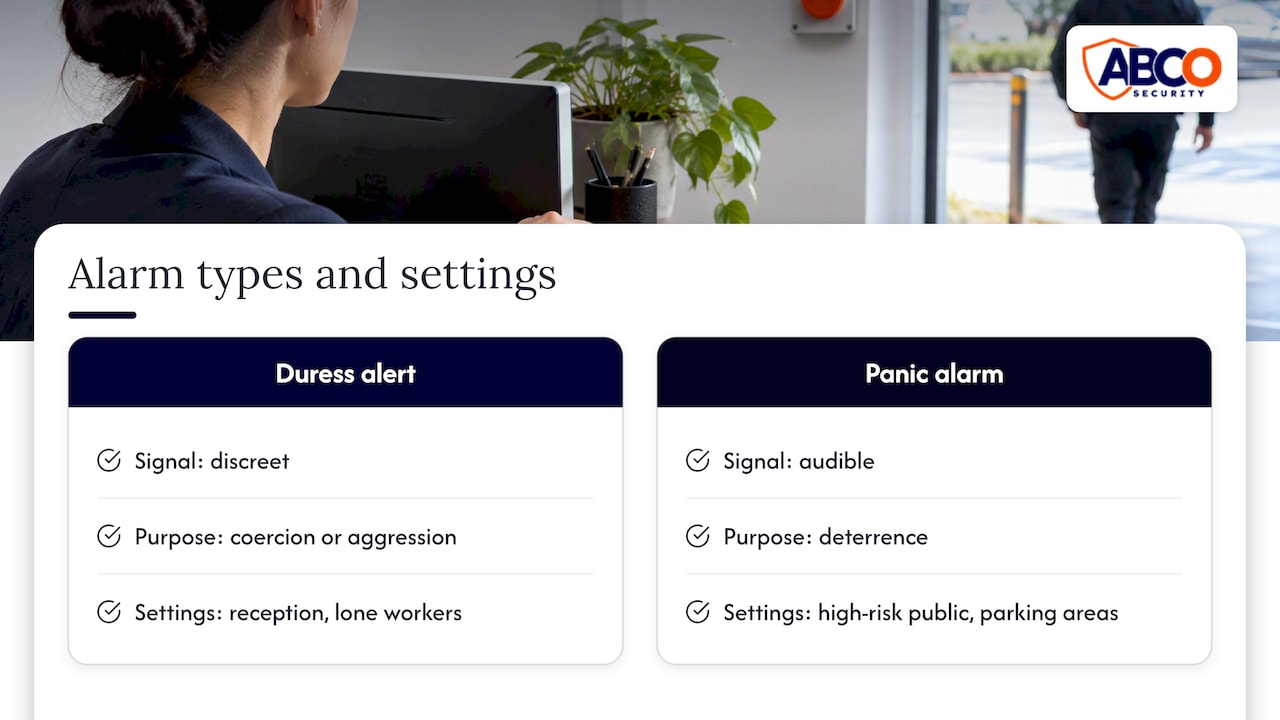
The Australian Government physical security management guidelines describe the usual split. Discreet duress alerts suit staff facing coercion or aggression, such as at reception or among lone workers. Audible panic alarms suit environments where deterrence is the goal, such as high-risk public or parking areas.
Retail and cash-handling counters
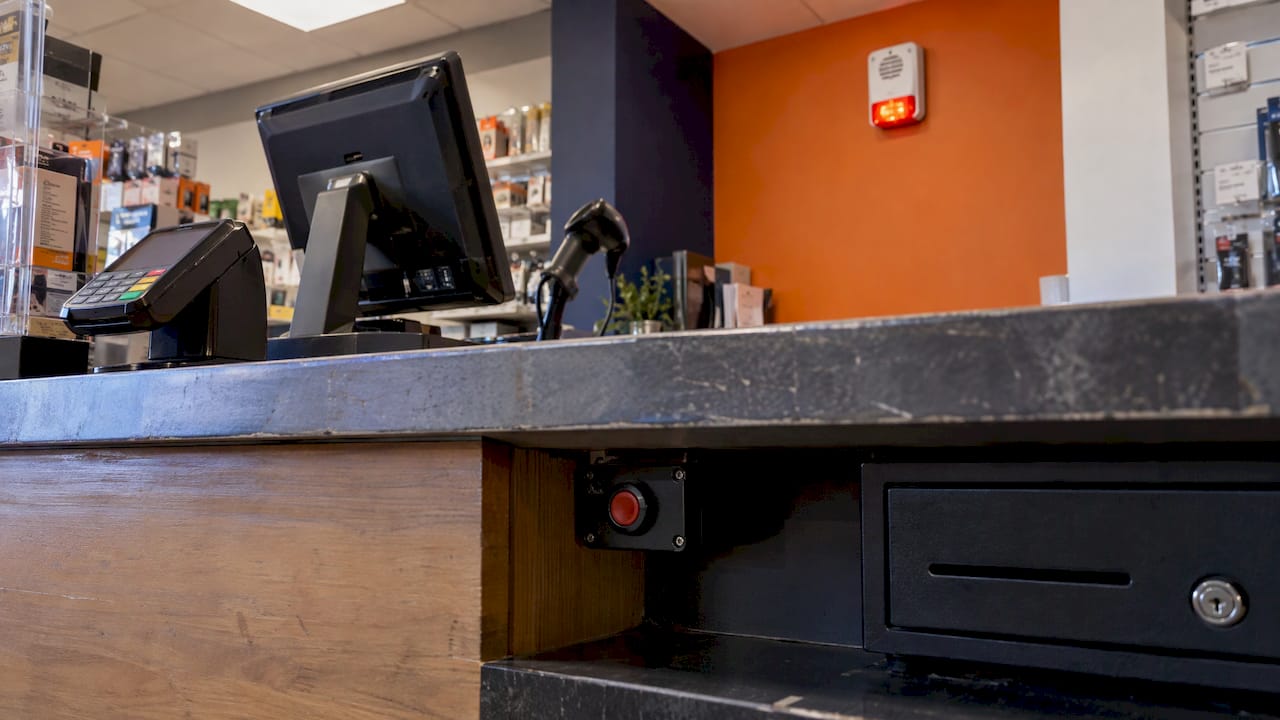
When someone is threatening a worker at the till, the last thing you want is a siren. Victoria Police advises that the best alarms can be discreetly activated, for example by a button near the cash drawer or by foot or knee. That points to fixed duress points at registers and back offices, with a clear plan for what happens once they are triggered.
If you handle cash, pair the alarm with sound procedures. Our cash handling security checklist covers the layers around the alarm itself.
Healthcare facilities
Emergency departments, triage desks, mental health areas and pharmacies all see aggression from people who are distressed, intoxicated or unwell. Staff need a quiet way to summon help and a team that knows exactly where to go. Wearable duress devices suit clinicians who move between rooms, while fixed buttons suit triage and consulting rooms. For the procurement side, see our guide to emergency department security.

Corporate offices and reception
Reception staff meet the public, deliver bad news and sometimes face aggressive visitors. A discreet fixed button at the desk, linked to security or a monitoring centre, is the standard answer. Out of hours, lone workers and cleaners benefit from a wearable device. Our after hours office security guide explains how to plan that coverage.
Construction sites
Sites are open, noisy and often staffed by small crews or a single supervisor after hours. Safe Work Australia lists providing duress alarms or alert systems as a proactive measure for managing remote or isolated work. On site, that usually means a wearable alert for the person on shift, backed by monitored cameras and a patrol that can attend. An audible alarm in a compound can also help deter intruders.
Events
Crowded venues need both approaches. Ticketing, cash-out points and VIP areas suit discreet alerts to the security supervisor. Open areas and car parks may rely on radio contact and visible security. Alerts are only useful if the control room or supervisor can see them and send someone, so the communication plan matters as much as the hardware.
How an alert reaches the right people
The route from button to responder is where systems succeed or fail. The usual options are:
- On-site response: the alert goes to a security officer, duty manager or nominated staff, often via a pager, radio, phone app or desk display.
- Monitored response: the alert goes to a 24/7 monitoring centre, where an operator follows your agreed procedure, which might include calling a patrol, a nominated contact or police.
- Combined: on-site staff and the monitoring centre are both alerted, and the procedure sets out who does what.
The key lesson from ASIS Victoria is to establish communication protocols with the monitoring centre in advance. Decide who is called first, what the operator says, and what counts as a verified emergency. Write it down before you need it.
If your plan relies on a monitoring centre, it helps to understand how monitored alarms work in general. Our guides to security alarm system monitoring and commercial alarm monitoring services go through the process. For the wider picture of what happens in the first minutes of an incident, see our physical security incident response guide.
What to check before you buy or install
ASIS Victoria recommends that workplaces develop a policy for installation, use and maintenance, make fixed alarm points accessible but inconspicuous, set up monitoring-centre protocols and train staff. Turning that into a checklist:
1. Start with a risk assessment
Government guidelines recommend that security assessments consider specific local threats, such as cash-handling risks or the potential for armed robbery, to decide alarm placement and type. A site with a cash office, a late-night roster and a public counter has different needs from a back-office floor.
2. Place fixed points where people actually stand
The Queensland guidelines specify fixed, non-latching, dual-press duress buttons located to minimise false alarms, and installed at reception desks and where money is stored or handled. A dual-press design reduces accidental activations, and a non-latching button stops the signal being left on by mistake.
3. Add wearables for people who move
Fixed buttons do nothing for a clinician in a corridor or a guard on a site walk-through. Wearable devices cover those gaps. Choose a design that can be pressed under stress, and test it with the people who will carry it.
4. Decide the response before the hardware
Ask three questions of every alarm point: who is alerted, how fast can they reach the location, and what do they do on arrival? If the answer to the second is “we are not sure”, you may need a patrol or on-site guard. Our mobile patrol and security guarding services exist to fill that gap.
5. Link cameras where you can
A verified alert is easier to act on. Linking a duress point to nearby cameras lets an operator see what is happening before dispatching help. Our camera monitoring page explains how that works.
6. Write the policy
Cover who can activate the alarm, when, what happens to false activations, and how incidents are reviewed afterwards. Keep it short enough that staff read it.
Training, testing and false alarms
A button that nobody trusts is a button nobody presses. ASIS Victoria says reliability rests on a maintenance and testing schedule, staff training on using the alarm and on responding to both intentional and accidental activations, and training for other staff on their response options.
In retail, SafeWork SA says employers should give workers information, training and supervision, including how to use equipment such as duress alarms. It also says workers should be trained to retreat to a safe location and activate alarms or alert security personnel or police during an incident. Pressing the button is not always the first move: getting to safety comes with it.
A practical routine:
- Induction: show every new starter where the alarm points are and what a press does.
- Regular tests: test each device on a set schedule and record the result. Tell the monitoring centre before you test.
- Drills: run short scenario exercises, including a false activation, so staff know the sequence.
- Review: after any real or accidental activation, check how long the response took and fix what slowed it.
If an incident might need an evacuation or lockdown, link your duress procedure to those plans. Our emergency response procedures and access control lockdown guides cover the next steps.
Our perspective
We see the same mistake on many sites: the device is bought first and the response is worked out later. A silent button that reaches nobody is no safer than no button at all.
Our view is that duress alarms and panic alarms are two tools in a single layered plan. Quiet alerts protect the people most exposed to aggression. Audible alarms, lighting, cameras and visible guarding deter trouble before it starts. The mix depends on the site, and a security risk assessment is the right place to decide it.
Technology is only one layer. Our approach combines licensed professionals, 24/7 monitoring and electronic security with proactive planning, so an alert leads to a response and not just a log entry. We work to ISO 9001 and ISO 30000 quality and risk standards, and we have more than 15 years of experience across construction, healthcare, corporate, retail and events work.
If you are choosing between a duress alarm and a panic button, start with who will respond and how quickly. The right device follows from that answer.
Abco
Put a response behind the alarm
ABCO Security provides alarm monitoring, electronic security installation and support, licensed static guards and mobile patrols across Australia, so your alert has a team behind it. Our A1 CCTV and alarm monitoring service and electronic security solutions are a sensible starting point for a duress or panic system. For after-hours cover, our Night Owl Service starts from $5.45 per day, with details on the Night Owl page.
For a deeper look at the system side, read our guide to duress alarm systems for Australian workplaces, or talk to our team about a security risk assessment for your site.
FAQ
What is the difference between a duress alarm and a panic alarm?
A duress alarm is generally silent and is used when making noise could put the person at greater risk. A panic alarm is generally audible and is used to attract attention or deter. Some suppliers use the words interchangeably, so check what the device actually does.
Can one system do both?
Yes. Many systems can send a silent alert to a monitoring centre or security team while also triggering a local siren or strobe, depending on how each button is configured. Your risk assessment should decide which behaviour suits each location.
Do I need a monitoring centre?
Not always, but it is worth considering for after-hours sites, lone workers and places where nobody is on site to hear a silent alert. Safe Work Australia lists alarm or alert systems as a measure for remote or isolated work. A monitoring centre gives you a trained operator following a documented procedure at any hour.
How often should a duress alarm be tested?
Set a regular schedule, record every test and tell your monitoring centre before testing. Industry guidance calls for a maintenance and testing schedule, but the right interval depends on your equipment and risk, so confirm it with your installer.
Sources
- ASIS Victoria Chapter: Duress alarms and operational responses
- IAHSS: Duress alarms and response
- Queensland Department of Education: Electronic security guidelines
- Australian Government physical security management guidelines
- Victoria Police: Responding to aggressive customers
- Safe Work Australia: Remote and isolated work, managing risks
- SafeWork SA: Customer aggression and violence in retail
Recommended
about
avada factory
Sempery ultricies nibh at dolor cras urna eleifend nec. Atiam efficitur tempor.