Effective emergency department security is governed, not improvised: a multidisciplinary committee runs regular risk assessments, the building itself is designed to reduce confrontation, staff carry duress alarms linked to a monitored response, and every officer works from written rules of engagement built around de-escalation, not restraint. Skip any one of those layers and the rest works harder to compensate.
TL;DR:
- A comprehensive ED security program relies on a multidisciplinary committee, site-specific risk assessments, and clear governance to adapt effectively to emerging risks.
- Security policies must be tailored to the ED environment, specifying roles, escalation codes, response triggers, and defining local terminology to prevent confusion during incidents.
- Proper placement of duress alarms and CCTV coverage, combined with CPTED-design principles, reduces incident risk and enhances environment-based prevention.
- Regular staff training, de-escalation protocols, and joint simulation exercises are essential to integrate security into clinical teams and ensure prompt, consistent responses.
- Effective measurement of security performance through incident tracking, response times, and data governance informs continuous improvement and procurement of tailored security services.
Table of Contents
- Policy and legal responsibilities: what your ED security policy must state
- How should you govern ED security risk assessment?
- Design and prevention: applying CPTED to waiting and triage areas
- Staff training and de-escalation: making security part of the clinical team
- Where should duress alarms and CCTV actually be placed?
- What happens during a Code Black activation?
- Reporting and continuous improvement: measuring what actually happens
- Turning the risk assessment into a procurement-ready brief
- Three priorities for safety officers this quarter
- How Abcosecurity supports ED security planning
- Sources
- FAQ
Policy and legal responsibilities: what your ED security policy must state
An emergency department security policy fails when it’s a generic workplace violence statement pasted from head office. It needs to speak directly to the ED, because ACEM’s P32 policy on violence in emergency departments treats ED safety as a distinct clinical governance issue, not a subset of general facility security.
Hospitals carry statutory duties to provide a safe workplace, and in an ED that duty extends to patients, visitors and contractors moving through an unpredictable, high-stress environment. A policy that only protects staff on paper while leaving patients and families exposed will not survive scrutiny after a serious incident.
Your written policy should cover:
- Purpose and scope — which areas count as “the ED” for security purposes (ambulance bay, waiting room, triage, short-stay, mental health assessment areas).
- Definitions — a shared vocabulary for aggression, duress, restraint and lockdown, so a triage nurse and a security officer mean the same thing when they use a term.
- Escalation codes — a locally defined Code Black (personal threat) and Code Grey (aggressive but unarmed behaviour), including who can activate them and from where.
- Roles and accountabilities — who owns the policy, who audits compliance, and who signs off on exceptions.
- Review triggers — a fixed review cycle plus a mandatory review after any serious incident.
Code definitions vary between health services, and that inconsistency causes real confusion during multi-site rotations or agency staffing. Document your local definitions clearly, distribute them at orientation, and test them in a tabletop exercise rather than assuming staff will absorb them from an intranet page nobody opens.
How should you govern ED security risk assessment?
Governance is the difference between a security program that adapts and one that reacts to the last incident forever. NSW Health’s Protecting People and Property framework sets out a structured risk management approach built on access control, duress systems, CCTV and defined security roles, reviewed on a cycle rather than left static.
Here’s how to structure it in practice:
- Form a multidisciplinary security committee with ED nursing and medical leads, the security manager, a mental health liaison clinician, facilities/CPTED input, and someone from executive who can approve funding.
- Commission a site-specific security risk assessment covering physical layout, patient acuity mix, after-hours staffing gaps and local crime context — a generic template misses the risks unique to your ED.
- Score and record every identified risk in a live register, rating likelihood and consequence rather than lumping everything into a vague “high priority” bucket.
- Escalate unresolved high-severity risks into the hospital-wide risk register so they get executive visibility and budget competition against other capital priorities.
- Set a review cadence — quarterly for the register, annually for the full risk assessment, and immediately after any Code Black activation that reveals a gap.
Validated clinical tools belong in this governance loop too. The Brøset Violence Checklist gives clinicians a short-term risk score at triage, and pairing that score with a defined escalation pathway means staff act on early warning signs instead of waiting for a crisis to unfold. A security risk assessment checklist built for Australian facilities gives committees a practical starting template rather than a blank page.
Design and prevention: applying CPTED to waiting and triage areas
Good design prevents more incidents than any guard roster ever will. The AusHFG health facility guidelines for ED planning specify Crime Prevention Through Environmental Design (CPTED) principles tailored to emergency departments, and getting these right at the redevelopment stage reduces how much your operational security has to compensate for later.
The core moves are consistent across well-designed EDs:
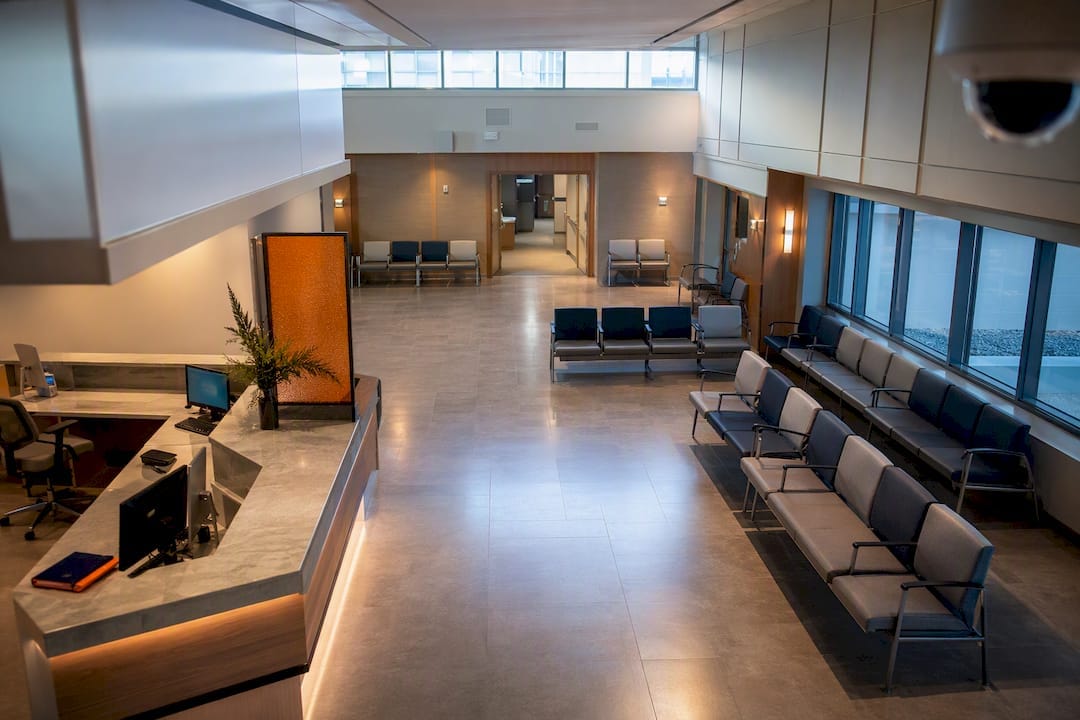
- Clear sightlines from the triage and nurse station to the entire waiting room, with no blind corners behind vending machines or pillars.
- Single controlled entry for the public, separate from ambulance and staff access, so movement through the department is predictable.
- Fixed, immovable seating in waiting areas, arranged to avoid crowding and to keep exit paths open.
- Safe assessment rooms for behaviourally unpredictable patients, with two exits, no loose or heavy objects, and duress alarms within reach of the clinician’s position, not just the doorway.
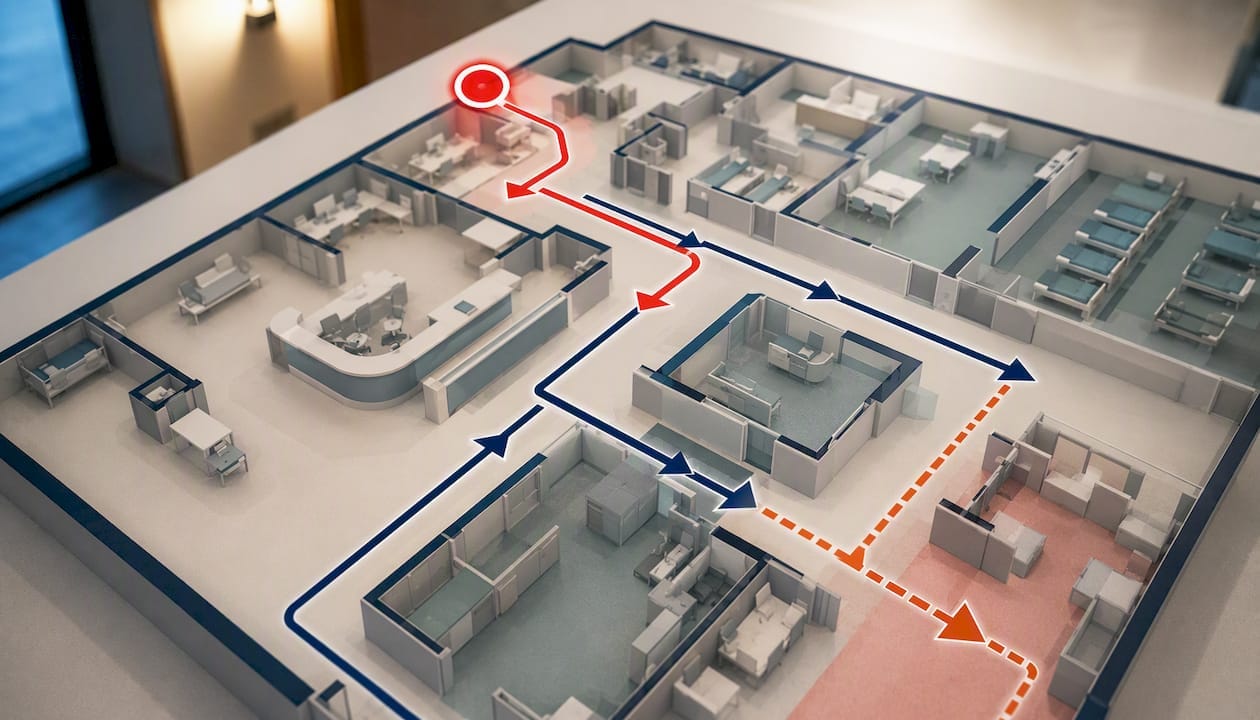
- Circulation design that never traps a staff member in a dead-end corridor with an agitated patient between them and the exit.
- Lighting and signage that reduce confusion for anxious or intoxicated patients rather than making the department feel clinical and cold.
Design interventions made during planning cost far less than retrofits, and they cut the load on visible security staff because the environment itself lowers the temperature. A CPTED-based layout applied at redevelopment stage is one of the few investments that pays off for the life of the building.
Staff training and de-escalation: making security part of the clinical team
Security officers who aren’t trained for the ED environment, and aren’t integrated into it, tend to either overreact or freeze. Research into frontline perceptions found that officer effectiveness during violent events depends heavily on training and clear integration with clinical staff — an officer who has never done a ward orientation is guessing at context clinicians already understand.
Your training matrix should include:
- Code Black/EDVPM training for all ED clinical and security staff, refreshed at least annually and after any major policy change.
- De-escalation as the default response, with physical intervention reserved for genuine, imminent risk to life.
- Written rules of engagement specifying exact trigger points: when to talk down, when to call for backup, when to physically intervene, and when to call police.
- Joint tabletop exercises run at least twice a year with security, nursing and medical staff together, not as separate silos.
- Role clarity documents so every shift knows who has authority to activate a code and who follows.
ACEM’s P32 policy is explicit that written rules of engagement should be tested in tabletop scenarios, because without them, security staff become risk-averse in real emergencies and inconsistent between shifts. That inconsistency is often the actual root cause when a review finds “security responded too slowly.”
On staffing models, dedicated ED-based security tends to outperform shared or roaming coverage, because dedicated officers build the same situational awareness as regular clinical staff. ACEM’s Breaking Point survey found this gap significant enough to recommend a directly employed, dedicated ED security workforce over outsourced or rotating coverage models, given how often EDs report frequent verbal and physical violence.
Pro Tip: Run your tabletop exercises with a real duress alarm trigger, not a verbal walkthrough. Teams discover gaps in response time and coverage they never would have caught on a whiteboard.
Where should duress alarms and CCTV actually be placed?
Placement decisions matter more than the hardware spec sheet. Duress alarms need to sit where a clinician’s hand naturally falls during an assessment, not bolted to a wall three steps away, and CCTV coverage needs to eliminate blind spots without turning every clinical interaction into a monitored performance.
Practical placement principles:
- Fixed duress points at triage desks, nurse stations, and inside every safe assessment room, with a mobile duress option for staff doing rounds in less predictable areas.
- CCTV coverage of all public entry points, corridors and waiting areas, but excluded from clinical examination spaces where patient privacy takes priority.
- Direct integration with the nurse station and a 24/7 monitored response, so an alarm triggers a human response within seconds, not a light that flashes unattended.
- Access control on all non-public doors, including staff-only corridors and medication storage, tiered by role rather than a single master key floating around the department.
Data governance deserves its own line item, because CCTV footage and duress logs are sensitive records that intersect with patient privacy law the moment they capture a clinical interaction. Decide upfront who owns the footage, how long it’s retained, who can request it, and how it’s purged.
| System element | Placement priority | Governance consideration |
|---|---|---|
| Fixed duress alarms | Triage desk, nurse station, safe assessment rooms | Response time SLA with monitoring provider |
| Mobile duress alarms | Roaming clinical and security staff | Battery/testing schedule, individual assignment |
| CCTV, public areas | Entrances, corridors, waiting room | Retention period, footage access approval chain |
| CCTV, clinical areas | Excluded or heavily restricted | Patient privacy override, legal sign-off required |
| Access control | Staff corridors, medication stores, EDs after hours | Role-based tiering, audit logging |
For departments building this out from scratch, a hospital access control system designed around role-based tiers avoids the common trap of one shared code that never gets updated when staff leave.
What happens during a Code Black activation?
A Code Black response only works if every person in the room already knows their job before the alarm sounds. ACEM defines Code Black as a coordinated security response to a serious threat, and that coordination has to be rehearsed, not improvised on the day.
- The first responder calls the code and states location clearly, then focuses on removing other patients and staff from immediate danger rather than confronting the threat alone.
- Security and the designated response team converge on the location, with one person taking clear command so instructions aren’t coming from three directions at once.
- De-escalation is attempted first, with physical or chemical restraint used only when there’s an imminent risk to life, following the least-restrictive option available at that moment.
- Any restraint used is documented immediately, including duration, method, clinical justification and who authorised it, because this record carries legal weight if the incident is later reviewed or challenged.
- Police are contacted per a pre-agreed threshold, ideally defined in a memorandum of understanding with local police that specifies which incidents require an emergency response versus a follow-up report.
- A debrief happens within 24 to 48 hours, capturing what worked, what didn’t, and any gap in the rules of engagement the incident exposed.
MOUs with police and ambulance services work best when they’re reviewed annually and named individuals, not just position titles, are listed as contacts. Position titles change hands quietly; a stale MOU is often discovered only during an actual emergency, which is the worst possible time to find out.
Reporting and continuous improvement: measuring what actually happens
You can’t improve what you don’t count, and EDs chronically undercount aggression because staff normalise it as “part of the job.” That normalisation is exactly what VMIA and ACEM’s joint analysis of patient harm flags as a systemic risk, not just a workplace culture problem.
Track these KPIs at minimum:
- Total incidents and near misses, split by severity and location within the department.
- Average security response time from duress alarm to physical arrival.
- Security coverage hours against ED occupancy and known peak-violence windows.
- Restraint episodes and their documented justification rate.
- Staff reporting rate compared to anonymous survey estimates of actual incident frequency, which is usually the biggest gap in the whole dataset.
Feeding these numbers into the hospital’s quality and safety committee, alongside clinical incident data, treats security as part of patient safety rather than a separate facilities issue. That single structural choice tends to do more for reporting rates than any poster campaign, because linking security metrics to clinical quality review shifts the culture around what gets reported.
Turning the risk assessment into a procurement-ready brief
A finished risk assessment is only useful once it becomes a service specification someone can actually tender against. That means translating each identified risk into a measurable requirement: response time, coverage hours, reporting format, escalation contact.
- Convert every high-priority risk into a scope-of-work line item with a defined KPI, not a vague “improve security presence” statement.
- Specify 24/7 monitoring response SLAs and incident reporting turnaround times in the contract itself, not as a verbal assurance during the pitch.
- Require monthly incident and near-miss reporting from any outsourced provider, formatted to slot straight into your quality committee papers.
- Build in a clinical liaison checkpoint so contracted security staff attend the same de-escalation refreshers as employed staff, closing the integration gap outsourcing often creates.
Pro Tip: Ask any prospective security provider for a sample incident report before you sign anything. If it reads like a generic template with the hospital’s name swapped in, that’s a preview of how your actual incidents will be documented.
Reviewing healthcare security service models before finalising a brief helps administrators see what a realistic scope of work actually contains.
Three priorities for safety officers this quarter
Start now, not after the next incident. This quarter: confirm duress alarms are tested and every staff member knows the rules of engagement. Next quarter: audit CCTV coverage and formalise data governance. Longer term: push for a funded, dedicated ED security establishment and a real MOU with police, because ad hoc coverage and handshake agreements are exactly what fail under pressure.
— Abco
How Abcosecurity supports ED security planning
Most hospitals patch together security coverage from whatever guard roster happens to be available, which leaves EDs exposed during the after-hours windows when incidents spike. Abcosecurity works differently: our teams are trained specifically for healthcare environments and operate under ISO 9001 and ISO 30000 quality frameworks, so the response your risk assessment calls for is what actually shows up on shift.
A typical engagement starts with a site walkthrough against your existing risk register, followed by a proposed scope covering security guarding for ED-based coverage, A1 CCTV & Alarm Monitoring for 24/7 duress response, and after-hours patrol support through the Night Owl Service, priced from $5.45 per day. If your department needs perimeter checks outside standard shifts, mobile patrol services fill that gap without adding a full-time post. Get in touch to scope a site assessment and see what a procurement-ready proposal looks like for your ED.
Sources
- Violence in emergency departments (ACEM)
- Protecting People and Property (NSW Health)
- Health facility guidelines: ED planning and design (AusHFG)
- Preventing patient harm in emergency and urgent care settings (VMIA/ACEM)
- Emergency Department Workers’ Perceptions of Security Officers’ Effectiveness During Violent Events
FAQ
What is the four hour ED rule?
It’s a national performance target requiring emergency departments to admit, discharge or transfer patients within four hours of arrival, and prolonged waits under this target are a known trigger for frustration-driven aggression in waiting areas.
What’s a Code Black in a hospital?
Code Black is the coordinated emergency response activated when a person poses a serious personal threat to staff, patients or themselves, and ACEM’s P32 policy recommends every hospital define its local activation criteria and train staff to use it consistently.
Do hospitals have their own security?
Many hospitals employ their own security staff or contract dedicated officers for the ED, and ACEM’s Breaking Point research recommends dedicated, directly employed ED security over rotating or shared coverage, though staffing models vary between facilities and jurisdictions.
What is the most common complaint in the ER?
Long wait times consistently rank as the leading patient and visitor complaint in emergency departments, and that frustration is one of the most frequent precursors to verbal aggression documented in ED violence research.
How can Abcosecurity support an ED security upgrade?
Abcosecurity provides ED-trained security guarding, 24/7 CCTV and alarm monitoring, and after-hours patrol coverage under ISO 9001 and ISO 30000 quality frameworks, starting with a site risk assessment to scope the right mix of services for your department.
Recommended
about
avada factory
Sempery ultricies nibh at dolor cras urna eleifend nec. Atiam efficitur tempor.