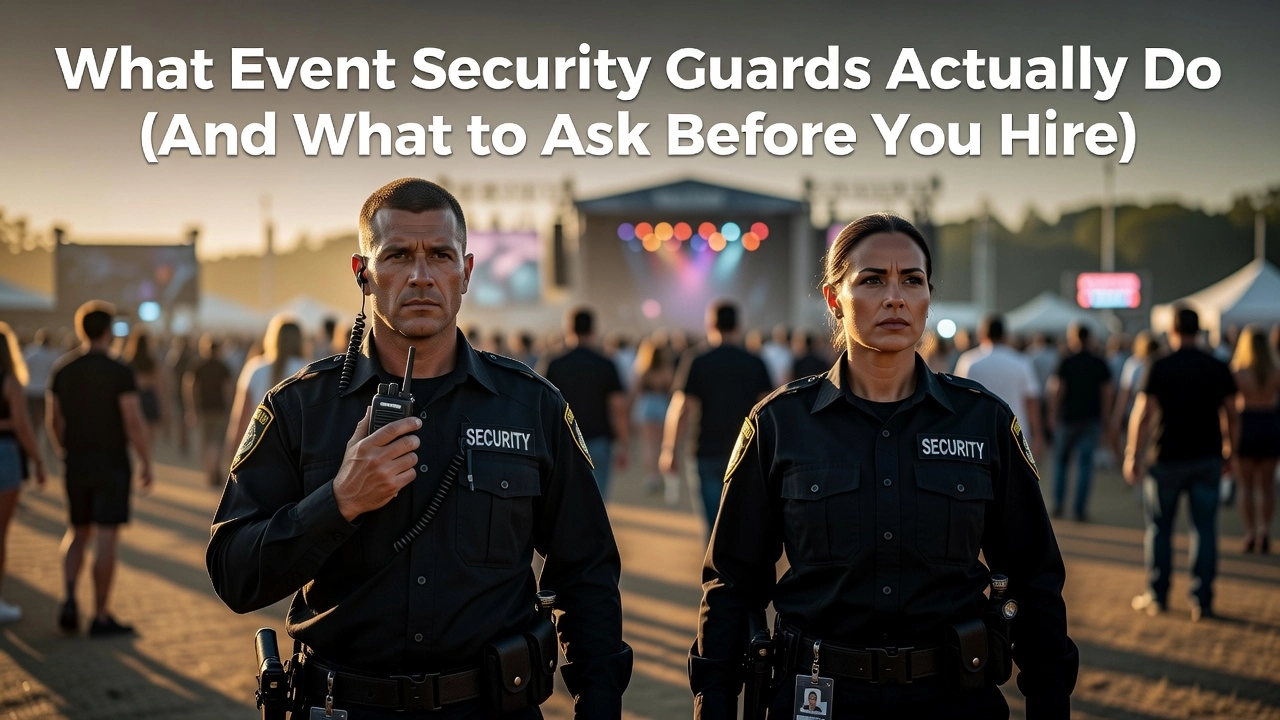
Most people assume that having security at an event means someone in a black shirt standing near the entrance. The reality is far more layered than that. Experienced event security guards operate as the backbone of any well-run gathering, from corporate conferences and private celebrations to large-scale concerts and public festivals. Their responsibilities stretch well beyond checking wristbands at the door.
If you have ever hired security for an event and felt uncertain about what you were actually paying for, you are not alone. Many event planners and organizers make costly mistakes simply because they did not know the right questions to ask before signing a contract.
This post breaks down exactly what professional event security guards do on the job, including crowd management, access control, emergency response coordination, and conflict de-escalation. More importantly, it gives you a practical list of questions to ask any security provider before you commit. Whether you are planning your first event or your fiftieth, understanding what competent security actually looks like will help you make a smarter, safer hire.
Direct Answer
Professional event security guards do more than stand at the door — they manage crowd flow, handle incidents before they escalate, and keep your liability exposure low. For any event in Melbourne with 50+ attendees, having licensed guards on-site isn’t a recommendation; it’s the baseline.
Under Victoria’s Private Security Act 2004, every guard deployed at your event must hold the correct licence category. Crowd control work requires a separate Crowd Controller Licence, not just a standard guard licence. Verify credentials before you sign any contract.
What Event Security Guards Actually Do
In Victoria, a security guard and a crowd controller are not the same role. They carry separate licence endorsements under the Private Security Act 2004 (Vic), each with a distinct legal scope. A crowd controller is specifically authorised to manage patrons at licensed premises and public events, operating under both security legislation and the Liquor Control Reform Act 1998 (Vic). Deploying a standard guard without the crowd controller endorsement at a licensed venue is a compliance failure, not a technicality.
Core Duties on the Ground
Professional event security in Melbourne covers four non-negotiable functions: access control, patron screening, incident de-escalation, and emergency response coordination. Guards check credentials, enforce age-restricted entry, manage occupancy limits, and keep emergency exits clear at all times. When tension builds between patrons, trained guards use verbal commands and physical positioning to de-escalate before force becomes necessary. Most people overlook that how many guards you deploy directly affects how quickly each of these functions can be executed under pressure.
Coordination and Liability
Guards do not operate in isolation. On any professional deployment, they maintain active communication with venue management, liaise directly with Victoria Police if escalation requires it, and coordinate patron handoffs to first aid teams on-site. This structured coordination matters because, as security law specialists note, both overstepping authority and failing to act can expose event organisers to injuries, lawsuits, or permit cancellations. Using correctly endorsed, licensed personnel is itself a documented compliance step that reduces an organiser’s duty-of-care exposure at licensed premises.
Pro Tip: Always request a copy of each guard’s Victoria Police-issued licence before the event. Verify the crowd controller endorsement is printed on the card, not just verbally confirmed by the provider.
Which Events Need Professional Security?
Not every event carries the same risk profile, but most benefit from professional oversight. Here are the six event categories where professional security coverage is consistently justified:
- Concerts and live music: High crowd density, alcohol service, and fan energy create unpredictable access control challenges from the moment doors open.
- Festivals: Multi-stage layouts, extended hours, and mixed demographics require coordinated security across multiple entry and exit points simultaneously.
- Corporate functions: I’ve found that corporate event organisers underestimate crowd dynamics more than any other client type. The suit-and-tie setting doesn’t eliminate access control risks; uninvited guests, disgruntled ex-employees, and media intrusion are real concerns.
- Sporting events: Rival supporter groups, alcohol licensing, and post-match crowd dispersal all demand trained personnel with crowd controller endorsements.
- Private parties: High-profile attendees, residential venues, and unlicensed alcohol service create liability exposure that most hosts don’t anticipate until something goes wrong.
- Trade shows and exhibitions: Credential management, exhibit asset protection, and controlled public access require structured security staffing from setup through pack-down.
The 50-Attendee Threshold
Fifty attendees is a practical inflection point for most Melbourne venues. Below that number, a single trained guard typically covers access and incident response. Above it, crowd dynamics shift; bottlenecks form at entries, alcohol consumption compounds risk, and a single incident can escalate before an untrained staff member recognises it. Most venues operating under a Victorian liquor licence are already subject to conditions that mandate licensed crowd controllers on-site.
High-Risk Factors Beyond Headcount
Headcount is a starting point, not the full picture. According to guidance on how many security guards an event needs, four variables consistently push risk levels higher regardless of attendance numbers: active alcohol licensing, unrestricted public access, the presence of high-profile attendees, and a complex venue layout with limited sightlines. A 40-person product launch with a VIP guest list and open bar can carry more security complexity than a 200-person ticketed community event. Assess these factors first, then determine your staffing ratio.
Pro Tip: Request a written venue inspection report from your security provider before the event. Any provider worth hiring will conduct one as standard practice; if they skip it, that tells you everything about how they’ll perform on the night.
How Many Guards Do You Need? Ratios by Event Type
These ratios are drawn from industry standards and operational experience across Melbourne events. Use them as your starting point, not your final answer.
| Event Type | Attendee Range | Recommended Guard Ratio | Risk Level |
|---|---|---|---|
| Corporate gala | 100–300 | 1:50 | Low–Medium |
| Music festival | 500–5,000 | 1:25–1:30 | High |
| Private party | Under 100 | 1–2 guards total | Low |
| Trade exhibition | 200–1,000 | 1:40 | Medium |
| Sporting event | 500+ | 1:25 | Medium–High |
These baselines assume a standard venue, sober crowd, and multiple access points. Add alcohol licensing, a complex floor plan, or VIP attendees and those numbers shift upward quickly. A music festival with alcohol service and a single-gate entry is not a 1:30 deployment problem; it is closer to 1:20 once you account for access control, roving patrols, and a dedicated incident response team.
The Chokepoint Problem Most Planners Miss
Most people overlook how entry and exit points affect guard distribution. A 300-person corporate event might calculate to six guards at a 1:50 ratio. If the venue has one entry point, two of those guards are pinned to access control for the entire event. That leaves four guards managing the interior, the perimeter, and any incidents. The raw ratio looks adequate; the operational reality is not.
Calculating the right number of security guards for your event crowd requires mapping your venue before you finalise any headcount. Count every entry, exit, and high-traffic corridor. Each controlled access point needs at least one dedicated officer, separate from your crowd management allocation.
I’ve found that clients who share a venue floor plan during the planning phase consistently end up with better-calibrated deployments than those who rely on attendee numbers alone. For a detailed breakdown of event security staffing and planning considerations, venue layout is consistently ranked as a primary deployment driver alongside event type and audience profile.
Pro Tip: Always build your guard count by layering three numbers: baseline ratio guards, dedicated access control officers per entry point, and at least one roving supervisor. That structure scales cleanly from a 150-person gala to a 3,000-person festival.
Licensing Requirements for Event Security in Victoria
Every individual performing a security function at a Victorian event must hold a current licence under the Private Security Act 2004 (Vic), administered through Victoria Police’s Licensing and Regulation Division. The employer’s business licence does not cover individual staff. Each guard or crowd controller must carry their own personal licence, and as of the June 2025 reforms under the Private Security and County Court Amendment Act 2024, anyone still on a registration must transition to a full Private Security Individual Operator Licence by 19 June 2026.
The Endorsement Distinction Most Organisers Miss
Most people overlook the licence endorsement distinction, and it is a $0 check before signing any contract that can save you from significant legal exposure. A standard security guard licence and a crowd controller licence are two separate activities under Victorian law; they are not interchangeable. The guard activity covers static posts, patrols, and access control. The crowd controller activity covers entry screening, queue management, refusal of entry, and physical removal of patrons at licensed premises and public events.
Deploying a standard guard to perform crowd control at a licensed event is a direct licensing breach, regardless of how experienced that guard is. Crowd controllers working at licensed venues also operate under the Liquor Control Reform Act 1998 (Vic), creating a dual compliance obligation a guard licence simply does not satisfy. The endorsement is printed on the licence itself and is fully verifiable. You can confirm the current eligibility requirements and licence activities through Victoria Police, and review the practical differences between a guard and crowd controller licence in Victoria before your next contract review.
What to Ask Your Provider
Before signing any event security contract, request the company’s business licence number and written confirmation that every deployed individual holds a personal licence with the correct endorsement for their assigned role. Verify currency through the Victoria Police licensing portal before the event date, not on the day. If your event serves alcohol at a licensed venue, confirm crowd controller endorsements specifically. I’ve found that reputable providers supply this documentation without hesitation; reluctance to provide licence numbers upfront is a clear signal to keep looking.
For training credentials, both activities require the CPP20218 Certificate II in Security Operations, plus a current First Aid certificate under the 2025 reforms.
Pro Tip: Ask for the individual licence numbers of the specific guards rostered to your event, not just the company licence. Staff rosters change, and a company licence tells you nothing about whether the person standing at your door is correctly endorsed on the night.
2026 Trends Reshaping Event Security
The event security industry is not static, and 2026 is proving that point at scale. The global event security guard services market hit $5.52 billion in 2025, growing at a CAGR of 6.9%, with projections placing it at $7.11 billion by 2029. That trajectory signals a growth-phase industry, not a mature one.
Hybrid Human-Technology Is the Operational Standard
The dominant model right now pairs AI-assisted surveillance with on-ground guards. Edge AI now performs real-time behavioural analysis directly on-device, reducing latency and cutting cloud dependence. Guards act on live intelligence rather than reviewing footage after an incident. Per Asia-Pacific digital security market analysis, “Hybrid Security Guard Solutions” is now a distinct buyer category, not an aspirational concept. Technology handles detection at scale; trained guards handle response, judgement, and duty of care.
Scalable Packages Are No Longer a Premium Option
Buyers now expect tiered, flexible security configurations as a baseline, not an upgrade. Subscription-based, managed, and integrated service models have become standard across both large enterprises and smaller event organisers. If a provider only offers one-size-fits-all coverage, that is a red flag.
Australia Sits in the Fastest-Growing Region
Asia-Pacific is the highest-growth corridor for event security demand globally, driven by rapid urbanisation and a rising events calendar. Australia’s schedule of concerts, sporting fixtures, conferences, and public festivals places it directly inside that growth curve. Demand here is structural, not cyclical.
For large-venue or multi-zone events, fixed guard posts alone will not cover every exposure point. Mobile patrol coverage fills the gaps across car parks, entry perimeters, and overflow zones that static positions cannot continuously monitor.
What to Look for When Hiring Event Security Guards
Once you have confirmed the licensing and ratio requirements covered earlier, the hiring decision comes down to five practical criteria.
1. SIRU-Licensed and Fully Insured Request the licence documentation before you sign anything. Every guard and the company itself must hold a current licence under Victoria’s Private Security Act 2004. I’ve found that reputable providers hand over this documentation without hesitation; those who stall on verification are a reliable red flag.
2. Demonstrated Experience With Your Specific Event Type A corporate conference and a music festival require fundamentally different skill sets. Crowd-flow management, VIP access control, and perimeter security are not interchangeable competencies. Ask directly: how many events of this type and scale have they staffed in the last 12 months?
3. 24/7 Availability and a Clear Incident Protocol Confirm that on-call support and an escalation chain to emergency services exist before the contract is signed. A provider who cannot articulate their communication structure for on-the-night incidents should not be shortlisted.
4. Technology Integration Capability For larger or higher-risk events, physical guards alone are not sufficient. Providers should be able to incorporate CCTV and electronic security integration into the overall security plan, covering access point monitoring and real-time surveillance alongside the ground team.
5. Scalability Without a Drop in Standard Test this directly: ask the provider to walk you through how their operational approach changes between a 100-person corporate function and a 5,000-person festival. The methodology should be consistent; only the headcount and deployment map should shift. Industry guidance suggests a baseline of one guard per 100 guests, adjusted upward for alcohol service or complex venues.
ABCO Security brings Melbourne-specific operational knowledge, including familiarity with local council requirements and venue layouts, combined with 24/7 protection and a booking process that scales from intimate corporate events to large public festivals without friction.
Pro Tip: Always request a pre-event site walk and briefing session. If a provider skips this step, their guards will be reacting on the night rather than operating to a plan.
Frequently Asked Questions
How many security guards do I need for an event of 200 people?
For a 200-person licensed event in Victoria, the baseline formula from Yarra City Council guidance requires a minimum of three guards: two for the first 100 patrons, then one additional guard per 100 patrons thereafter. As a commonly applied professional guideline, corporate events without alcohol service often use a 1:50 ratio, which would put the figure closer to four guards for 200 attendees. Alcohol service, dense crowd configurations, fireworks, or high-value assets on site all push that number up. Victoria Police and Liquor Licensing Victoria may also stipulate exact ratios as licence conditions, so confirm requirements before finalising your staffing plan.
What licences must event security guards hold in Victoria?
All event security personnel in Victoria must hold a current licence under the Private Security Act 2004 (Vic), administered through Victoria Police’s Licensing and Regulation Division. From 19 June 2025, reforms under the Private Security and County Court Amendment Act 2024 expanded licensing requirements, meaning all private security activities are now classified as licensed activities. The foundational qualification is the CPP20218 Certificate II in Security Operations. You can verify any guard’s credentials through Victoria Police’s public register of current licence holders before your event date.
What is the difference between a crowd controller and an event security guard?
A standard security guard licence does not authorise someone to work as a crowd controller in Victoria. These are legally distinct roles requiring separate endorsements. Security guards handle patrol, access monitoring, and property protection. Crowd controllers are authorised for active patron management, entry and exit control, and lawful physical intervention where required. Both roles train under the CPP20218 qualification, but the crowd controller endorsement reflects a higher operational scope. For most ticketed or licensed events, you will need crowd controllers, not general guards.
Do I need security guards for a private corporate event in Melbourne?
Most venues in Melbourne will require evidence of a security plan for events exceeding 50 attendees, and many will mandate licensed guards as a condition of hire. Even where it is not mandatory, events involving alcohol service, external guests, or high-value equipment carry meaningful liability exposure if an incident occurs without security present. Engaging a licensed event security provider early in your planning process also ensures your team attends briefings and understands the specific layout and risk profile of your venue.
Can event security guards also monitor CCTV during an event?
Guards can support basic CCTV awareness, but dedicated monitoring is a specialist function. The CPP20218 qualification trains a distinct Control Room Operator role alongside patrol and crowd control, which signals that these are separate operational responsibilities. For smaller events under 150 people with limited camera infrastructure, a guard doubling as a monitor may be sufficient. For larger or higher-risk events, a dedicated operator reviewing live feeds significantly improves response times and incident documentation. Integrated human-technology deployments are now standard practice across Melbourne’s professional security providers.
Pro Tip: Always request a copy of every guard’s licence number before the event day, not on arrival. Post-June 2025 regulatory changes mean licence status can be verified in real time through Victoria Police’s public register, and confirming credentials in advance removes the risk of an unlicensed individual working your event.
Pro Tip
Always confirm your provider holds a current Victorian crowd controller licence endorsement, not just a general security licence, before signing any contract for events at licensed venues. The Victoria Police licensing portal is publicly accessible and costs nothing to check. That single pre-contract verification step protects you from personal liability under the Private Security Act 2004 (Vic). A general security licence does not authorise crowd control work at licensed premises. A $0 check before you sign is worth more than any contract clause written after an incident.
Conclusion
Hiring event security is one of the most important decisions you will make as an event organizer. Professional guards do far more than stand at a door; they manage crowds, control access, de-escalate conflicts, and coordinate emergency responses in real time. Knowing what to expect from them and what to ask before signing any contract protects both your investment and your guests.
The right security team brings structure, confidence, and safety to any gathering, large or small. The wrong one leaves you vulnerable in ways you may not discover until something goes wrong.
Before your next event, use the questions and insights from this guide to vet every provider carefully. Ask for credentials, experience, and clear protocols. Your guests deserve a safe environment, and you deserve a security partner who can deliver it. Start those conversations today.
about
avada factory
Sempery ultricies nibh at dolor cras urna eleifend nec. Atiam efficitur tempor.