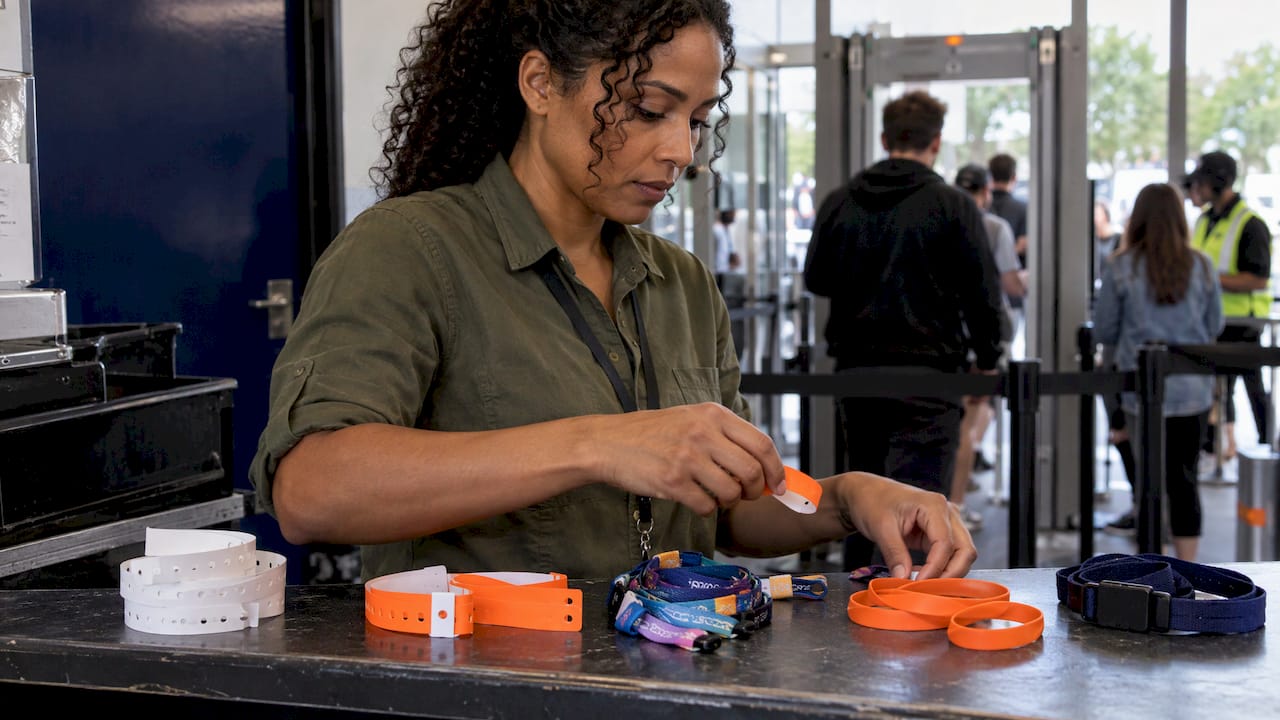
The main event wristband types are Tyvek (paper-style), vinyl or plastic clip, woven fabric, silicone and slap bands, RFID or NFC bands, and LED bands. Match the band to how long people will wear it and how much a stolen or passed-back band would cost you. Tyvek suits a single night, vinyl or woven suits a multi-day site, and RFID suits cashless or multi-zone entry. As an event security provider, we see the wristband work or fail at the gate, so this guide covers the security side as well as the material.
TL;DR
- One night or day: Tyvek is the usual choice. It is cheap, quick to apply and shows damage if someone tampers with it.
- Camping weekend or multi-day festival: choose vinyl with a snap lock or woven fabric with a one-way lock.
- Cashless, re-entry or multi-zone access: use RFID, or a barcode or QR band tied to a scanner.
- Whatever the material: add a sequential number, keep one meaning per colour, and order a buffer above your ticket count.
- Bands only work with trained gate staff: brief them on the colour key and the removal rules before doors open.
Table of Contents
- The main event wristband types at a glance
- Tyvek wristbands
- Vinyl and plastic clip wristbands
- Woven fabric wristbands
- Silicone and slap wristbands
- RFID, NFC, barcode and QR bands
- LED wristbands
- Choosing by event length and size
- Security features that stop transfer and copying
- Colour coding that gate staff can actually read
- Ordering: quantities, lead times and buffers
- Applying bands at the gate
- Perspective
- Event security that works with your wristband plan
- FAQ
- Sources
The main event wristband types at a glance
Australian suppliers describe a similar set of options. One Australian event wristband guide lists six material types: Tyvek, vinyl or plastic, woven fabric, silicone, RFID or NFC, and LED. The table below sets out how they are typically used. The durations come from that guide and from the supplier pages cited in each section.
| Type | Best for | Typical wear time | Main security feature | Keepsake value |
|---|---|---|---|---|
| Tyvek | Club nights, one-day events | Up to 24 hours | Tamper-evident adhesive closure | Low |
| Vinyl / plastic clip | Wet, dusty or multi-day sites | 3 to 7 days | One-way snap lock | Low |
| Woven fabric | Festivals, VIP and artist access | Several days | One-way or barrel lock | High |
| Silicone / slap | Fundraisers, awareness, souvenirs | Ongoing | Limited, rarely used for admission | High |
| RFID / NFC | Cashless payments, multi-zone access | Event-specific | Chip tied to a digital record | Medium |
| LED | Single-performance stadium moments | One show | Not an access control tool | Medium |
The sections below explain each one and when to rule it in or out.
Tyvek wristbands
Tyvek is the default Australian festival and club ticket. It is paper-like, with a tamper-evident adhesive closure, and organisers often use one colour per day, age group or stage. Manufacturers describe it as made from high-density polyethylene fibres, which makes it lightweight with a lower cost per attendee.
The security logic is simple. The adhesive closure is non-transferable: if someone peels it off to pass it to a friend, it shows visible damage. Gate staff only need to look at it. Application is fast too. One guide says a Tyvek band goes on in under three seconds per attendee, which matters when 5,000 people arrive in a 90-minute window.
Tyvek has three common functional variants, according to one Australian product page:
- A standard admission band with branding and optional sequential numbers.
- A barcode band, where a scannable code links the band to an admissions record.
- A ticket-stub band with a perforated section that tears off at a service point, for drink redemption, prize draws or seat assignments.
The limit is endurance. Tyvek’s adhesive tamper-evidence works reliably for a single day or evening. For events longer than 48 hours, that source recommends a mechanical closure. If your attendees will camp, shower or swim, step up.
Vinyl and plastic clip wristbands
Vinyl is the upgrade for hard conditions. Plastic clip bands are described as the better choice for wet, dusty or multi-day sites, where a one-way clip survives a weekend better than paper-style Tyvek. The same guide says plain clip bands start at 50 units and can leave the same day, while custom-printed clip bands start at 500 units and take 10 to 14 days.
Vinyl is built from multiple PVC layers. One manufacturer says its vinyl bands have a triple-layer backing with a single-use snap lock that is non-transferable. Another says these bands are virtually impossible to remove without destroying them and can carry sequential numbers, barcodes or QR codes.
The trade-off is door speed. The Australian guide cited above notes that a snap-lock vinyl band adds a couple of seconds per person compared with Tyvek. Over a large gate, plan extra application points.
Woven fabric wristbands
Woven or printed fabric bands are the usual VIP and artist “laminate on the wrist” in Australia. Minimums are typically 100 units with about 7 to 10 days of production. They read as merchandise, and they still lock if you choose a metal clamp or barrel fastener.
Fabric bands are made from woven or printed polyester, are soft for extended wear, and use one-way locking closures that tighten but cannot loosen without cutting. Upfront cost is higher, but attendees keep them, which is value for sponsors and brands. Some suppliers offer recycled polyester options with a high-security clasp or a reusable bamboo lock, which suits events with sustainability goals.
Silicone and slap wristbands
Silicone is a souvenir and cause band more than an access tool. One supplier says silicone bands are rarely used for admission control and are commonly worn to support causes or commemorate an organisation. Another describes them as reusable and designed for ongoing wear.
If you want people still wearing the band next week, silicone or slap bands are the keepable option, according to one Australian supplier guide. Use them for fundraisers, fun runs and brand activations, and pair them with a separate access band if entry matters.
RFID, NFC, barcode and QR bands
Chips and codes turn a band into a record. RFID suits cashless payments, multi-zone access and re-entry tracking. One Australian supplier lists RFID fabric wristbands at $2.60 each plus GST, built for multi-day events with waterproof construction, which gives a sense of how the cost compares with a plain band.
The operational payoff can be large. A Gold Coast schoolies deployment used long-range RFID and QR scanning with live capacity monitoring for over 20,000 attendees, and cut wristband collection queues from 2 to 3 hours to 15 to 30 minutes.
Two practical points. First, lead time: one guide advises booking RFID and LED bands at least four weeks ahead for chip programming and electronics checks. Second, site conditions: barcodes and QR codes suit events that want a stronger link between physical access and digital check-in, depending on scanner reliability, staffing and network conditions. Plan for patchy mobile coverage at regional sites.
LED wristbands
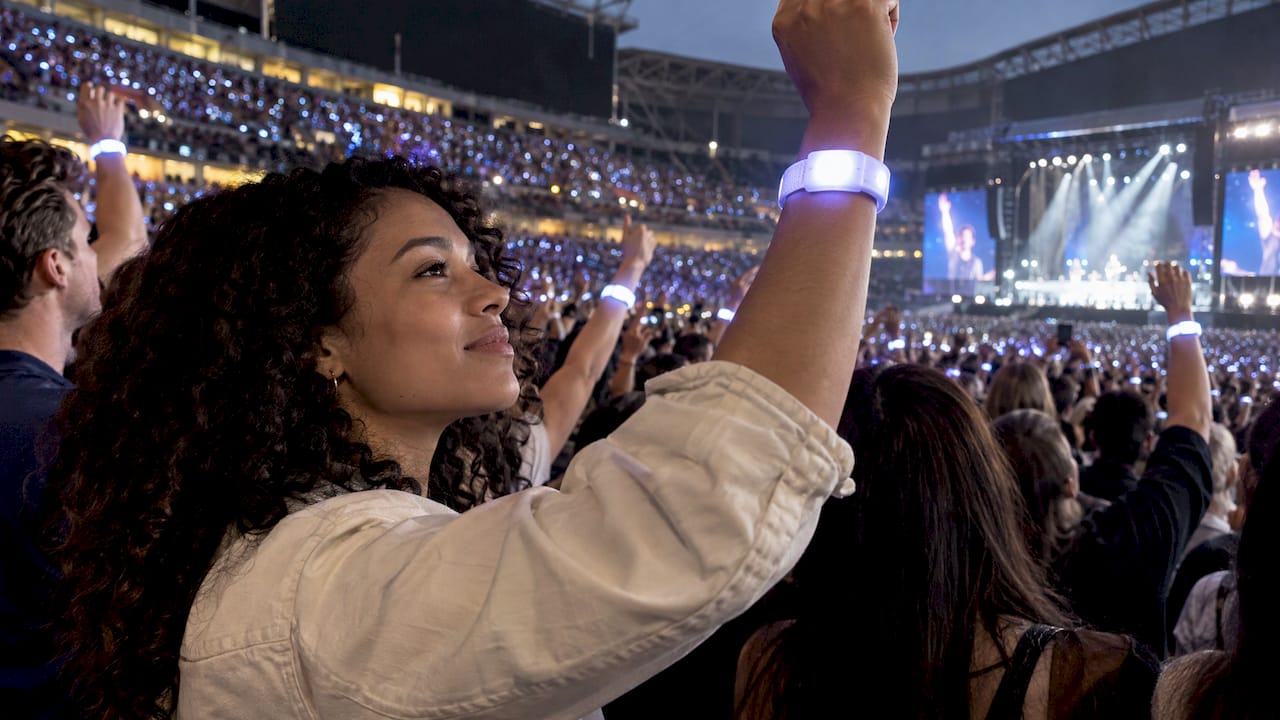
LED bands are for spectacle. They light up in sync with a show, and the guide cited earlier describes them as suited to single-performance stadium activations. They are not an access control tool, so treat them as an add-on, not a replacement for your entry band.
Choosing by event length and size
Start with the hours of wear, then the crowd.
- One-night party or venue door: Tyvek is the usual answer.
- Camping weekend or multi-day festival: woven is the right choice by the same source, and vinyl clip is the tougher alternative for wet or dusty ground.
- Under about 2,000 attendees: Tyvek or vinyl usually covers the brief. Above that, or where take-home brand value matters, move up to fabric or silicone.
- Large festivals: one manufacturer suggests woven or vinyl bands with tamper-proof closures and RFID may suit best.
Then weigh risk. One guide says the right security level depends on crowd size, ticket value, alcohol service, re-entry rules and how likely transfer attempts are. A free community fair needs far less than a licensed 10,000-person festival with re-entry.
Security features that stop transfer and copying
No band is secure by itself. Layer these features.
- A tamper-evident or one-way closure. A tamper-evident closure does not stop someone trying to remove a band, but it leaves visible, irreversible evidence. Vinyl snaps and fabric barrels cannot be undone without cutting.
- A sequential number or unique ID. One guide says every event band should carry a sequential number or unique ID plus a hard-to-copy visual identifier. Numbers also help stock control and incident review.
- Print that is hard to copy. Unique artwork, event text, dates and tightly controlled colour combinations make copying harder, though none of them replaces competent gate management.
- Scannable verification. Barcodes, QR or RFID tie each band to a record so staff can flag a band that was scanned in with no matching exit.
- Specialist materials. Credential providers also offer hologram elements, UV ink or micro-text on top of chips and numbering.
Colour coding that gate staff can actually read
Colour is your fastest signal, so keep the system simple. Three rules from one colour guide hold up in practice:
- Use high contrast between tiers so security can read bands at arm’s length in a moving queue.
- Give each colour one meaning. If red is VIP on Saturday, it should not be crew on Sunday.
- Brief the gate team with a laminated colour key at every entry point.
Avoid using one colour across every access tier. For licensed events, a distinct band or tear-off tab marks patrons over 18. At one NSW festival, the plan says every patron is issued a band at entry and anyone without one is evicted, with the entry sequence of ticket check, bag check, ticket scan, then wristband. Another festival says licensed areas are controlled through age verification and secure wristbanding, with minors excluded from bar zones.
Make the rule visible to guests as well. One festival’s terms say bands must be worn at all times and may be inspected at any time, with eviction possible without a valid band.
Ordering: quantities, lead times and buffers
Order more than your ticket count. A common guide recommends a 15% buffer on festival general admission, 10% on VIP and crew, and 5% on fixed-count tiers. Bands get dropped, misapplied or replaced when someone loses one.
Build a timeline backwards from opening day:
- Plain stock Tyvek or clip: can sometimes ship the same day on eligible orders.
- Custom Tyvek: standard production is around 10 business days at one Australian supplier.
- Custom woven or printed clip: roughly one to two weeks, per the supplier guide above.
- RFID and LED: at least four weeks.
Supplier terms and minimums change, so confirm current figures on the supplier’s own page before you commit.
Applying bands at the gate
A good band fails with a slow or untrained gate. Put application points ahead of the scanning point, give each lane a colour key, and rehearse peak flow. Faster bands such as Tyvek suit a rush, while snap-lock bands need more stations. Staff who issue bands should also know basic first aid and crowd handling, which is why many organisers invest in first aid training for security staff.
Crowd numbers and ratios are a regulatory matter too. The Victorian Code of Practice says organisers must have a reliable method of recording how many patrons enter a venue to avoid overcrowding. It also says crowd controller numbers may be set in liquor licence conditions or by police specifications. It gives an estimated ratio of two crowd controllers for the first 100 patrons and one for each additional 100. Check the rules that apply in your state, and see our guide on how many security guards you need for an event.
Perspective
We treat the wristband as the first checkpoint in a security plan, not an accessory. A well-chosen band gives our guards something to check in a second: the right colour, a number, a closure that has not been touched.
Our experience of over 15 years in security shapes how we plan events. We recommend choosing the band after you have mapped your zones, your licensed areas and your re-entry rules, because the band should serve the plan and not the other way round.
Our licensed guards and crowd control teams are briefed on the colour key before doors open, and we design entry lanes so band issue and checking never compete for the same space. Proactive planning is how ABCO works: we anticipate where queues, transfer attempts and disputes will happen, and we put people and process there first.
Abco
Event security that works with your wristband plan
We provide licensed event security, crowd control and gate staffing across Australia, so your wristband choice is backed by people who know how to check it. Tell us your expected attendance, zones and licensing, and we will help you plan gate lanes and staffing levels.
See our events security service or read our festival security planning playbook and our guide to hiring event security in Australia.
FAQ
Which event wristband is best for a one-day event?
Tyvek is the usual pick. It is lightweight, quick to apply and has a tamper-evident adhesive closure that shows damage if someone tries to pass it on. Suppliers describe it as suited to events up to about 24 hours.
Which wristband suits a multi-day festival?
Vinyl clip bands or woven fabric bands with one-way locks. Vinyl is typically used for 3 to 7 days and copes with wet or dusty sites. Woven bands are more comfortable for extended wear and double as a souvenir.
How do I stop people swapping wristbands?
Layer your controls: a tamper-evident or one-way closure, a sequential number, distinctive print, and scanning where you can. Then brief gate staff to check bands, because features support good gate management and do not replace it.
How many extra wristbands should I order?
A common recommendation is a 15% buffer for festival general admission, 10% for VIP and crew, and 5% for fixed-count tiers. Allow more lead time if you want RFID or LED bands, which need programming and testing.
Sources
- Handband: Event & Festival Wristbands, Complete Guide
- Handband: Event Wristbands Australia, Festivals & Access
- Handband: What Wristband Colours Mean
- Custom Wristband: Event Wristbands Australia
- The Wristband Co: Fabric vs Tyvek Wristbands
- The Wristband Co: Eco-friendly fabric wristbands
- AAC Product Catalogue 2025
- AAC: How to Choose the Best Wristbands for Your Event
- Handy Imprints: Promotional Wristbands
- Promotional Products Australia: Wristbands
- Promotional Products Australia: Custom Tyvek Wristbands
- TyvekWristband.com.au: Event Wristbands
- wristband.com: Event wristband security features guide
- Lotsa Lanyards: Festival Access Control Wristbands
- SKIDATA: Concert & Festival Physical Credentials
- CrowdFlo: RFID Fabric Wristbands
- CrowdFlo: Solution Use Case
- Out2Lunch Festival 2026 Event Management Plan
- Good Things Festival: Event Info
- Electric Island: Terms & Conditions
- Victorian Code of Practice for running safer music festivals and events
- First aid training for security staff
Recommended
about
avada factory
Sempery ultricies nibh at dolor cras urna eleifend nec. Atiam efficitur tempor.