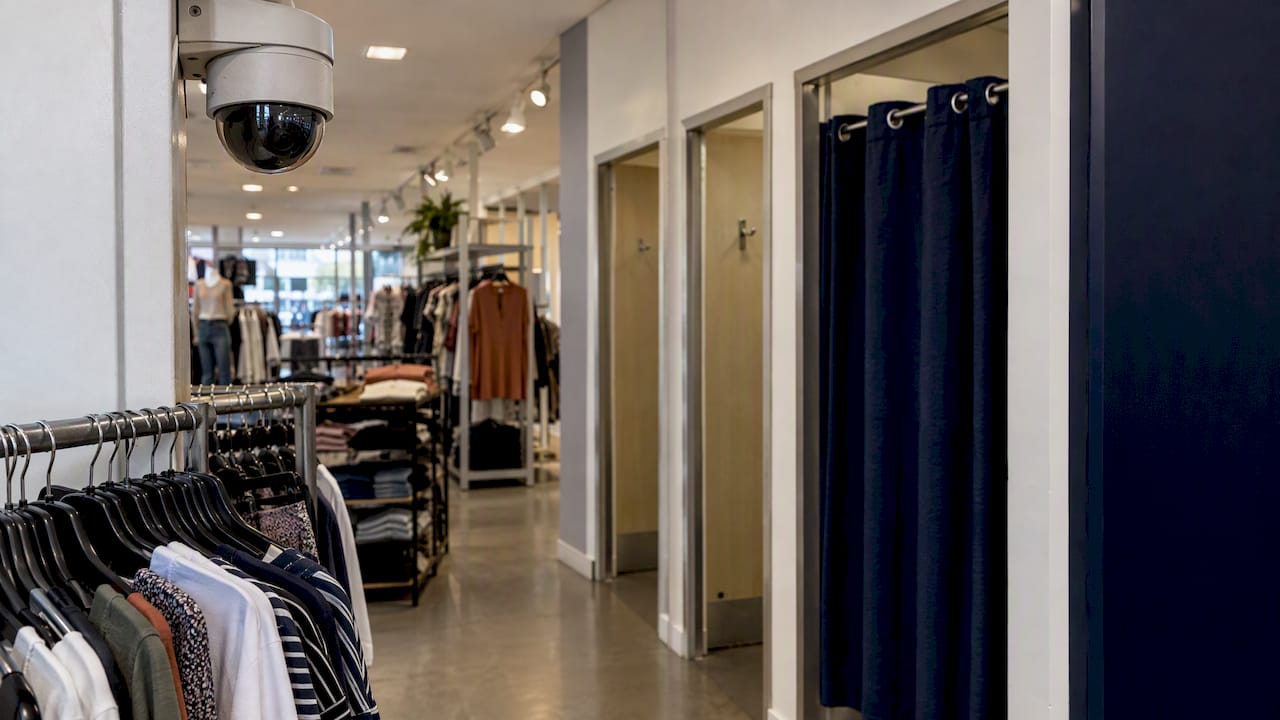
The best fitting room security combines resilient tags on every garment, staff who monitor entry and exit with item counts, and non-camera sensors that call for help when something’s wrong. Cameras inside change rooms are off the table under OAIC guidance, and any new monitoring technology needs a privacy impact assessment before it goes live. We outline how to put this together below.
TL;DR:
- Count every garment entering and leaving, record totals on tickets, offer help at the door, and test tamper resistant tags and EAS gates regularly.
- Use dwell sensors, door counters, pressure mats, and call buttons instead of cameras inside rooms; log counts and timestamps only, and route alerts to staff.
- Complete a privacy impact assessment before introducing monitoring technology, publish a plain language summary, disable audio, and keep recorded footage only as long as needed.
- Australian retailers lose roughly $9 billion annually to theft, while 60% of harm is attributed to 10% of offenders, supporting targeted rather than blanket surveillance.
Table of Contents
- Action checklist: what to do this week to reduce fitting-room theft
- Which security tags and EAS choices make sense for change rooms
- Non-camera sensors and alerting to detect misuse without invading privacy
- CCTV, facial recognition and the OAIC guidance retailers must follow
- Procedures: how to organise staff, log incidents and train teams
- Quick design and layout fixes that reduce concealment in fitting rooms
- Step-by-step: what staff should do after a suspected theft or tag tampering
- ABCO Security view: why an integrated, privacy-first plan is the sustainable choice
- How ABCO Security can help implement this plan
- FAQ
- Sources
- Primary sources and further reading
Action checklist: what to do this week to reduce fitting-room theft
Most of these changes cost nothing and take effect immediately.
- Count items in and out of every fitting room, every time, and write the number on the ticket.
- Give staff a simple script for offering help at the fitting-room door rather than standing guard silently.
- Swap worn or single-pin tags for tamper-resistant versions and test a sample weekly.
- Fit non-camera sensors or a staff call button inside rooms so customers can summon help without being watched.
- Display clear privacy and signage notices, and publish a short privacy impact assessment summary wherever new monitoring tech is introduced.
- Log every incident the same way and escalate repeat or serious cases to police.
Which security tags and EAS choices make sense for change rooms
Pin and clamshell tags remain the baseline, but they’re also the easiest for a practised offender to defeat with a thin blade or a basic detacher. Multipolar and SuperLock-style tags use multiple locking points and resist the same tools, making them a sturdier choice for higher-value garments. Ink tags add a second layer: any forced removal stains the fabric, which discourages tampering even if the tag itself is beaten.
Retail security research backs a multi-layered approach rather than any single tag type: strong tags, staff monitoring, item counts and clear sight lines together, not tags alone. Booster bags lined with foil are built to beat electronic article surveillance (EAS) at the door, so a weak tag paired with a careless exit check is a genuine gap.
- Check tag strength on a sample of stock weekly, not just at delivery.
- Place tags where they’re hardest to reach without removing the garment entirely.
- Test EAS pedestals at opening and closing to confirm they’re still triggering correctly.
Pro Tip: Rotate which staff member tests the EAS gates each morning so tampering or faults get noticed faster.
Non-camera sensors and alerting to detect misuse without invading privacy

Dwell sensors, pressure mats and door counters tell staff how long a room has been occupied and whether the count matches who went in, without recording any image. A help-call button inside the room lets a customer or staff member flag a problem instantly, which is a more reliable prompt than hoping someone glances down the corridor.
Configure these systems to log counts and timestamps only, never personal data, so there’s nothing sensitive to store or secure. For additional guidance, refer to Data privacy tips for SMEs which offers practical compliance advice on data handling and technical controls. Staff should be trained to check alerts promptly and know who covers that zone if the usual attendant is busy elsewhere.
- Set dwell sensors to flag rooms occupied well beyond a typical fitting time.
- Route call-button alerts to a handheld or earpiece so response isn’t tied to one fixed position.
- Review sensor logs weekly to spot patterns worth adjusting staffing around.
Sensors do the job cameras would do inside a change room, without the legal and trust problems cameras create in that space.
CCTV, facial recognition and the OAIC guidance retailers must follow
Cameras have a role on the sales floor and at entry and exit points, but never inside the fitting room itself. The OAIC’s guidance on security cameras requires organisations to notify people their image may be captured, secure and properly dispose of recorded footage, avoid recording in spaces where people reasonably expect privacy, and disable audio by default. A change room is exactly the kind of space that guidance is built around, and covert surveillance there carries real legal exposure.
Facial recognition raises the same issue at a larger scale. The OAIC’s investigation into Kmart found that collecting biometric data without first checking for less intrusive alternatives was disproportionate, and its review of the Bunnings decision makes the same point: facial recognition collects sensitive information and needs a genuine necessity and proportionality test before deployment, not just a business case.
Retail theft costs Australian retailers roughly $9 billion a year, with around 60% of that harm attributed to just 10% of offenders. That concentration is exactly why privacy-by-design matters: broad surveillance of every shopper does little against the small group driving most of the loss.
- Run a PIA before installing any new monitoring technology, not after.
- Publish a plain-language summary of that PIA where customers can see it.
- Keep retention periods short and disable audio capture by default.
Procedures: how to organise staff, log incidents and train teams
Hardware only works when the people around it follow a consistent process.
- Document the item-count procedure so every staff member counts and records the same way, every shift.
- Give staff a standard assistance script: offer to help, note the count, check back within a set time.
- Train the team to recognise behavioural indicators, loitering near tag-removal tools, unusually bulky bags, and to de-escalate safely rather than confront.
- Keep a simple incident log, secure any relevant footage immediately, and record who accessed it and when.
- Review incidents monthly and feed what’s learned back into training.
Pro Tip: Keep the incident log in one shared format across all stores so patterns across locations are easy to spot.
Quick design and layout fixes that reduce concealment in fitting rooms
Small layout changes often do more than extra technology.
- Keep a clear sightline from the sales floor to the fitting-room entrance, and avoid long corridors that block that view.
- Use even lighting and position mirrors to improve visibility without pointing them into private spaces.
- Keep bag and parcel storage away from the fitting-room area and clear of clutter that could hide concealed items.
- Confirm any layout change still meets building and fire-safety requirements before it’s finalised.
Business security guidance points to the same basics: clear sight lines, good lighting and controlled entry points reduce the opportunities that drive opportunistic theft.
Step-by-step: what staff should do after a suspected theft or tag tampering
Safety comes first, every time.
- Keep staff and customers safe, secure the area calmly, and avoid any physical confrontation.
- Write down the time, what happened and any witness names while the details are fresh.
- Secure relevant CCTV footage from the sales-floor cameras quickly, following the store’s retention policy, and log who accessed it.
- Call police for serious or repeat offending, and loop in local retail crime initiatives where they exist.
- Run a short review afterwards to see whether a policy or sensor setting needs adjusting.
ABCO Security view: why an integrated, privacy-first plan is the sustainable choice
We think the retailers who get fitting-room security right treat it as a system, not a single purchase. Strong tags without staff engagement just teach offenders which tools to bring. Cameras without a privacy impact assessment create legal risk the moment someone questions where that footage went.
Our view, informed by experience across guarding, monitoring and electronic security, is that layering trained personnel with the right sensors and clear signage protects both stock and customer trust at once. Transparency isn’t a compliance box to tick, it’s what keeps shoppers comfortable using the fitting room at all.
— Abco
How ABCO Security can help implement this plan
We put this layered approach into practice through security guarding, A1 CCTV & Alarm Monitoring, and electronic security solutions.
If you’re weighing up where to start, we can support you in planning security for your fitting-room area. Our mobile patrol services can complement your security arrangements, and our processes follow international quality and risk management standards.
Ready to see what fits your store? Get in touch about our Night Owl Service, starting from $5.45 a day, and we’ll talk through what a layered fitting-room plan looks like for your space.

FAQ
Do fitting rooms have security cameras?
Fitting rooms themselves should never contain cameras: OAIC guidance treats change rooms as spaces where people reasonably expect privacy. Retailers typically place cameras on the sales floor and at entry points instead, paired with staff monitoring at the fitting-room door.
What is the best deterrent for shop stealing?
No single tool works alone. A layered approach combining tamper-resistant tags, staff item counts and good sightlines is the most reliable deterrent, backed by sensors that alert staff without recording images.
Are you allowed to go into a dressing room with your partner?
Store policies vary, and many apparel retailers allow a companion into a larger fitting room to assist with items such as formalwear, generally with a staff member aware of who’s inside. Check the specific store’s posted policy, since limits often depend on room size and item counts.
Can they put cameras in changing rooms?
No. Cameras should not record inside a space where people reasonably expect privacy, and installing one covertly risks significant legal exposure under the Privacy Act. Retailers needing better in-room detection should use non-camera sensors and call buttons instead.
Sources
Primary sources and further reading
- Shoplifting prevention: a multi-layered approach
- Privacy by design and privacy impact assessments | OAIC
- Security cameras | OAIC
- Shoplifting – Crime Stoppers South Australia
- Commissioner Initiated Investigation into Kmart Australia Limited (Privacy) [2025] AICmr 155
- Facial recognition technology in retail settings: after the Bunnings decision | OAIC
- Business security assessment guidance | NSW Police
Recommended
about
avada factory
Sempery ultricies nibh at dolor cras urna eleifend nec. Atiam efficitur tempor.