
In this article, healthcare visitor management means contracted physical security and integrated security systems for controlling, screening and monitoring visitors, not check-in software. Start by commissioning a targeted security risk assessment and verifying that every guard, installer and monitoring provider holds the correct state security licence. Match that against AS 4485.1:2021, the benchmark standard for healthcare security policy in Australia, before you sign anything.
TL;DR:
- Healthcare visitor management involves contracted physical security services, including guards, patrols, CCTV, access control, and duress alarms, not check-in software.
- All security personnel and electronic service providers must hold proper, verified licenses and comply with AS 4485.1:2021, with separate licences for guards and system installers.
- A targeted risk assessment focusing on high-risk areas like emergency departments and car parks should guide guard deployment, patrol frequency, and CCTV placement.
- Contracts must specify performance KPIs, response times, incident reporting standards, and clear data retention and privacy handling procedures.
- Ongoing system tuning, quarterly audits, and clear communication strategies with staff and patients are essential during the first year of implementation.
Table of Contents
- What contracted healthcare visitor management actually covers
- Regulatory and licensing essentials for contracted services
- Risk assessment: where to focus and how it shapes your service mix
- What you’re actually paying for in a service contract
- Procurement and contracting checklist for facility managers
- Implementation and commissioning: the first 12 months
- Infection control and hygiene protocols for visitor management
- Emergency response procedures involving visitors
- Communication strategies with patients and staff regarding visitor policies
- Compliance with healthcare regulations and standards specific to visitor management
- Data management and retention policies for visitor information
- Abco Security: practitioner perspective and practical lessons
- How Abcosecurity can help you get this right
- Key standards, policies and privacy guidance to consult
- Sources
- FAQ
What contracted healthcare visitor management actually covers
Healthcare visitor management, in the sense that matters for procurement, is a bundle of physical and electronic services delivered under contract, not a piece of software your reception staff log into. It sits alongside, but is distinct from, digital check-in kiosks and pre-registration platforms that some facilities also run for administrative purposes. The services you’re buying are:
- Static guards and reception or concierge security at entrances, wards and high-traffic zones
- Mobile patrol services covering car parks, loading docks and after-hours perimeters
- CCTV installation with monitored alarm integration, feeding a control room or on-site guard post
- Access control systems, including card or biometric readers on restricted wards
- Duress alarms for staff and reception points, tied into the monitoring system
If your shortlist is only visitor check-in software, you’re solving a different problem. Contracted security exists to physically control who gets past the front desk, respond when something goes wrong, and provide evidence when it does. That distinction matters when you’re writing a tender, because a systems integrator quoting on kiosks won’t be licensed, insured or trained to also provide guards.
Regulatory and licensing essentials for contracted services
AS 4485.1:2021 is the reference point for healthcare security policy and procedure in Australia, and any provider worth shortlisting should be able to talk you through how their service maps to it. It covers governance, risk assessment methodology and the baseline procedures a hospital or health service is expected to have in writing.
Licensing is where a lot of contracts go wrong. Security personnel who patrol, guard or install and maintain equipment need a state security licence, and the class and endorsement requirements differ by state. A guard licensed for static duties isn’t automatically licensed to install CCTV, and an installer isn’t automatically licensed to monitor alarms. Confirm each licence class before the contract is signed, not after an incident.
Quick check before shortlisting a provider:
- Current state security licence for every guard and patrol officer rostered to your site
- Separate licence/endorsement for CCTV and alarm installation staff, verified with the local regulator
- Evidence of mandatory training and criminal history checks, not just a licence number
- A privacy policy that references the Privacy Act and OAIC health privacy guidance
Health services collecting images or footage of patients carry specific obligations under the Privacy Act. The OAIC’s guide to health privacy sets out governance, access control and ICT security expectations for exactly this kind of surveillance data, and it’s worth building those requirements into your contract rather than assuming a provider already meets them.
Risk assessment: where to focus and how it shapes your service mix
A generic, whole-of-site risk assessment tells you almost nothing useful. What works is a targeted assessment that ranks areas by actual incident likelihood and consequence, then lets that ranking drive your service decisions. NSW Health’s security risk management framework is a solid structural model for this, and Queensland Health’s security guideline offers comparable operational benchmarks if you want a second reference point.
The areas that consistently rank highest for visitor-related risk are:
- Emergency departments, where distress, intoxication and long wait times combine
- Mental health units, where duress response times are clinically significant
- Paediatric reception areas, where custody disputes and unauthorised access are common triggers
- Car parks and loading docks, which are poorly lit, low-traffic and rarely staffed
- After-hours entrances that revert to a single unmonitored access point
Run the assessment with a multidisciplinary panel, not just a security manager working alone. Clinical staff know where workflow gets disrupted by a bag search or a locked door; workplace health and safety staff know where duress incidents actually cluster. Security controls designed without them tend to get quietly bypassed within a month.
Pro Tip: Ask your provider to walk the site with clinical unit managers before finalising guard rosters. A patrol pattern that looks efficient on paper often misses the exact ten minutes a paediatric ward needs coverage most.
Once the assessment is done, it should directly determine guard hours, patrol frequency, whether a zone gets continuous CCTV monitoring or scheduled checks, and where duress points get installed.
What you’re actually paying for in a service contract
A contracted visitor management arrangement typically bundles several distinct deliverables, and it pays to know what each one should look like in practice.
Static guards and reception staff handle visitor screening, sign-in verification, and the first response to any incident. Their reporting should follow a defined escalation pathway. A one-line incident log emailed at the end of a shift isn’t good enough for an emergency department; you want time-stamped entries and a clear line to a duty manager.
Mobile patrols cover the gaps static guards can’t, particularly car parks and after-hours zones. Coverage windows, handover notes between shifts, and a communication protocol with the on-site team all need to be specified, not assumed.
Integrated electronic services are where a lot of value gets left on the table. CCTV and monitored alarms should be genuinely integrated, meaning a duress alarm triggers a camera view, not two separate systems that a guard has to cross-reference manually. WA Country Health Service’s CCTV and security data policy makes a point worth repeating: CCTV supplements direct observation, it doesn’t replace it.
Finally, someone needs to own footage retention periods, who has authorised access, what signage is required, and how you’ll respond to a freedom-of-information or police request for footage. Put that person’s name in the contract.
Procurement and contracting checklist for facility managers
Before you sign, your contract and tender documents should nail down the following.
Must-have clauses:
- Defined scope covering every service element, not a vague “security services as required”
- Licence verification obligations, refreshed annually
- Insurance certificates, current and matched to the scope of work
- Explicit reference to AS 4485.1 compliance
- Data and privacy clauses covering footage handling and access requests
- An escalation procedure naming who gets called and when
KPIs and evidence to demand:
- Response times for duress alarms and reported incidents
- Patrol frequency and route verification, not just a promised schedule
- False alarm tolerance thresholds and how they’re managed down over time
- Reporting cadence, plus audit rights so you can check the numbers yourself
- Training evidence, including Certificate III in Security Operations (CPP31318) units or equivalent, criminal history checks, and refresher training dates
Also confirm who’s responsible for system maintenance and warranty support once the initial deployment is done. A provider that installs and disappears leaves you carrying the risk.
Implementation and commissioning: the first 12 months
Every integrated system needs a settling-in period, and pretending otherwise is how facilities end up with alarm fatigue and ignored cameras within the first quarter. Expect to spend the first few months tuning motion sensitivity, adjusting camera angles that seemed fine on paper but miss the actual pinch points, and reducing false alarms that erode staff trust in the system.
Before sign-off, run acceptance tests: functional checks on every device, a live duress alarm trial with a real response, and a test of how quickly authorised staff can actually retrieve CCTV evidence when asked. If it takes twenty minutes to pull footage during a drill, it will take longer during an actual incident.
Checklist for the first year:
- Scheduled audits at three, six and twelve months, not just an annual review
- KPI reviews against the response times and patrol data in your contract
- Incident analysis that feeds back into roster and coverage decisions
- A formal operational handover once tuning is complete
Pro Tip: Budget a full 12 months before judging whether the service mix is right. Facilities that review after three months usually mistake normal settling-in noise for provider underperformance.
Infection control and hygiene protocols for visitor management
Visitor screening points are also infection control checkpoints, and the two roles overlap more than most contracts acknowledge. Static guards and reception staff are often the first people to notice a visitor showing obvious symptoms of a communicable illness, particularly during seasonal outbreaks or a declared infection control alert.
Contracts should specify what guards and reception staff are expected to do when a facility activates enhanced infection control measures. That includes directing visitors to hand hygiene stations, enforcing mask requirements at entry points during outbreak periods, and knowing which wards are under visitor restrictions on a given day. This isn’t a clinical judgement call for security staff to make on their own. It’s a protocol they follow, set by infection control teams, with clear signage and a simple decision tree.
Hygiene also has a physical security dimension. Access control card readers, duress buttons and reception counters get touched constantly, and cleaning schedules for these points should sit in the facility’s broader infection control plan, not fall through the gap between security and environmental services contracts.
During heightened outbreak periods, some facilities temporarily reduce entry points to concentrate screening at a single location. That’s a security decision with infection control consequences, and it works best when planned jointly rather than improvised on the day. Build a trigger point into your contract, so your provider knows in advance what a “restricted visitor access” day looks like operationally, including which entrances close and how patrols redirect foot traffic.
Emergency response procedures involving visitors
Visitors are present during almost every code called in a hospital, and most emergency response plans focus entirely on staff and patients while treating visitors as an afterthought. That’s a gap worth closing before an incident, not during one.
Static guards and reception staff typically hold frontline responsibility for directing visitors during a fire alarm, a security lockdown, or a code black. Their training needs to cover evacuation routes specific to visitor areas, how to communicate calmly with people who have no familiarity with the building, and when to physically restrict movement versus when to assist evacuation.
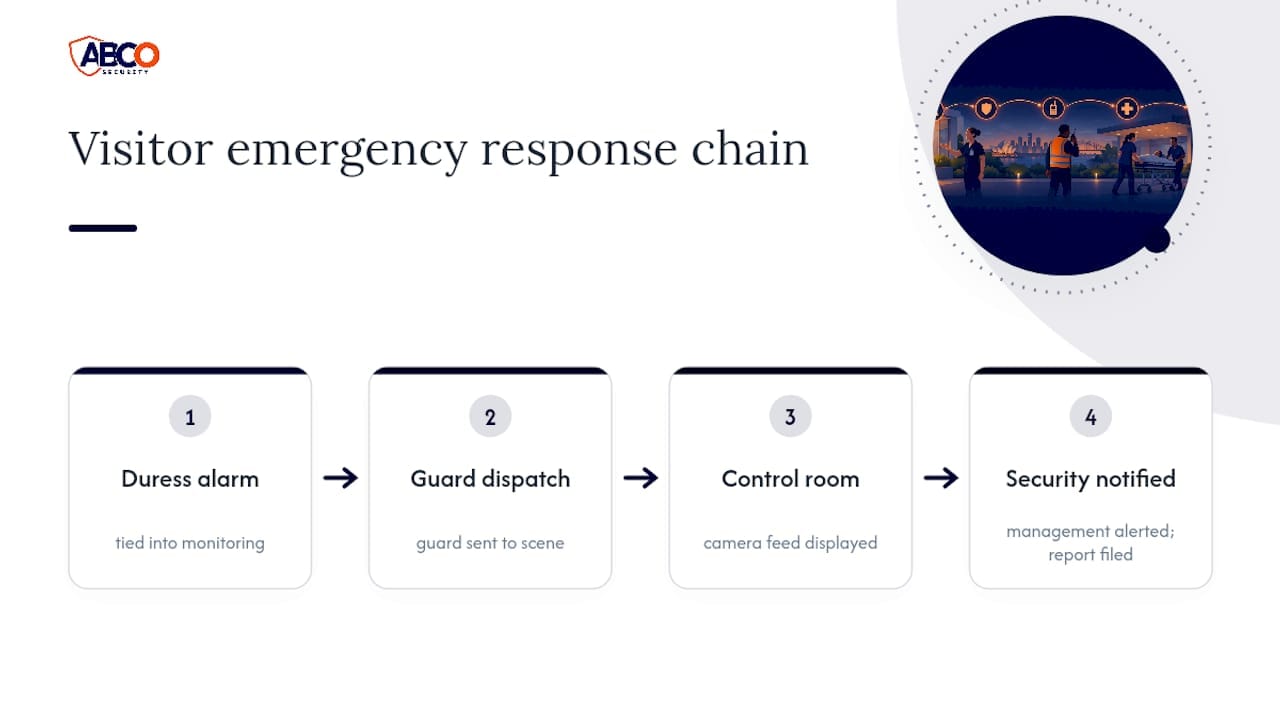
Duress alarms tied into the monitoring system should trigger a defined response chain: a guard dispatched, a camera view pulled up in the control room, and a notification path to hospital security management. NSW Health’s operational manual frames this kind of layered response as core to its risk management approach, and it’s worth using as a template when drafting your own procedures.
Lockdown scenarios, whether triggered by an aggressive visitor, an external threat, or a clinical emergency requiring restricted access, need rehearsed procedures, not improvised ones. That means periodic drills involving your contracted security provider, not just internal staff. A guard who has never practised a lockdown response with your specific floor plan and communication systems is a liability in the moment it counts.
Post-incident, every emergency involving a visitor should generate a written report that feeds into your next risk assessment review, closing the loop between what happened and what changes.
Communication strategies with patients and staff regarding visitor policies
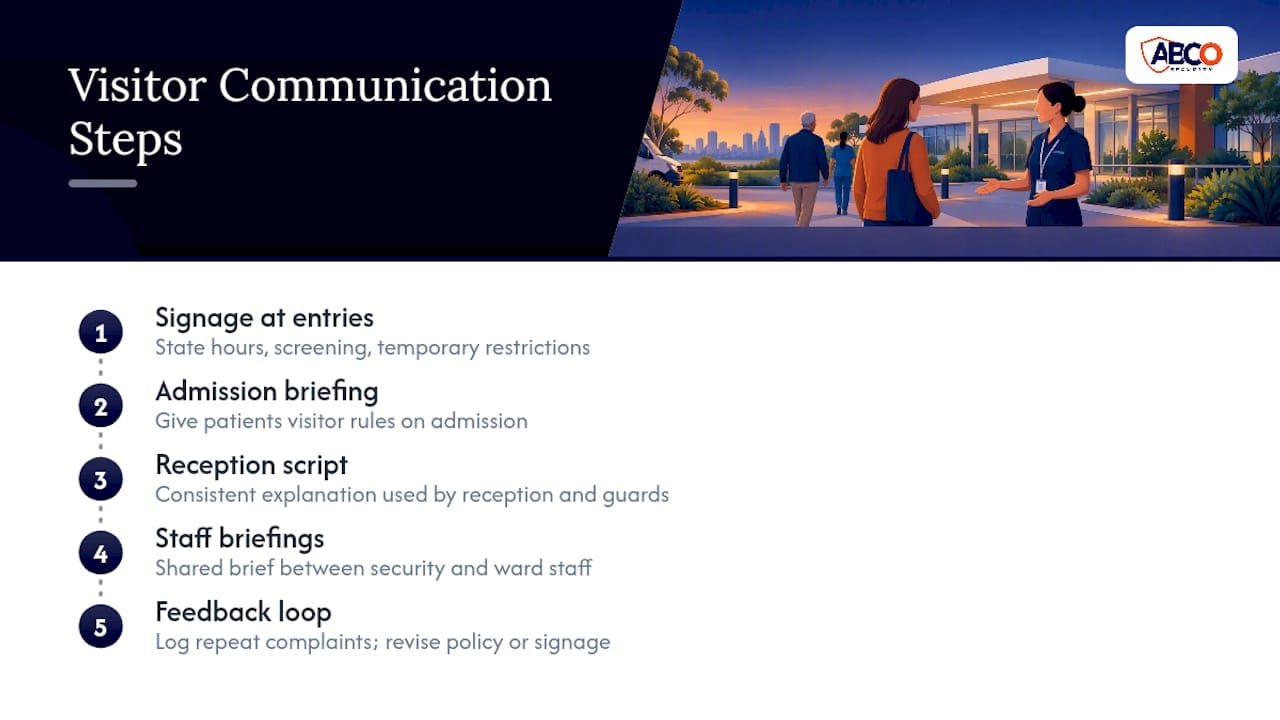
Visitor policies fail more often from poor communication than from poor design. A restricted visiting hours policy that isn’t clearly signed, isn’t explained at admission, and isn’t reinforced by reception staff will generate constant friction and undermine the security team enforcing it.
Signage at every entry point should state current visiting hours, screening requirements, and any temporary restrictions in plain language, updated the moment a policy changes. Reception and guard staff need a consistent script for explaining restrictions to frustrated visitors, because inconsistent explanations from different staff members are what escalate a minor disagreement into a formal complaint.
Staff communication matters just as much. Ward staff should know exactly what security is screening for at entry, so they’re not caught off guard when a visitor arrives without having passed through the expected checkpoint. This is a coordination gap that shows up repeatedly in facilities where security is contracted separately from clinical operations, with no shared briefing process.
Patient-facing communication deserves its own attention. Patients admitted for extended stays want to know, in advance, who can visit and when, particularly in mental health and paediatric units where restrictions are often stricter. Handing this information over at admission, rather than leaving patients to discover it when a visitor gets turned away, avoids a genuinely common source of distress.
Build a simple feedback loop too: if reception staff are fielding the same visitor complaint repeatedly, that’s a signal your policy or its signage needs revising, not a signal to train staff to repeat the explanation more firmly.
Compliance with healthcare regulations and standards specific to visitor management
Compliance for contracted visitor management sits across several layers, and it’s worth treating them as a checklist rather than a single certification you tick off once.
AS 4485.1:2021 remains the primary Australian standard for healthcare security policy and procedure, and state health departments generally build their own operational guidelines on top of it. Queensland Health’s security guideline explicitly aligns with AS 4485 and sets benchmark procedures for its Hospital and Health Services, which is a useful reference even outside Queensland if you want to see how a state health system translates the standard into practice.
Privacy compliance runs in parallel. Any facility using CCTV, access control logs, or visitor sign-in records is handling personal information, and health information carries additional sensitivity under the Australian Privacy Principles. The OAIC’s guide to health privacy sets out governance, ICT security and access control expectations that your contracted provider should be meeting, not just your internal IT team.
State-specific operational guidance adds another layer. WA facilities work to the WACHS CCTV and security data policy, while NSW facilities reference the Protecting People and Property manual. None of these override AS 4485.1, but they add jurisdiction-specific detail on footage handling, signage and access controls that a national standard doesn’t spell out.
Compliance isn’t a document sitting in a drawer. Build a review cycle into your contract so licensing, training records and privacy practices get checked annually, not just at the point of signing.
Data management and retention policies for visitor information
Every piece of contracted visitor management generates data, whether that’s a sign-in log, CCTV footage, or an incident report, and each of those needs a retention policy that someone actually owns.
Footage retention periods should be set deliberately, balancing evidentiary usefulness against storage cost and privacy risk. The WACHS policy on CCTV and security data prescribes storage and access controls precisely because footage sitting indefinitely on an unsecured server is a liability, not an asset. Shorter, clearly defined retention windows, with documented exceptions for footage relevant to an active incident or investigation, tend to work better than open-ended storage.
Access to that data needs to be restricted and logged. Not every staff member with facility access should be able to pull CCTV footage or visitor sign-in records, and every instance of someone doing so should leave an audit trail. The OAIC’s health privacy guidance treats this kind of access control as a core governance obligation, not an optional extra.
Freedom of information requests and police requests for footage or visitor records need a defined response process, including who authorises release and how the request itself gets documented. Facilities without this process tend to improvise under time pressure, which is exactly when mistakes involving sensitive health information happen.
Finally, if your contracted provider uses any digital device to capture images of patients or visitors, whether a body-worn camera or a mobile device, the OAIC’s guidance on taking photos of patients applies. Consent, identifiability, and secure storage settings all need to be addressed in the contract, not left to individual staff discretion.
Abco Security: practitioner perspective and practical lessons
Fifteen years of running guarding and integrated systems across construction, healthcare and corporate sites teaches you the same lesson repeatedly: facilities that involve clinical teams in security planning from day one end up with fewer disputed incidents and better staff confidence in the system. Facilities that treat security as a bolt-on tend to see the opposite. Working to ISO 9001 and ISO 30000 forces a discipline around documentation and continuous review that pays off exactly when an incident report needs to hold up under scrutiny.
The most common mistake we see is skipping licence verification because a provider “came recommended.” Ask for the paperwork every time, and plan a formal 12 month review from the outset rather than treating the contract as set and forget.
— Abco
How Abcosecurity can help you get this right
Healthcare clients can choose a comprehensive security service that includes licensed static guards, mobile patrols, and monitored CCTV and alarm systems delivered under integrated contracts aiming to meet recognized international standards, so licensing, reporting, and escalation pathways are managed cohesively.
If you’re at the point of writing a tender or reviewing an existing contract, start with a security risk assessment that maps your site’s priority areas before you specify guard hours or camera placement. From there, our healthcare security services team can quote on static guards, mobile patrols, or monitored CCTV and alarm integration as a single scope. For after-hours coverage specifically, the Night Owl Service starts from $5.45 a day. Get in touch to book a site walk-through and a tender response scoped to your facility’s actual risk profile, not a generic package.
Key standards, policies and privacy guidance to consult
Before finalising any policy or contract, check your service specifications against these primary sources directly, rather than relying on a provider’s summary of them.
- AS 4485.1:2021, the national benchmark for healthcare security policy and procedure
- The OAIC’s guide to health privacy, covering surveillance data and image handling obligations
- Queensland Health’s security guideline, a practical model of AS 4485 applied at state level
- The WACHS CCTV and security data policy, on footage governance and signage
- NSW Health’s Protecting People and Property manual, for a full security risk management framework
For a broader methodology on scoping the assessment itself, Trouble Defense’s facility risk assessment primer offers a useful complementary perspective.
Sources
- Security licences — NSW Police Force
- Guide to health privacy — OAIC
- Security | Queensland Health guideline
- WACHS closed‑circuit television footage and security data policy
- Protecting People and Property — NSW Health
FAQ
What does healthcare visitor management actually include?
It means contracted physical security services, static guards, reception screening, mobile patrols, and integrated CCTV and alarm monitoring, rather than check-in software. Abcosecurity delivers this as licensed guarding and integrated electronic security under a single contract.
Which Australian standard governs hospital security?
AS 4485.1:2021 is the national benchmark covering security policies and procedures for healthcare facilities. State health departments, including Queensland Health, build their own operational guidelines on top of it.
Do security guards and CCTV installers need different licences?
Yes. Licence classes and endorsements for guarding, patrolling and installing or monitoring equipment differ by state, so always verify the specific endorsement against the exact role before contracting.
How long should CCTV footage be retained?
Retention periods should be set deliberately based on evidentiary need and privacy risk, following governance principles set out in policies like the WACHS CCTV and security data policy. There’s no single fixed period across all facilities; it depends on your state guidance and your own risk assessment.
What does Abcosecurity’s after hours service cost?
The Night Owl Service starts from $5.45 per day. Pricing for guarding, mobile patrols and CCTV monitoring contracts is scoped to each facility and available on request.
Recommended
about
avada factory
Sempery ultricies nibh at dolor cras urna eleifend nec. Atiam efficitur tempor.