
Integrated, tiered access control that combines physical barriers, electronic authentication, CCTV and documented risk zones is the single most effective approach for protecting patients, staff and high-risk assets in Australian hospitals. The core system elements are credentials, readers and controllers, electronic locking devices, visitor management, CCTV integration and audit logging. Start by commissioning a documented risk assessment that targets your highest-risk zones: pharmacy, NICU, mental health wards, controlled drug stores and medical records. Both the Australian Health Facility Guidelines (AusHFG) and NSW Health’s Protecting People and Property require documented risk assessments and tiered zoning before any system is designed or procured. Abcosecurity delivers this full scope across Australian healthcare facilities, from initial risk assessment through to 24/7 monitoring and a post-commissioning tuning period that regulators and practitioners expect.
Table of Contents
- What does hospital access control actually cover?
- What types of access control systems do hospitals use?
- Why does access control matter so much in hospitals?
- How should you zone a hospital and document the risk assessment?
- What should your procurement checklist include?
- How should you plan the rollout, testing and maintenance?
- What are the key compliance obligations for Australian hospitals?
- How does Abcosecurity deliver compliant hospital access control?
- Key takeaways
- The part most hospitals get wrong
- Abcosecurity’s hospital security assessment
- Useful sources for compliance and procurement
- FAQ
What does hospital access control actually cover?
Hospital access control systems span three interconnected scopes: physical, electronic and logical. Physical controls include perimeter fencing, vehicle barriers, controlled public entrances, doors, locks and intercom systems. Electronic controls layer credential-based authentication over those physical barriers. Logical access governs who can reach clinical information systems, such as electronic health record (EHR) consoles and pharmacy dispensing software, and it intersects directly with physical access when those systems sit inside controlled rooms.
For procurement and audit purposes, the component breakdown looks like this:
| Component | Function | Audit artifact |
|---|---|---|
| Credentials (cards, PINs, biometrics, mobile) | Authenticate identity at a reader | Credential issuance and expiry log |
| Readers and controllers/panels | Verify credentials and trigger locking devices | Hardware maintenance records |
| Electronic locking devices | Enforce access decisions at doors and gates | Fail-safe test records |
| Intercom and duress systems | Enable communication and staff alerts | Duress escalation logs |
| Visitor management software | Issue temporary credentials and log visits | Visitor register and badge audit trail |
| CCTV integration | Provide visual verification and event correlation | Recorded footage retention schedule |
| Audit and management software | Centralise credential lifecycle and reporting | Access event logs, role-change records |
| Power and redundancy (UPS, generators) | Maintain operation during outages | Resilience test records, BCP documentation |
The logical layer deserves particular attention in hospitals. An EHR console room or a pharmacy dispensing terminal is a physical space with a door, and access to that door should be governed by the same role-based logic that governs the software login. When physical and logical access are managed separately, gaps open: a contractor with a valid card can enter a server room but should never reach a clinical workstation. Aligning the two systems, and documenting that alignment, is what AS 4485.1:2021 expects auditors to verify.
Documentation artifacts that auditors will request include: a risk assessment report, a zone matrix, an access policy document, and credential lifecycle logs showing issuance, modification and expiry for every user class.
What types of access control systems do hospitals use?
The right technology depends on the zone, the workflow and the fail-safe requirement. Hospitals typically deploy several system types in parallel rather than choosing one.
Perimeter and site access uses gates, vehicle barriers, boom gates and controlled public entrances fitted with screening intercoms. The goal is to channel all movement through observable, staffed or monitored points before visitors reach clinical areas.
Electronic door control and credential systems are the backbone of internal healthcare entry control. Proximity and contactless smart cards remain the most common credential in Australian hospitals because they are fast, auditable and easy to replace. PIN keypads suit low-traffic restricted areas where card readers are impractical. Mobile credentials (smartphone-based) are gaining ground in new builds and refurbishments because they eliminate card printing costs and support remote provisioning. Biometric systems, including fingerprint and iris readers, suit the highest-security zones such as controlled drug stores and server rooms, where the cost and enrolment overhead is justified by the risk level.
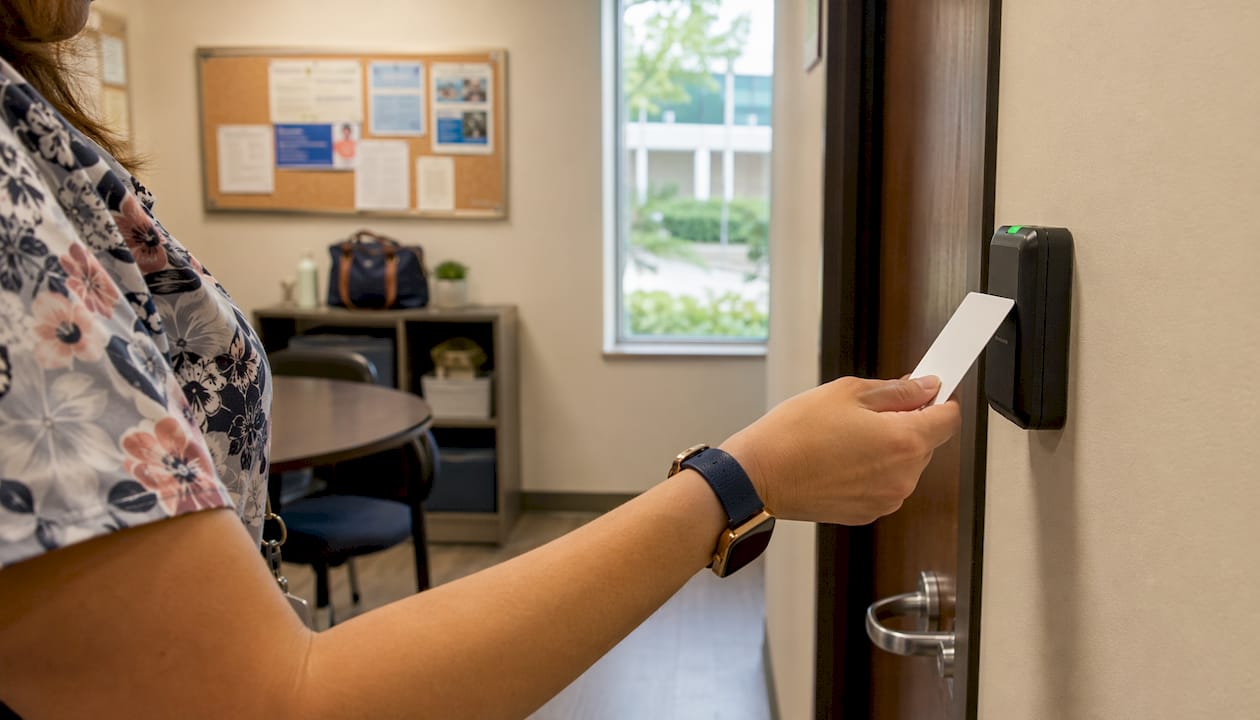
Visitor management and reception screening can be delivered through a staffed reception model, a self-service kiosk, or a hybrid. Kiosks pre-screen visitors against watchlists and print time-limited badges; staffed reception adds human judgement for edge cases. Either model should integrate with the access control platform so that a temporary credential issued at reception expires automatically at the end of the approved visit window.
Lockdown and emergency response systems require centralised control logic that can lock or unlock specific zones in a single action. Integration with fire and life-safety systems is mandatory: doors that are normally locked must fail-safe to open on fire alarm activation, while other zones may need to remain secured during a security incident. These two requirements pull in opposite directions, and resolving them at design stage is far easier than retrofitting.
Trends worth watching include contactless biometrics (palm-vein readers that work without physical contact), tighter CCTV-to-access-control analytics that flag tailgating in real time, and AI-assisted anomaly detection that surfaces unusual access patterns before they become incidents.
Pro Tip: Match credential type to clinical workflow, not just security level. Caregivers moving between rooms dozens of times per shift need a credential they can activate in under two seconds. A biometric reader that takes five seconds per scan will be propped open within a week.
Why does access control matter so much in hospitals?
The risks from inadequate access control in a hospital are not theoretical. Unauthorised entry to clinical areas creates direct patient safety hazards: elopement from mental health or dementia wards, infant abduction from maternity units, and violent incidents in emergency departments. Safe Work Australia identifies lack of access control for worker-only areas as a specific work environment hazard in healthcare, alongside poor sightlines and poorly designed workplaces.
Key regulatory expectation: AusHFG and NSW Health guidance require that access control measures, including electronic card systems, CCTV at entrances and duress alarms, are specified in the security design from the earliest stage of a new build or refurbishment, not added as an afterthought.
Controlled drugs and medical records represent two of the highest-value targets in any hospital. Physical access control is the first line of defence against drug diversion, which is a significant contributor to medication errors and staff misconduct investigations. For protected health information (PHI), the Australian Privacy Principles require that access to personal health data is limited to those with a legitimate need, and physical access to the rooms where that data is stored or processed is part of that obligation.
Operational continuity is a less-discussed but equally important driver. A poorly designed system that fails during a power outage, or that locks staff out of a resuscitation room, creates immediate WHS liability under the Work Health and Safety Act 2011. Redundancy is not optional.
How should you zone a hospital and document the risk assessment?
Tiered zoning is the design principle that makes access control manageable at scale. Rather than treating every door as an individual decision, you group spaces by risk level and apply consistent controls to each tier.

A practical six-tier model for Australian hospitals:
| Zone tier | Examples | Typical credential | CCTV required | Audit frequency |
|---|---|---|---|---|
| Public | Main lobby, outpatient waiting, café | None | Recommended | Annual |
| Administrative | Offices, meeting rooms, HR | Card or PIN | Recommended | Annual |
| Clinical | Wards, consulting rooms, treatment areas | Card (staff-issued) | Yes | — |
| Restricted clinical | Operating theatres, ICU, NICU, ED resus | Card + PIN or biometric | Yes, with recording | Quarterly |
| High-security | Pharmacy, controlled drug stores, medical records | Biometric or dual-factor | Yes, with recording | Quarterly |
| Plant and utility | Electrical, BMS, server rooms | Card + PIN | Yes | — |
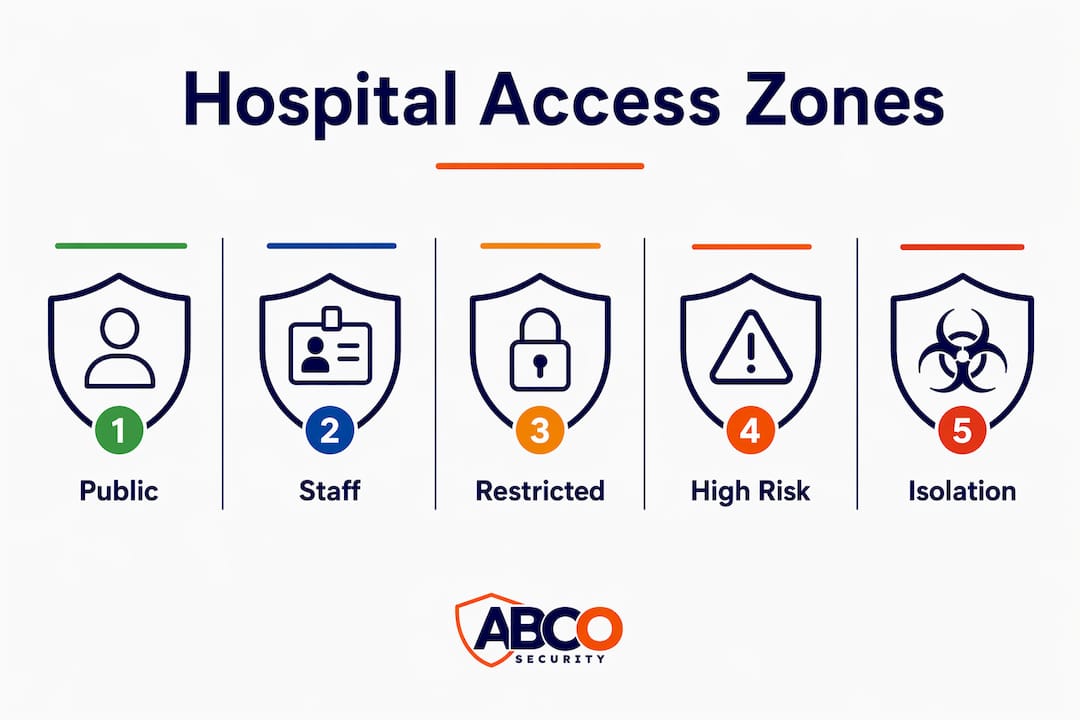
AusHFG and WA hospital guidelines require documented risk assessments for high-risk and restricted zones. The assessment must identify the hazard, the likelihood and consequence of a breach, the existing controls and the residual risk after controls are applied.
Stakeholders to involve in the assessment: clinical leads for each affected area, the WHS officer, facilities engineering, ICT (for logical access alignment), the security manager, and union or health and safety representative (HSR) delegates. NSW Health guidance is explicit that security risk management must be multidisciplinary and documented before any new or refurbished facility is finalised.
Pro Tip: Build a 12-month tuning period into the contract as a deliverable, not an afterthought. Health WA practitioner guidance notes that newly commissioned systems routinely need rule adjustments in the first year as real-world workflow patterns differ from design assumptions. Without a formal tuning plan, workarounds like propped doors become permanent.
What should your procurement checklist include?
Good procurement starts with scope definition and ends with a signed acceptance test report. The table below gives the key checklist items, the questions to ask vendors and the acceptance criteria to specify in your RFP.
| Procurement area | Questions to ask vendors | Acceptance criteria |
|---|---|---|
| Zone matrix and integration | How does the system handle CCTV, nurse call, fire and EHR integration? | Documented integration architecture; tested interoperability |
| Fail-safe behaviour | What happens to each door type during power loss or fire alarm? | Fail-safe/fail-secure behaviour documented per zone; tested in commissioning |
| Redundancy and MTBF | What is the MTBF for controllers and locking hardware? What is the repair SLA? | MTBF figures provided; SLA aligned with hospital disaster plan |
| Credential lifecycle | How are credentials issued, modified and revoked for staff, contractors and visitors? | Automated expiry; audit log of all credential events |
| Patch and firmware lifecycle | How are firmware updates managed? What is the end-of-support date? | Documented patch schedule; no end-of-life hardware at commissioning |
| Healthcare deployments | Can you provide references from Australian hospital deployments? | Minimum two verifiable references; ISO certification evidence |
| Scalability | Can the system expand to additional buildings or campuses? | Scalability demonstrated in reference sites or lab environment |
NSW Health’s Protecting People and Property specifies that security design must adopt Crime Prevention Through Environmental Design (CPTED) principles from the earliest stage of planning. That means sightlines to controlled doors, reception layouts that support screening, and glazing that allows natural surveillance. A vendor who cannot speak to CPTED integration in their design process is a vendor who has not worked in healthcare before.
Commissioning deliverables to require contractually: as-installed drawings, functional test records, resilience test records (power failover, fire alarm integration), user acceptance test results for each zone type, training materials, O&M manuals and a tuning plan covering the post-commissioning adjustment period.
How should you plan the rollout, testing and maintenance?
A staged rollout reduces operational disruption and gives the project team time to identify issues before they affect the whole facility.
Typical phases:
- Detailed design and stakeholder sign-off on zone matrix and integration architecture
- Pilot in a single ward or entrance (ideally a lower-risk area first, then a high-risk zone)
- Staged rollout by building or floor, with each stage formally accepted before the next begins
- Full commissioning and handover with all deliverables signed off
- 12-month tuning period with scheduled monthly reviews
Testing checklist for each stage:
- Credential issuance and expiry: issue a test credential, verify access, expire it, verify denial
- Duress escalation: activate a duress alarm, verify alert reaches the monitoring centre within the agreed response time
- Intercom flows: test two-way communication at each intercom point
- Emergency egress: activate fire alarm, verify all fail-safe doors release correctly
- Audit logging: verify that every access event, denial and alarm is captured in the management software with correct timestamp and user ID
- Power failover: cut primary power, verify UPS holds all critical doors in the correct state, verify generator handover
Maintenance schedule:
Daily and weekly checks cover door operation, intercom function and alarm panel status. Monthly reviews cover access event logs for anomalies, credential expiry reports and any outstanding firmware patches. Annual activities include a full audit against the zone matrix, a lockdown drill and a penetration test of the networked components. WA engineering guidance highlights that redundancy and disaster planning must be coordinated with building management systems, so the annual audit should involve facilities engineering, not just the security team.
Training priorities: reception and security staff need to understand credential issuance workflows and visitor management procedures. Clinical staff with elevated access need to understand their responsibility for tailgating prevention. Contractors and temporary staff need a documented onboarding process that includes credential issuance, site rules and expiry confirmation.
Pro Tip: Document the emergency override procedure for every zone type and laminate a copy inside each controller cabinet. During a real incident, the person who needs that procedure will not have time to search a shared drive.
What are the key compliance obligations for Australian hospitals?
Australian hospitals face overlapping obligations from standards, WHS legislation and privacy law. Meeting all three requires documentation, not just technology.
Standards and guidance:
- AusHFG C-0790 Safety and Security Precautions sets out recommended controls including electronic access control, CCTV with digital recording and duress alarms for staff.
- NSW Health Protecting People and Property requires multidisciplinary security risk management and CPTED integration from the design stage.
- AS 4485.1:2021 covers general security requirements for healthcare facilities, including pharmacy security, data security and incident procedures. Regulators increasingly expect security policies to be demonstrably linked to identified risks using an all-hazards approach, and documentation is the evidence.
- State health department policies (Health WA, Queensland Health, SA Health) add jurisdiction-specific requirements that must be checked for each facility.
Work Health and Safety obligations:
The Work Health and Safety Act 2011 requires employers to eliminate or minimise risks so far as is reasonably practicable, and to consult workers in the risk management process. For access control, this means: designing out hazards (not just controlling them), maintaining egress and exit logic, and aligning MTBF and repair SLAs for critical hardware with the facility’s business continuity plan. A door controller that fails and traps staff in a clinical area is a WHS incident, not just a maintenance issue.
Privacy obligation: The Australian Privacy Principles require that access to systems holding personal health information is limited to those with a legitimate need. Physical access control to server rooms, EHR console rooms and medical records storage is part of that obligation, and audit logs of physical access events are part of the evidence trail.
Action items for compliance documentation:
- Retain the documented risk assessment and zone matrix as a living document, updated after every significant change
- Keep commissioning records and acceptance test results retained as required for the system lifetime
- Schedule annual audits against the zone matrix and AS 4485.1:2021 requirements
- Include security in facility planning governance from the earliest design stage, not as a late-stage review
How does Abcosecurity deliver compliant hospital access control?
Abcosecurity’s healthcare security services cover the full delivery lifecycle: integrated design, installation, project management, 24/7 monitoring, ongoing maintenance and documented risk assessments. For hospital clients, the handover package includes a zone matrix, commissioning records, acceptance test results, staff training materials and a 12-month tuning plan, which are the exact deliverables that AusHFG and NSW Health guidance expect a compliant supplier to provide.
On integrated hospital security: Effective hospital access control is not a product you buy off the shelf. It is a system you design around clinical workflow, document against identified risks, and tune over time as the facility evolves. The technology is the easy part; the discipline of documentation and ongoing governance is what separates compliant facilities from those that fail audits.
Abcosecurity holds ISO 9001 and ISO 30000 certifications and brings over 15 years of sector experience across healthcare, corporate and government facilities in Australia. The team includes licensed security professionals who understand both the technical requirements of integrated systems and the operational realities of clinical environments.
For healthcare deployments, Abcosecurity’s approach includes:
- A documented risk assessment and zone matrix before any hardware is specified
- Integration design covering CCTV, duress alarms, nurse call and fire systems
- Staged rollout with formal acceptance testing at each phase
- 24/7 monitoring with documented escalation procedures
- A contractual 12-month tuning period with scheduled monthly reviews
Key takeaways
Effective hospital access control requires a documented, risk-based zone matrix, integrated technology, and a formal tuning period after commissioning; these are key to maintaining compliance and operational soundness.
| Point | Details |
|---|---|
| Start with a risk assessment | Commission a documented zone risk assessment before specifying any hardware or credentials. |
| Require redundancy evidence | Mandate MTBF figures and repair SLAs aligned with your facility’s business continuity plan in every RFP. |
| Pilot before full rollout | Test integrated CCTV and access control in one high-risk area before staging across the facility. |
| Cite the right standards | Reference AusHFG C-0790, AS 4485.1:2021 and NSW Health Protecting People and Property in procurement documents. |
| Abcosecurity as your partner | Abcosecurity delivers the full lifecycle, from risk assessment and zone matrix through to 24/7 monitoring and a 12-month tuning plan. |
The part most hospitals get wrong
The conventional wisdom in hospital security procurement is to lead with technology: choose a credential type, pick a platform, then design the zones around what the system supports. That order is backwards, and it is why so many hospital access control projects end up with doors propped open, credentials shared between staff and a zone matrix that no longer reflects how the facility actually operates.
The real discipline is documentation first. A zone matrix that has been signed off by clinical leads, the WHS officer and ICT before a single reader is specified forces the right conversations early. It surfaces the conflicts, such as the fire egress requirement that contradicts the lockdown logic for the mental health ward, before they become expensive change orders. It also gives you the audit trail that AS 4485.1:2021 and NSW Health guidance expect to see.
The 12-month tuning period is the other piece that gets cut in budget negotiations. Facilities that skip it almost always end up with workarounds that undermine the entire system within 18 months. Build it into the contract as a deliverable with scheduled monthly reviews, not as an optional add-on.
Technology matters, but governance is what keeps a hospital secure over time.
Abcosecurity’s hospital security assessment
Hospitals that have gone through a documented risk assessment and zone matrix process with Abcosecurity consistently find gaps they did not know existed, typically in contractor credential management, visitor expiry logic and the interface between fire and access control systems.
Abcosecurity’s integrated security solutions for healthcare facilities include a full risk assessment, zone matrix development, system design, installation, acceptance testing and a tuning plan covering the initial adjustment period, all delivered by licensed professionals holding ISO 9001 and ISO 30000 certifications. The process is designed to produce the documentation that AusHFG, AS 4485.1:2021 and NSW Health guidance require, not just a working system.
To schedule a documented risk assessment and discuss a pilot deployment in your highest-risk zone, contact Abcosecurity directly through the healthcare security services page.
Useful sources for compliance and procurement
The following Australian guidance documents and standards are the primary references for hospital access control procurement, commissioning and audits. Bookmark these for RFP development and annual audit preparation.
- AusHFG C-0790 Safety and Security Precautions — sets out recommended access control measures for Australian health facilities including electronic card systems, CCTV and duress alarms. Essential for procurement scope definition.
- NSW Health Protecting People and Property — covers CPTED integration, multidisciplinary risk management and security design requirements for NSW public health facilities. Directly applicable to design and procurement governance.
- AS 4485.1:2021 Security for healthcare facilities, Part 1 — the primary Australian standard covering general security requirements, pharmacy security, data security and incident procedures. Cite this in every RFP and acceptance test plan.
- Work Health and Safety Act 2011 (Cth) — establishes the duty to eliminate or minimise risks and to consult workers. Relevant to egress design, redundancy requirements and the obligation to address access control gaps identified in risk assessments.
- Work Health and Safety Regulations 2011, Reg 298 — specifically addresses security of workplace obligations, including access control for worker-only areas.
- Safe Work Australia: Work environment hazards (healthcare) — identifies lack of access control for worker-only areas as a specific WHS hazard in healthcare settings. Useful for justifying investment to finance and executive stakeholders.
- Health WA WAHFGES2025 — Western Australian health facility engineering guidelines covering tiered zoning, redundancy requirements and disaster planning for hospital security systems. Applicable to WA facilities and useful as a benchmark for other states.
FAQ
What are the four types of access control?
The four main types are discretionary access control (DAC), mandatory access control (MAC), role-based access control (RBAC) and attribute-based access control (ABAC). In hospitals, RBAC is the most practical model because it assigns access rights by job role rather than by individual, which simplifies credential management across large, rotating workforces.
What is the most common access control system in hospitals?
Contactless smart card systems are the most widely deployed credential type in Australian hospitals because they are fast, auditable and straightforward to replace when lost. They are typically combined with PIN or biometric authentication in higher-risk zones such as pharmacies and controlled drug stores.
What are the four components of an access control system?
The four core components are: credentials (what the user presents), readers (what verifies the credential), controllers or panels (what makes the access decision), and locking devices (what physically enforces that decision). Audit and management software is the fifth component that ties all four together for reporting and compliance purposes.
What does a documented risk assessment need to cover for hospital access control?
A compliant risk assessment must identify each zone, the roles permitted to access it, the likelihood and consequence of unauthorised access, the existing controls and the residual risk. AusHFG and NSW Health guidance require this to be a multidisciplinary process involving clinical, WHS, facilities, ICT and security stakeholders, and the output must be retained as a living document updated after any significant change.
How does Abcosecurity support hospital access control compliance?
Abcosecurity delivers the full compliance lifecycle: documented risk assessment, zone matrix, integrated system design, installation, acceptance testing, staff training and a 12-month tuning plan. The team holds ISO 9001 and ISO 30000 certifications and has over 15 years of experience across Australian healthcare and government facilities.
Recommended
about
avada factory
Sempery ultricies nibh at dolor cras urna eleifend nec. Atiam efficitur tempor.