For most Australian events, start with two crowd controllers for the first 100 patrons, then add one per additional 100 patrons. That baseline comes from WA licensing guidance and is widely used across states. For lower-risk, daytime events without alcohol, one guard per 100 attendees is often workable. For higher-risk events, expect that figure to climb quickly once you factor in alcohol, late trading, and venue complexity.
Before you book anyone, run these three checks:
- Liquor-licence conditions: Your permit may specify a minimum number of crowd controllers. This overrides your own calculation.
- Venue rules and council requirements: Some venues and local councils mandate a security plan or Emergency Management Plan (EMP) before approval.
- Police or council consultation: Large events, or those with late trading past 1am, often require a formal briefing with police and may trigger mandatory staffing levels.
Quick estimate by attendance:
- Under 100 guests, no alcohol: at least 1 or 2 guards
- 100–300 guests, no alcohol: generally 2 or 3 guards
- 100–300 guests, with alcohol: a few crowd controllers
- 300–1,000 guests, with alcohol: several crowd controllers plus a supervisor
- Over 1,000 guests: consult your state licensing authority and police event liaison before confirming numbers
Key takeaways
The baseline for most Australian events is two crowd controllers for the first 100 patrons and one per additional 100, but liquor-licence conditions, late trading, and council requirements can raise that number before your own risk assessment even begins.
| Point | Details |
|---|---|
| Baseline staffing ratio | Two crowd controllers for the first 100 patrons, then one per additional 100, per WA licensing guidance. |
| Three fastest number-raisers | Liquor-licence conditions, late trading past midnight, and police or council requirements can each mandate higher staffing. |
| Supervisor requirement | Plan for one supervisor per a group of guards; never skip this role for events over 200 people. |
| EMP and incident register | Lodge your EMP with council and police before the event; the security licensee must maintain an incident register on site. |
| Abcosecurity | Provides licensed crowd controllers, supervisors, and camera monitoring with a written staffing plan and EMP input for events across Australia. |
Table of Contents
- How many security guards for an event: the calculation method
- What Australian law requires before you confirm your numbers
- What each security role does and how many you need
- Staffing scenarios: small, medium, and large events
- How to hire a professional security provider
- How to run a security risk assessment and build your EMP
- What actually makes security numbers effective
- Abcosecurity’s event security service for Australian organisers
- Sources
- FAQ
How many security guards for an event: the calculation method
Getting to a defensible number takes about five steps. Here is the process.
- Define your attendance figure. Use your ticketed capacity or a realistic worst-case headcount, not the optimistic one. If you are expecting 350 but the venue holds 500, plan for 500.
- Map entry and exit points. Each staffed gate or door needs at least one static guard. A venue with four entry points needs four guards before you count anyone inside.
- Identify risk multipliers. Alcohol service, late trading past midnight, VIP areas, pyrotechnics, multiple stages, and large car parks all increase your baseline. Each factor typically adds 10–25% to your staffing requirement.
- Apply the baseline ratio and adjustments. Start with two crowd controllers for the first 100 patrons and one per additional 100. Add guards for each risk multiplier you identified. Round up, never down.
- Confirm supervisor and relief ratios. Plan for one supervisor per a group of guards. For shifts longer than six hours, factor in a 15–20% relief allowance so guards can take breaks without leaving posts uncovered.
Sample calculations:
Small event: 80-person birthday party, licensed venue, alcohol served, one entry point. Baseline: 2 crowd controllers. Alcohol multiplier: add 1. Total: 3 crowd controllers, no supervisor required at this size, though a senior guard acting as lead is good practice.
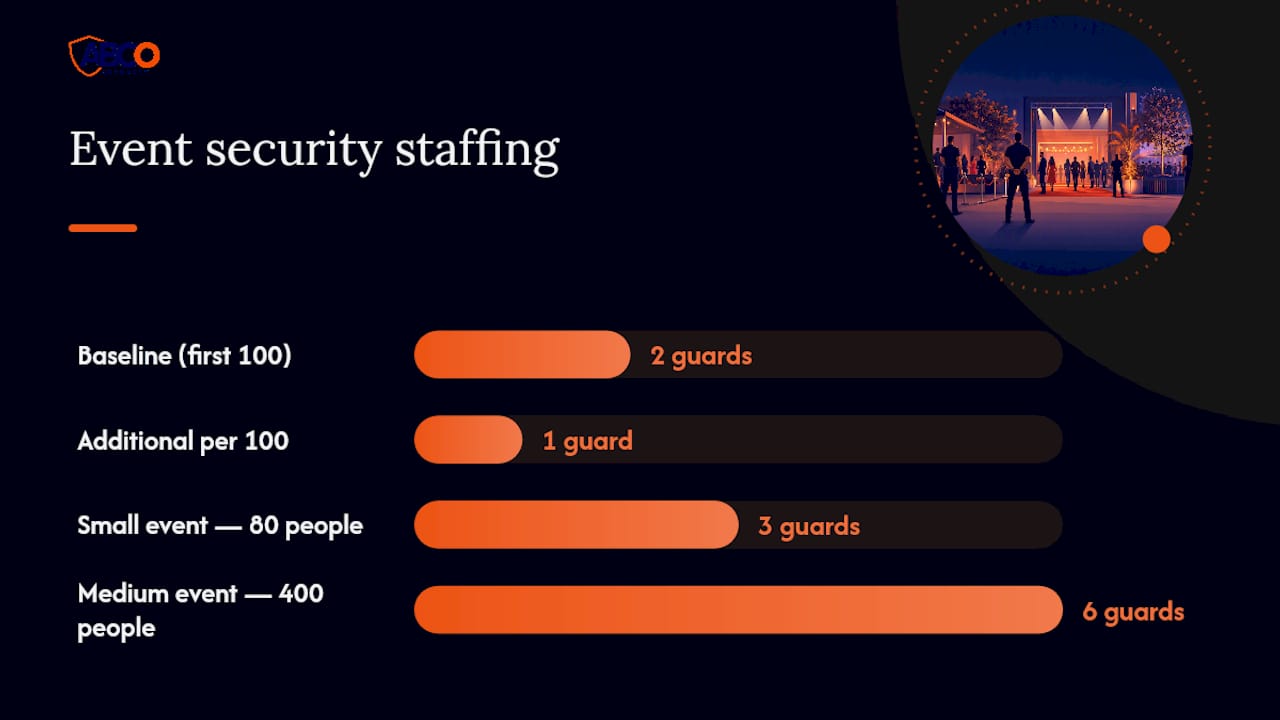
Medium event: 400-person corporate gala, alcohol, two entry points, finishes at midnight. Baseline: 2 + 3 = 5 crowd controllers. Two static guards for entry points (already counted in the 5). Add staff for alcohol service and late finish. Total: 6 crowd controllers plus 1 supervisor.
Pro Tip: Plan your shift lengths before you finalise headcount. A six-hour event with a 30-minute pre-event briefing and 30-minute post-event pack-down effectively becomes a seven-hour shift. If your guards are contracted for eight hours, you have buffer. If they are contracted for six, you will need overlap staff or you will be paying overtime at the worst possible moment.
What Australian law requires before you confirm your numbers
Licensing and insurance requirements can override every calculation above. This is where many organisers get caught.
State licensing: Every crowd controller working at a licensed venue or public event in Australia must hold a valid state-issued security licence. In WA, the licensing conditions set explicit ratios for late-trading venues. In NSW, the NSW Government event safety guidance requires that crowd controllers in restricted areas hold the appropriate licence class, and that your security plan includes each supplier’s master licence number and individual licence details.
Liquor-licence conditions: This is the most commonly overlooked trigger. Your liquor permit may specify a minimum number of crowd controllers, CCTV requirements, or both. Liquor-licence conditions are a legal instrument. If your permit says four crowd controllers and you book three, you are in breach regardless of what your risk assessment says. Always pull the actual permit document and read the conditions before finalising numbers.
Documents to request from every security provider:
- Master licence number (company-level)
- Individual crowd-controller licence numbers for every person on site
- Certificate of currency for public liability insurance (minimum $20 million is standard for most Australian events)
- Certificate of currency for workers’ compensation
- Written commitment to maintain a security incident register on site
- References from at least two comparable events
When police or council can mandate higher staffing: Large events, events in public spaces, and events with late trading frequently require a formal EMP lodged with local council and police. Police may direct you to increase staffing as a condition of their support. Non-compliance can void your event permit, trigger insurance exclusions, and expose you personally to liability if an incident occurs.
WorkSafe Victoria’s guidelines for planning safe public events cover the full range of risk management, crowd dynamics, and alcohol-related obligations that should inform your staffing plan and EMP content.
What each security role does and how many you need
Not all security staff do the same job. Booking the wrong mix is as problematic as booking too few.
- Crowd controller (door staff): The primary role at licensed venues and events. Must hold a crowd-controller licence. Manages entry, checks IDs, refuses entry, and handles ejections. This is the role your liquor-licence conditions will specify.
- Static guard: Positioned at a fixed post, typically an access point, cash room, equipment area, or restricted zone. May or may not need a crowd-controller endorsement depending on the state and the specific duties.
- Roving/mobile guard: Moves through the venue on a patrol circuit. Effective for large outdoor events where static posts cannot cover the full perimeter. One roving guard can often replace two static posts if sightlines and radio coverage are good.
- Supervisor/shift lead: Manages the security team on the ground, liaises with police and venue management, and makes real-time staffing decisions. Plan for one supervisor per a group of guards. Never skip this role for events over 200 people.
- First-aid/medical liaison: Not a security role, but your security plan must account for how guards interact with first-aid staff. Assign one guard as the dedicated medical liaison for events over 500 people.
- Communications runner: For large events with radio dead zones, a dedicated runner between command posts prevents critical delays.
NSW access control guidance is clear that restricted areas require guards specifically licensed for crowd control, not general security officers. The distinction matters legally and operationally.
Communications equipment checklist:
- One radio per guard (not shared)
- Designated channel for security-only communications
- Backup channel shared with venue management and first aid
- Supervisor holds a direct line to police event liaison
- Pre-event radio check at least 30 minutes before doors open
Staffing scenarios: small, medium, and large events
The table below maps three common event types to realistic staffing numbers, including adjustments for alcohol and late trading.
A few factors that change these numbers fast:
- Late trading past 1am: WA licensing conditions and most state liquor authorities treat this as a high-risk trigger. Expect mandatory ratios to apply and budget to increase your baseline staffing levels.
- Pyrotechnics or special effects: Adds a dedicated safety perimeter guard and typically requires a separate risk assessment.
- Remote or regional locations: Longer response times for police and ambulance mean you carry more of the safety burden internally. Add at least one extra supervisor and confirm first-aid coverage independently.
- Multiple stages or zones: Each zone effectively becomes its own event for staffing purposes. Calculate each zone separately, then add a command-level supervisor across all zones.
For large licensed events, WA security licensing conditions note that a ratio of one crowd controller per 150 patrons may be considered for some large events depending on risk, but this is a ceiling for low-risk configurations, not a starting point.
How to hire a professional security provider
Choosing a provider is not just about price. A provider who cannot produce the right documents on request is a liability, not an asset.
Before you sign anything, verify:
- Master licence number (check against your state’s licensing register)
- Individual crowd-controller licences for every named staff member
- Public liability certificate of currency (check the expiry date and the insured amount)
- Workers’ compensation certificate of currency
- Incident register policy in writing
- References from two events of comparable size and risk profile
What a professional quote should include:
- A site-specific staffing plan with named roles and post assignments
- Shift patterns, including briefing time and pack-down
- Supervisor ratio and who the on-site supervisor reports to
- Equipment list (radios, PPE, barriers, torches)
- Incident reporting process and escalation contacts
- Input into your EMP, including the security section
Abcosecurity’s event security guard services covers what a thorough procurement process looks like and what to expect from a compliant provider proposal.
Vendor checklist (copy into your procurement process):
- [ ] Master licence confirmed against state register
- [ ] Individual licences sighted for all named staff
- [ ] Public liability certificate of currency received
- [ ] Workers’ compensation certificate of currency received
- [ ] Incident register commitment confirmed in writing
- [ ] References checked (minimum two comparable events)
- [ ] Site visit completed before event day
- [ ] Written staffing plan and EMP input received
NSW festival guidance requires the security licensee to maintain a security incident register and to be named in your liquor management, crowd control, and traffic plans. Make sure your provider understands this obligation before you engage them.
How to run a security risk assessment and build your EMP
A risk assessment is not a bureaucratic exercise. It is the document that justifies your staffing numbers to a council, insurer, or coroner.
Ordered risk assessment checklist:
- Identify hazards: Crowd density, alcohol, weather exposure, site access, traffic, lighting, noise, and any activities with injury potential.
- Score each hazard: Likelihood (1–5) × consequence (1–5) = risk score. Anything scoring 12 or above needs a documented mitigation measure.
- Define mitigation measures: For each high-scoring hazard, record the control (extra guard, barrier, CCTV, lighting) and who is responsible.
- Translate to staffing: Each mitigation measure that involves a person becomes a staffing line item. Add those to your baseline calculation.
- Record residual risk: After controls, re-score each hazard. If residual risk is still high, escalate to police or council before the event.
EMP template outline (security section):
- Event name, date, venue, and organiser contact
- Security provider name, master licence number, and on-site supervisor contact
- Staffing plan: roles, post assignments, shift times
- Incident register: location on site, who maintains it, escalation triggers
- Evacuation triggers and assembly points
- Police event liaison name and direct number
- Ambulance and first-aid provider contact
- Communication plan: radio channels, escalation chain
City of Greater Geelong guidance confirms that the risk assessment and EMP should be prepared in consultation with the venue owner, local council, and relevant emergency services. Do not finalise either document without that consultation.
For a detailed risk assessment framework, Abcosecurity’s risk assessment process guide walks through the full methodology.
Pre-event briefing requirements:
- Hold a joint briefing with security, venue management, and first-aid staff at least 30 minutes before doors open
- Distribute the incident register location and escalation contacts to all staff
- Confirm radio channels and test all equipment
- Walk all guards to their posts and confirm sightlines
Victorian multi-agency guidelines treat the pre-event briefing as a core operational requirement, not optional.
What actually makes security numbers effective
The number of guards on a run-sheet is rarely the deciding factor in how safe an event is. Supervision, communication, and briefing quality are the real force multipliers.
A team of eight well-briefed guards with clear post assignments, functioning radios, and a supervisor who knows the venue will outperform twelve guards who arrived separately, have never met the venue manager, and are sharing two radios between them. The briefing is where the team becomes a team.
Relief breaks are where most organisers underestimate headcount. A guard who has been on a static post for four hours without a break is not at full capacity. For a team of ten, that means one or two guards are always in rotation, which means you effectively need eleven or twelve on the roster.
Roving guards and static posts serve different purposes. Static posts anchor access control. Roving guards catch what static posts miss: the group gathering near a fence line, the person who has had too much and is heading toward the car park, the gate that has been propped open. For complex venues, the right mix is usually more roving guards and fewer static posts than organisers initially plan. Adding one extra supervisor to coordinate the roving team often reduces the total headcount needed while improving coverage.
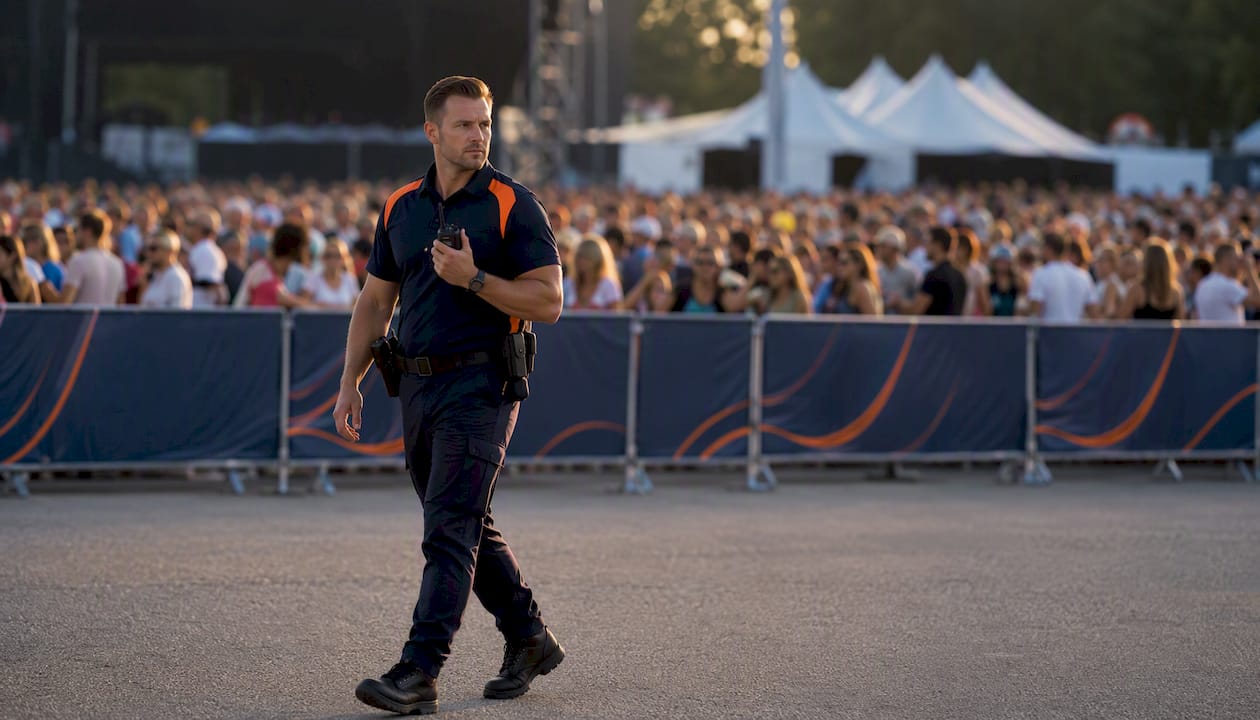
One practical example: at a multi-zone outdoor event, replacing two static perimeter posts with one roving guard and one additional supervisor reduced total staffing by one person while improving incident response time, because the supervisor could redirect the rover in real time rather than waiting for a radio call to reach a static post.
Abcosecurity’s event security service for Australian organisers
Calculating the right number of guards is one thing. Finding a licensed, insured provider who can deliver a written staffing plan, contribute to your EMP, and show up briefed and equipped is another.
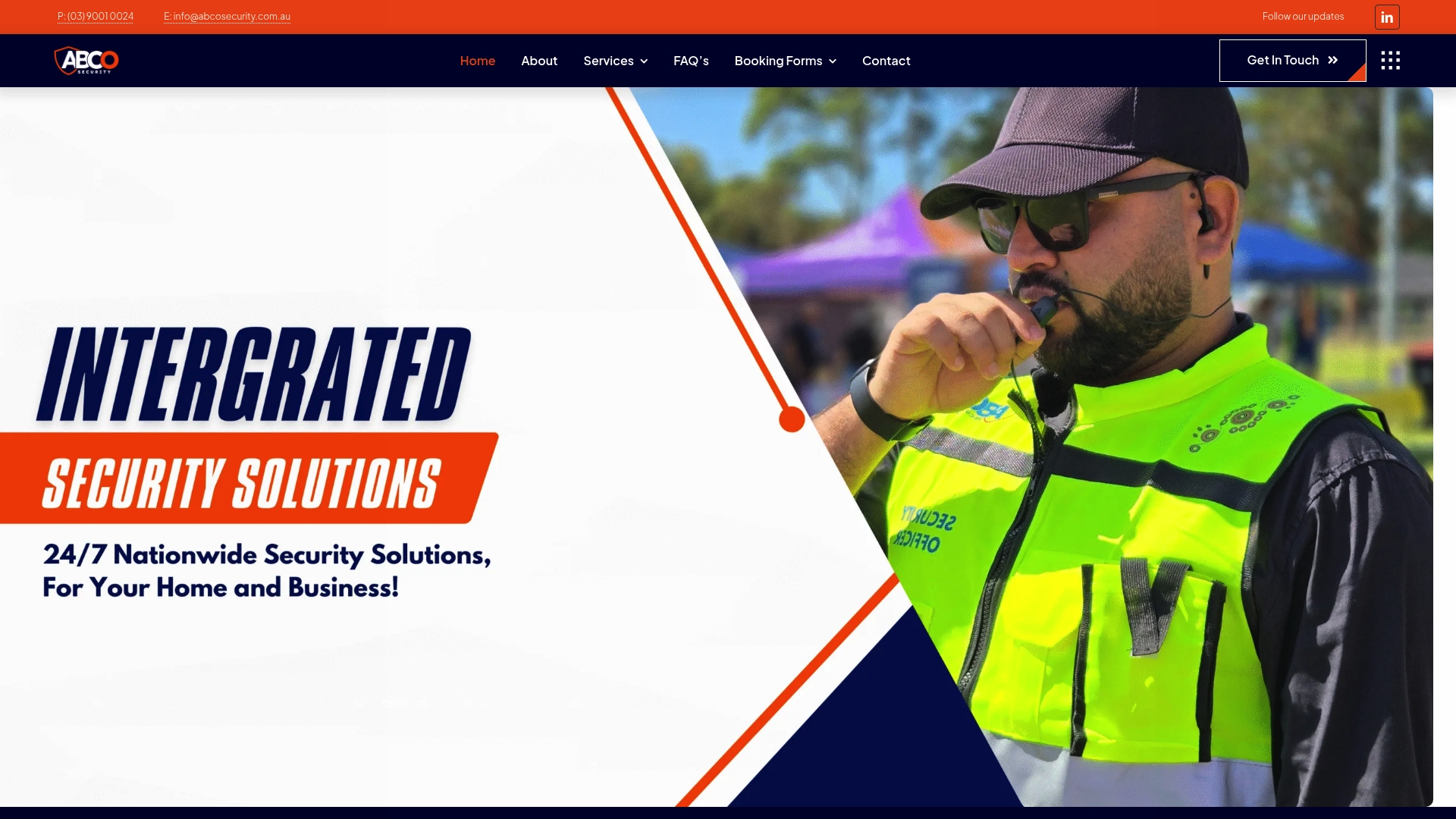
Abcosecurity provides licensed event security across Australia, with crowd controllers, static guards, supervisors, and live camera monitoring that can be bundled for higher-risk events. Every engagement includes a site-specific staffing plan, EMP input, and a named on-site supervisor. Abcosecurity holds ISO 9001 certification and has over 15 years of experience across events, corporate, construction, and healthcare environments.
To get a written staffing plan and a site assessment for your event, contact Abcosecurity directly. The process starts with a brief conversation about your event size, venue, and licence conditions, then moves to a written proposal you can take straight to your council or insurer.
Sources
These are the primary Australian sources to consult when finalising your staffing plan. Each sets either mandatory conditions or best-practice guidance.
- Security licensing conditions
- Security and crowd control planning at events | City of Greater Geelong
- Safety and security for your event | NSW Government
- Victorian guidelines: planning safe public events | WorkSafe Victoria
FAQ
How many security guards do you need for 100 people?
Start with two crowd controllers for the first 100 patrons. If alcohol is served or the event trades late, add additional crowd controllers, and check your liquor-licence conditions, which may specify a higher minimum.
How many security guards are typically at a concert?
For a large outdoor concert with alcohol and late trading, expect dozens of crowd controllers plus a few supervisors. The exact number depends on the venue layout, number of stages, and any conditions imposed by police or the liquor authority.
How do you plan security for an event in Australia?
Start with the baseline ratio, then check your liquor-licence conditions, map your entry points, score your risk factors, and confirm the number with your state licensing authority or police event liaison. Document everything in an EMP and lodge it with council and police before the event.
What is the difference between a crowd controller and a security officer?
A crowd controller holds a specific licence endorsement allowing them to work at licensed venues, manage entry, and remove patrons. A security officer performs static guarding and monitoring duties. For any event with a liquor licence, crowd controllers are the required role, not general security officers.
What documents should I ask a security provider to supply?
Request the master licence number, individual crowd-controller licences for all named staff, a certificate of currency for public liability insurance, a workers’ compensation certificate, and a written commitment to maintain a security incident register on site.
Recommended
about
avada factory
Sempery ultricies nibh at dolor cras urna eleifend nec. Atiam efficitur tempor.