Infant abduction from a hospital is rare, but a maternity ward is built around the one asset that can be carried out the door in seconds. Preventing it takes layers that work together: a controlled entry, positive identification of every baby, staff routines that never leave a newborn unattended, and a rehearsed response if a baby goes missing. This guide sets out those layers as Australian hospital policy describes them, and where a licensed security partner, electronic access control and 24/7 monitoring make each layer hold on a busy ward.
It is written for healthcare administrators and facility managers who own the physical side of maternity ward security. Parents get a short section too, because their habits are part of the system.
TL;DR
- Layer your defences: controlled entry, identification bands, tagging or alarms where policy requires them, staff routines and a tested missing-infant response.
- Doors to birth units and newborn care areas should stay locked at all times, with visitor identification and limits, as Australian hospital policy requires.
- Identification fails at handovers and separations, so two-person checks and clear documentation matter as much as the hardware.
- Staff, parents and visitors should all challenge anyone who tries to remove a baby without valid identification.
- Security design should come from a documented risk assessment, then be tested and monitored around the clock.
Table of Contents
- Why maternity wards need their own security design
- Layer one: control who can enter the unit
- Layer two: identify every baby, every time
- Layer three: staff routines that never lapse
- Layer four: bring parents and visitors in
- Layer five: a missing-infant response you have rehearsed
- Start with a risk assessment
- Where a security provider fits
- Our view
- FAQ
- Sources
Why maternity wards need their own security design
A general ward protects patients who can speak for themselves and walk away from a stranger. A newborn cannot. Add constant visitor traffic, shift handovers, babies moving between the ward, theatre and special care, and parents who are exhausted, and the risks are specific.
The Australasian Health Facility Guidelines state the design aim plainly for neonatal units: the security system should protect newborns, families and staff and minimise any risk of abduction, with capital, operating and maintenance costs weighed before security infrastructure is added. That is the right frame for a facility manager: define the risk, choose controls that match it, and plan how they will be run and maintained.
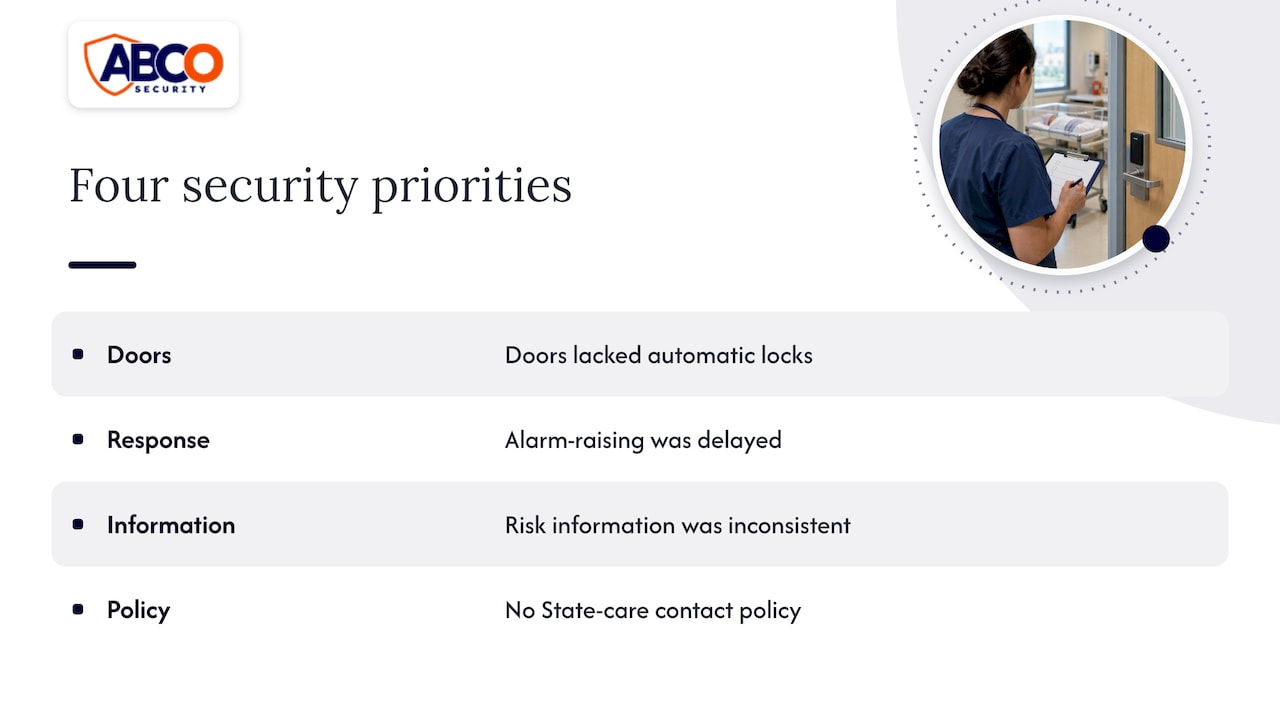
Australia has seen real incidents. The West Australian reported that two newborns were taken from WA public hospitals in 2013-14 and returned unharmed after a few hours. The investigation found ward doors without automatic locks, delayed alarm-raising, staff without consistent risk information about the mothers, and no policy for managing parent contact with babies in State care. Those four findings map neatly onto the four things to get right: doors, response, information and policy.
Layer one: control who can enter the unit
Most abduction prevention starts at the door, because every other control assumes the wrong person has already been kept out or noticed.
What Australian policy requires
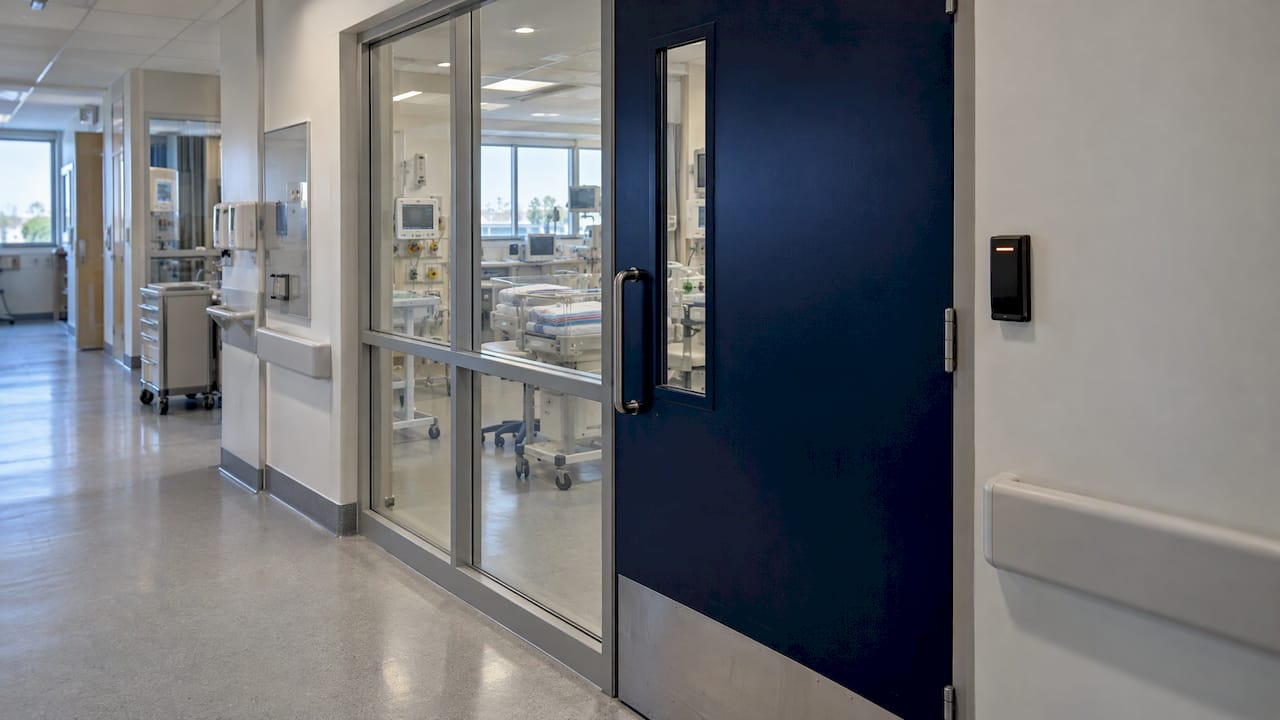
The Royal Hospital for Women’s clinical rule RHW CLIN067 (April 2024) requires doors in the Birth Unit and Newborn Care Centre to remain locked at all times, and postnatal ward doors locked during non-visiting times. It also requires visitor identification and limits on visitors.
The Australasian Health Facility Guidelines for neonatal care units describe a single controlled public entry, with optional CCTV and a phone or video intercom for after-hours access, access-control cards for parents, alarmed emergency exits, and duress alarms at reception and staff stations. For child care units, the guidelines for safety and security add video intercoms and access control at the entrance, direct staff observation, restricted window openings and high-level door latches.
Exits matter as much as entries
An abductor has to leave. Guidance summarised by Security Info Watch from the US National Center for Missing & Exploited Children recommends alarms on propped or forced-open doors with real-time alerts, one controlled visitor entry point, and protection of elevators and stairwells as escape routes. It also notes that the further a unit is from the ground floor, the more time there is to respond. A maternity unit on an upper level has a built-in advantage, but only if stairwell and lift doors are actually controlled and monitored.
The same author argues egress points should be secured at all times, not only when a tagged infant approaches. In practice that means a card reader and delayed-egress device on exit doors, so the door itself buys time while an alarm sounds. Older paediatric guidance likewise calls for time-delay locks and alarms on stairwell and exit doors near the maternity ward, with self-closing hardware.
Where electronic access control earns its place
A locked door is only as good as the process behind it. Cards that are never deactivated when staff leave, doors propped open for convenience and alarms nobody watches are the usual failures. Our guide to hospital access control systems covers how to structure zones, credentials and logs so that the maternity unit is its own controlled area rather than part of a general ward perimeter. Our wider hospital security systems guide shows how access control, cameras and alarms fit together.
The door log is also useful after the fact: it shows who entered, when, and which doors were held open.
Layer two: identify every baby, every time
Controlled doors reduce the chance of a stranger reaching a baby. Identification ensures the right baby goes to the right parent, and that a missing identity is noticed at once.
Bands and the three-identifier check
Under RHW CLIN067, a band goes on each ankle as soon as possible after birth. It carries the mother’s family name in capitals with “B/O” (baby of) and her given name, the order of multiples, the date and time of birth, gender and Medical Record Number, and it is verified with the parent before placement. Three approved identifiers are checked at care points, and two clinicians verify at handovers and separations.
The Child and Adolescent Health Service in WA sets a similar standard: two correctly labelled bands on each infant, checked against three identifiers before care, medication, transfer and discharge, and at shift handover. If an infant is found without bands or with incorrect identification, every infant in the area is verified, the shift coordinator is told immediately and a replacement band is checked by two nurses before it goes on.
Mater tells families that babies receive tags on each ankle right after birth, checked every shift, and that if both bands fall off, all babies on the ward are checked against the mother’s band.
Tags, alarms and what they add
Where local policy calls for it, an electronic tag adds a layer that works without anyone watching. The Australasian guidelines list a newborn security tag system where local policy requires it.
A nursing journal review explains the principle: a tag or abduction alarm can trigger an alarm, lock doors and hold elevators if the infant comes within about 4 feet (roughly 1.2 metres) of an exit or lift. A technical explainer on RFID infant protection describes ankle or umbilical-clamp transmitters broadcasting a unique ID to receivers at exits and stairwells, which can lock doors automatically and alert staff to which infant’s tag triggered which location, including tamper alerts.
For a facility manager the lesson is integration. A tag alarm that does not lock a door, or a locked door that does not raise an alert anyone sees, leaves a gap. The tag, the door hardware, the cameras and the alarm monitoring need to be specified as one system.
Layer three: staff routines that never lapse
Technology fails quietly when routines slip. The routines in RHW CLIN067 are short and worth building into orientation and audits:
- Never leave the neonate unattended.
- Move babies in a cot or on the resuscitaire, not in arms.
- Check ID bands daily.
- Use two-clinician identification checks at handover, before feeds or medication, and at every separation and return, completing a separation sticker.
- Escalate any security concern immediately.
The same policy requires staff to flag at-risk families, for example where child protection services are involved, where there was substance use in pregnancy, or where there are domestic violence or apprehended violence orders. The WA findings above show why: staff without consistent risk information are slow to recognise a problem. Flagging only helps if the people on duty, including security, know who to watch for and what to do.
A nursing review adds that a record of where the infant is at all times is a distinct layer from access control and alarms, and that babies should never be carried or left in hallways without supervision.
Staff also need to be encouraged to challenge. One Australian maternity unit policy says staff, women and families should be encouraged to challenge anyone who attempts to remove an infant regardless of the reasons given.
Layer four: bring parents and visitors in
Parents are the most present people on the ward. Give them clear, short instructions, in the admission pack and at the bedside.
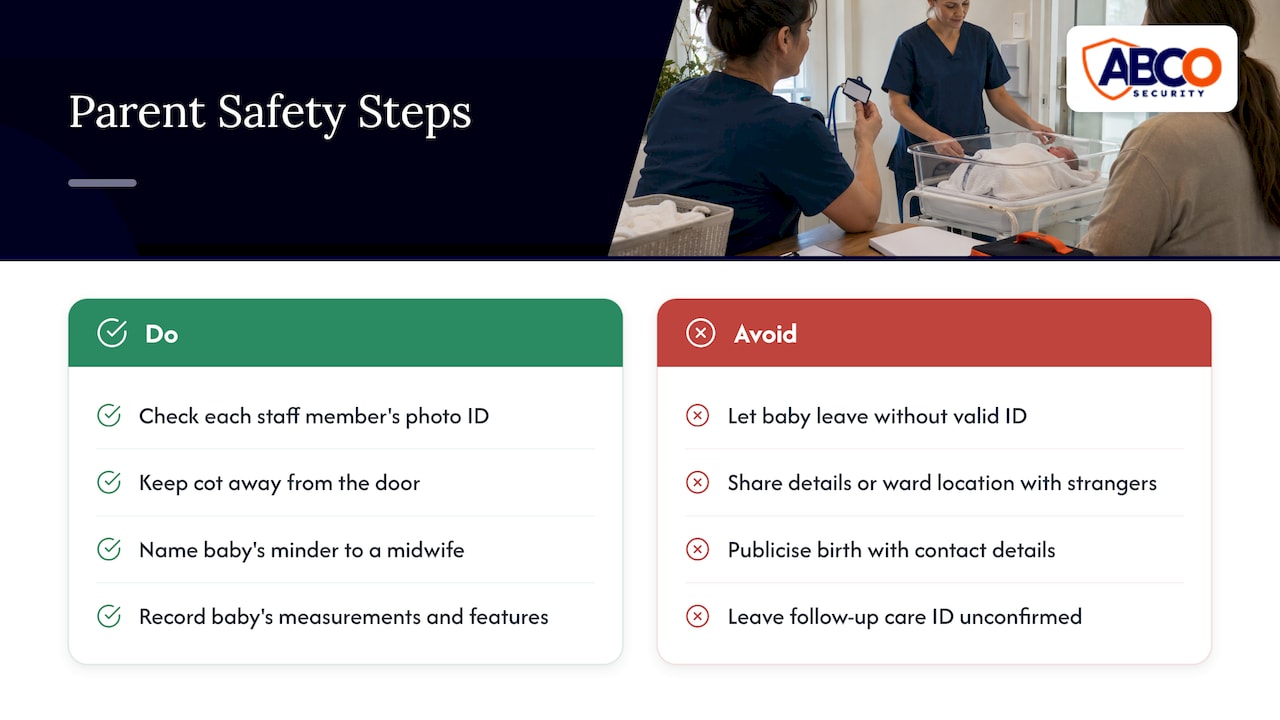
Mater advises parents to check that a staff member’s photo ID badge matches the person, never allow the baby to be taken by anyone without valid identification, keep the cot on the side away from the door with the baby in sight, and tell staff about anything suspicious.
WA Health adds that parents should name the person minding the baby to a midwife before leaving the ward and avoid giving personal details or ward location to strangers. It also suggests recording the baby’s weight, length, head circumference and distinguishing features in the Neonatal Health Record, starting a family photo album early, confirming who will provide follow-up home care and what identification they will carry, and avoiding publicising the birth with address or contact details.
Those points cost nothing to print. They work best when the ward culture backs them up: visitors are asked who they are visiting, and no one is offended when a midwife asks to see a badge.
Layer five: a missing-infant response you have rehearsed
The first minutes decide the outcome. The nursing review’s guidance is to activate the unit’s infant alarm immediately, which locks all exits while security searches the building and grounds. Without an alarm system, staff contact security at once to secure the perimeter and post people at the unit’s exit doors until security arrives.
Australian hospital procedures add what security needs to act: a description of the infant, a description of the possible abductor, the last known location, and the immediate area secured. Build that into a one-page code card and rehearse it.
A response plan has several moving parts that each need an owner:
- who raises the alarm and how, including duress alarms at reception and staff stations (see our guide to nurse duress alarms)
- who locks down exits, stairwells, car parks and the loading dock
- who holds the footage and door logs
- who briefs police and the family
After hours, the plan has to work with the people actually on site at 2 am. That is where guarding and monitoring arrangements matter.
Start with a risk assessment
No two maternity units share a layout. A unit with a single corridor and one lift is a different problem from a campus with several stairwells, a shared car park and a public cafe next door. A documented assessment identifies entry and exit routes, blind spots, handover points and after-hours gaps, then ranks them so the budget goes where the risk is. Our guide to AS 4485-ready healthcare security risk assessments explains the process for facility managers, and our overview of security in hospitals shows where maternity sits among other risks such as patient elopement and occupational violence.
A short checklist to work through on a walk-through of your own unit:
| Question | What good looks like |
|---|---|
| Is there one controlled public entry? | Intercom or reception check, door locked at all times |
| Are all other exits alarmed? | Stairwells, lifts, fire exits, loading areas monitored |
| Can a door be propped open unnoticed? | Alert goes to a person who responds |
| Do bands, tags and handover checks match policy? | Two-person checks documented |
| Is after-hours cover defined? | Named responder, tested response time |
| Has the missing-infant plan been drilled? | Drill within the past year, gaps fixed |
Where a security provider fits
The layers above are clinical and physical. Your clinicians own the identification routines. Doors, cameras, alarms, patrols and monitoring are where an experienced security contractor takes work off your plate and keeps it running overnight and on weekends.
ABCO Security provides licensed static guards, mobile patrols, CCTV and alarm installation and monitoring, access control and security risk assessments for healthcare facilities across Australia, with 24/7 monitoring and over 15 years in the industry. We work to ISO 9001 and ISO 30000. For a maternity unit that can mean a licensed guard at a defined post, electronic security solutions that put the unit on its own controlled zone, and CCTV and alarm monitoring so an exit alarm reaches a person rather than an empty room. Where a post is needed, our security guarding service is the starting point, and our healthcare security services page shows how we approach hospitals generally.
If you want a view of your maternity unit’s doors, exits and after-hours coverage, start from our healthcare security systems page or contact us through abcosecurity.com.au.
Our view
Newborn security is a systems problem. Most failures we read about are not a missing gadget. They are a door that did not lock, an alarm nobody answered, or a risk nobody told the people on duty.
That is why we start with the building and the roster, not the product list. We map how a person could reach the unit and how they could leave it, then match controls to each point: access control on the doors, cameras on the approaches, monitored alarms on the exits, and licensed people who know what to do when one sounds.
Hospitals set the clinical rules, and they are good ones. Our job is to make the physical side as reliable at 3 am on a Sunday as it is at 10 am on a Tuesday, with proactive 24/7 monitoring and a response plan that has been written down and tested.
Abco
FAQ
What is the best method for preventing infant abductions?
No single control does it. The strongest programs combine a locked, single-entry unit, identification bands checked by two people at handovers, tags or exit alarms where policy requires them, staff who never leave a baby unattended, and a rehearsed response plan. Australian guidance such as RHW CLIN067 builds on exactly these layers.
Do Australian hospitals use infant security tags?
The Australasian Health Facility Guidelines list a newborn security tag system for neonatal units where local policy requires it. Everyday identification relies on two ankle bands and three-identifier checks. Which controls apply depends on the hospital’s policy and its risk assessment.
What should parents do to keep a newborn safe in hospital?
Check the photo ID badge of anyone who handles the baby, and do not hand the baby to anyone without proper identification. Keep the cot away from the door and in sight, name who is minding the baby before leaving the ward, and tell staff about anything suspicious. WA Health and Mater publish these steps for families.
What should staff do if a baby is missing?
Activate the unit’s infant alarm straight away so exits lock while security searches the building and grounds. Without an alarm system, call security immediately and post staff at the unit’s exits. Give security the infant’s description, the possible abductor’s description and the last known location.
Sources
- RHW CLIN067 Identification and Security of the Neonate
- HPU 390 Neonatal Care Unit, Australasian Health Facility Guidelines
- HPU 540 Child Care Unit, Australasian Health Facility Guidelines
- Hospitals reveal baby abductions, The West Australian
- Best Practices for Preventing Infant Abductions in Healthcare, Security Info Watch
- Infant abduction, Contemporary Pediatrics
- Identification of the Infant, Child and Adolescent Health Service WA
- Safety and security for your new baby, Mater
- Preventing infant abduction in the hospital, American Journal of Nursing
- Preventing Newborn Abductions in Hospitals with RFID Infant Protection Technology
- Personal security for your baby, WA Health
Recommended
about
avada factory
Sempery ultricies nibh at dolor cras urna eleifend nec. Atiam efficitur tempor.