
TL;DR:
- Integrated security systems unify access control, CCTV, alarms, and intercoms under a single management platform for better safety and operations. They improve efficiency by consolidating data, automating workflows, and supporting compliance with Australian risk management standards. Proper governance, security, and planning ensure reliable long-term performance of these integrated solutions.
Integrated security solutions are defined as unified systems that connect access control, CCTV, alarm, and intercom technologies under a single management platform to improve safety outcomes and operational oversight. For security professionals working across construction sites, healthcare facilities, and corporate offices, this architecture replaces fragmented, siloed systems with one coordinated framework. AS/NZS ISO 31000:2018 provides the enterprise risk management foundation that most Australian organisations use to govern these deployments. Abcosecurity has delivered integrated security management solutions across these sectors for over 15 years, holding ISO 9001 and ISO 30000 certifications that underpin its service quality.
What are the key components of integrated security systems?
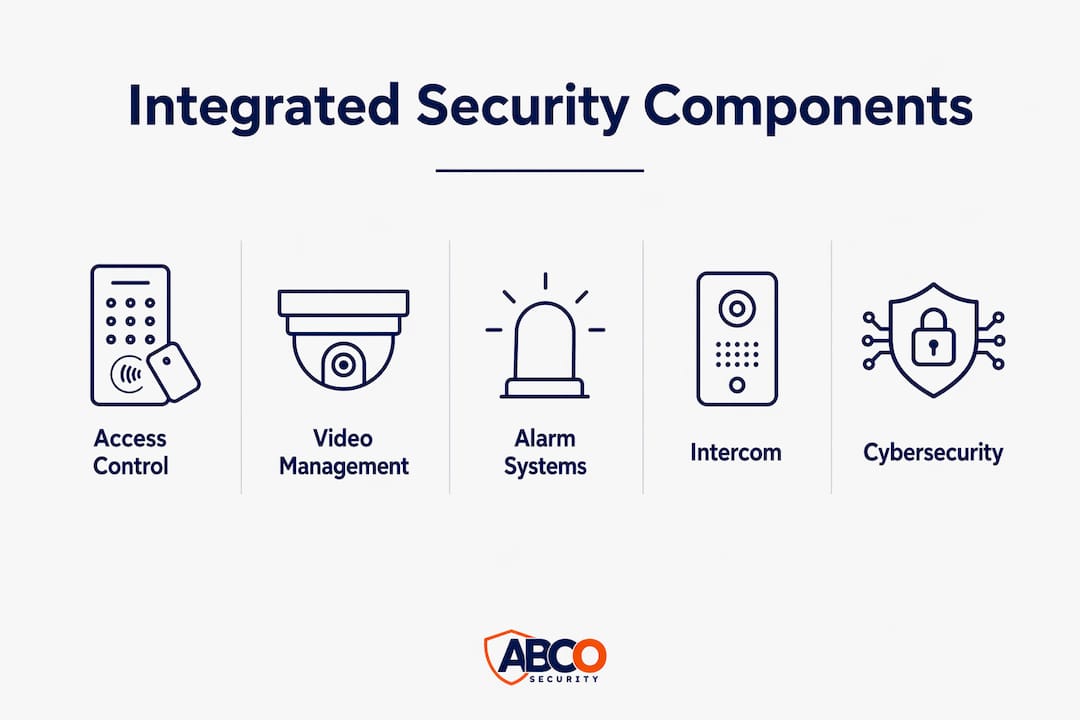
Australian organisations typically integrate four core system types: access control, video management systems (VMS) with CCTV, alarm and intrusion detection, and intercom with visitor management. Each component addresses a distinct threat vector. Together, they form a single security ecosystem rather than four separate contracts.
Access control systems manage identity and permissions at every entry point. When integrated, they synchronise user credentials across the whole site so a terminated employee loses access everywhere the moment HR updates the record, not just at the front door.

Video management systems centralise camera feeds and recordings. A VMS integrated with access control can automatically pull up the relevant camera feed when a door alarm triggers, cutting the time an operator spends manually searching footage.
Alarm and intrusion detection systems generate the events that drive automated responses. In a properly integrated environment, an after-hours motion detection event can simultaneously lock down adjacent zones, alert the monitoring centre, and start a camera tour of the affected area.
Intercom and visitor management close the loop on identity verification. Integrated intercoms allow operators to verify a visitor on video, unlock the door remotely, and log the event automatically, all from one interface.
- Define which platform owns which data before deployment begins.
- Map every device to a consistent naming convention across zones.
- Confirm software licence compatibility between all integrated platforms.
- Test failover scenarios before go-live, not after.
Pro Tip: Nominate a system of record for each data type early. Use the access control system for permissions and the VMS for video retention. Mixing ownership creates audit conflicts that are difficult to resolve under compliance pressure.
How does integration improve operational efficiency and security outcomes?
Integrated systems reduce operational complexity by replacing multiple monitoring interfaces with one. Operators no longer switch between four separate dashboards to correlate an alarm event with a camera feed and an access log. That consolidation directly reduces response time and the risk of human error during an incident.
Integrated systems cut duplicated monitoring and support contracts and resolve incidents faster when all data flows through a single platform. That cost reduction is not theoretical. Security managers who have consolidated from multiple vendors to one integrated platform report fewer support escalations and faster mean time to resolution.
Automated workflows are where integration delivers its most measurable gains. Consider these examples:
- An intercom video verification event unlocks the door and writes an access log entry simultaneously, removing the need for a separate manual log.
- A forced-door alarm triggers a camera tour of the affected zone and sends a push notification to the duty officer, all without operator intervention.
- A lockdown procedure initiated from the access control panel automatically disables lift access, activates PA announcements, and timestamps every action for the post-incident report.
- Visitor pre-registration in the visitor management system pre-populates the access control system, so the visitor’s temporary credential is ready before they arrive.
Audit trails improve significantly when all systems write to a single event log. Compliance reporting for frameworks like the Protective Security Policy Framework (PSPF) requires demonstrable records of who accessed what and when. A unified log satisfies that requirement without manual data reconciliation across separate systems.
Cybersecurity is a non-negotiable consideration for any integrated deployment. Effective integrated security solutions require TLS encryption, role-based user access, secure API keys, VLAN segmentation, and regular patching. Integration increases the attack surface because each API connection is a potential entry point. Treat the integration layer with the same rigour you apply to your IT network. For further guidance on securing the IT layer beneath physical security systems, IT security hardening practices from the IT security discipline apply directly here.
What are best practices for designing integrated security solutions?
Design decisions made before installation determine whether an integrated system performs reliably for years or becomes a maintenance burden within months. The following practices reflect what experienced practitioners apply on complex sites.
- Define the system of record first. Access control owns permissions; VMS owns video data. Documenting this before configuration prevents data conflicts and simplifies audits.
- Map devices consistently. Assign a naming convention that reflects zone, floor, and function. “B2-CAM-04” is auditable. “Camera 4” is not.
- Plan licences before procurement. Software compatibility and licence counts across platforms are the most common cause of integration delays. Confirm API support and version compatibility in writing with each vendor.
- Test in three phases. Load testing confirms the system performs under peak event volume. Failover testing confirms redundancy works. User acceptance testing confirms operators can execute procedures without confusion.
- Apply cybersecurity controls at the integration layer. VLAN segmentation isolates security devices from general IT traffic. Role-based access limits what each operator can see and change. Secure API keys rotate on a defined schedule.
Pro Tip: When choosing between native integration, middleware, and custom API approaches, prefer native integration where the vendor supports it. Middleware adds a dependency that can break on software updates. Custom APIs give maximum flexibility but require ongoing developer support. Match the approach to your team’s long-term maintenance capacity.
The table below summarises the three integration approaches and their trade-offs.
| Approach | Maintenance burden | Flexibility | Best suited for |
|---|---|---|---|
| Native integration | Low | Limited to vendor ecosystem | Sites with standardised platforms |
| Middleware | Medium | Moderate | Multi-vendor environments with IT support |
| Custom API | High | Maximum | Enterprise sites with dedicated development resources |
Upfront planning on device mapping, naming conventions, and licence management reduces errors and makes post-deployment audits significantly faster. Treat the planning documentation as a live asset, not a project deliverable that gets filed away.
How do integrated systems support Australian regulatory compliance?
Running one credible risk management process aligned with AS/NZS ISO 31000:2018 satisfies requirements from SOCI, PSPF, APRA, and other frameworks more efficiently than running separate programmes for each. That single-programme approach is the most practical argument for integration from a compliance perspective.
“Multiple Australian security compliance frameworks share a common risk management spine. A coordinated programme aligned with AS/NZS ISO 31000:2018 addresses SOCI, PSPF, and APRA requirements simultaneously, reducing redundant effort and strengthening the overall security posture.”
The table below maps key Australian frameworks to the integrated security controls that satisfy their core requirements.
| Framework | Core requirement | Integrated security control |
|---|---|---|
| PSPF | Physical access records and incident logs | Unified access control and event log |
| SOCI | Asset protection and incident response | Automated alarm response and audit trail |
| APRA CPS 234 | Information security governance | Role-based access and cybersecurity controls |
| AS/NZS ISO 31000:2018 | Enterprise risk management | Single risk assessment feeding all controls |
Integrated systems make continuous improvement cycles more tractable. When all security data flows into one platform, you can run a single risk assessment process and feed its outputs directly into the controls for each framework. That removes the duplication of running separate assessments for PSPF, SOCI, and APRA. During audits, a unified event log with consistent timestamps and device naming is far easier to present than exports from four separate systems. Abcosecurity’s security management services are structured around this single-programme model, which is why clients find compliance reporting less resource-intensive after integration.
Key takeaways
Integrated security solutions deliver their greatest value when technology, governance, and compliance are treated as a single coordinated programme rather than separate workstreams.
| Point | Details |
|---|---|
| Define system of record early | Assign data ownership to access control for permissions and VMS for video before configuration begins. |
| Automate workflows at integration points | Use alarm-triggered camera tours, visitor verification, and lockdown procedures to reduce manual operator load. |
| Apply cybersecurity controls to the integration layer | TLS encryption, VLAN segmentation, and role-based access protect every API connection in the system. |
| Align with AS/NZS ISO 31000:2018 | One coordinated risk programme satisfies PSPF, SOCI, and APRA requirements simultaneously. |
| Plan licences and naming conventions upfront | Consistent device naming and confirmed software compatibility reduce deployment errors and audit effort. |
What I have learned after 15 years integrating security systems
The technology is rarely the hard part. The hard part is governance. Every integration project that has struggled did so because nobody clearly owned the data, the maintenance schedule, or the decision about which system was authoritative when two platforms disagreed.
The convergence of IT and physical security is accelerating. AI-driven video analytics, IoT sensors, and cloud-based access control platforms are pushing security teams into territory that traditionally belonged to IT departments. That is not a problem. It is an opportunity, provided you establish clear ownership before the first cable is pulled.
The most common pitfall I see is treating integration as a one-time project rather than an ongoing programme. Software updates break API connections. New devices get added without updating the naming convention. Licences lapse. The system that worked perfectly at go-live degrades quietly over 18 months until an incident exposes the gaps.
My practical advice: build a quarterly integration health check into your security management calendar. Review API connection status, confirm all devices are reporting correctly, and verify that your cybersecurity controls are current. That discipline separates organisations that get sustained value from integration from those that eventually revert to siloed systems. For teams building this capability, business impact analysis is a useful starting point for identifying which systems are truly critical and where integration gaps carry the most operational risk.
— Abco
Abcosecurity’s tailored integrated security programmes
Abcosecurity designs and deploys integrated security systems for construction sites, healthcare facilities, and corporate environments across Australia. With over 15 years of experience and ISO 9001 certification, the team combines licensed professionals, advanced technology, and 24/7 monitoring to deliver systems that go beyond incident response.
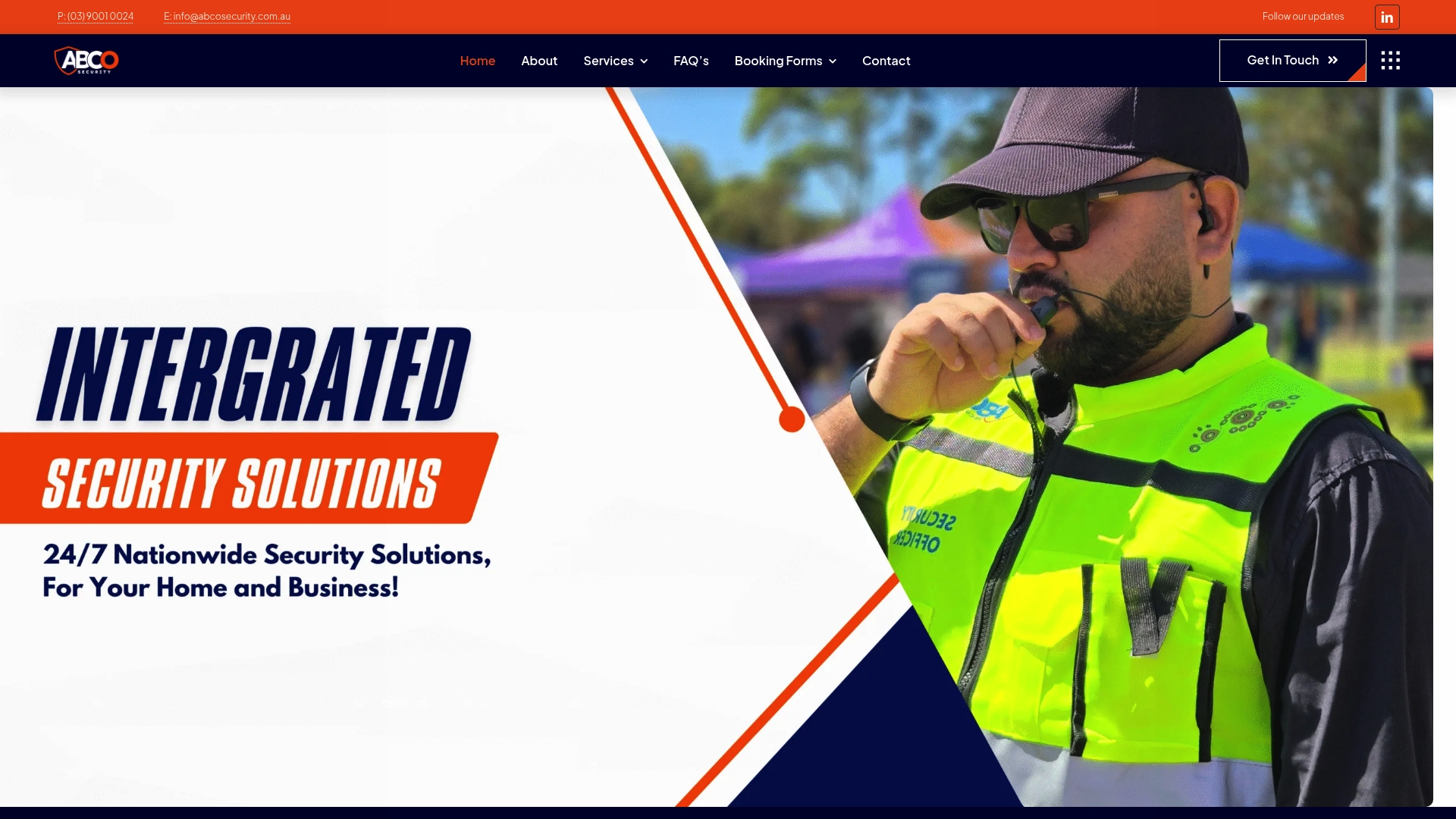
Whether you need construction site security with integrated access control and CCTV, or a corporate environment with unified visitor management and alarm systems, Abcosecurity builds to your site’s specific risk profile. Every deployment is backed by a proactive monitoring service that anticipates threats rather than simply reacting to them. Contact Abcosecurity for a site assessment and find out how a coordinated integrated security programme can reduce your compliance burden and improve safety outcomes.
FAQ
What is the definition of integrated security solutions?
Integrated security solutions are unified systems that connect access control, CCTV, alarms, and intercom technologies under one management platform. The goal is coordinated threat detection, automated response, and consolidated audit trails across a single interface.
What are the four core components of integrated security systems?
The four core components are access control, video management systems, alarm and intrusion detection, and intercom with visitor management. Together, these systems form the basis of most commercial and critical infrastructure deployments in Australia.
How do integrated security systems support compliance in Australia?
A single risk management programme aligned with AS/NZS ISO 31000:2018 satisfies requirements from PSPF, SOCI, and APRA simultaneously. Integrated systems produce the unified audit trails and access records these frameworks require.
What cybersecurity controls are required for integrated security deployments?
Integrated deployments require TLS encryption, role-based user access, secure API keys, VLAN segmentation, and regular patching. Each API connection between integrated systems is a potential attack surface and must be governed accordingly.
How do you choose between native integration, middleware, and custom API approaches?
Native integration suits sites with standardised platforms and low IT maintenance capacity. Middleware works for multi-vendor environments with IT support. Custom APIs suit enterprise sites with dedicated development resources and a long-term maintenance commitment.
Recommended
about
avada factory
Sempery ultricies nibh at dolor cras urna eleifend nec. Atiam efficitur tempor.