TL;DR:
- Implement a layered system with physical barriers, verified access control, high-resolution CCTV, and proper procedures to secure loading docks. These measures close the main gaps exploited by thieves and prevent safety incidents, aligning with Safe Work Australia requirements.
Secure a loading dock by deploying a layered system that combines physical barriers and vehicle restraints, identity-verified access control, fixed high-resolution CCTV, and written SOPs aligned with Safe Work Australia requirements. That combination closes the three gaps attackers and accidents exploit most: open doors, unverified identities, and undocumented procedures. Abcosecurity provides integrated implementation across all of these layers for Australian facilities.
Act on these immediately:
- Close and lock all roller doors when a bay is not actively in use
- Apply wheel chocks and install trailer restraints before any loading or unloading begins
- Verify driver identity against a booking reference and a government-issued photo ID
- Enable fixed cameras aimed directly at roller-door thresholds and handling lanes
- Mark and enforce pedestrian exclusion zones at all active vehicle interfaces
- Brief staff on how to recognise and report suspicious driver behaviour or unusual booking changes
Table of Contents
- Why are loading docks such a common security and safety failure point?
- What does cargo theft actually cost, and how is it changing?
- How does a layered security model work for loading docks?
- What hardware does every loading dock need?
- How should you design CCTV and access control for a loading dock?
- What operational procedures close the gaps that hardware cannot?
- What are your Safe Work Australia obligations for loading docks?
- How do you detect, respond to, and investigate a dock incident?
- Key takeaways
- Why integration matters more than any single control
- Abcosecurity’s loading dock security services
- Useful sources and standards
- FAQ
Why are loading docks such a common security and safety failure point?
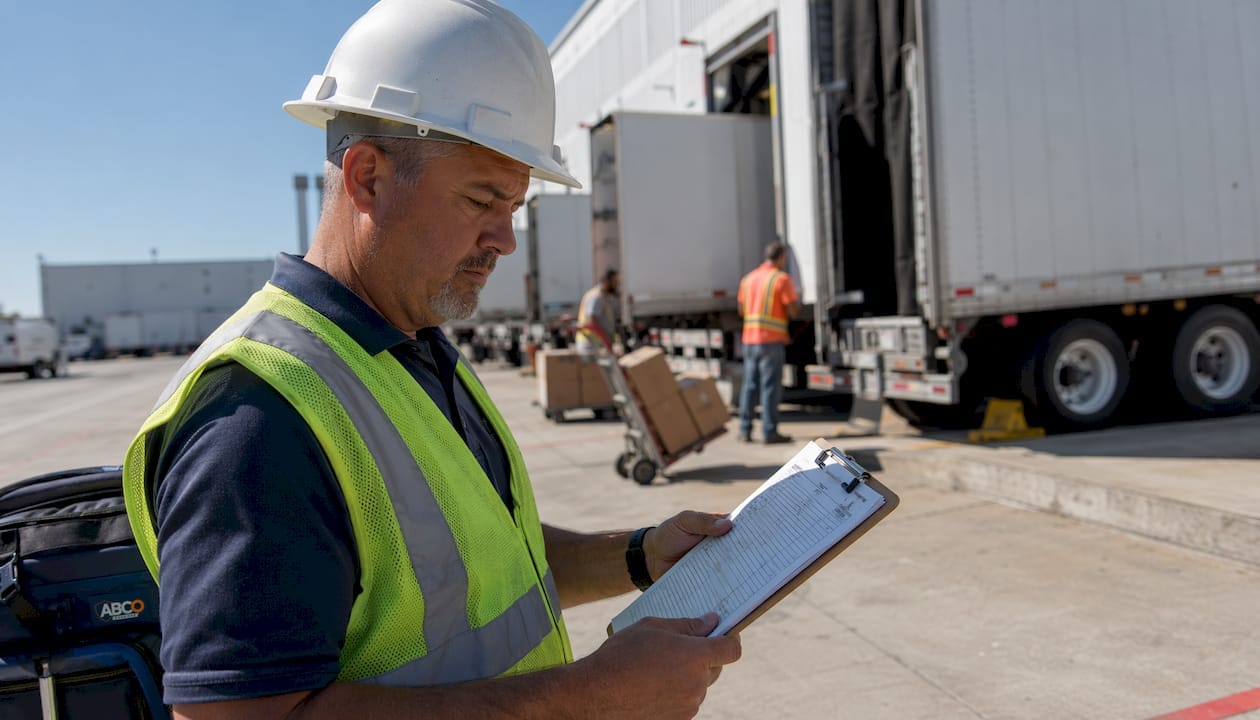
The dock is the one place in a facility where the perimeter is deliberately opened, repeatedly, on a schedule that is largely public knowledge. High throughput, multiple interfaces — drivers, carriers, third-party logistics operators, and their trailers — and the operational norm of leaving doors raised during shifts create predictable windows for opportunistic theft and organised diversion.
Several structural blind spots compound the risk. Driver amenity areas are often located away from the dock face, which means drivers wander through active vehicle zones. Visibility from the main building is poor. Pedestrian and vehicle flows overlap at the threshold. Access readers and control panels are mounted at ground level where forklifts and trucks routinely clip them.
The most damaging incidents rarely look dramatic. A common pattern: a fraudster uses a cloned booking reference and a convincing driver ID to collect a load that was never meant for them. The trailer leaves before anyone checks the paperwork. Supply-chain crime in Australia has shifted from opportunistic theft toward sophisticated digital fraud, including identity cloning and cyber-enabled freight diversion. Insider collusion and double-brokering — where a legitimate carrier sub-contracts to an unknown party — are increasingly common vectors.
Safe Work Australia’s traffic management guidance addresses the physical side of this problem directly, recommending pedestrian exclusion zones and controls that keep drivers away from loading areas when not operationally required. Abcosecurity’s experience across Australian industrial sites confirms that the facilities with the fewest incidents are those that treat the dock as a controlled access point, not a service entrance.
What does cargo theft actually cost, and how is it changing?
The financial case for dock security is straightforward. Cargo theft creates direct inventory loss, operational downtime while investigations run, insurance premium increases, and reputational damage with supply-chain partners. None of those costs are trivial, and most are preventable.
Industry data point: US industry datasets recorded dock-related theft rising to 12% of total cargo theft incidents in 2022, reflecting a global pattern of criminals targeting the loading interface specifically rather than in-transit freight.
The trend in Australia mirrors this shift. Organised crime groups have moved away from hijacking trucks in transit toward exploiting the dock itself, where access is legitimately granted and cameras are often poorly positioned. Load security measures such as chains, tamper-evident seals, and load-securing kits are reported to reduce theft significantly among facilities that adopt them consistently.
The cost picture extends beyond the stolen goods:
- Insurance: repeated incidents trigger premium reviews and, in some cases, coverage exclusions for specific cargo categories
- Downtime: a single diversion incident can freeze outbound operations for hours while police and insurers are briefed
- Compliance exposure: a theft that results in a workplace injury (e.g., a confrontation at the dock) can trigger a Safe Work Australia notifiable incident
- Reputational damage: supply-chain partners and customers increasingly audit security practices before awarding contracts
The TAPA APAC 2025 intelligence report confirms shifting cargo crime patterns across the Asia-Pacific region, with counterfeit losses and in-transit risk both escalating. Australian operators are not isolated from these trends.
How does a layered security model work for loading docks?
No single control secures a dock. A vehicle restraint stops trailer creep but does nothing about an impersonator. A camera records an incident but cannot prevent it. The layered model works because each layer compensates for the gaps in the others.
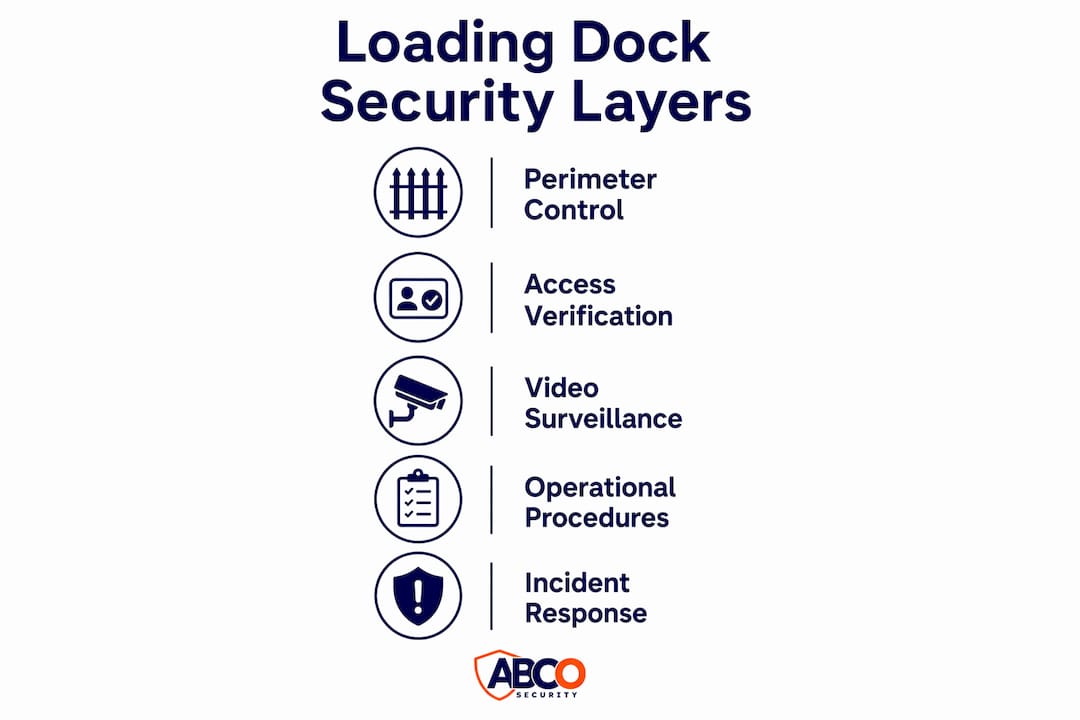
The six layers, in order of physical proximity:
- Perimeter and yard control — boom gates, fencing, and gatehouse or intercom verification before a vehicle reaches the dock face
- Dock hardware and restraints — vehicle restraints, wheel chocks, dock levellers, edge protection, and high-security roller doors
- Access control and scheduling — identity-verified booking systems, role-based door permissions, and time-windowed access
- CCTV and detection — fixed high-resolution cameras at thresholds, active deterrence units for after-hours, and integrated alarm triggers
- SOPs and training — documented procedures for arrival, verification, restraint application, and incident reporting
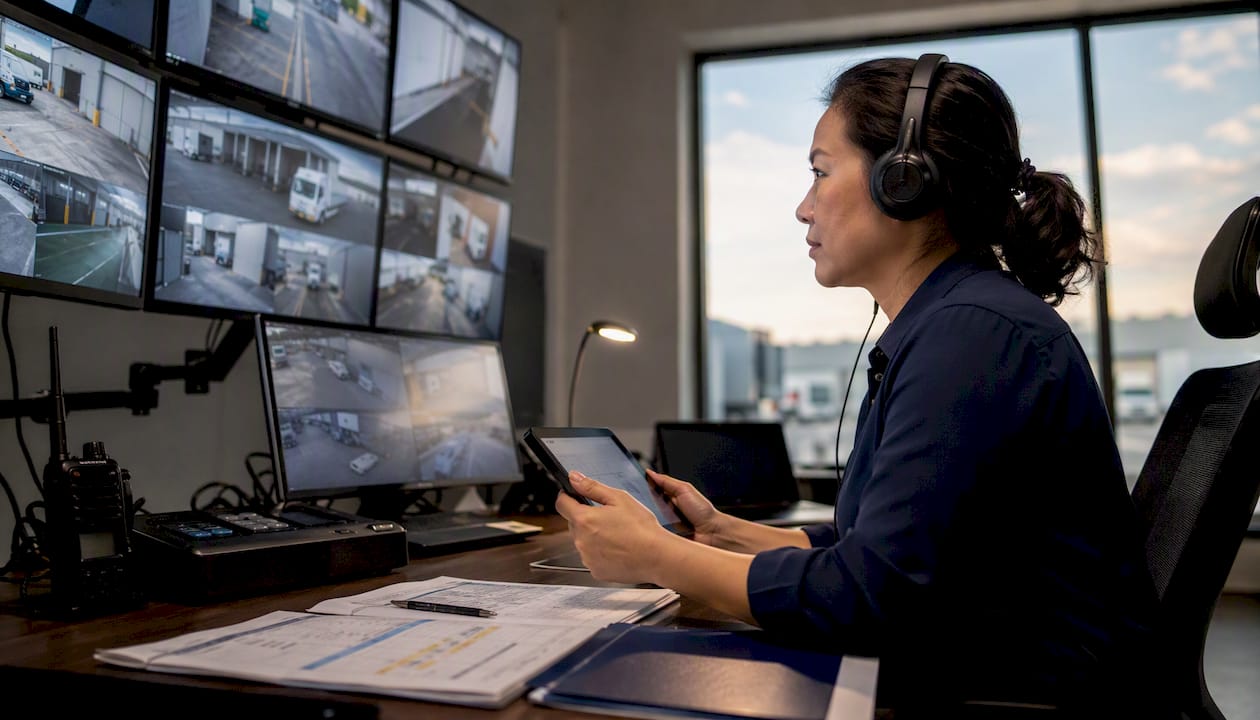
- Monitoring and response — 24/7 monitoring, escalation protocols, and evidence capture procedures
| Layer | Primary risk addressed | Minimum investment | High-ROI upgrade |
|---|---|---|---|
| Perimeter and yard | Unauthorised vehicle entry | Boom gate + intercom | Gatehouse with guard |
| Dock hardware | Trailer creep, falls, forced entry | Wheel chocks + restraints | Automated dock locks |
| Access control | Identity fraud, unauthorised door operation | Swipe/PIN reader | Credential + booking integration |
| CCTV and detection | Evidence gaps, after-hours intrusion | Fixed IP cameras at thresholds | Active deterrence units |
| SOPs and training | Human error, insider risk | Written procedure + staff brief | Regular drills + third-party audit |
| Monitoring and response | Slow incident detection | Alarm to phone | 24/7 professional monitoring |
Pro Tip: The two controls that deliver the highest ROI relative to cost are identity verification at the dock face and fixed cameras aimed at roller-door thresholds. Both are inexpensive to implement and directly address the most common attack vectors: impersonation and evidence-free theft.
Integrating access control logs with video is the step most facilities skip. When the system can confirm that the person who operated a door at a given time matches the scheduled booking and the captured credential, investigations that would otherwise take weeks resolve in hours.
What hardware does every loading dock need?
Physical controls are the foundation. No amount of camera coverage compensates for a dock door that can be opened with a standard padlock or a trailer that rolls away because no restraint was applied.
Required equipment checklist
- Vehicle restraints: hook-style or wheel-activated restraints that lock the trailer to the dock face; automated dock locks for high-throughput bays
- Wheel chocks: rated rubber or steel chocks applied to both rear wheels before any loading begins
- Dock levellers: pit-style or edge-of-dock levellers with self-acting safety legs; WorkSafe Victoria recommends dual-gate systems where floor openings are required
- Edge protection: raised edges or fixed barriers at any point where a forklift could go over a dock edge
- Bollards: steel bollards protecting access readers, control panels, and pedestrian pathways from vehicle impact
- Boom gates: vehicle-rated boom gates at yard entry with intercom or card-reader integration
- High-security roller doors: industrial-rated doors with electro-mechanical locks; avoid standard padlocks on external dock doors
- Rated padlocks or electro-mechanical locks: where padlocks are used, specify a minimum Grade 5 hardened shackle; prefer electro-mechanical locks that log every operation
Camera and reader placement
- Mount fixed cameras directly above each roller-door threshold, angled to capture the full door opening and the trailer registration plate
- Position a second camera to cover the handling lane inside the bay, capturing forklift and pedestrian movement
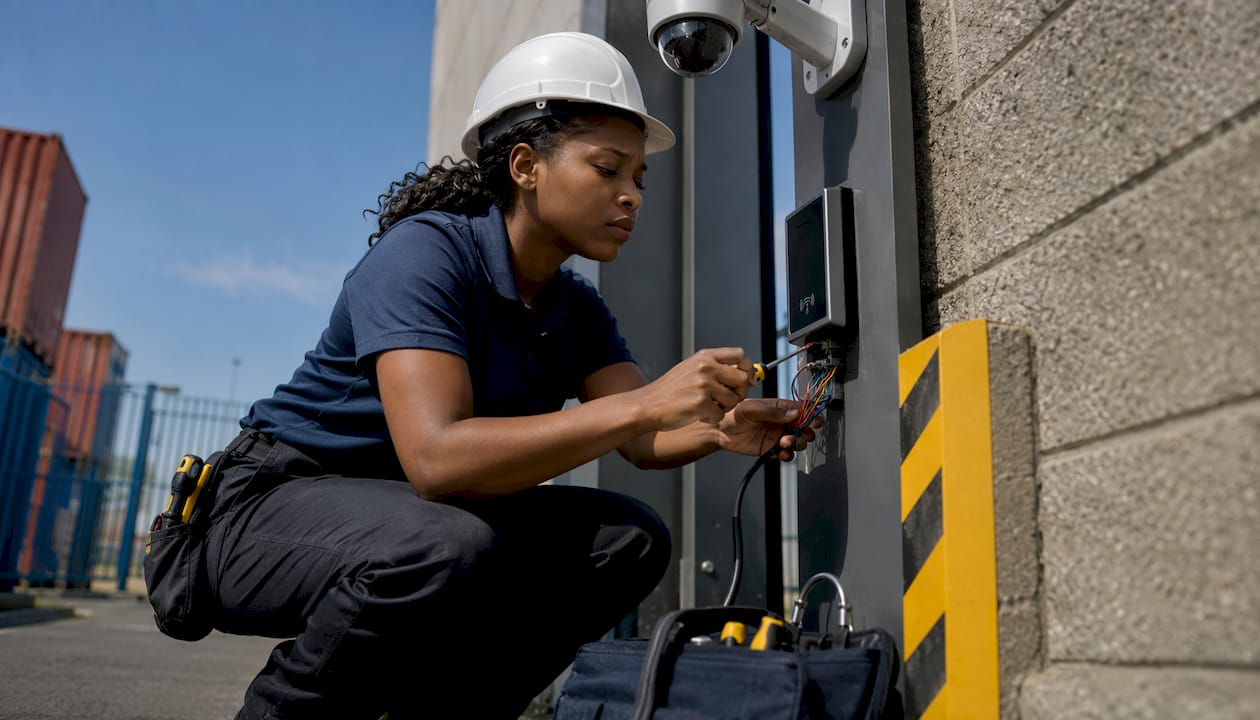
- Install access readers at a height and angle that captures the operator’s face, not just the credential
- Protect all readers and control panels with steel bollards or a recessed housing; industrial-rated hardware around readers and control panels reduces downtime caused by vehicle vibration and accidental impacts
- Run cabling inside conduit rated for industrial environments; exposed cabling at dock level is a maintenance and tampering risk
Rite-Hite is one of the established manufacturers of vehicle restraint and dock leveller systems available in Australia. Specifying products to a recognised standard ensures compatibility with Australian workplace safety requirements.
How should you design CCTV and access control for a loading dock?
The most common CCTV mistake at docks is relying on PTZ (pan-tilt-zoom) cameras as the primary evidence source. PTZ cameras are useful for monitoring large yards, but they produce moving, inconsistent footage that is difficult to use in prosecutions. Fixed, high-resolution cameras aimed at roller-door thresholds produce consistent footage that supports investigations and prosecutions far more reliably.
What a well-integrated system looks like
- Fixed IP cameras (minimum 4MP) at every dock threshold, covering the full door opening and trailer plate
- PTZ cameras in the yard for situational awareness, supplementing rather than replacing fixed units
- Access control readers tied to a booking management system so each door operation is matched to a scheduled arrival
- Video management software that links access log events to the corresponding camera footage automatically
- Active deterrence cameras with audio warnings and flashing lights at yard entry points and unmonitored dock faces for after-hours protection
Pro Tip: Set your access control system to restrict dock door operation to a 15-minute window around each scheduled booking. Any attempt to operate a door outside that window triggers an alert. This single configuration change catches a large proportion of impersonation attempts before they succeed.
Retention and privacy
Australian privacy obligations under the Privacy Act 1988 apply to footage that captures identifiable individuals. For operational and investigative purposes, retain dock footage for a minimum of 30 days; 90 days is preferable for facilities handling high-value cargo. Store footage on a network video recorder (NVR) that is physically secured and access-logged. For facilities with networked systems, network security hardening prevents unauthorised digital access to dock controls and camera feeds — a growing risk as dock management systems move to IP-based platforms.
What operational procedures close the gaps that hardware cannot?
Hardware stops the physical act. Procedures stop the human one. The most sophisticated restraint system in the world does not help if a staff member waves a driver through without checking their ID.
Vehicle arrival SOP
- Driver calls ahead or checks in via intercom at the yard gate; operator confirms booking reference and expected arrival window
- Driver presents government-issued photo ID at the dock office; operator cross-checks against the booking system and records the ID number
- Operator visually inspects the trailer: seal number, registration plate, and condition; any discrepancy is escalated before the door opens
- Wheel chocks are applied and the vehicle restraint is engaged; the driver is directed to the designated waiting area away from the active dock face
- Loading or unloading proceeds; the operator records start and finish times in the booking system
- Restraint is released only after the trailer doors are closed and the driver has returned to the cab
- All actions are logged with timestamps; any deviation from the SOP is documented and reported to the operations manager
Staff training checklist
- Recognising double-brokering indicators (driver unfamiliar with the load, mismatched paperwork, reluctance to show ID)
- Driver ID verification procedure and what to do when ID does not match the booking
- How to handle a suspicious or aggressive driver without escalating to a physical confrontation
- Incident reporting: who to call, what to record, and how quickly
- Emergency procedures for a dock breach or confrontation
Audit schedule
- Weekly: visual check of all restraints, chocks, door locks, and camera angles; review of access log anomalies
- Monthly: tabletop drill covering a simulated impersonation or theft attempt; review of SOP compliance records
- Annually: third-party security audit covering physical controls, CCTV coverage, access control configuration, and SOP documentation
Security industry best practices recommend that annual audits be conducted by an independent assessor, not internal staff, to avoid confirmation bias in the findings.
What are your Safe Work Australia obligations for loading docks?
Australian facility managers have specific legal obligations under the Work Health and Safety Act 2011 (and its state equivalents) that directly intersect with dock security controls. Meeting these obligations is not optional, and many align precisely with the security measures already described.
Safe Work Australia requires systems to prevent trailer creep and falls, including vehicle restraints, raised edges or buffers, and designated pedestrian exclusion zones. These are not recommendations — they are minimum controls under the duty to manage foreseeable risks.
Compliance checklist for facility managers
- Vehicle restraints: installed and used for every trailer docking event; maintenance records kept
- Raised edges and barriers: fixed barriers or raised dock edges at all points where a forklift could go over the edge; dual-gate systems where floor openings are required
- Pedestrian exclusion zones: physically marked and enforced; drivers directed to amenity areas away from the active dock face
- Traffic management plan: documented plan covering vehicle and pedestrian routes, speed limits, and separation controls
- Dock leveller safety: self-acting safety legs on all pit levellers; regular inspection and maintenance records
- Training records: documented evidence that all dock operators and relevant staff have been trained on the traffic management plan and emergency procedures
- System of work: written SOP for every dock operation, reviewed at least annually
Compliance note: WorkSafe WA publishes specific guidance on forklifts and loading docks, including edge protection requirements and risk control hierarchies. State-based regulators (WorkSafe Victoria, SafeWork NSW, WorkSafe WA) each publish supplementary guidance that may impose additional requirements beyond the national model.
The overlap between safety compliance and security is significant. A pedestrian exclusion zone that meets Safe Work Australia requirements also prevents a driver from wandering into a blind spot where they could tamper with a load. A vehicle restraint that prevents trailer creep also prevents a driver from repositioning a trailer without authorisation. Treating these as separate programmes wastes resources; treating them as one integrated system saves both time and money.
How do you detect, respond to, and investigate a dock incident?
Speed and discipline in the first 30 minutes after an incident determines whether you recover the loss and support a prosecution, or lose both. The response flow is simple; the discipline to follow it under pressure is what most facilities lack.
Incident response flow
- Detect: alarm trigger, camera alert, or staff report; confirm the incident is real before escalating
- Secure the scene: stop all dock operations at the affected bay; do not allow vehicles to move until police or the security provider advises
- Capture evidence: export fixed camera footage covering 30 minutes before and after the incident; download access control logs for the affected door and time window; photograph physical evidence (broken locks, missing seals, tyre marks)
- Notify stakeholders: operations manager, security provider, and (if cargo is missing) the freight owner or insurer
- Escalate: contact local police with a prepared incident summary including footage, access logs, vehicle registration, and driver ID details
- Document: record every action taken and by whom; this chain of custody record is required for insurance claims and prosecutions
Contact checklist
- Operations manager (internal): immediate notification
- Security provider (e.g., Abcosecurity 24/7 monitoring): activate incident response protocol
- Local police: provide footage, access logs, vehicle details, and driver ID
- Insurer: lodge a claim with the incident summary and evidence package
- Freight owner or consignee: notify of potential loss or delay
Evidence capture guidance
Fixed cameras produce the most useful footage. Export the relevant clips to an encrypted USB drive immediately; do not rely on the NVR remaining accessible if the system is tampered with. Access control logs should be exported in their native format and stored separately from the video. Label every file with the date, time, bay number, and the name of the person who exported it. This chain of custody documentation is what makes the difference between a successful prosecution and a dismissed case.
Key takeaways
A layered approach combining physical restraints, verified access control, fixed CCTV, and documented SOPs aligned with Safe Work Australia requirements is the most effective way to protect a loading dock from theft, unauthorised access, and safety incidents.
| Point | Details |
|---|---|
| Act this week | Secure all dock doors, apply wheel chocks, brief staff on ID verification, and check camera angles at every threshold. |
| 30 days or more | Install vehicle restraints, integrate access control with booking schedules, and run a staff training session on double-brokering and impersonation. |
| 90-day target | Commission an integrated CCTV and access log review, schedule a third-party audit, and align all physical controls with Safe Work Australia obligations. |
| Compliance overlap | Safe Work Australia’s vehicle restraint and pedestrian exclusion zone requirements directly reinforce security controls — treat them as one programme. |
| Abcosecurity | Abcosecurity provides integrated risk assessments, CCTV and access control installation, 24/7 monitoring, and incident response for Australian loading dock environments. |
Why integration matters more than any single control
The facilities that get dock security wrong almost always make the same mistake: they invest heavily in one layer and neglect the others. A facility with excellent cameras but no identity verification is easy to defraud. A facility with tight access control but no trained staff is vulnerable the moment a procedure is skipped under time pressure.
The case for integration is not theoretical. Facilities that combine access control logs with video surveillance and role-based access windows consistently resolve incidents faster and with better evidentiary outcomes than those running disconnected systems. The access log tells you who opened the door; the fixed camera tells you whether the person who opened it was the person authorised to do so. Neither is sufficient alone.
There is also a compliance dimension that is easy to underestimate. Safe Work Australia’s requirements for vehicle restraints, pedestrian exclusion zones, and traffic management are not separate from security — they are security. A facility that meets those obligations has already implemented several of the most effective theft-prevention controls available. The investment in compliance pays a security dividend that most facility managers do not account for when they calculate the ROI of a safety upgrade.
The shift toward cyber-enabled freight diversion means that physical controls alone are no longer sufficient. Booking systems, access control platforms, and NVRs are all networked, and all are potential attack surfaces. An integrated approach that covers both the physical dock and the digital systems that control it is the only model that addresses the full threat picture facing Australian operators today.
Abcosecurity’s loading dock security services
Protecting a loading dock is not a one-off project. It requires a risk assessment that maps your specific layout and threat profile, followed by a coordinated installation of physical and electronic controls, and then ongoing monitoring and periodic audits to keep the system effective as your operations change.
Abcosecurity delivers exactly that for Australian facilities. The service scope relevant to loading docks includes:
- Site risk assessments that identify physical vulnerabilities, access control gaps, and CCTV blind spots specific to your dock layout
- Integrated CCTV and access control installation with fixed cameras at thresholds, active deterrence units, and booking-system integration
- 24/7 professional monitoring with escalation protocols for after-hours intrusion and alarm events
- Licensed static guards and mobile patrols for high-value or high-throughput dock environments
- Incident response support including evidence capture guidance and liaison with police and insurers
The starting point is a site survey, which Abcosecurity conducts as part of its discovery process. During that survey, the team maps camera coverage, tests access control configurations, reviews existing SOPs, and identifies the highest-priority gaps. From there, you receive a scoped proposal covering both immediate controls and a 90-day implementation plan.
To request a site survey or get a quote for your facility, visit Abcosecurity’s integrated security solutions page or explore the technology integration project portfolio for examples of completed dock and warehouse deployments.
Useful sources and standards
The following sources support the guidance in this article and are worth consulting directly for compliance and deeper technical detail.
- Safe Work Australia — Industrial lift trucks: general guide: covers vehicle restraints, raised edges, exclusion zones, and dock leveller requirements. Primary reference for the safety and compliance section.
- Safe Work Australia — General guide to workplace traffic management: pedestrian exclusion zones, driver amenity placement, and traffic separation controls. Relevant to operational procedures and compliance checklist.
- WorkSafe Victoria — Work practices to control risks from forklifts: fixed barriers, dual-gate systems, and dock leveller safety. Relevant to hardware specification and fall prevention.
- WorkSafe WA — Forklifts and loading docks: WA-specific regulations for edge protection and risk control hierarchies at loading docks.
- Safe Work Australia — Key WHS statistics: national workplace health and safety data, useful for benchmarking incident rates and compliance context.
- TAPA APAC — 2025 intelligence data: Asia-Pacific cargo crime patterns, counterfeit losses, and in-transit risk trends. Relevant to the costs and trends section.
- Transvirtual — How to prevent cargo theft in Australia: Australian-specific guidance on identity verification, double-brokering, and supply-chain fraud. Relevant to operational controls and the vulnerability section.
- Abcosecurity — Warehouse security systems guide: ABCO’s resource covering integrated CCTV, alarms, and monitoring for warehouse and dock environments.
This article provides general information for facility managers and security professionals. It is not legal or compliance advice. Confirm current regulatory requirements with Safe Work Australia, your state-based regulator, or a qualified workplace health and safety professional for your specific situation.
FAQ
How do you make a loading dock safe and secure?
Apply vehicle restraints and wheel chocks before every loading event, enforce pedestrian exclusion zones, verify driver identity against a booking reference and photo ID, and install fixed cameras at every roller-door threshold. Document all procedures in a written SOP aligned with Safe Work Australia requirements.
What should I do if there is a loading dock security breach?
Stop all dock operations at the affected bay immediately, export fixed camera footage and access control logs covering the incident window, notify your operations manager and security provider, then contact local police with a prepared summary including vehicle details and driver ID. Preserve all evidence with a chain of custody record for insurance and prosecution purposes.
What are the key safety procedures for a loading dock?
Safe Work Australia requires vehicle restraints to prevent trailer creep, raised edges or fixed barriers where forklifts could go over a dock edge, designated pedestrian exclusion zones, and a documented traffic management plan. All dock operators must be trained on these procedures and training records kept.
Do loading docks require fall protection under Australian law?
Yes. Safe Work Australia and state regulators including WorkSafe Victoria require fixed barriers or raised edges at dock edges where a forklift could fall, and dual-gate or self-acting gate systems where floor openings are necessary. Dock levellers must have self-acting safety legs and be inspected and maintained regularly.
How long should loading dock CCTV footage be retained?
Retain dock footage for a minimum of 30 days for operational purposes; 90 days is preferable for facilities handling high-value cargo. Store footage on a physically secured NVR with access logging, and comply with the Privacy Act 1988 obligations for footage that captures identifiable individuals.
Recommended
about
avada factory
Sempery ultricies nibh at dolor cras urna eleifend nec. Atiam efficitur tempor.