A professionally monitored system sends every alarm signal to a staffed control room that checks it and acts. A self-monitored system sends the alert to you, and you decide what happens next. For a business, the real question is not which is cheaper per month. It is who is awake, reachable and authorised to act at 2 am on a Sunday, and what that person can actually do. This guide sets out how the two approaches differ, where each one fails, which Australian rules and insurance questions apply, and how to match the choice to your type of site.
TL;DR
- Self-monitored means alerts go to your phone and you verify, call police or a guard and manage the outcome. It suits low-risk, attended sites with a person who is always reachable.
- Professionally monitored means a staffed centre receives signals around the clock, follows your response plan and escalates. It suits unattended, high-value or regulated sites.
- Self-monitoring is not free of cost: apps, cloud storage, SIM or internet connections and your own staff time all count.
- Some buildings have no choice. In NSW, certain healthcare and residential care buildings must connect fire alarms to Fire and Rescue NSW, and many commercial insurers set their own alarm requirements.
- For most commercial sites the strongest set-up is monitored alarms and cameras, backed by a physical response such as a mobile patrol or guard.
Table of Contents
- What each approach actually means
- What happens after an alert
- Reliability and the limits of each approach
- Rules, standards and insurance in Australia
- What each option really costs
- Which approach fits your site
- A simple decision test
- Our perspective
- Where our services fit
- FAQ
- Sources
What each approach actually means
Self-monitored security
With self-monitoring, your alarm panel, sensors or cameras send a notification to an app on your phone, or to the phones of a few nominated people. You look at the alert, check the camera feed if there is one, and decide whether to ring police, a security provider or a neighbour. Nobody else is watching the system unless you set that up.
That gives you control and usually avoids a monthly monitoring fee. It also means you are the control room. If your phone is on silent, flat, out of range or you are on a flight, the alert sits unread. A PCWorld comparison of DIY and professional monitoring makes a similar trade-off point from a US perspective: professional monitoring can bring peace of mind, while self-monitoring keeps decisions in your hands.
Professionally monitored security
With professional monitoring, signals from your alarm, duress buttons, fire panel or cameras reach a monitoring centre staffed around the clock. An operator follows the procedure agreed for your site: verify the alert, call your contacts in a set order, dispatch a patrol or guard, or contact police or fire services where warranted.
This is not just a bigger version of the app. The operator does not need to be you, and the procedure survives holidays, staff turnover and night shifts. You pay for that coverage, usually as a recurring fee, and you need a written response plan so the operator knows what to do.
Monitoring versus surveillance
The two words get mixed up, and the difference matters when you buy. Surveillance is watching: cameras recording or streaming footage. Monitoring is receiving signals, such as an alarm trigger, a tamper alert or a panic button, and acting on them. Cameras can feed a monitoring service, but a camera you only review after an incident is surveillance, not monitoring. If you are weighing cameras specifically, our guide to security camera monitoring in Australia covers the options.
Monitoring centre or control room?
You will hear both terms from providers. NSW Police explains that a monitoring centre is defined by AS 2201.2 and focuses on receiving remote signals, while a control room is typically a site-specific hub, often staffed by personnel who manage localised security and physical responses. On a large construction project or hospital campus you may want both: a site control room for people on the ground and an external centre watching alarms after hours.
Central versus local alarms
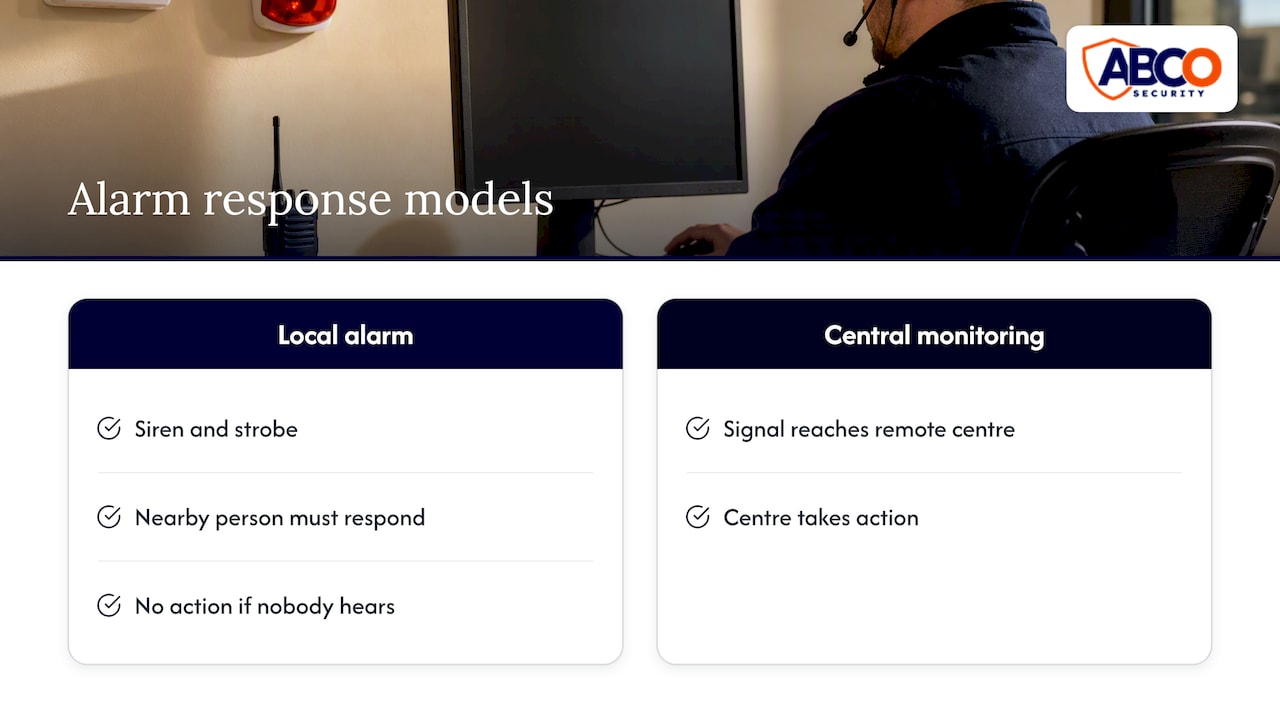
A local alarm, such as a siren and strobe, relies on someone nearby hearing it and doing something. A centrally monitored (also called back-to-base) alarm sends a signal to a remote centre. Local alarms deter some opportunists but do nothing if nobody is within earshot, which describes most commercial premises overnight and on weekends.
What happens after an alert
The difference is clearest in the first ten minutes after something triggers.
| Step | Self-monitored | Professionally monitored |
|---|---|---|
| Who receives the signal | You and any people you nominate | A staffed monitoring centre, then your contacts |
| Verification | You open the app or camera yourself | Operator checks the alarm type, zone, any video and your site notes |
| Decision to escalate | Yours, made on the spot | Made by the operator according to your agreed plan |
| Physical response | You attend, or you arrange a guard or police | Operator can dispatch a contracted patrol or guard, or call police or fire as the plan sets out |
| If you do not answer | Nothing happens | Operator moves to the next contact on your list |
| Record of the event | Whatever your app logs | Time-stamped operator log you can request |
Two points are easy to miss. First, neither model puts a person at your door by itself. Monitoring tells someone, and a response still has to be arranged. Second, a monitored alarm with no response plan behind it can become an expensive notification service. Ask what actually happens after the operator verifies an alarm and who pays for it.
Reliability and the limits of each approach
Power and internet outages
Both models depend on a communication path. If your system uses only a site internet connection, an outage, a cut cable or a tripped router can stop alerts leaving the building, whichever model you choose. Professionally monitored systems commonly add a second path, such as a cellular communicator, and a battery backup in the panel. Ask any provider which paths the system uses and whether the centre is told when a signal stops arriving. A self-monitored system with a single Wi-Fi path and no battery is the weakest combination for an unattended site.
The human limits
Self-monitoring depends on one or two people. Typical failure points are alert fatigue from false alarms, phones on silent, alerts missed during meetings or sleep, and a single person who cannot leave their family at midnight to attend a site. If you do go self-monitored, nominate at least three contacts, test the chain every quarter and write down who attends.
Professional monitoring depends on the quality of your data. Out-of-date contact lists, wrong zone descriptions and vague instructions slow the operator. The fix is a site briefing at installation and a review each time staff, tenants or layouts change.
False alarms
False alarms drain both models. Self-monitored owners learn to ignore alerts. Monitored sites can face call-out charges from patrol services when alarms are not genuine. Good sensor placement, camera verification and proper user training reduce this more than any choice of monitoring type.
Rules, standards and insurance in Australia
Some of this decision is made for you by regulation or by your insurer. Check the following before you buy.
Fire alarms in certain buildings. Fire and Rescue NSW states that under the National Construction Code, specified smoke-detection systems in Class 3 buildings, Class 9a health-care buildings accommodating more than 20 patients and Class 9c buildings must connect to a fire alarm monitoring system linked to its dispatch centre under AS 1670.3. Its page on automatic fire alarm service providers sets this out. Self-monitoring is not an option for these systems. Other states have their own arrangements, so confirm with your fire authority and building certifier.
Licensing of monitoring providers. The same page notes that in Victoria monitoring centres must hold a Private Security Business Licence. Whichever state you operate in, ask your provider for its licence details and which standards its centre is audited against.
Government and high-security zones. The South Australian Government’s protective security framework for physical security zones requires alarm systems in high-security zones to be monitored and responded to in a timely manner, with requirements for hardware and contractor clearance. If you supply services to government in South Australia, this affects your choice directly.
Installation standards. Standards Australia has listed DR AS/NZS 2201.1:2026, a draft covering design, installation, commissioning and maintenance of intruder alarm systems for clients’ premises. It is a draft, so ask your installer which version of the standard they work to and whether your system will be certified against it.
Insurance. Many commercial policies set minimum alarm standards, and some expect monitoring. Do not assume a self-monitored system, or cameras alone, satisfies your policy. Ask your insurer or broker in writing which configuration they require and whether it affects your premium or excess, and keep the reply with your policy documents. Our business security monitoring guide and commercial alarm monitoring guide explain what to ask.
What each option really costs
Self-monitoring looks free because there is no monitoring fee, but the costs move elsewhere. You may still pay for cloud video storage, a SIM or cellular communicator, an internet plan with enough upload capacity, replacement batteries and cameras. The largest hidden cost is time: someone’s evenings and weekends, and the risk of an incident the day they are unreachable.
Professional monitoring adds a recurring fee that varies by provider, communication path, number of zones, video verification and whether patrol attendance is included. Prices differ enough that a generic figure would mislead you, so ask for a written quote that lists:
- the monitoring fee and billing period
- what is included in call-outs and patrol attendance, and what is charged extra
- the contract term and exit conditions
- the cost of duress or panic button monitoring
- charges for changing contacts, test calls and false alarm attendance
- who owns the equipment if you leave
Compare quotes line by line, and weigh them against the cost of one break-in, one stolen load of tools or one night of vandalism, plus the insurance excess.
Which approach fits your site
Construction sites
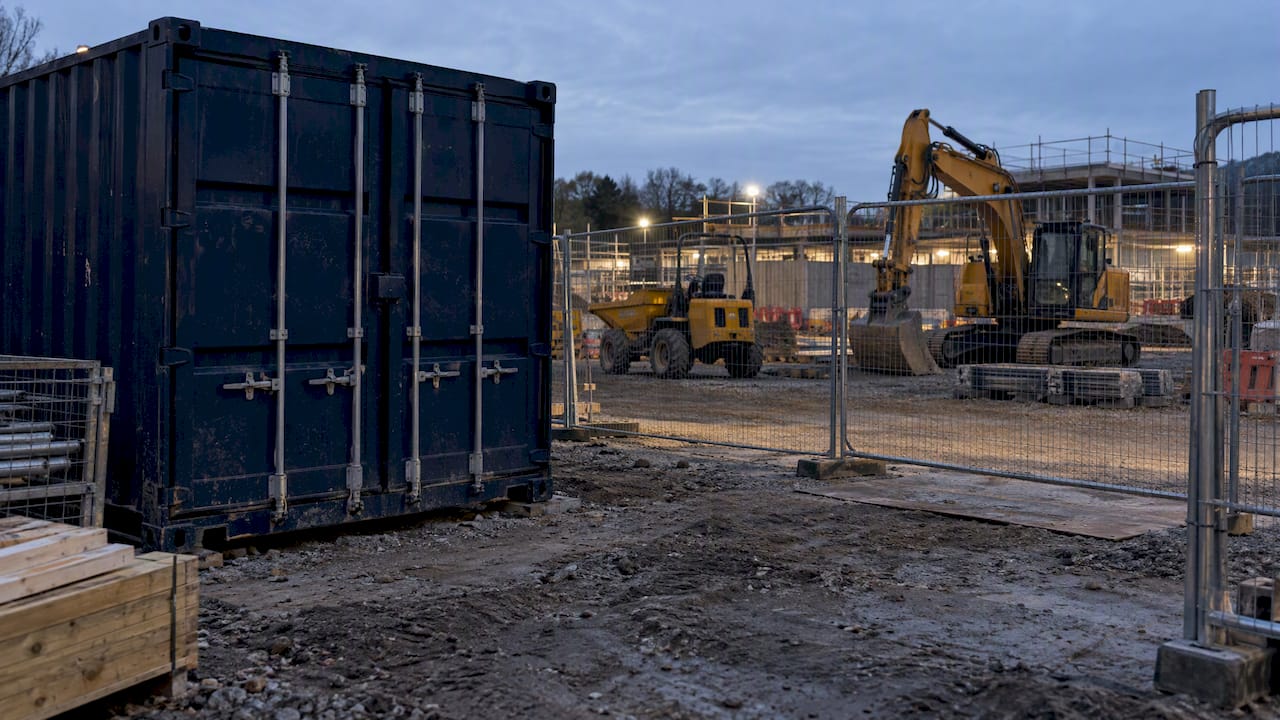
Construction sites are attractive to thieves because materials and plant sit in the open, the site is empty at night and the perimeter keeps changing. Self-monitoring rarely holds up here: the project manager is usually off site at night and cannot attend in person. Camera and alarm monitoring with a patrol or guard response suits most projects, with access control and locked storage for tools. Our guides to construction site security planning and night security for construction sites go through the layers.
Healthcare facilities
Healthcare combines life safety, medicine storage and vulnerable people. Fire alarm monitoring may be mandatory depending on building class, as the NSW rules above show. Duress alarms for staff, controlled access to pharmacy and records areas, and a clear after-hours escalation path point firmly to professional monitoring, often with on-site guarding.
Corporate offices
A small, staffed office with a responsive owner can run self-monitored cameras reasonably well. A larger office, or one holding client data, valuable equipment or multiple tenants, needs after-hours alarm monitoring with access control logs. Treat the alarm and the physical-access system together, and ask the insurer what they expect. See our commercial alarm systems guide.
Retail premises
Retail faces two problems: after-hours break-ins and theft during trading. Monitoring covers the first, with alarms on entry points, a monitored panic or duress button and camera verification. The second is a staffing and layout question, where visible guards and good camera coverage matter more than any monitoring type. Self-monitored cameras can help on a single small shop with an owner living close by, but they leave the shop uncovered when the owner is away.
Events
Events are temporary, so a fixed alarm does not apply. Crowd control, entry screening and radio-linked supervisors matter more, with a control point that receives incident reports and coordinates responses. The model is closer to a site control room than to alarm monitoring.
A simple decision test
Answer these five questions honestly:
- Is the site empty for long stretches? If yes, lean towards professional monitoring.
- Can at least three named people respond within minutes, any hour, every day? If not, self-monitoring will fail you.
- Does a regulator, a building code, a client contract or your insurer require monitoring? If yes, the decision is made.
- What is lost in one incident? Add stock, equipment, downtime, excess and reputation. Compare it with a year of monitoring fees.
- Who attends in person? If the answer is “someone will sort something out”, add a patrol or guard arrangement.
Two or more answers pointing to monitoring, and you have your answer. If you are unsure, start with professional monitoring on the highest-risk areas and keep self-monitored cameras for low-risk ones.
Our perspective
We have seen the same pattern across construction, healthcare, retail and corporate clients: the technology is rarely the weak link. The weak link is the gap between an alert and a person on site who knows what to do. Self-monitoring closes that gap only when the owner is always reachable and willing to attend. Most businesses cannot promise that every night of the year.
That is why we treat monitoring as one layer in a response chain. Alarms and cameras detect, a monitoring centre verifies, and licensed patrols or guards respond. We work to ISO 9001 and ISO 30000 and have over 15 years in the industry. We run 24/7 operations across Australia, because a threat does not keep business hours. We would rather help you choose a lighter set-up that you will actually maintain than sell a larger one that sits unattended. Our alarm monitoring guide and security systems monitoring guide set out how we think about it.
— Abco
Where our services fit
If you have decided that you need someone watching and responding, we can build the chain around your site. Our A1 CCTV and alarm monitoring service covers monitored alarms and cameras, our mobile patrol service provides the physical response, and our security guarding puts licensed staff on site where the risk justifies it. Our Night Owl Service is listed from $5.45 per day, and the page shows the 12M and 24M plan options.
Tell us about your site, hours and current alarm set-up, and we will recommend a layered arrangement and quote it in writing. You can start from our electronic security solutions or contact us through the Abcosecurity website.
FAQ
Is self-monitoring good enough for a business?
Sometimes. It can work for a small, low-risk, attended site where several reachable people can respond at any hour. It is a poor fit for unattended sites, regulated buildings or anywhere an insurer requires monitoring. Confirm your policy terms before you rely on it.
Does a monitored alarm mean police will attend automatically?
No. The operator verifies the alarm and follows your agreed plan, which may mean calling your contacts, sending a patrol or contacting police or fire services. Ask your provider exactly what the plan says for each alarm type, and write it into your contract.
Can I add professional monitoring to a self-monitored system later?
Often you can, but it depends on the panel, the communicator and the cameras. Some equipment locks you into one app or cloud service. Ask an installer to check compatibility before you buy, so you are not replacing hardware later.
What is the difference between a monitoring centre and a control room?
A monitoring centre receives remote alarm signals and is defined under AS 2201.2, as NSW Police explains. A control room is usually a site-specific hub that manages local security staff and responses. Large sites can use both.
What should I ask a monitoring provider before signing?
Ask which licences they hold, how their centre is audited and which communication paths and backups the system uses. Ask who attends after verification, what call-outs cost and how you can exit the contract. Get all of it in writing.
Sources
- PCWorld: Security system monitoring, should you DIY or pay a pro?
- NSW Police: monitoring centre versus control room
- Fire and Rescue NSW: automatic fire alarm service providers
- South Australian Government: physical protections security zones
- Standards Australia: draft standards open for comment
Recommended
about
avada factory
Sempery ultricies nibh at dolor cras urna eleifend nec. Atiam efficitur tempor.