TL;DR:
- Onsite security guards in Australia must hold valid state-issued licenses, White Cards for construction sites, and appropriate qualifications. They perform surveillance, access control, patrols, incident response, and documentation to ensure site safety and compliance. Proper licensing, integrated safety practices, and risk-based deployment are essential for effective security management.
Onsite security guards are trained, licensed professionals who protect construction sites and commercial premises through surveillance, access control, patrol, and incident response. The industry term is “security officer,” though “guard” remains widely used across Australian workplaces. For construction site managers, corporate security officers, and business owners, deploying the right on-site guards is a compliance obligation as much as a safety decision. Australian state licensing frameworks, WHS regulations, and the CPP20218 Certificate II in Security Operations all govern who can legally work in a security role. Getting this wrong exposes your business to legal penalties, insurance gaps, and preventable theft.
What licences and qualifications must onsite security guards hold in Australia?
Australian security licensing is state-based, meaning there is no single national licence. Providers must hold a Master Licence, and every individual guard must carry a Class 1 licence appropriate to their jurisdiction and role. Queensland, New South Wales, Victoria, and Western Australia each administer their own licensing schemes with different application processes, fees, and renewal cycles.
The baseline training qualification is the CPP20218 Certificate II in Security Operations. This nationally recognised qualification covers surveillance techniques, conflict resolution, legal powers, and report writing. No reputable provider deploys guards who have not completed it.
Before any Class 1 licence is issued, criminal history checks and fingerprinting are mandatory. These background checks exist to protect clients and the public. A guard who cannot produce evidence of a cleared check has not met the legal threshold for deployment.
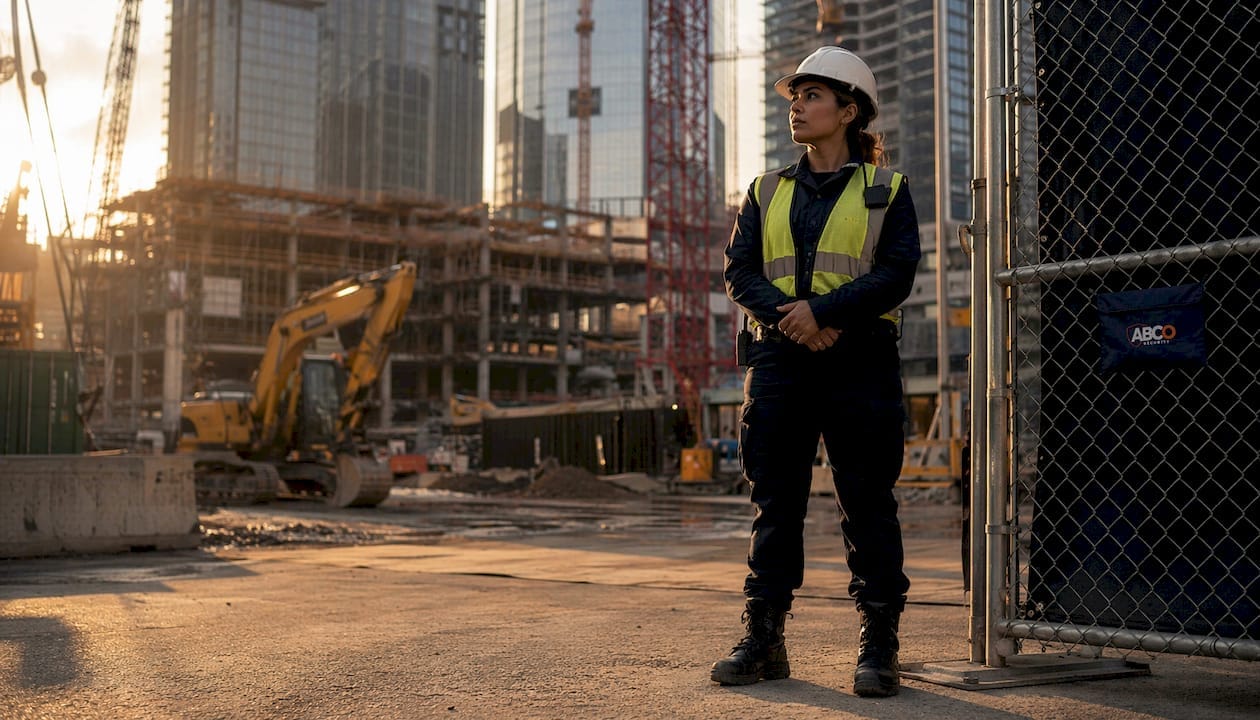
Construction sites add a further requirement. Guards on construction sites must hold a White Card in addition to their security licence. The White Card demonstrates completion of the general construction induction training required under WHS legislation. Without it, a guard cannot legally set foot on an active building site.
Key licensing requirements for onsite security officers in Australia:
- Valid Class 1 security licence issued by the relevant state authority
- CPP20218 Certificate II in Security Operations
- White Card (construction induction) for any construction site deployment
- Criminal history clearance and fingerprinting prior to licence issue
- Master Licence held by the employing security provider
- Additional endorsements such as traffic control where site conditions require it
Pro Tip: Ask any security provider to supply copies of individual guard licences and the company’s Master Licence before signing a contract. Verbal assurances are not sufficient for compliance purposes.
What are the core duties of onsite security guards on construction sites?
Core security officer duties cover five functional areas: surveillance, access control, patrol, incident response, and documentation. Each area serves a distinct protective purpose, and gaps in any one of them create exploitable vulnerabilities.
Surveillance and site monitoring. Guards observe CCTV feeds, conduct visual sweeps, and identify suspicious behaviour before it escalates. On large construction sites, this often means coordinating with camera monitoring systems to cover areas that physical patrols cannot reach continuously.
Access control and credential verification. Guards check identification, verify contractor credentials, and manage entry logs at site gates. Unauthorised access is the most common precursor to theft and vandalism on construction sites.
Patrol duties. Static guards provide fixed-post presence critical for high-value asset protection and immediate incident response. Mobile patrols cover perimeter checks and randomised visits that deter opportunistic intruders. Most sites benefit from a combination of both.
Incident response and emergency handling. Guards are the first point of contact when an incident occurs. They contain the situation, contact emergency services, and preserve the scene for investigation. A guard without a clear incident response protocol is a liability, not an asset.
Report writing and documentation. Every incident, near-miss, and access event must be recorded in a site log. These records support insurance claims, legal proceedings, and WHS audits. Accurate documentation is what separates a professional security operation from an informal arrangement.
Pro Tip: Request weekly incident reports and access logs from your security provider. If a provider cannot supply these, their guards are not meeting professional documentation standards.
How do onsite security guards support WHS compliance?
Effective onsite security guards actively contribute to WHS compliance rather than operating separately from it. They participate in site-specific inductions, wear correct PPE, and support emergency evacuation procedures. This integration matters because WHS legislation places a duty of care on every person who enters a worksite, including security personnel.

Guards deployed on construction sites must wear high-visibility clothing, steel-capped boots, and hard hats as standard. These are not optional. A guard who arrives on site without correct PPE creates a compliance breach for the site manager, not just for the guard’s employer.
Guards with first aid qualifications add measurable value. They can provide initial treatment while waiting for emergency services, which reduces harm and demonstrates due diligence under WHS obligations. Abcosecurity recommends specifying first aid certification as a minimum requirement when engaging security personnel services for high-risk sites.
WHS contributions from on-site guards include:
- Conducting and recording site-specific inductions for contractors and visitors
- Enforcing PPE compliance at entry points
- Participating in emergency drills and evacuation procedures
- Identifying and reporting hazards during patrol rounds
- Supporting first aid response when qualified to do so
- Maintaining communication with site managers during incidents
The connection between security and safety is direct. A guard who spots an unsecured hazard and reports it prevents a WorkCover claim. That outcome has a measurable financial value beyond the cost of the security contract.
What should you consider when selecting onsite security services?
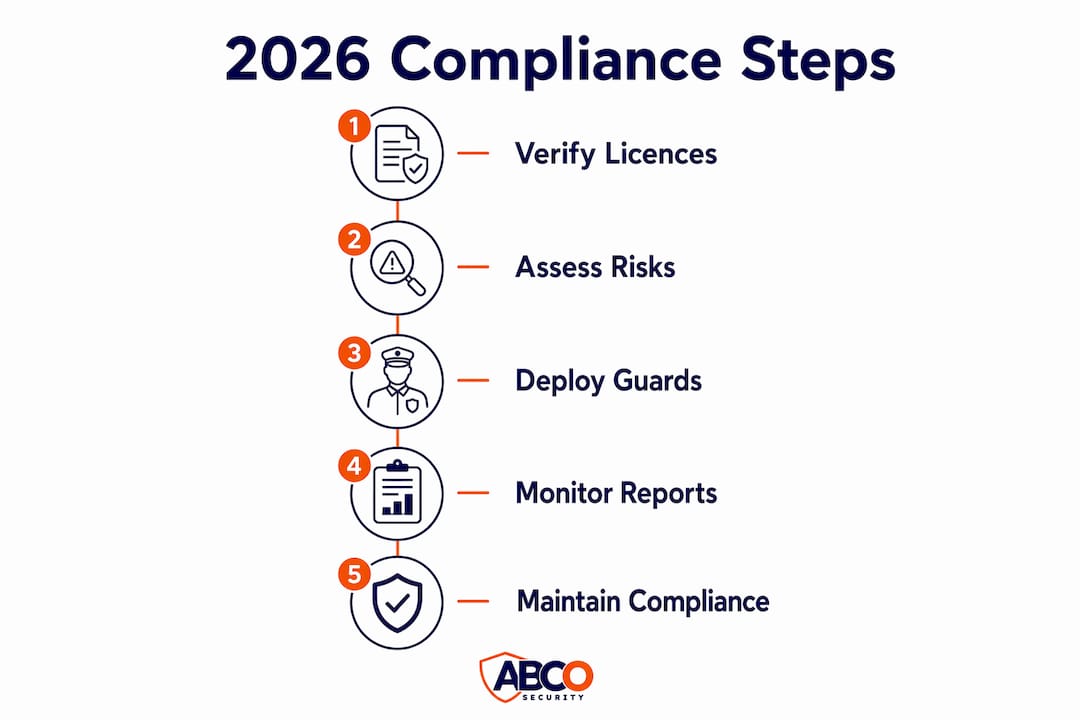
Selecting the right security personnel services starts with verifying licences. Employers must confirm that providers hold a valid Master Licence and that individual guards carry appropriate Class 1 licences. Failure to verify exposes the business to legal penalties and leaves security gaps that insurers will not cover.
Matching guard deployment type to a site-specific risk assessment is the next step. A small commercial premises with a single entry point has different needs from a multi-hectare construction site with several access gates and high-value plant on site.
| Deployment type | Best suited for | Key advantage |
|---|---|---|
| Static guard | Single entry points, high-value asset areas | Immediate response, visible deterrent |
| Mobile patrol | Large perimeters, multi-access sites | Cost-effective coverage, unpredictable timing |
| Combined static and mobile | Large construction sites, corporate campuses | Layered protection across all risk zones |
Beyond deployment type, consider these factors when evaluating providers:
- Contractual clarity. Confirm shift hours, guard-to-site ratios, and escalation procedures are written into the contract.
- Compliance monitoring. Ask how the provider tracks licence renewals and training currency for their guards.
- Incident reporting systems. Providers should supply digital or written logs within 24 hours of any incident.
- Traffic control endorsements. Sites near public roads may require guards with traffic control qualifications.
- Cost structure. Hourly rates vary by state, shift time, and guard classification. Budget for after-hours and public holiday loadings.
Businesses must maintain internal compliance systems that reflect jurisdictional licensing differences and stay alert to evolving state regulations. This is not a one-time check. Licences expire, regulations change, and a provider compliant in january may have gaps by july. Build a review cycle into your security management plan.
Pro Tip: For guidance on security guard licensing requirements across Australian states, review the specific obligations for your jurisdiction before engaging any provider.
For construction-specific planning, Abcosecurity’s construction site security services resource covers site-specific risk assessment frameworks in detail.
For businesses managing security incident documentation within their security operations, establishing clear procedures from the outset prevents compliance failures later.
Key takeaways
Onsite security guards deliver legal, compliant protection only when they hold the correct state-issued licences, White Card, and CPP20218 qualification matched to a site-specific risk assessment.
| Point | Details |
|---|---|
| Licensing is state-based | Verify Master Licence and Class 1 licences for every provider and individual guard before deployment. |
| White Card is mandatory on construction sites | Guards without a White Card cannot legally work on active building sites under WHS legislation. |
| Match deployment type to risk profile | Use static guards for fixed high-value assets and mobile patrols for large perimeters. |
| Guards contribute to WHS compliance | They conduct inductions, enforce PPE, report hazards, and support emergency procedures. |
| Documentation is non-negotiable | Incident logs and access records protect your business in insurance claims and legal proceedings. |
What I’ve learned from 15 years of onsite security in Australia
The biggest compliance failure I see is not a missing licence. It is a site manager who assumes the security provider has handled everything. That assumption is wrong, and it is expensive when it surfaces during a WorkCover investigation or an insurance dispute.
The sites that manage security well treat their on-site guards as part of the safety team, not a separate contractor who shows up at the gate. When guards attend toolbox talks, know the site emergency plan, and have a direct line to the site manager, incidents get resolved faster and documented properly. That integration does not happen automatically. It requires deliberate planning from the start of the engagement.
Sophisticated theft on construction sites has changed the risk profile significantly. Organised groups now target specific plant and materials with advance knowledge of site layouts. A static guard at the front gate does not address that threat. A layered approach combining mobile patrols, camera monitoring, and access control systems does. Abcosecurity’s experience across construction, corporate, and healthcare environments consistently shows that single-layer security fails against determined adversaries.
The other pattern worth noting is that temporary security staff engaged for short-term projects often receive less scrutiny than permanent arrangements. That is backwards. A guard on a two-week engagement has the same legal obligations as one on a 12-month contract. Verify their credentials every time.
— Abco
Abcosecurity’s onsite security guard solutions for Australian businesses
Abcosecurity has delivered licensed, WHS-compliant security guard services across construction, corporate, and healthcare sectors for over 15 years. Every guard deployed meets state licensing requirements, holds a current White Card where required, and operates within a documented security plan tailored to your site.
Whether you need static guards for a high-value asset area, mobile patrols for a large construction site, or a combined security management approach for a complex commercial environment, Abcosecurity builds the deployment around your risk profile. ISO 9001 and ISO 30000 certified, Abcosecurity brings international quality standards to every engagement. Contact Abcosecurity to request a site assessment and receive a security plan matched to your specific needs.
FAQ
What qualifications must onsite security guards hold in Australia?
Guards must hold a state-issued Class 1 security licence and have completed the CPP20218 Certificate II in Security Operations. Construction site deployments also require a White Card under WHS legislation.
Do security guards on construction sites need a White Card?
Yes. A White Card is mandatory for any person working on an active construction site in Australia, including security personnel, to comply with WHS induction requirements.
What is the difference between static and mobile security guards?
Static guards maintain a fixed post for continuous presence and immediate response at a specific location. Mobile patrols cover larger areas through randomised perimeter checks, which deter opportunistic intrusion across multi-access sites.
How do I verify that a security provider is properly licensed?
Confirm the provider holds a valid Master Licence issued by the relevant state authority, and request copies of individual Class 1 licences for every guard assigned to your site. Licence status can be verified directly with state licensing bodies.
Can temporary security staff be deployed without full licence checks?
No. Temporary security staff carry the same legal obligations as permanent guards. Every individual must hold a valid Class 1 licence and meet all state-specific requirements regardless of the length of the engagement.
Recommended
about
avada factory
Sempery ultricies nibh at dolor cras urna eleifend nec. Atiam efficitur tempor.