Organised retail crime is theft carried out by groups or repeat offenders who plan it, target specific goods and resell them, rather than a person grabbing one item on impulse. In Australia it now sits alongside rising violence against staff, and the answer for a retailer is rarely one product. It is a layered setup: good intelligence on who is hitting you, cameras someone is watching, and trained people on the floor and the perimeter.
This guide explains what the term covers, what the current data shows, how these crews typically work, and what store owners and centre managers can do about it.
TL;DR
- Organised retail crime means planned, repeated theft (often for resale) by crews or small groups of repeat offenders, and it is increasingly paired with threats and weapons.
- Retail settings accounted for 45% of recorded theft incidents in 2024, and retail crime involving weapons rose 66% year on year in the period reported by the retail industry body.
- A small group does most of the damage: industry data puts roughly 60% of retail harm and loss on the top 10% of offenders.
- Police cannot attend everything, so retailers need layered security: recording and sharing evidence, monitored CCTV, visible guarding and patrols, and clear staff procedures.
Table of Contents
- What counts as organised retail crime in Australia
- What the numbers show
- How organised crews operate
- What governments and police are doing
- A layered defence that works against crews
- Matching the response to your type of site
- Our perspective
- Where we can help
- FAQ
- Sources
What counts as organised retail crime in Australia
There is no single offence called “organised retail crime” that every state charges the same way. In practice the term describes a pattern, and a few features usually mark it out:
- Planning. Offenders choose stores, times and goods in advance, and often scout first.
- Repetition. The same people or crews return to the same store, chain or centre.
- Resale. Stolen stock is on-sold, rather than used by the offender. Items that are small, high in value and easy to move, such as spirits, baby formula, cosmetics and electronics, are common targets.
- Roles. One person may distract staff, another take the goods, another drive or receive them.
The difference matters because the defence is different. A casual shoplifter may be put off by a visible camera or a friendly greeting. A crew that has done this before is not. If you want the everyday end of the problem covered as well, our guide to shoplifting prevention steps for Australian retailers is the companion read.
What the numbers show
The national picture is serious, though it is not a story of one-way decline.
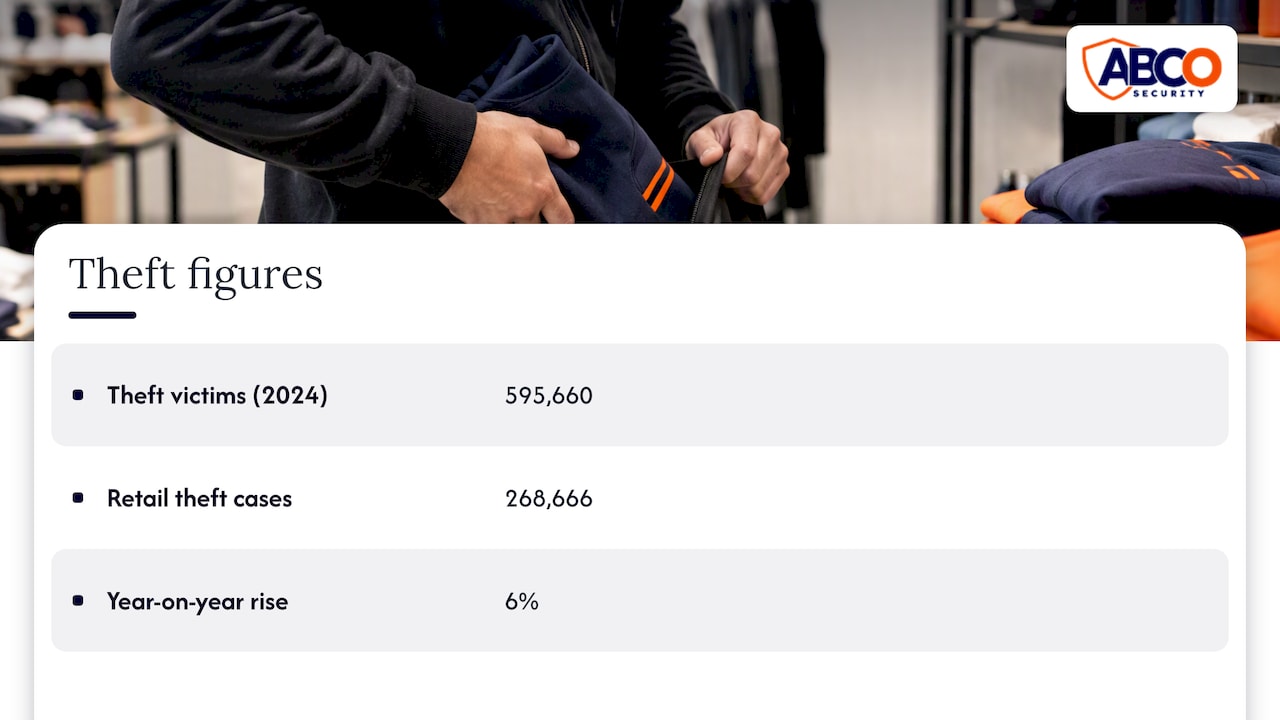
The Australian Bureau of Statistics reported 595,660 victims of theft in 2024, the highest number since 2003 and a 6% rise on the previous year. The Australian Retail Council notes that almost half of all theft incidents, 268,666 cases, happened in retail settings.
The ABS then reported that victims of theft (excluding motor vehicles) and robbery recorded by police in 2025 fell for the first time since the declines in 2020 and 2021 respectively. That is welcome, but it is one year of data after a 21-year high, and it says nothing about how violent or organised the remaining incidents are.
The violence is the part retailers raise most. The Australian Retail Council reported a 66% year-on-year increase in retail crime involving weapons in the year it covered, alongside a large rise in violent and threatening events. In Victoria, police recorded 95,181 criminal incidents in retail locations in the year to 31 December 2025 is not what that source states, so treat the Victorian figure as a headline only and check the latest Crime Statistics Agency release before quoting it in a board paper.
For New South Wales, the state’s crime bureau publishes quarterly figures. Its December 2025 update lists steal from retail store among the offence categories to watch over the 24 months to December 2025.
A small group causes most of the harm
The most useful figure for a security plan is this one: practitioners cited by the retail industry say the top 10% of offenders account for roughly 60% of retail harm and loss. If that holds in your stores, the job is less about stopping everyone and more about identifying, documenting and deterring the few people who keep coming back.
How organised crews operate
We do not publish offender playbooks, but retailers should understand the broad patterns, because they shape where defences go.
They test before they hit. A crew may visit to check camera coverage, staff numbers and exit routes. Unusual loitering, repeated short visits or people photographing shelves are worth noting.
They exploit gaps in coverage. Quiet trading hours, shift changes, loading docks, back-of-house doors and car parks are common weak spots. Staff on their own are the easiest to overwhelm.
They move between stores. Offenders hit several locations of the same chain or the same centre, so a single store’s incident log rarely shows the full picture.
They use intimidation. The Australian Retail Council’s data on weapons and threats, and ABC News reporting on shops driven to the brink, describe thieves smashing through glass and threatening staff. That changes the rule for frontline teams: protect people first, stock second.
One large case shows the scale. Victoria Police dismantled an alleged network accused of stealing $10 million worth of goods from major supermarkets. Cases like this are the exception that makes the news; most of the loss for an independent or mid-size retailer comes from smaller, repeated hits that never reach a headline.
What governments and police are doing
Policing is shifting towards the same insight retailers have: target the repeat offenders. The NSW Government has launched a Retail Crime Strategy and a statewide rollout of Operation Percentile, a policing model aimed at repeat offenders. In Victoria, police presence in major shopping centres has produced thousands of charges under Operation Pulse, according to trade reporting.
Retail bodies are also pushing for faster workplace protection orders and tougher penalties for assault. Rules differ by state and territory, so ask your state police retail liaison or your industry association what applies to your premises before you rely on any one tool.
The practical point: police effort is real but finite. As Auror’s Nick McDonnell has said in industry commentary, the volume of incidents means police cannot respond to all of them, which is why businesses need an intelligence-led approach of their own. What helps police most is a clean, well-documented brief.
A layered defence that works against crews
No single measure stops organised offenders. These layers work together.
1. Record incidents consistently
Write down every incident the same way: date, time, location in store, items, method, description of people and vehicle, and whether staff were threatened. Patterns across weeks are what let police link cases and what justify action against repeat offenders. Intelligence platforms used by large retailers do this at scale; smaller operators can start with a shared log across all sites.
2. Make CCTV a monitored system, not an archive
Recording after the fact helps prosecutions. Live monitoring helps stop the incident while the crew is still in the store. Placement and image quality matter: you need faces at entrances and clear views of high-value aisles, not just wide shots. Our guides on CCTV placement to AS 4806 and CCTV monitoring in Australia cover the detail, and the CCTV laws guide is worth reading before you add cameras, because surveillance and privacy rules vary by state.
3. Put trained people where the risk is
A licensed guard at the door or on the floor changes the odds. Offenders look for soft targets, and a visible, professional presence in the right place at the right hours is a deterrent. Guards also give your staff someone to call on instead of confronting thieves themselves. See our overview of security guard services in Australia for how guarding is structured.
4. Cover the hours and places guards are not
Many hits happen at the loading dock, in the car park or after close. Mobile patrols visit multiple sites at irregular times, which suits stores with limited foot traffic or sites on the edge of a centre. Our explainer on what mobile patrol security involves sets out how that works.
5. Set staff rules that protect people
The retail industry’s emphasis on staff safety is clear. Build these into induction and refreshers:
- Do not physically confront or chase offenders.
- Greet and engage customers; a noticed offender is a deterred one.
- Report suspicious behaviour to a manager or guard, not to the person.
- Treat any weapon or threat as an emergency and call 000.
- Hold a debrief and record the incident after every event.
6. Reduce what is easy to take
Move the highest-value, highest-resale lines to controlled locations, keep stock counts tight and check receiving areas. Our loss prevention guide for retail stores and overview of retail security go through store layout, stock control and procedures. Areas with no sightlines need different handling again; see fitting room security without cameras.
Matching the response to your type of site
| Site type | Main exposure | Layers to prioritise |
|---|---|---|
| Single independent store | Repeat visits, low staffing | Incident log, monitored CCTV, staff rules |
| Multi-site chain | Crews moving between stores | Shared intelligence, consistent procedures, guarding at highest-loss sites |
| Shopping centre tenancy | Group entry, escalation | Guard presence, coordination with centre management, clear escalation |
| Stockroom or loading dock | After-hours theft | Access control, patrols, alarm monitoring |
The goal is to spend where the loss is. Review your own incident data by site and by hour before you buy anything.
Our perspective
We have worked in security for more than 15 years, and the pattern we see is that retailers often buy the visible item first, usually a camera or a sign, and leave the response question unanswered. A camera nobody watches tells you what happened. It does not stop it.
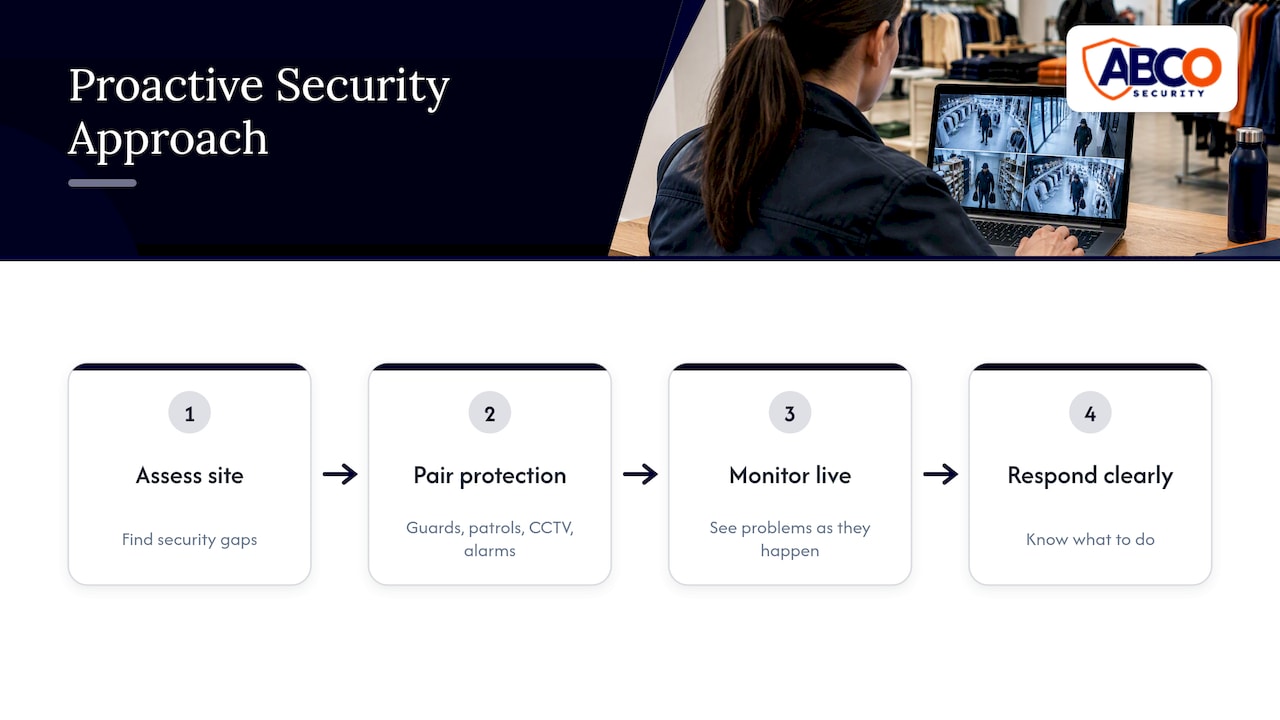
Our approach is proactive: assess the site, find the gaps, then combine licensed people and technology so that someone sees the problem while it is happening and knows what to do. That is why we pair guarding and patrols with CCTV and alarm monitoring, and why we run our work to ISO 9001 and ISO 30000 quality and risk management standards. For organised crime in particular, we would put documentation and consistency ahead of heroics: a calm guard, a clear record and a clean handover to police is worth more than a confrontation.
Staff safety is the line we do not cross. No stock is worth an injury.
— Abco
Where we can help
If you run retail premises and want a risk assessment, a combination of guarding, patrols and monitoring, or after-hours cover, start with our security guarding and mobile patrol services, or our CCTV and alarm monitoring. Our Night Owl service is listed from $5.45 per day, and other services are quoted to the site. Tell us your locations and trading hours through our main site and we will scope what fits.
FAQ
What qualifies as organised retail theft?
It is planned, repeated theft by a group or a small set of repeat offenders, usually of goods that can be resold. Roles are often split between lookouts, thieves and drivers. Definitions and charges vary by state, so police and your legal adviser can tell you how a specific incident would be treated.
Is organised retail crime really growing in Australia?
Theft victims reached a 21-year high in 2024, and retailers report more weapons and violence. The ABS then recorded a first fall in theft and robbery in 2025, so the trend is mixed, but severity remains a concern for retailers.
Should I report every incident to police?
Report anything involving violence, threats, weapons or significant loss, and report repeat offenders. Keep your own record of smaller incidents so patterns can be shown. Call 000 in an emergency.
Do security guards stop organised crews?
Guards deter and disrupt, and they protect staff, but they work best alongside monitored CCTV, good records and clear procedures. A guard should observe, report and de-escalate, not chase.
What should a small retailer do first?
Start a consistent incident log, check that your cameras capture faces at the entrance, and agree staff rules for suspicious behaviour and threats. Then review which hours and areas carry the most loss and add guarding or patrols there.
Sources
- Retailers bear the brunt as theft surges to 21-year high, Australian Retail Council
- Australian retailers record huge spike in armed and violent retail crime, Australian Retail Council
- Theft reaches 21 year high, Australian Bureau of Statistics
- First drop in theft and robbery since COVID-19, Australian Bureau of Statistics
- NSW Recorded Crime Statistics quarterly update December 2025, BOCSAR
- NSW Government Retail Crime Strategy and Operation Percentile
- Shops driven to the brink by surge in violence and aggression against staff, ABC News
- Victoria Police dismantles alleged $10 million organised retail theft syndicate, Policing Insight
- Victoria Police lay thousands of charges in shopping centre crackdown, Retail Risk
- Retail crime and the price of justification in 2026, Inside Retail Australia
Recommended
about
avada factory
Sempery ultricies nibh at dolor cras urna eleifend nec. Atiam efficitur tempor.