
Preventing patient elopement depends on a structured risk assessment on admission, matched observation tiers and layered safeguards that prioritise least-restrictive practice. If a patient screens as high risk, set the observation level immediately, brief the team at handover, and notify security or the after hours coordinator before you move on to anything else.
TL;DR:
- Patients with a prior elopement history, active substance withdrawal, or involuntary legal status are at the highest risk and require immediate layered safeguarding measures.
- Risk assessments should be conducted on admission, at 72 hours, quarterly, and after any condition change, focusing on specific factors like orientation, mobility, and legal status.
- Observation levels must match defined risk tiers, with continuous observation reserved strictly for genuinely high-risk cases to prevent resource wastage.
- Environmental design and clinical engagement both play critical roles, with technology acting as an adjunct rather than a substitute for thorough assessment and communication.
- Security systems should support clinical protocols, with alarms and access controls aligned to actual search patterns and workflows to avoid unnecessary restriction.
Table of Contents
- What is patient elopement prevention and why terminology matters
- When should you assess elopement risk, and what should you check?
- How do you layer clinical, environmental and technology controls?
- What bedside habits actually cut elopement attempts?
- What’s the response protocol once a patient goes missing?
- How does prevention change for higher-risk populations?
- Which KPIs prove your elopement prevention strategy is working?
- How should security systems support clinical elopement prevention?
- Multidisciplinary prevention and a predictable response
- How ABCO Security supports your elopement prevention plan
- Sources
- FAQ
What is patient elopement prevention and why terminology matters
Patient elopement is the unauthorised departure of a patient from a care area or facility without staff knowledge or a safe discharge process. That is a distinct clinical event from wandering or leaving against medical advice, and the difference is not academic. It changes what your team documents, who gets notified, and how fast you escalate.
Wandering describes a patient moving within a unit or facility, often disoriented, but still inside a monitored area. Leaving against medical advice (AMA) happens when a competent patient states an intent to leave and staff acknowledge it, even if they disagree with the decision. Elopement has neither of those safeguards. Nobody signed off, nobody was told, and the patient is now outside the care environment without support.
Each scenario demands a different response:
- Wandering: redirect, reorient, check for triggers like pain or toileting needs, and adjust the environment rather than launching a search.
- Leaving AMA: document capacity, risks explained, and the patient’s decision; notify the treating team but this is not a security event.
- Elopement: activate the facility’s missing-patient protocol immediately, including a structured search and, where indicated, security or police notification.
Getting this distinction wrong in documentation creates real exposure. Calling an AMA departure an “elopement” in the chart can trigger unnecessary reporting obligations, while mislabelling a genuine elopement as wandering can delay the search that actually finds the patient.
When should you assess elopement risk, and what should you check?
Risk assessment is the foundation everything else sits on. ECRI’s guidance on preventing patient elopement sets out a repeatable timing cycle that removes the guesswork clinicians otherwise face:
- On admission — a baseline risk screen before the patient reaches the ward.
- At 72 hours — because risk shifts once initial sedation, withdrawal, or acute confusion starts to settle or worsen.
- Quarterly — for longer admissions, particularly in mental health and aged care settings.
- On any change in condition or transfer — a new diagnosis, a medication change, or a ward move all reset the clock.
The screening itself should cover a small, specific set of items rather than a vague gut check. Prior elopement history is the single strongest predictor clinicians consistently flag. Orientation status, expressed intent to leave, mobility (can they actually get far?), legal status (voluntary versus involuntary), and active substance withdrawal round out the core list. An Australian retrospective study on absconding found higher risk concentrated in younger, male patients with schizophrenia or substance use diagnoses, particularly in the early days of admission, which is exactly why the 72 hour recheck matters as much as the admission screen.
Observation tiers translate that risk score into an actual staffing decision. A low risk patient might need routine ward checks every couple of hours. Moderate risk usually means increased visual checks, a bed near the nurses’ station, or a locked interior door. High risk warrants continuous observation, but that should be a considered decision, not a default. Guidance on tiered observation is explicit that staffing and environmental controls work as complements, not substitutes for one another, and a graduated system lets a unit step observation up or down without running a full reassessment every time.
Pro Tip: Reserve continuous 1:1 observation for genuinely high-acuity cases. Overusing it burns through nursing hours fast, and it can mask the fact that the underlying risk factor, like unmanaged withdrawal or acute psychosis, hasn’t actually been addressed.
How do you layer clinical, environmental and technology controls?
No single control stops elopement on its own. The facilities that manage this well stack three layers and let each one cover the others’ gaps.
Clinical measures come first because they address the reason a patient wants to leave, not just the mechanics of leaving. Orientation conversations, structured diversion activities, carer involvement, and thoughtful room placement all reduce the underlying urge to go. Facilities that actively engage patients and involve family in routines see fewer unauthorised departures than those relying purely on physical barriers.
Environmental design is the second layer:
- Clear sightlines from the nurses’ station to high-risk beds.
- Exit placement that doesn’t put unsupervised patients closer to a door than staff are.
- Delayed-egress hardware where local building code permits it.
- Signage and pathway design that guide confused patients back rather than out.
Technology is the third layer, and it’s the one most likely to be misused. RF wristbands, door and bed alarms, and CCTV monitoring all reduce reliance on constant 1:1 staffing when they’re paired with consistent assessment. But alarm fatigue and over-reliance on tags are recurring pitfalls when staff start trusting the device instead of the protocol behind it. Toolkits from risk management groups are blunt on this point: technology is an adjunct, not a substitute for assessment and communication.
An implementation study that standardised assessment, precautions and response cut elopement events from 34 to 12 and dropped average event duration from 118 minutes to 24 minutes in the comparison period. That’s the return on layering controls properly rather than betting everything on one intervention.
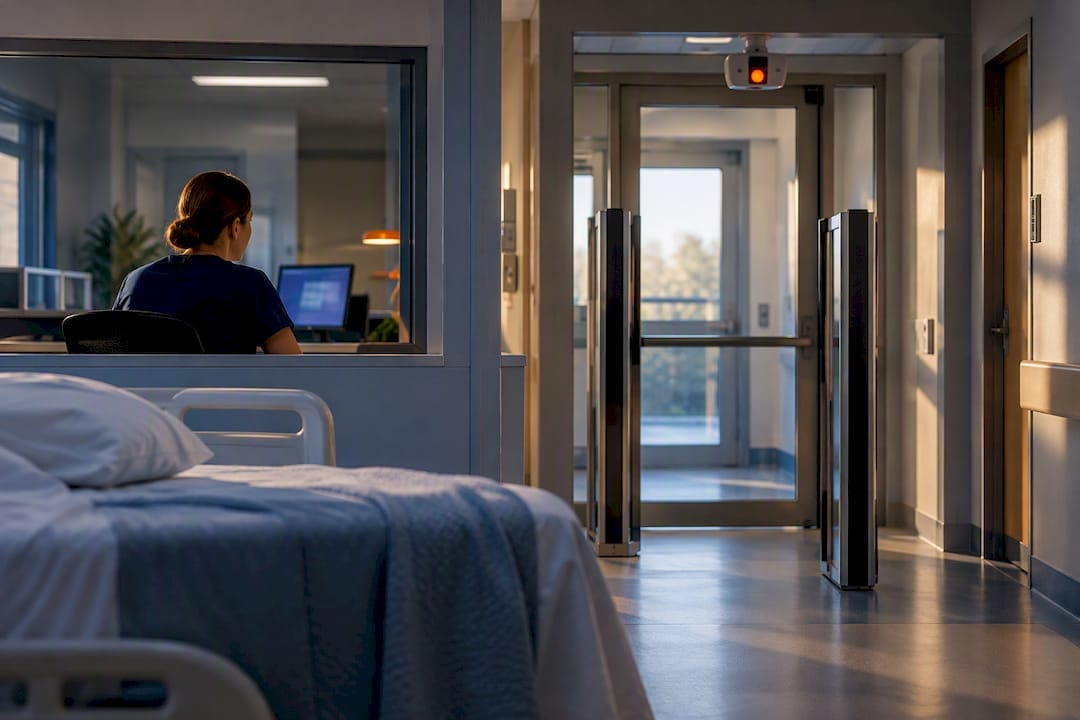
Choosing the right mix depends on your unit’s population and resources. An acute mental health ward with a high proportion of involuntary patients needs a different balance than a general medical ward managing the occasional delirium case.
What bedside habits actually cut elopement attempts?
Bedside placement decisions do more of the work than most units credit. A high-risk patient in a room near the nurses’ station, away from stairwells and exits, is measurably harder to lose than one tucked at the end of a corridor.
- Place at-risk patients within direct line of sight of the nurses’ station, not just “on the same ward”.
- Choose rooms away from stairwell exits and loading docks, even if it means shuffling a lower-risk patient.
- Loop family members or a sitter programme into watch rotations where the facility has one running.
- Treat shift change and handover as a risk window in its own right; verbally confirm observation level and any elopement history, don’t just rely on the chart.
- Reassess before de-escalating observation. Dropping a patient from 1:1 to routine checks needs the same documented rationale as escalating them.
Handover is when risk information gets lost. A patient flagged as high risk on the morning shift can quietly slip to “routine” by evening simply because nobody said it out loud. Triage your limited 1:1 hours toward patients with active intent or a recent attempt, and free up that resource once the acute driver, like withdrawal or delirium, has genuinely resolved.
What’s the response protocol once a patient goes missing?
Speed and sequence both matter once a patient is confirmed missing. A defined protocol turns a chaotic first ten minutes into a manageable one.
- Launch an immediate unit search using a predefined pattern, with one coordinator managing the sequence rather than everyone searching randomly.
- Time-box the search to a set window (commonly 15 to 30 minutes) before escalating further.
- Escalate to on-site security once the unit search comes up empty, and to police when the patient is involuntary, at acute risk of harm, or a minor.
- Notify family as soon as the situation is confirmed, following your facility’s documented communication protocol.
- Run post-event tasks: clinical reassessment on return, an updated risk plan, a root-cause review, and policy revisions where the review finds a gap.
Legal status changes the escalation math directly. An involuntary mental health patient triggers faster police notification requirements than a voluntary medical inpatient who wandered off a general ward. Facilities that run regular elopement drills, simulating both low and high-risk scenarios, consistently find gaps in their search patterns before a real event exposes them.
How does prevention change for higher-risk populations?
Dementia care needs environmental cues rather than restriction: memory boxes outside doors, wander paths that loop back to a safe area, and meaningful activity schedules that reduce the drive to leave in the first place.
Involuntary admissions carry legal notification requirements that voluntary patients don’t, and escalation should move faster given the elevated risk profile these patients often carry.
- Aboriginal and Torres Strait Islander patients benefit from culturally safe engagement, family involvement in care planning, and awareness that historical distrust of institutions can itself be a risk factor for unplanned departure.
- Paediatric patients need age-appropriate engagement and near-constant carer presence rather than device-based monitoring alone.
- Substance withdrawal and acute psychosis both spike risk unpredictably, often outside the standard reassessment windows, so clinical judgement should override the schedule when symptoms shift.
Which KPIs prove your elopement prevention strategy is working?
A prevention programme without measurement is just a policy sitting in a folder. Track a small set of numbers consistently rather than a long list nobody reviews.
- Elopement rate per patient-days, tracked monthly.
- Average event duration, from confirmed missing to patient located.
- Percentage of admissions with a completed risk assessment within the required timeframe.
- Time-to-escalation, from search initiation to security or police notification.
Run a root cause analysis after every event, not just the serious ones, and feed findings directly into policy revisions rather than letting them sit in a report. Assign a named owner for the audit cadence, whether that’s clinical governance or the risk manager, and review the numbers quarterly alongside the reassessment schedule.
Pro Tip: Track time-to-escalation separately from total event duration. A slow internal escalation is a training and protocol problem; a slow search once security is involved is usually a resourcing or design problem, and they need different fixes.
How should security systems support clinical elopement prevention?
Electronic systems only help when they’re built around clinical workflow, not bolted on beside it. CCTV coverage and access control should map to actual search patterns, and alarm monitoring needs defined false-alarm thresholds so staff don’t tune it out.
- Configure door and exit alarms to escalate to both the ward and the monitoring centre simultaneously, not one after the other.
- Build a clear escalation handoff between clinical staff and security so a missing-patient call doesn’t stall on who’s responsible for what.
- Specify monitoring services aligned to ISO quality standards for reliability and consistent reporting.
- Address consent and privacy expectations for any wearable tag or camera system before it goes live, not after a complaint.
Getting this wrong usually means alarms nobody trusts or cameras nobody’s watching. Getting it right means the environmental and technology layer actually backs up the clinical protocol instead of sitting apart from it.
Multidisciplinary prevention and a predictable response
The evidence here is consistent: structured assessment, observation matched to actual risk, and layered safeguards outperform any single intervention, and security systems only add value when they’re built around clinical workflow rather than around themselves. Getting this right takes clinical teams and security operations working from the same protocol, not two separate ones running in parallel.
— Abco
How ABCO Security supports your elopement prevention plan
A reliable option for facilities managing elopement risk is to avoid piecing together disconnected alarm vendors and generic monitoring contracts. Where most providers sell hardware and walk away, Abcosecurity backs its installations with 24/7 monitoring built to ISO 9001 and ISO 30000 standards, so a triggered door alarm reaches a real response, not a missed notification.
For facilities building or reviewing an elopement prevention plan, three services matter most. Electronic Security Solutions cover access control and alarm integration tailored to ward layouts. A1 CCTV & Alarm Monitoring keeps eyes on exits around the clock. And where a facility needs extra hands during a search or after-hours coverage gap, Security Guarding and Mobile Patrol Services add trained personnel who know how to work alongside clinical staff rather than around them.
If your current setup has gaps in alarm response, camera coverage, or after-hours patrol, consider requesting a facility security audit to get a procurement-ready specification built around your actual risk profile.
Sources
- Elopement | PSNet
- 10 Steps to Preventing Patient Elopement — ECRI
- Elopement: Evidence-based mitigation and management (PubMed)
- Best practice guideline: Mental health consumers who are missing or absent without leave — WA Health
- Absconding study — Flinders University
FAQ
What are some ways to prevent patient elopement?
Prevention relies on a structured risk assessment at admission, observation levels matched to that risk, and layered safeguards spanning clinical engagement, environmental design and technology. Standardising assessment and response reduced event counts and duration in one hospital implementation study, showing these measures work best combined rather than used alone.
What does elopement prevention mean?
It means the combined set of screening, staffing and environmental practices designed to stop a patient leaving a care area without staff knowledge. This differs from managing wandering or a documented leave against medical advice, since elopement involves no safe discharge process or staff awareness.
What are three risk factors for elopement?
Prior elopement history, active substance withdrawal, and involuntary legal status are three consistently flagged risk factors. Australian research also found younger age, male sex, and a schizophrenia or substance use diagnosis linked to higher absconding rates, particularly early in admission.
What is the first step in the prevention of elopement?
The first step is a structured, individualised risk assessment performed on admission, then repeated at 72 hours, quarterly, and after any change in condition or transfer. That assessment sets the observation tier and determines which environmental or technology controls apply.
How can security systems help without restricting patients unnecessarily?
Door and exit alarms, CCTV, and access control should support the clinical search and handover process rather than replace it, avoiding restriction-first approaches. Abcosecurity configures monitoring aligned to clinical workflows so alarms escalate quickly without adding unnecessary lockdown to patient areas.
Recommended
about
avada factory
Sempery ultricies nibh at dolor cras urna eleifend nec. Atiam efficitur tempor.