
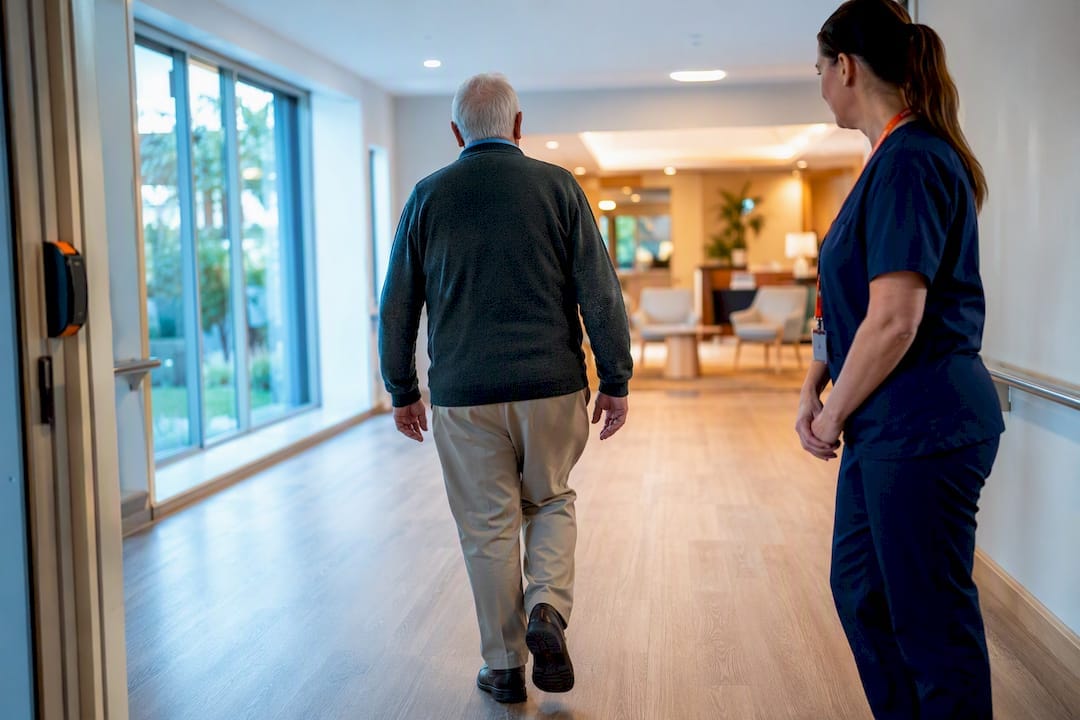
The safest approach right now is person-centred: pair non-pharmacological strategies with environmental controls and a written response plan, then follow up with a proper clinical risk assessment. Wandering isn’t a problem to shut down. It’s a need to understand, and the goal is safe walking, not restraint.
TL;DR:
- Regular risk assessments should be conducted quarterly, with immediate updates after medication changes or behavioral shifts to keep the care plan current.
- Environmental modifications, such as camouflage exit doors and pressure-sensitive mats, can significantly reduce elopement risk without making the facility feel restrictive.
- Tracking devices like GPS and door sensors serve as supplementary tools and must be paired with vigilant supervision and staff training to be effective.
- A prompt, coordinated response within the first 15 minutes of a person going missing, including staff and police notification, is crucial to prevent tragedy.
- Non-pharmacological interventions, like establishing a predictable daily routine and validating resident feelings, are the primary strategies for managing wandering behavior.
Table of Contents
- What is patient wandering prevention and who needs it most?
- Why do patients wander? Common causes and reversible triggers
- Non-pharmacological strategies that reduce wandering risk
- Environmental changes that stop exits without locking anyone in
- Do tracking devices and alarms actually prevent wandering?
- What to do in the first hour after someone goes missing
- How often should wandering risk be reassessed?
- How facility policy and access control support clinical care
- Restraints, privacy, and the ethics of keeping someone safe
- Getting family and the care team on the same page
- When medication becomes part of the plan
- Balancing safety and independence
- How Abcosecurity helps facilities operationalise a wandering plan
- Sources
- FAQ
What is patient wandering prevention and who needs it most?
Patient wandering prevention means identifying people likely to walk into danger and putting supports in place before it happens, not reacting after they’ve gone missing. Certain patients need that closer watch far more than others.
Risk climbs with the stage of dementia, particularly moderate stages where mobility and memory are still intact but judgement and orientation are not. A prior episode of wandering is the single strongest predictor of another. Sensory impairment, unmet toileting needs, and a recent move to unfamiliar surroundings all add to the picture.
- Dementia during stages when mobility is retained but judgement and orientation decline
- A history of wandering or getting lost documented by caregivers
- Recent admission or relocation, especially during the early adjustment period
- Sensory impairments such as hearing or vision loss contributing to disorientation
- Restlessness potentially linked to unmet physical needs like toileting, hunger, or pain
- Agitation patterns that may increase during certain times of day, such as late afternoon
Log the time, location, and apparent trigger of every incident. A pattern showing repeated attempts, especially near exits or at consistent times of day, should push someone into a high-risk category with more frequent checks and a tighter care plan.
Why do patients wander? Common causes and reversible triggers
Wandering is usually communication, not confusion for its own sake. The person is trying to meet a need they can’t otherwise express: pain, thirst, boredom, anxiety, or the urge to use the toilet. Before adding any restriction, work through the reversible causes.
- Check for infection or illness first. A urinary tract infection or other acute illness can trigger sudden agitation and wandering that resolves once treated.
- Review medications. Sedatives, new prescriptions, or drug interactions can cause delirium that looks like wandering behaviour.
- Rule out physical discomfort. Pain, constipation, hunger, or an overfull bladder often drive restless movement.
- Look at the environment. Noise, poor lighting, or an unfamiliar layout can provoke a search for something familiar.
- Consider emotional state. Anxiety, loneliness, or a wish to find a past routine (going to work, collecting children) frequently sits behind “I want to go home.”
Clinicians recommend a systematic work-up of physical health and triggers before assuming a purely behavioural response is needed. A simple wandering diary tracking time, location, and what happened just before each episode often reveals the actual driver within a week or two.
Non-pharmacological strategies that reduce wandering risk
Non-pharmacological interventions are the recommended first-line approach for managing wandering, and antipsychotics are generally discouraged for mild-to-moderate symptoms because of the serious side-effect risk they carry. That guidance shapes everything below.
Structure does more heavy lifting than most carers expect. A predictable daily rhythm, meals, activity, rest, at the same times reduces the disorientation that often triggers wandering. Supervised exercise burns off restlessness that would otherwise surface as pacing near an exit.
- Build a daily schedule with fixed meal, activity, and rest times
- Offer meaningful tasks: folding washing, gardening, sorting objects
- Get the person outside in daylight each morning to support circadian rhythm
- Schedule stimulating activity earlier in the day to reduce late-afternoon agitation
- Use music during high-risk periods; it measurably reduces wandering and night-time restlessness
When someone insists they need to “go home,” arguing rarely helps and often escalates distress. Validate the feeling first (“You miss home, that makes sense”) then redirect: a cup of tea, a photo album, a short walk in a safe garden. Practitioners specifically warn against arguing the point, because it tends to make wandering worse, not better.
Staff training should focus on three things: recognising early agitation cues, using validation language instead of correction, and knowing the facility’s response plan cold.
Pro Tip: Keep a laminated card at the nurses’ station with three go-to redirection lines for “I need to go home” moments. Staff under pressure default to arguing when they haven’t rehearsed an alternative.
Environmental changes that stop exits without locking anyone in
Small physical changes at doors, windows, and walkways cut elopement risk without making a facility feel like a lockup. Dementia Australia’s practical guidance recommends removing departure cues, creating safe walking areas, and keeping identification on the person at all times.
- Fit door locks at unusual heights (high or low), out of the typical eye line
- Camouflage exit doors with matching paint or a curtain to reduce their visual pull
- Use pressure-sensitive mats or door chimes to alert staff to movement
- Place large, clear clocks and directional signage at eye level for wayfinding
- Remove coats, keys, or bags left near exits, common triggers for a “leaving” impulse
- Designate an enclosed garden or looped indoor path for safe, unsupervised walking
- Keep night lighting on in hallways and bathrooms to reduce disorientation after dark
- Limit fluids close to bedtime and use bathroom-adjacent rooms where possible
None of this needs to look institutional. A repainted door and a well-placed clock often do more than a locked ward.
Do tracking devices and alarms actually prevent wandering?
Technology helps, but it’s an adjunct to supervision, never a replacement for it. Devices fail, batteries die, and signals drop, so no facility or family should treat a tracker as a substitute for eyes and ears.
- Sew-in ID labels or medical alert bracelets speed up identification if someone is found by the public
- Registering with a safe-return program gives police and the community a faster way to reunite a missing person with carers
- Door sensors, pressure mats, and motion detectors work best when linked directly to a staffed response, not just a beeping panel
- GPS trackers help locate someone quickly outdoors but can be forgotten, removed, or lose signal indoors
- Consent and privacy matter under Australian aged-care standards; tracking a competent adult without agreement raises real ethical issues, discussed further below
A person-centred framework that blends interpersonal care, selected technology, and clear facility policy consistently outperforms relying on any single layer alone. Facilities weighing new hospital security systems should treat alarms and sensors as one part of that layered approach, not the whole plan.
What to do in the first hour after someone goes missing
Speed matters more than anything else in the first sixty minutes. Delay is the biggest factor that turns a wandering incident into a tragedy.
- Search immediately and locally. Check bathrooms, stairwells, garden areas, and any room with a door left open.
- Alert every staff member on shift and assign someone to watch the main exits while others search.
- Call neighbours or nearby businesses if the person may have left the property, and preserve the last known sighting location and time.
- Call police once the immediate search is exhausted, generally within 10 to 15 minutes for a high-risk person. Provide a recent photo, physical description, likely destinations, and known routes.
- Contact the family and, if registered, the safe-return service the person is enrolled with.
- Log the incident fully once the person is found or police take over, timing, actions taken, and outcome.
Pro Tip: Print the search file before it’s needed. Trying to find a recent photo while someone is missing wastes minutes you don’t have.
How often should wandering risk be reassessed?
Risk isn’t static, so assessment shouldn’t be either. Clinical guidelines call for formal review on admission, again at 72 hours, then quarterly, with monthly checks for anyone flagged as high risk.
- Keep a maintained search file: recent photo, physical description, favourite destinations, and usual routes
- Use a structured tool like the Australian-developed SWAP assessment to standardise how walking-related risk gets scored
- Map assessment outcomes directly to supervision levels, low risk might mean routine checks, high risk means line-of-sight supervision and daily documentation
- Update the plan any time medication, mobility, or cognition changes, not just at the scheduled review
A search file that’s a year out of date is close to useless. Update the photo every few months.
How facility policy and access control support clinical care
Clinical strategies work best when the building itself backs them up. A written policy should spell out reception checks on anyone entering or leaving, staff roles during a wandering alert, and a clear escalation flow from first sighting to police contact.
- Reception staff trained to notice and gently redirect a disoriented person near exits
- Access control on external doors that alerts staff without feeling like a locked cage
- Monitored alarms tied to a real response, not just a siren nobody answers
- Regular staff drills so the escalation flow is automatic, not improvised
Reviewing reception security priorities and hospital access control systems alongside your clinical protocols closes the gap between “we have a plan” and “our building actually supports it.”
Restraints, privacy, and the ethics of keeping someone safe
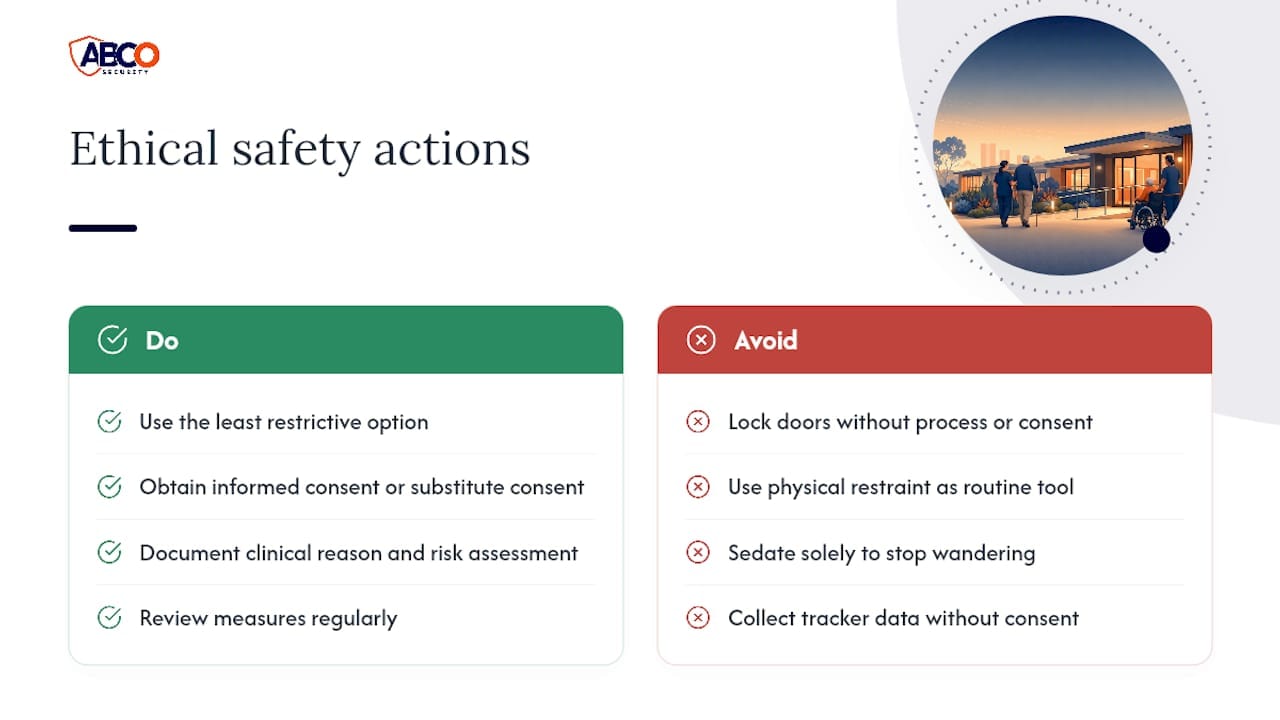
Locking a door or fitting a tracker on someone who hasn’t consented isn’t a neutral safety measure. It’s a restriction on a person’s liberty, and Australian aged-care standards treat it that way.
Physical and chemical restraint are now regulated activities in residential aged care, not routine tools. A facility generally needs informed consent from the person or their substitute decision-maker, a documented clinical reason, and evidence that less restrictive options were tried first. Locking someone in a room, using a chair they can’t get out of unassisted, or sedating them purely to stop wandering all fall into this category, and using them without proper process exposes a facility to real regulatory risk.
Privacy cuts the other way too. GPS trackers and door sensors collect movement data on a vulnerable person, and that data needs the same consent-based handling as any other health information. Family members sometimes push for tracking out of fear, but the person being tracked still has rights unless a guardian has been formally appointed.
The practical rule most facilities land on: use the least restrictive option that keeps the person safe, document why it was chosen, review it regularly, and involve family in the decision rather than presenting it as settled. A locked door installed without that process is a liability. The same door, installed after a documented risk assessment and family discussion, is defensible care.
None of this means avoiding physical security measures. It means pairing them with a paper trail that shows the reasoning behind each one.
Getting family and the care team on the same page
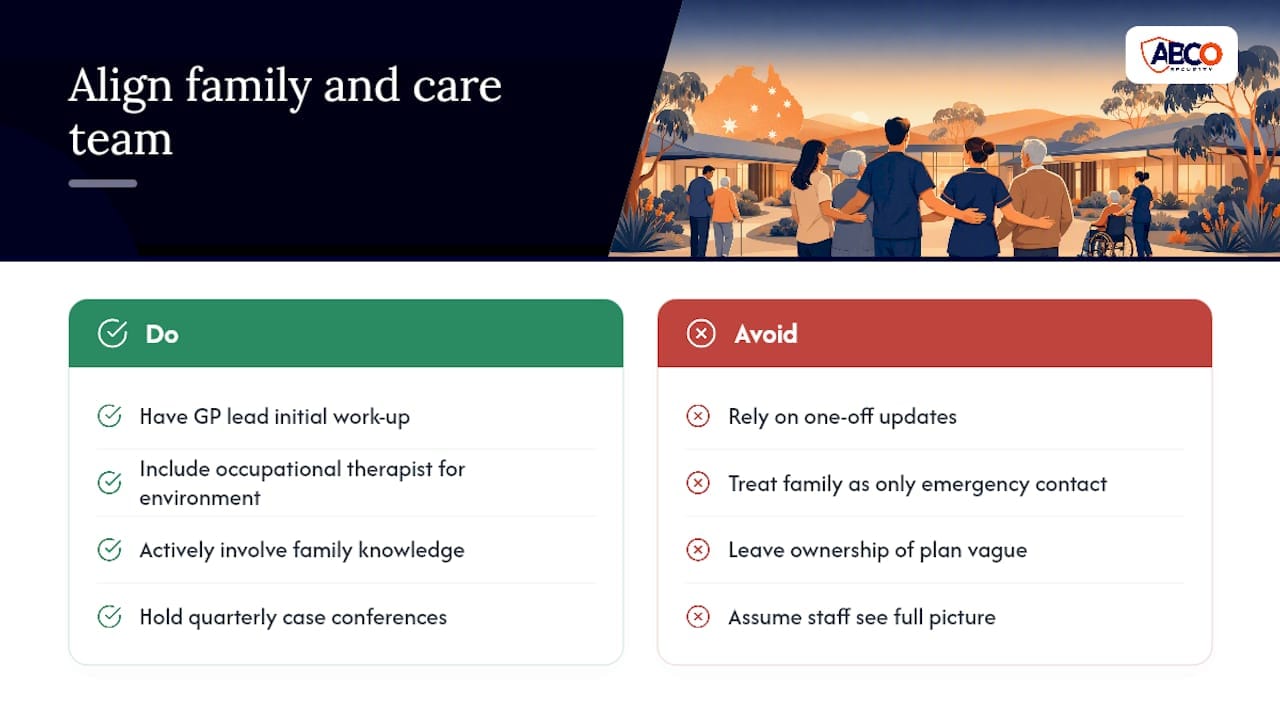
Wandering plans fail more often from poor communication than from bad ideas. A GP, aged-care nurse, occupational therapist, and family member each see a different slice of the person’s behaviour, and none of them has the full picture alone.
A GP or geriatrician should lead the initial medical work-up, ruling out infection, medication side-effects, and pain before any behavioural plan gets written. Occupational therapists are often the most useful voice on environmental changes. They know how to assess a specific building layout for exit risks and safe walking routes, not just recite general advice.
Family input matters just as much as clinical input, arguably more. A spouse or adult child usually knows the person’s history, their old routines, and what “going home” actually means to them, information no chart captures. That knowledge shapes redirection scripts that actually land, rather than generic ones that feel hollow to the person hearing them.
Case conferences work better than one-off updates. Bring the GP, nursing staff, and family together at each quarterly review, not just when something has gone wrong, and use that meeting to update the search file and adjust supervision levels together. Facilities that treat family as an information source, not just a contact number for emergencies, catch changes in baseline behaviour faster than staff working in isolation ever will.
Document who is responsible for what. Vague ownership of a wandering plan is how obvious risks get missed.
When medication becomes part of the plan
Medication should enter the conversation only after non-pharmacological options have had a genuine trial, and even then, it comes with real limits. This isn’t a step to skip toward when a behavioural plan feels slow to work.
Antipsychotics carry documented risks in people with dementia, including increased stroke risk and higher mortality, which is why guidance is explicit that they’re not appropriate for managing mild-to-moderate wandering. They are sometimes considered for severe agitation that puts the person or others at immediate risk, and only at the lowest effective dose for the shortest possible period.
Sedatives used purely to stop someone walking around raise the same restraint concerns discussed earlier, plus a practical one: sedated patients fall more, and falls in older adults with dementia carry serious consequences of their own. Trading a wandering risk for a fall risk isn’t a win.
Where medication is genuinely warranted, treat it as one part of a broader plan, not a replacement for the environmental and behavioural work already in place. Reassess regularly and taper off as soon as the underlying trigger, often pain, infection, or acute distress, resolves. A prescription written six months ago and never revisited is a red flag for any care plan review.
The honest summary: medication has a narrow, specific role for genuine crisis situations, and almost no role as a default response to ordinary wandering behaviour.
Balancing safety and independence
Dignity and safety pull against each other constantly in dementia care, and pretending otherwise helps nobody. Good planning doesn’t eliminate that tension, it just stops it from becoming a crisis. For the building-level side of that plan, ABCO can help.
— Abco
How Abcosecurity helps facilities operationalise a wandering plan
A clinical care plan is only as strong as the building behind it. Some security providers work with aged-care and healthcare facilities to close that gap: risk assessments that map exit points and blind spots, access control fitted to how staff actually move through the building, and monitored alarms tied to a real 24/7 response rather than a panel nobody’s watching.
Staff training rounds it out, covering escalation flow, reception checks, and what to do in the first minutes after someone goes missing. Facilities already reviewing their wandering protocols often start with a formal risk assessment to see exactly where the physical building falls short of the clinical plan on paper. If you manage a facility and want that gap mapped honestly, get in touch with Abcosecurity for a site assessment and a straight answer on what needs fixing first.
This article is general information, not a substitute for advice from a qualified doctor. Consult a qualified healthcare professional about your own circumstances before acting on anything here.
Sources
- The RACGP silver book: behavioural and psychological symptoms of dementia
- Clinical guidance on dementia behaviours (CDPC/Dementia guidelines)
- Wandering | Dementia Australia
- Framework for wandering management (Brain Sci. review)
FAQ
What is the best way to handle a wandering patient?
Start with a medical check to rule out pain, infection, or medication side-effects, then use validation and redirection rather than argument, backed by a documented environmental and supervision plan.
How do you stop an elderly person from getting out of bed unsafely?
Use low-cost measures like pressure-sensitive mats, night lighting, and addressing toileting or discomfort before bed, since unsafe night movement is often the person trying to meet an unmet need.
At what stage do dementia patients typically start wandering?
Wandering often occurs during the moderate stages of dementia, where mobility is preserved but memory, judgement, and orientation may be impaired.
What should you say when someone with Alzheimer’s wants to go home?
Validate the feeling instead of correcting it (“I understand you miss home”), then redirect to a calming activity, since arguing tends to escalate distress rather than resolve it.
Recommended
about
avada factory
Sempery ultricies nibh at dolor cras urna eleifend nec. Atiam efficitur tempor.