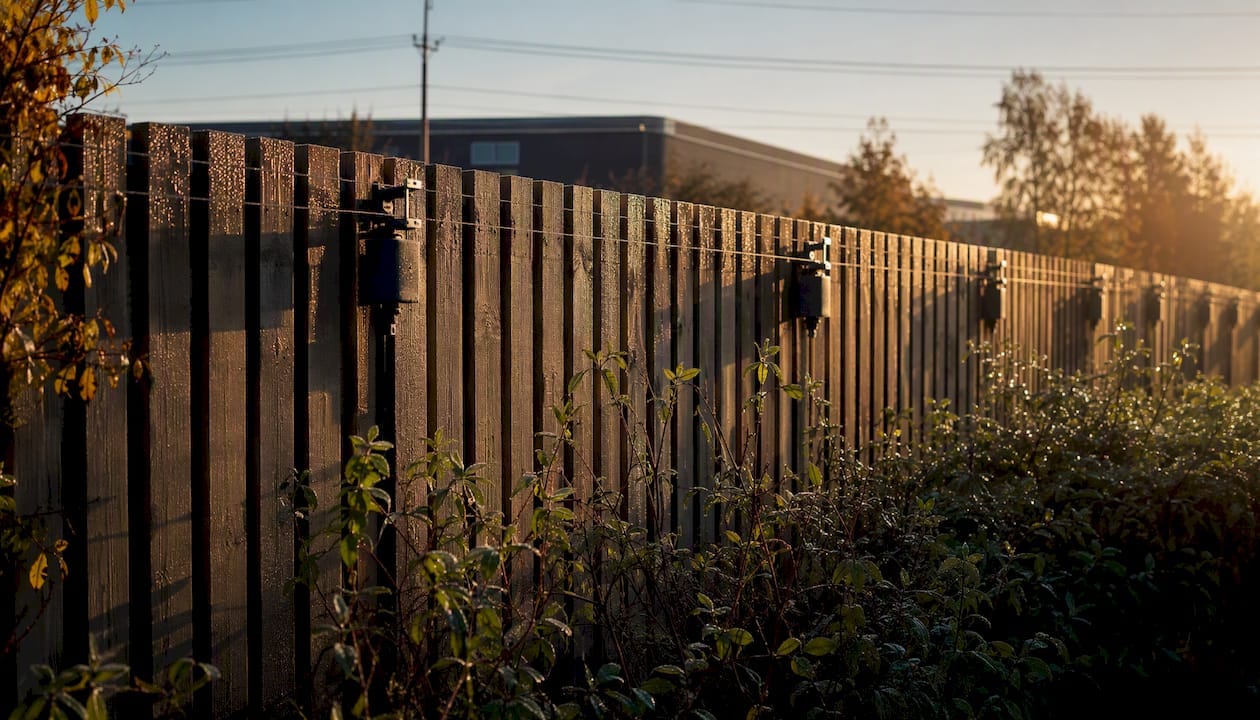
A perimeter intrusion detection system (PIDS) is a layered set of sensors, analytics, and alarm-signalling components that detects an intruder at or before the boundary of a protected site, giving security teams time to verify and respond before a breach reaches the asset. The single most important thing you can do before selecting any technology is to commission an operational requirements (OR)–led site survey.
Before you open a vendor catalogue, work through these three steps:
- Define your threat profile: who is likely to attempt access, how, and from which direction.
- Decide whether a sterile zone (a cleared buffer between the outer fence and the inner asset) is achievable and what width is realistic.
- Map environmental constraints: vegetation, wildlife, soil type, prevailing weather, and proximity to public areas.
Pro Tip: Write your operational requirements document before you speak to a single vendor. Every technology choice you make after that point should be traceable back to a specific OR item. If it is not, cut it.
Key takeaways
Effective perimeter intrusion detection requires an operational requirements document written before any technology is selected, a site survey that maps every environmental nuisance-alarm source, and a commissioning test plan written into the contract before procurement.
| Point | Details |
|---|---|
| OR before technology | Write operational requirements and complete a site survey before approaching any vendor. |
| Demand PoD and FAR figures | Require stated probability of detection and false alarm rate figures with test conditions from every vendor. |
| Integration is not optional | PIDS must connect to CCTV verification and a documented response workflow to be operationally useful. |
| Commission to contract | Specify walk tests, tamper tests, and a FAR baseline period as contractual deliverables, not handover extras. |
| Abcosecurity for full lifecycle | Abcosecurity delivers OR development, installation, commissioning, 24/7 monitoring, and maintenance for PIDS projects across Australia. |
Table of Contents
- What does a perimeter intrusion detection system do?
- What types of PIDS technology are available?
- How do you design and select the right PIDS for a site?
- What performance metrics should you demand from a PIDS?
- How should PIDS integrate with CCTV, access control and response?
- What standards and commissioning tests apply to PIDS?
- Where is PIDS most commonly used, and what are the real limitations?
- What does a PIDS project cost and how long does it take?
- How a professional integrator designs and delivers PIDS
- Cybersecurity considerations for PIDS
- Regulatory and compliance considerations beyond standards
- Environmental impact and sustainability in PIDS deployment
- Training requirements for operators and maintenance personnel
- Sources
- FAQ
What does a perimeter intrusion detection system do?
A PIDS sits at the outermost layer of a defence-in-depth security model, generating an alarm the moment an intruder contacts, crosses, or approaches the boundary, before they reach any door, lock, or access-control point. That early-warning function is what separates a PIDS from an internal intruder alarm: the response clock starts at the fence line, not the front door.
The five architecture layers
A well-designed PIDS is not a single product. It is a stack of five functional layers, each of which must be specified separately:
- Physical barrier layer — the fence, wall, or natural boundary that defines the perimeter and provides the mounting surface or sterile zone for sensors.
- Detection layer — the sensors themselves: vibration cables, buried geophones, microwave beams, radar units, fibre-optic cables, or cameras with video analytics.
- Analytics and processing layer — the controllers, servers, or edge-compute units that filter raw sensor data, classify events, and generate alarm signals. This is where nuisance-alarm suppression happens.
- Alarm transmission layer — the signalling path from the detection layer to the control room: hardwired, fibre, encrypted IP, or cellular backup. Redundancy here is not optional for high-assurance sites.
- Monitoring and response layer — the control room, operator workflows, CCTV verification cameras, dispatch protocols, and incident-logging systems that turn an alarm signal into a graded response.
A PIDS that generates an alarm nobody acts on within a defined time window is operationally equivalent to no PIDS at all. The monitoring and response layer is as important as the sensors themselves.
The NPSA Guide to Perimeter Intrusion Detection Systems makes this point explicitly: operational requirements must drive technology selection, and commissioning tests must validate the full stack, not just the sensor layer.
Pro Tip: Mount transmitters, receivers, and junction boxes on the secure (inner) side of the fence wherever possible. A sensor that can be physically accessed from outside the perimeter is a tamper risk, regardless of how good its electronic tamper detection is.
What types of PIDS technology are available?
The NPSA groups PIDS into four deployment categories: barrier-mounted, ground-based/buried, free-standing/volumetric, and wide-area systems. Video analytics and fibre-optic sensing sit across those categories depending on how they are deployed. Each technology has a distinct detection physics, a characteristic nuisance-alarm profile, and a set of environments where it performs well or poorly.
Barrier-mounted systems
Fence-mounted vibration or strain sensors attach directly to a fence or wall and detect the mechanical disturbance caused by climbing, cutting, or lifting. They work well on rigid palisade or weld-mesh fences. On chain-link fences, wind-induced vibration and vegetation contact produce nuisance alarms at a rate that can overwhelm operators unless the analytics layer applies aggressive filtering. Taut-wire systems are a variant: a tensioned wire runs along the fence top, and any deflection triggers an alarm. They are more discriminating than vibration cables on chain-link but require a clean, vegetation-free fence line.
Buried and ground-based sensors
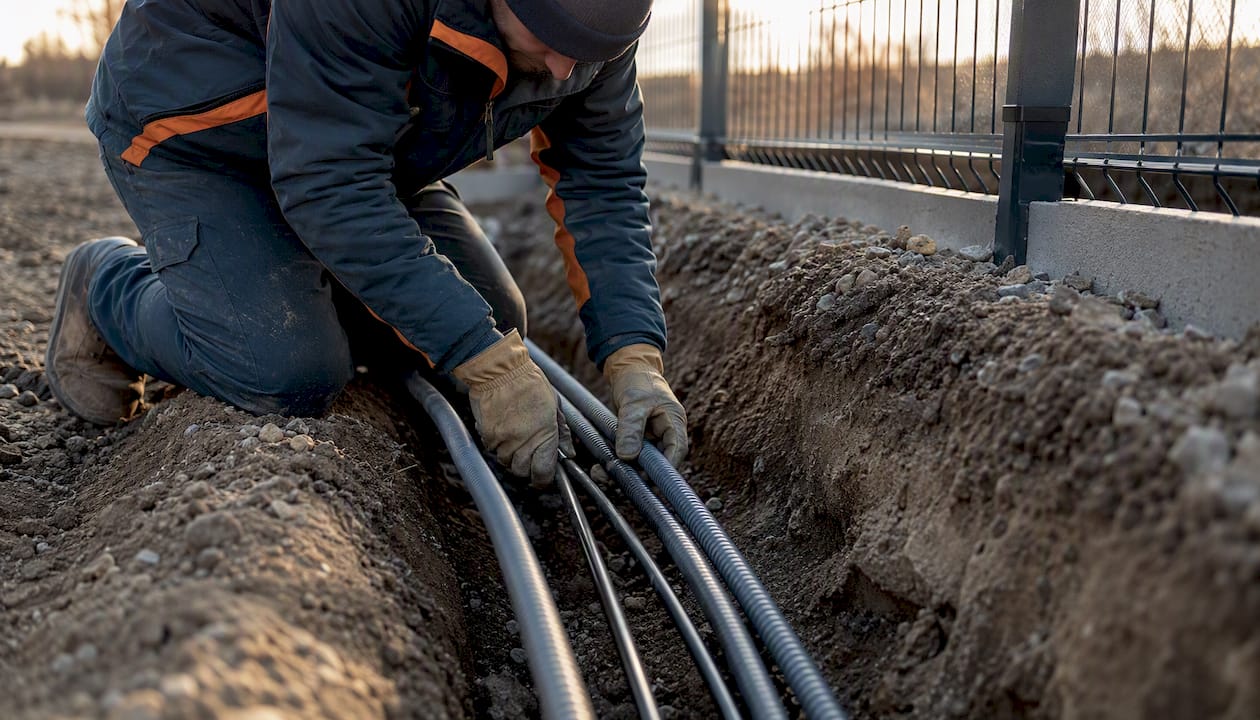
Buried seismic, geophone, or pressure sensors detect footfall vibration transmitted through the ground. Their invisible footprint is a genuine advantage for covert protection, and they are unaffected by weather above ground. The trade-off is civil works: trenching, conduit, and careful backfill are required, and any future ground disturbance (landscaping, utility works) risks damaging the cable run. Detection-zone design is critical because soil type, moisture content, and compaction all affect how far a footfall signal travels. A peer-reviewed sensor study confirms that environmental variables such as soil moisture and surface cover significantly affect the sensitivity of ground-based sensing modalities.
Free-standing volumetric sensors
Passive infrared (PIR), microwave, and dual-technology (PIR + microwave) detectors create a detection volume in open space rather than on a barrier. They are cost-effective for covering open ground between a fence and a building, and they install quickly. Their weakness is range: most units cover 20–100 metres, so large perimeters need many units. PIR sensors are sensitive to temperature differentials, which means animals, blowing debris, and solar heating of surfaces all generate nuisance alarms. Dual-technology units reduce this by requiring both PIR and microwave channels to trigger simultaneously.
Wide-area radar and LiDAR
Ground-based radar and LiDAR units can cover hundreds of metres from a single unit, making them attractive for open-ground perimeters, ports, airports, and large utility sites. Radar tracks moving targets and is largely unaffected by darkness, rain, or fog. LiDAR produces a higher-resolution point cloud and can classify target shape. Both require skilled configuration to suppress false tracks from wildlife, blowing vegetation, and vehicle traffic near the perimeter. Experimental performance data confirms that radar and LiDAR each have distinct environmental sensitivities that must be characterised during site survey before deployment. They are best used as cueing sources that direct a verification camera to a target rather than as standalone alarm generators.
Fibre-optic sensing
Distributed acoustic sensing (DAS) uses a fibre-optic cable as a continuous linear sensor: any vibration along the cable’s length is detected and localised to within a few metres. The cable can run along a fence, buried in the ground, or attached to a wall. Because the fibre itself is the sensor, there are no active electronics in the field, which reduces maintenance burden and eliminates field-device power requirements. The processing unit at the cable end is the only component requiring power and maintenance. DAS is well suited to long, straight perimeters such as pipeline corridors, airport boundaries, and railway lines.
Video analytics
Camera-based PIDS use computer-vision algorithms to detect movement, classify objects, and generate alarms from video feeds. A 2022 survey of video-based PIDS documents the range of algorithmic approaches and highlights consistent environmental challenges: lighting changes, shadows, rain, fog, and camera vibration all degrade detection performance. Video analytics work best as a verification layer paired with a primary sensor rather than as the sole detection technology. In well-lit, controlled environments with stable camera mounting, they can serve as a primary sensor for short perimeter segments.
Technology comparison
| Technology | Typical detection range | Primary nuisance-alarm sources | Best suited to |
|---|---|---|---|
| Fence-mounted vibration | Fence line only | Wind, vegetation contact, chain-link flex | Rigid palisade/weld-mesh fences |
| Buried seismic/geophone | 3–10 m either side of cable | Heavy rain, vehicle vibration, burrowing animals | Covert protection, sterile zones |
| PIR/microwave volumetric | 20–100 m per unit | Animals, solar heating, blowing debris | Open ground between fence and building |
| Radar/LiDAR wide-area | 100–500+ m per unit | Wildlife, moving vegetation, nearby traffic | Airports, ports, large open sites |
| Fibre-optic DAS | Kilometres per cable | Heavy machinery, rail traffic | Long linear perimeters, pipelines |
| Video analytics | Camera field of view | Lighting changes, shadows, rain, fog | Verification layer, short controlled segments |
Pro Tip: Hybrid deployments consistently outperform single-technology systems. Pairing fence-mounted vibration sensors with a video-analytics verification layer, for example, lets the fence sensor trigger a camera preset so an operator sees the event within seconds of the alarm, dramatically reducing response time and false-alarm follow-up cost.
How do you design and select the right PIDS for a site?
Operational requirements drive technology choice. That is the starting point, not the vendor brochure. The NPSA guide is unambiguous on this: OR development and a structured site survey must precede any technology selection.
Site survey framework
Work through each of these dimensions before shortlisting technologies:
- Threat profile — insider threat, opportunistic intruder, determined adversary, or organised group? Each implies different detection speed, covertness, and response-time requirements.
- Asset value and consequence — what is the cost of a successful breach? High-consequence sites (critical infrastructure, data centres, government facilities) justify higher sensor density and redundancy.
- Approach vectors — which fence sections, gates, or natural boundaries are most likely to be used? Sensor density should reflect risk, not be uniform across the perimeter.
- Visibility and sterile zone — can a cleared buffer zone be maintained? Without a sterile zone, vegetation management becomes a continuous operational cost.
- Environmental constraints — prevailing wind, frost, flooding, soil type, wildlife species present, and proximity to roads or rail lines all affect which technologies will produce acceptable nuisance-alarm rates.
- Public access — does the perimeter adjoin a public footpath, road, or park? This affects both nuisance-alarm sources and privacy/data-collection obligations.
Vendor specification checklist
Require the following from every vendor responding to your RFP:
- Scaled detection-zone diagrams showing coverage at the specified sensitivity setting, not at maximum sensitivity.
- Stated probability of detection (PoD) and false alarm rate (FAR) figures, with the test conditions under which those figures were measured.
- Environmental tolerance ratings: temperature range, wind speed, rainfall intensity, and any conditions that require the system to be placed in a degraded mode.
- Tamper-protection specifications: what happens when a sensor is cut, shorted, or physically removed?
- Integration documentation: alarm-output formats, API specifications, and any proprietary control-room software requirements.
- Commissioning test plan: a written test methodology the vendor will execute and sign off before handover.
- Spares list and recommended holding quantities for a two-year maintenance period.
- Training plan for operators and maintenance technicians.
Pro Tip: Ask vendors to provide PoD and FAR figures from an independent third-party test, not just from their own laboratory. If they cannot, treat their stated figures as aspirational and build contingency into your acceptance-test criteria.
For asset protection at high-value sites, the procurement brief should also specify the minimum response time from alarm to operator acknowledgement and from acknowledgement to dispatch, so the PIDS design can be validated against those timelines.
What performance metrics should you demand from a PIDS?
Five metrics define whether a PIDS is actually working:
- Probability of detection (PoD) — the proportion of genuine intrusion events that generate an alarm. A system with a PoD of 95% misses one in twenty real intrusions at the specified sensitivity setting.
- False alarm rate (FAR) / nuisance alarm rate (NAR) — the number of alarms per unit time that are not caused by a genuine intrusion. High FAR leads to operator desensitisation and delayed response.
- Detection time — the elapsed time from the moment an intruder contacts or crosses the detection zone to the moment an alarm is generated. For most applications, sub-10-second detection time is the target.
- Localisation accuracy — how precisely the system can identify where along the perimeter the alarm originated. Poor localisation forces operators to review long camera segments or dispatch guards to a wide search area.
- Mean time to repair (MTTR) — the average time to restore a failed sensor or zone to full operation. A long MTTR means extended gaps in coverage that may not be immediately visible to operators.
Practical tuning techniques
Raw sensor output almost always needs tuning before a system reaches its specified PoD/FAR balance. Common techniques include:
- Zone discrimination — dividing the perimeter into short, independently alarmed zones so a nuisance event in one zone does not mask a genuine alarm in an adjacent zone.
- Time-of-day masking — suppressing alarms from zones adjacent to public areas during business hours when foot traffic is expected, while maintaining full sensitivity outside those hours.
- Analytic threshold adjustment — raising or lowering the signal amplitude or duration required to trigger an alarm in each zone based on observed nuisance-alarm sources.
- Seasonal tuning — recalibrating sensors after seasonal vegetation growth, leaf fall, or ground-frost cycles that change the acoustic or thermal background.
- Environmental filters — applying wind-speed or rainfall-rate inputs to automatically adjust sensitivity during adverse weather.
SLA and acceptance-test items
Include these as contractual requirements, not optional extras:
- Walk tests: a person of specified weight walks the full perimeter at a defined pace; every zone must alarm within the specified detection time.
- Simulated climb test: a person climbs the fence at three randomly selected points; PoD must meet the specified threshold.
- Environmental stress test: sensors must maintain specified PoD during rain, wind, and temperature extremes representative of the site’s climate.
- Tamper test: physically removing or shorting a sensor must generate a tamper alarm within 30 seconds.
- FAR baseline: a 30-day monitoring period with no deliberate intrusion events; the FAR must not exceed the contracted threshold.
Commissioning tests that are not contractually specified before procurement are rarely executed rigorously after installation. Write the test plan into the contract, not the handover checklist.
How should PIDS integrate with CCTV, access control and response?
A PIDS that generates an alarm with no verified image and no dispatch protocol is a liability, not an asset. Integration with CCTV verification and a structured response workflow is what converts a sensor signal into an operationally useful event.
Integration layers
Alarm signalling connects the PIDS controller to the control room via a monitored path. Any break in that path should generate a fault alarm, not silence. Use encrypted signalling over dedicated management VLANs rather than shared network infrastructure.
Video verification links each PIDS zone to one or more camera presets. When a zone alarms, the relevant camera automatically slews to the preset covering that zone and begins recording. The operator sees the event within seconds rather than hunting through a camera grid. A video-based PIDS survey confirms that camera-based verification significantly improves operator confidence in alarm classification.
Access control integration allows the PIDS to automatically lock down gates or doors in the alarmed zone, preventing an intruder from using a legitimate access point while a response is underway. For practical guidance on integrating these systems, access control for business provides a useful framework.
Operator workflow defines what the operator does in the first 60 seconds after an alarm: acknowledge, view the camera preset, classify the alarm (genuine, nuisance, or unknown), and initiate the appropriate response. Without a written playbook, operators improvise, and response times become unpredictable.
Control-room playbook example
A graded response structure for a PIDS alarm might look like this:
- Grade 1 (unverified alarm): Operator acknowledges within 60 seconds, reviews camera preset, and classifies.
- Grade 2 (verified intrusion): Operator dispatches on-site guard and notifies site manager within 90 seconds of classification.
- Grade 3 (confirmed breach or multiple zones): Operator escalates to police or emergency services, activates site lockdown, and notifies senior management.
Every grade should have a maximum response time, a named escalation contact, and a logging requirement.
Cybersecurity checklist for PIDS components
The Australian Signals Directorate’s physical security guidelines warn that network devices in publicly accessible locations require physical protection to prevent tampering. For PIDS specifically:
- Place all network-connected field devices in locked, tamper-evident enclosures.
- Segment PIDS traffic on dedicated management VLANs, isolated from general corporate or operational networks.
- Disable all unused physical ports on controllers and network switches.
- Enforce firmware update schedules: patch all PIDS components within 30 days of a vendor security release.
- Use strong, unique credentials for every device; disable default passwords before commissioning.
Pro Tip: Treat the PIDS signalling path as a critical communications circuit. If an adversary can cut or jam the alarm transmission layer without generating a fault alarm, your sensor investment is wasted. Specify supervised signalling paths and test the fault-alarm function during commissioning.
What standards and commissioning tests apply to PIDS?
The most directly relevant Australian standards for PIDS specification and acceptance are the AS/NZS 2201 series, which cover intruder alarm system design (AS/NZS 2201.1:2007), monitoring centres (AS 2201.2:2022), and detection-device considerations. For international reference, the NPSA guide provides detailed commissioning test methodology that complements the AS/NZS framework.
Commissioning test schedule
| Test type | Method | Pass criterion |
|---|---|---|
| Walk test (full perimeter) | Person walks each zone at defined pace | 100% of zones alarm within specified detection time |
| Simulated climb | Person climbs fence at 3 random points | PoD meets contracted threshold |
| Tamper test | Sensor physically removed or shorted | Tamper alarm within 30 seconds |
| Environmental stress | Test during rain/wind representative of site | PoD maintained within 5% of baseline |
| Verification integration | Alarm triggers camera preset | Camera slews to correct preset within 10 seconds |
| FAR baseline | 30-day passive monitoring | FAR does not exceed contracted threshold |
| Signalling fault | Comms path severed | Fault alarm generated within 60 seconds |
Maintenance schedule
A PIDS that is not maintained degrades silently. Build the following into the service contract:
Daily (operator checks):
- Review fault log for any sensor or comms faults.
- Confirm all zones show healthy status on the control-room display.
Weekly:
- Walk-test a rotating sample of zones (minimum 20% of total zones per week).
- Check vegetation encroachment on fence-mounted and buried sensors.
Quarterly:
- Full perimeter walk test.
- Firmware and software patch review.
- Review FAR log and adjust analytic thresholds if NAR has increased.
- Inspect physical enclosures for tamper evidence, corrosion, or damage.
Annually:
- Full commissioning re-validation against original acceptance-test criteria.
- Review operational requirements against current threat profile and adjust sensor configuration if required.
- Contractor handover documentation updated.
Documentation requirements for acceptance should include: as-built drawings, zone maps, sensor configuration records, test results signed by both integrator and client, operator training records, and a spares register.
Where is PIDS most commonly used, and what are the real limitations?
Critical infrastructure operators, utilities, logistics yards, government facilities, and construction sites are the most common PIDS users, each for different reasons.
Critical infrastructure and utilities (power stations, water treatment plants, substations) need high-PoD systems with low FAR because the consequence of a missed detection is severe and the sites are often remote. Fibre-optic DAS and radar are common choices for long perimeters; fence-mounted vibration sensors cover shorter, higher-risk sections.
Government and defence facilities require certified systems, covert sensor placement, and integration with access control and staffed response. Security for government buildings involves additional certification and procurement requirements that affect both technology selection and vendor eligibility.
Construction sites present a different challenge: the perimeter changes as the project progresses, and the site is occupied during the day by legitimate workers. Rapidly deployable volumetric sensors, temporary fence-mounted vibration cables, and mobile CCTV towers with video analytics are the practical options. For detailed guidance on construction site security technology, temporary PIDS must be re-sited and re-commissioned each time the perimeter moves.
Logistics yards and ports have large open areas, high vehicle traffic, and legitimate after-hours activity that complicates alarm classification. Radar cueing with video verification is well suited here because radar can track a person-sized target among vehicles and direct a camera to verify before an alarm is escalated.
Limitations to plan for
- Environmental false alarms are the single biggest operational problem with any PIDS. No technology is immune; the question is which nuisance-alarm sources are present on your site and which technology is least sensitive to them.
- Wildlife triggers volumetric and buried sensors regularly on rural or semi-rural sites. Radar and video analytics can classify target size, which helps, but does not eliminate wildlife alarms entirely.
- Maintenance burden is often underestimated. Vegetation control alone on a fence-mounted system can require monthly contractor visits on sites with fast-growing vegetation.
- Verification gaps occur when a camera preset does not cover the full alarmed zone, or when lighting is insufficient for the camera to produce a usable image at night.
- Public-access adjacency limits sensitivity settings on perimeter sections adjoining footpaths or roads, creating a lower-detection-quality zone that must be compensated by other means (lighting, guards, or additional camera coverage).
Pro Tip: For temporary deployments on construction sites or events, specify rapid-deploy volumetric sensors with cellular alarm transmission and battery backup. Avoid technologies that require civil works or fixed power supplies unless the deployment period justifies the installation cost.
What does a PIDS project cost and how long does it take?
A PIDS project moves through five phases, and the timeline for each depends heavily on site complexity, technology choice, and procurement method. Early phases like operational requirements and site survey usually require several weeks, with design, procurement, installation, and commissioning adding further time. Total elapsed time from OR development to operational handover typically spans several months for a medium-complexity site.
Timeline drivers by site size
- Small site (single building, perimeter under 500 m): 3–5 months total; fence-mounted or volumetric sensors, minimal civil works.
- Medium site (industrial or logistics, 500 m–2 km perimeter): 5–8 months total; likely hybrid technology, some civil works, control-room integration.
- Large site (critical infrastructure, airport, port, perimeter over 2 km): 8–18 months total; radar or DAS, significant civil and comms infrastructure, formal tender process.
Primary cost drivers
- Sensor type and density — radar and DAS cost significantly more per linear metre than fence-mounted vibration cables; volumetric sensors fall in between.
- Communications infrastructure — running fibre or hardwired signalling across a large site can exceed the sensor cost on greenfield installations.
- Civil works — trenching for buried sensors or fibre runs is the largest variable cost on most projects.
- Verification cameras — high-resolution PTZ cameras with IR illumination for night-time verification add materially to the total.
- Control-room integration — integrating PIDS alarms into an existing video management system (VMS) or security management platform can require custom development.
How a professional integrator designs and delivers PIDS
A professional integrator delivers a documented, tested, and maintainable system, not just installed hardware. The expected outcome for the client is a PIDS that meets its specified PoD and FAR targets on day one of operation and continues to meet them across its service life.
Abcosecurity implementation checklist
Site survey deliverables:
- Scaled perimeter map with approach-vector risk ratings for each fence section.
- Environmental constraint register: vegetation, wildlife, soil type, weather, public-access zones.
- Sterile-zone assessment and recommendations.
- Existing infrastructure audit: power availability, comms routes, existing cameras and access-control points.
- Draft threat profile aligned to the client’s security risk assessment.
Operational requirements template elements:
- Detection goal per fence section (PoD threshold, detection time, localisation accuracy).
- Acceptable FAR per zone per 24-hour period.
- Response-time requirements from alarm to operator acknowledgement and from acknowledgement to dispatch.
- Integration requirements: VMS platform, access-control system, monitoring centre.
- Environmental tolerance requirements specific to the site.
Integration milestones:
- Zone map and camera-preset alignment confirmed before installation begins.
- Alarm-signalling path tested end-to-end before sensor installation.
- VMS integration tested with simulated alarms before live sensor connection.
- Operator workflow documented and approved before commissioning tests begin.
Testing and acceptance criteria:
- Full commissioning test plan executed and results documented.
- FAR baseline monitoring period completed before formal handover.
- All faults identified during testing rectified and re-tested before sign-off.
Operator training and handover items:
- Minimum two days of control-room operator training covering alarm classification, camera-preset operation, and escalation procedures.
- Written operator playbook covering graded response, escalation contacts, and logging requirements.
- Maintenance technician training covering sensor adjustment, fault diagnosis, and vegetation management.
- As-built documentation package: zone maps, configuration records, test results, spares register.
Sample RFP technical response items
Require vendors to address these in their technical submission:
- Detection-zone diagrams at the specified sensitivity setting for each proposed technology.
- PoD and FAR figures with test conditions and, where available, independent test evidence.
- Environmental tolerance data for the site’s specific climate and soil conditions.
- Integration API documentation and any proprietary software licensing requirements.
- Commissioning test plan methodology and sign-off process.
- Maintenance schedule and response-time commitments for fault rectification.
- References from comparable installations (sector, perimeter length, technology type).
Abcosecurity holds ISO 9001 certification and brings over 15 years of integrated security experience across construction, healthcare, government, and corporate environments.
Cybersecurity considerations for PIDS
Modern PIDS are networked systems, and that connectivity creates attack surfaces that did not exist in earlier analogue installations. Three threat vectors deserve specific attention.
Signal tampering and jamming affects wireless PIDS components: microwave beams, wireless alarm transmitters, and cellular backup paths can all be disrupted by deliberate interference. Specify supervised signalling on all critical paths so that a loss of signal generates a fault alarm rather than silence. Wired or fibre signalling paths are preferable for high-assurance applications.
Software vulnerabilities in PIDS controllers, analytics servers, and VMS platforms are a growing concern. Many PIDS controllers run embedded operating systems that receive infrequent vendor updates. Require vendors to provide a software bill of materials (SBOM) and a patch-support commitment for the full expected service life of the system. The ASD’s physical security guidelines reinforce that physical access restrictions to network devices are a baseline requirement, not an optional hardening measure.
Hacking and unauthorised access to PIDS management interfaces can allow an adversary to suppress alarms, alter zone configurations, or extract camera footage. Mitigations include: network segmentation (dedicated management VLAN), multi-factor authentication for all management interfaces, role-based access control, and audit logging of all configuration changes. For specialist guidance on network protection for security systems, integrating PIDS cyber-hardening into a broader network security programme is the most defensible approach.
Regulatory and compliance considerations beyond standards
PIDS deployment intersects with several regulatory frameworks that sit outside the AS/NZS standards.
Privacy and surveillance laws apply wherever PIDS cameras or video analytics capture images of people who are not on the protected site, including members of the public on adjacent footpaths or roads. In Australia, the Privacy Act 1988 and state-level surveillance legislation govern the collection, storage, and use of personal information captured by security cameras. Cameras must be positioned and configured to minimise capture of people outside the protected boundary, and data-retention periods must comply with applicable legislation.
Critical infrastructure obligations under the Security of Critical Infrastructure Act 2018 (Cth) impose risk-management programme requirements on operators of critical infrastructure assets, which include physical security measures. PIDS deployed at assets covered by that Act must be documented as part of the operator’s critical infrastructure risk management programme (CIRMP).
Contractor licensing for PIDS installation varies by state and territory. In most Australian jurisdictions, installation of alarm systems requires a licensed security equipment installer. Confirm that your integrator holds the relevant licence for the jurisdiction before signing a contract.
Data sovereignty applies when PIDS analytics or video footage is processed or stored in cloud platforms. Confirm that any cloud-based analytics or storage component uses Australian-hosted infrastructure if your site’s security classification or contractual obligations require it.
Environmental impact and sustainability in PIDS deployment
Sustainability considerations are increasingly part of procurement decisions for large infrastructure projects, and PIDS is no exception.
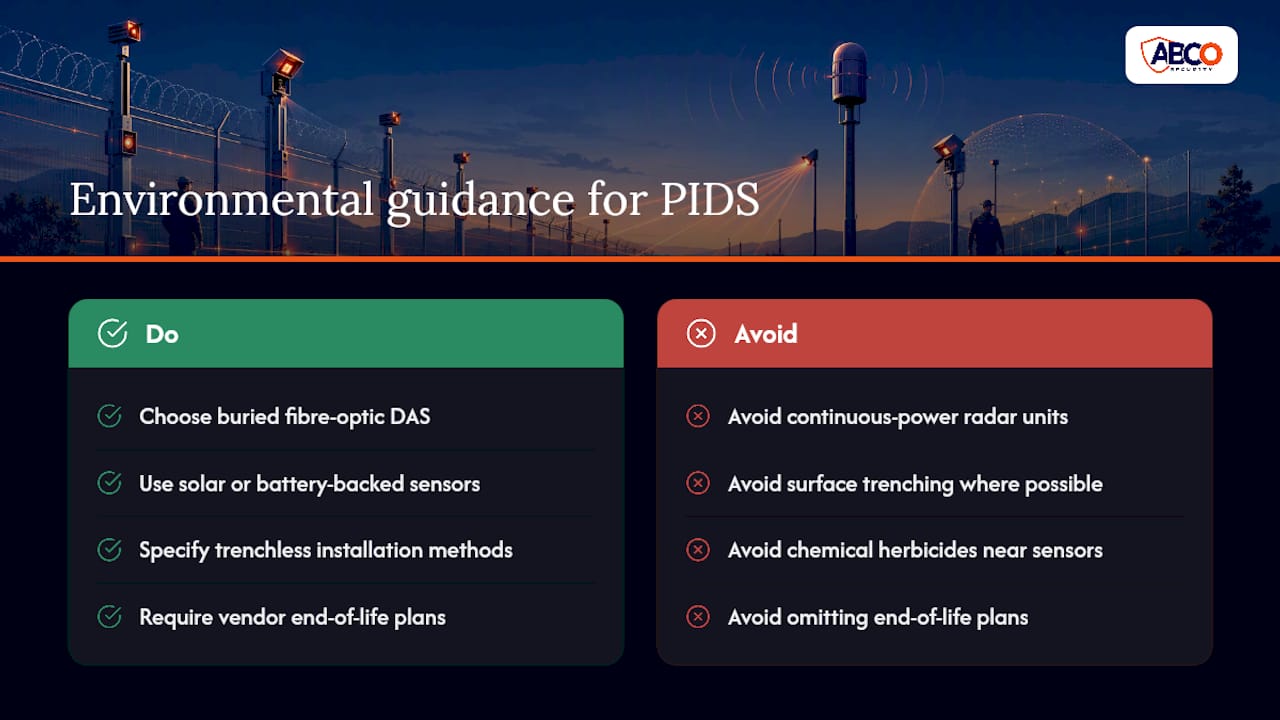
Power consumption varies significantly by technology. Buried fibre-optic DAS systems have no active field electronics and consume power only at the interrogator unit, making them among the lowest-energy options for long perimeters. Radar units, by contrast, consume continuous power and generate heat. Where grid power is unavailable or carbon reduction is a project objective, solar-powered volumetric sensors or battery-backed wireless fence sensors reduce both installation cost and ongoing energy use.
Civil works impact is the largest environmental footprint item for buried sensor systems. Trenching disrupts soil structure, vegetation, and drainage. Specifying trenchless installation methods (directional drilling) where soil conditions allow reduces surface disturbance. Restoration requirements should be written into the installation contract.
End-of-life planning for PIDS components is rarely addressed in procurement documents. Sensors, cables, and electronics contain materials that require specific disposal pathways. Require vendors to provide an end-of-life disposal plan as part of the equipment specification, particularly for systems containing lithium batteries or legacy electronics.
Vegetation management as an ongoing operational requirement has its own environmental dimension. Chemical herbicides used to maintain sterile zones near buried sensors or fence lines can affect soil and groundwater. Mechanical or manual vegetation control is preferable where the site’s environmental obligations require it.
Training requirements for operators and maintenance personnel
A PIDS is only as effective as the people operating and maintaining it. Training is a contractual deliverable, not an afterthought.
Control-room operators need to understand alarm classification, camera-preset operation, graded response procedures, and escalation protocols. Minimum training should cover: how each sensor technology generates an alarm, what a genuine intrusion alarm looks like versus a nuisance alarm on the camera, how to navigate the VMS to the correct camera preset, and how to log and escalate an event. Two days of structured training before go-live is a reasonable minimum; refresher training annually keeps skills current as staff turn over.
Maintenance technicians require a different skill set: sensor adjustment, fault diagnosis, vegetation management around sensor zones, firmware update procedures, and the documentation requirements for each maintenance visit. Technicians working on networked PIDS components also need basic cybersecurity awareness, particularly around password management and physical port security.
Training documentation should be retained as part of the site’s security management records. In the event of an incident, evidence that operators were trained to the specified standard is a material factor in any subsequent review or legal proceeding.
Pair training with a written operator playbook and a maintenance log template so that institutional knowledge is captured in documents, not just in the heads of individual staff members. When staff change, the playbook is what keeps the system operating as designed.
The mistake most PIDS projects make
The most common failure mode in PIDS projects is treating the system as a product purchase rather than an operational capability. A facility manager specifies a sensor type based on a vendor demonstration, installs it, and then discovers that the nuisance-alarm rate makes the system unusable within six months. The sensors are switched off or set to a sensitivity so low that genuine intrusions are missed.
The correct sequence is the reverse: define what you need the system to detect, under what environmental conditions, with what response time, and at what acceptable false-alarm rate. Then find the technology that meets those requirements. That sounds obvious, but the vendor sales cycle consistently pulls buyers in the wrong direction, leading with product capabilities rather than site-specific operational fit.
The single most valuable thing you can do in the first week of a PIDS project is walk the perimeter with someone who has no stake in selling you a particular technology, and write down every environmental factor that will generate a nuisance alarm. That list becomes the filter through which every vendor proposal is evaluated.
Abcosecurity’s PIDS capability
Abcosecurity delivers integrated security solutions that cover the full PIDS project lifecycle: OR development, site survey, technology selection, installation, commissioning, 24/7 monitoring, and scheduled maintenance. The difference from a product-only supplier is that every engagement starts with a documented operational requirements process, so the technology chosen is matched to the site’s specific threat profile and environmental conditions, not to a standard catalogue.

Concrete deliverables from an Abcosecurity PIDS engagement include:
- Perimeter risk assessment and OR document.
- Technology recommendation with PoD/FAR targets per zone.
- Full installation and commissioning to AS/NZS 2201 series standards.
- Operator training and written playbook.
- Scheduled maintenance contract with defined response times.
For facilities where property protection is a board-level priority, Abcosecurity’s extensive experience across construction, healthcare, government, and corporate sectors means the team has encountered and solved the environmental and operational challenges most likely to affect your site. Contact Abcosecurity to arrange a site survey and OR workshop.
Sources
Referencing recognised standards and independent guidance in your specification and RFP documents strengthens your procurement position and gives acceptance-test criteria independent authority.
- Guide to Perimeter Intrusion Detection Systems
- Cyber
- Perimeter intrusion detection by video surveillance: a survey
- DOI:10.3390/s22093601
- Electronic Security Standards (ASIAL)
FAQ
What is a perimeter intrusion detection system?
A perimeter intrusion detection system (PIDS) is a set of sensors, analytics, and alarm-signalling components that detects an intruder at or before a site’s boundary, providing early warning before a breach reaches the protected asset.
What are the main types of intrusion detection systems?
The NPSA identifies four core PIDS categories: barrier-mounted systems (fence vibration, taut-wire), ground-based/buried sensors (seismic, geophone, fibre-optic DAS), free-standing volumetric sensors (PIR, microwave, dual-technology), and wide-area systems (radar, LiDAR). Video analytics typically serve as a verification layer across all four categories.
What are common examples of perimeter security measures?
Perimeter security measures include fence-mounted vibration sensors, buried seismic cables, microwave beams, ground-based radar, distributed acoustic sensing on fibre-optic cables, PTZ cameras with video analytics, and taut-wire systems, usually deployed in combination with physical barriers, lighting, and staffed response.
What does PID mean in a surveillance context?
In surveillance, PID stands for perimeter intrusion detection. It refers specifically to the detection of unauthorised access at the boundary of a protected site, as distinct from internal intruder detection systems that operate inside a building or structure.
How do you reduce false alarms in a PIDS?
Reducing false alarms requires matching sensor technology to the site’s specific nuisance-alarm sources (wildlife, vegetation, wind, vehicle vibration), applying zone discrimination and time-of-day masking in the analytics layer, and scheduling seasonal tuning after environmental changes such as vegetation growth or ground frost.
Recommended
about
avada factory
Sempery ultricies nibh at dolor cras urna eleifend nec. Atiam efficitur tempor.