A video management system (VMS) records, manages and retrieves video. A physical security information management platform (PSIM) sits above it and pulls video, access control, alarms and sensors into one screen, with rules for what operators do next. Most Australian sites need a good VMS first. Only large, multi-system, multi-site operations usually need a PSIM on top.
This guide is for the person who has to make that call: a facility manager, a construction site manager, a hospital security lead or an operations head with a budget and a vendor presentation in front of them.
TL;DR
- A VMS is the video engine: cameras, recording, playback, evidence export. A PSIM is the command layer that integrates disparate devices such as video, access control and sensors into one interface and correlates events.
- A PSIM usually contains or connects to a VMS. You are rarely choosing one instead of the other.
- Single-site operations with one camera estate and a modest access control system are usually well served by a strong VMS with sensible integrations.
- Neither product replaces people. In Australian health settings, standards and policy treat CCTV as a support to direct observation, not a substitute.
- Cyber hygiene decides whether either system is safe: change default camera passwords, segment networks and protect server rooms.
Table of Contents
- What a VMS actually does
- What a PSIM adds
- PSIM vs VMS side by side
- The grey zone: when a VMS starts to behave like a PSIM
- Cost and complexity: the honest trade-off
- Where intelligence fits: analytics, not just integration
- People still make the decision
- Security of the security system
- Choosing by site type
- Our perspective
- How we help
- A short decision checklist
- FAQ
- Sources
What a VMS actually does
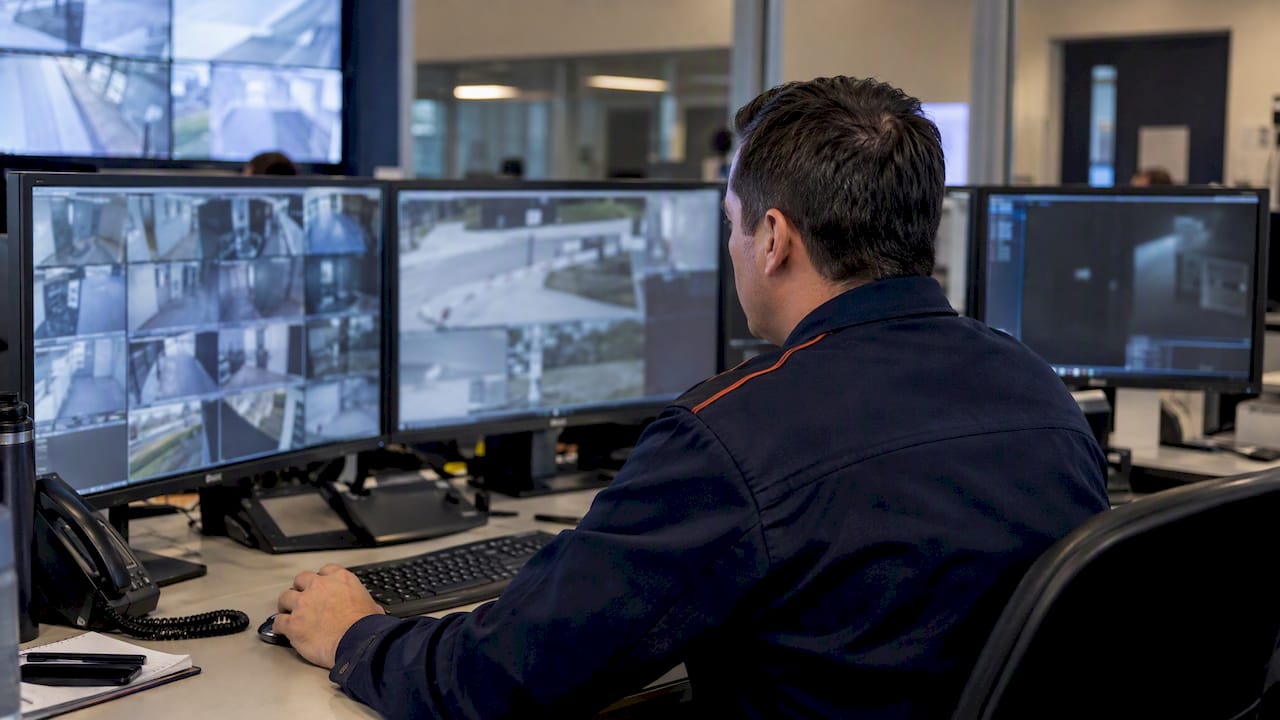
A VMS is the software that sits between your cameras and the people who need to use them. It discovers and configures cameras, records streams to storage, lets operators watch live views and search playback, and exports clips as evidence. Many also handle user permissions, basic alarms from camera events such as motion, and mapping.
The research behind this guide describes VMS tools as focused on capturing, managing and retrieving video footage. That focus is the strength. A good VMS does one job reliably, and it is usually the first thing a site buys after the cameras themselves.
What a VMS does not do well, on its own, is tell you what is happening across your whole operation. A door forced open, a camera that sees a person at that door and an alarm panel that trips are three separate facts in three separate systems unless something joins them.
What a PSIM adds
PSIM is a category of software that acts as middleware. As one industry author put it, it provides a single integrated cockpit view of security system silos, which can include one or more VMS platforms, access control, alarms and sensors.
The typical PSIM capability set runs in a sequence:
- Collection: inputs arrive from many devices and systems.
- Analysis: the platform correlates them, so a door alarm plus a camera event plus a badge anomaly become one incident rather than three alerts.
- Verification: an operator confirms what is real, usually with video attached.
- Resolution: the platform guides the response with step-by-step workflows.
- Reporting and audit: every action is logged for review.
That list follows the capability description in the source we reviewed. The value is not another screen. It is a consistent, auditable response to events, regardless of which operator is on shift.
PSIM vs VMS side by side
| Question | VMS | PSIM |
|---|---|---|
| Main job | Record, view and retrieve video | Correlate many systems and guide the response |
| Typical inputs | Cameras, camera analytics | Video (often via a VMS), access control, alarms, sensors, building systems |
| Who uses it | Operators, investigators | Control room operators and supervisors, plus those who review incidents |
| Output | Footage and evidence | Verified incidents, workflows, audit trail |
| Complexity | Moderate | High: integration, scripting, procedure design |
| Best fit | Single sites, one or two systems | Large or multi-site operations with several systems and formal procedures |
| Relationship | Often a component of a PSIM | Often built on top of one or more VMS platforms |
The last row is the one that trips up buyers. The two are layers, not rivals.
The grey zone: when a VMS starts to behave like a PSIM
The market has blurred the line. Many modern VMS platforms accept feeds from access control, alarms and third-party sensors, and let you build maps, rules and alarm handling. For a site with a few integrated systems, that may be everything you need.
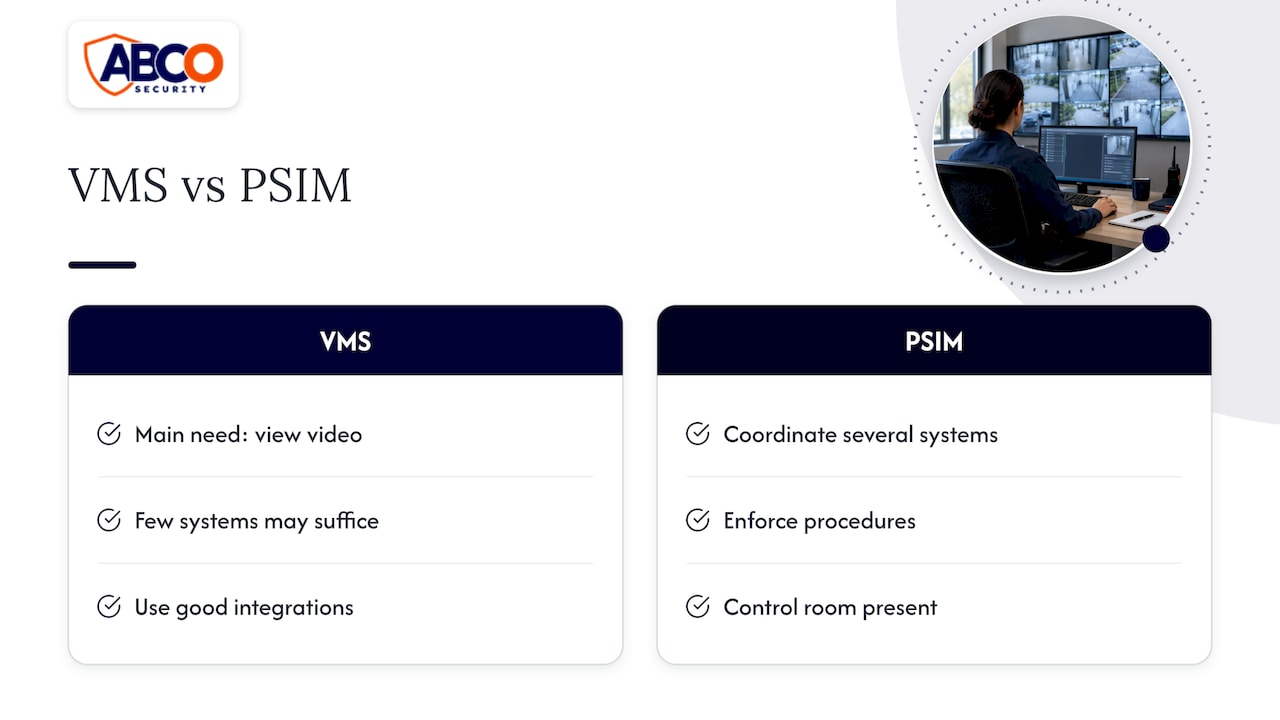
A fair test is to write down the situations you want handled, then ask whether they are mostly “see the video” or “coordinate several systems and enforce a procedure”. If your list is mostly the first, you want a VMS with good integrations. If it is mostly the second, and you have a control room, you are in PSIM territory.
Our own guide to access control integrations covers the technical side of joining door control to video and alarms, which is where most of the practical value sits at mid-size sites.
Cost and complexity: the honest trade-off
A PSIM is not a box you plug in. It is typically a custom installation: someone has to map each connected system, define the rules and write the response procedures. That means higher up-front effort, a dependency on whoever configured it and a maintenance load every time a connected system is upgraded.
A VMS is quicker to deploy and easier to staff for. The risk with an over-built PSIM is shelfware: a platform that costs a great deal, is configured once and is then bypassed by operators who go back to watching video directly.
Before you commit, ask any vendor:
- Which of our systems will integrate natively and which need custom work?
- Who maintains the integrations when firmware changes?
- What happens to our workflows if we change VMS later?
- What does a typical incident look like on screen, from alert to closure?
Where intelligence fits: analytics, not just integration
The other axis is what the software understands. Research involving Curtin University showed that intelligent surveillance can learn normal patterns and alert operators only to unusual behaviour, which helps with the fatigue problem of watching many screens for long periods. Researchers at Queensland University of Technology make a related point: systems need context, because behaviour that is normal in one setting may be suspicious in another, something a simple, non-integrated video tool can miss.
Both findings argue for the same thing from different directions. Video alone is not enough, and neither is an integration platform with nothing intelligent feeding it. Our overview of video analytics security explains what analytics can and cannot do for a control room.
People still make the decision
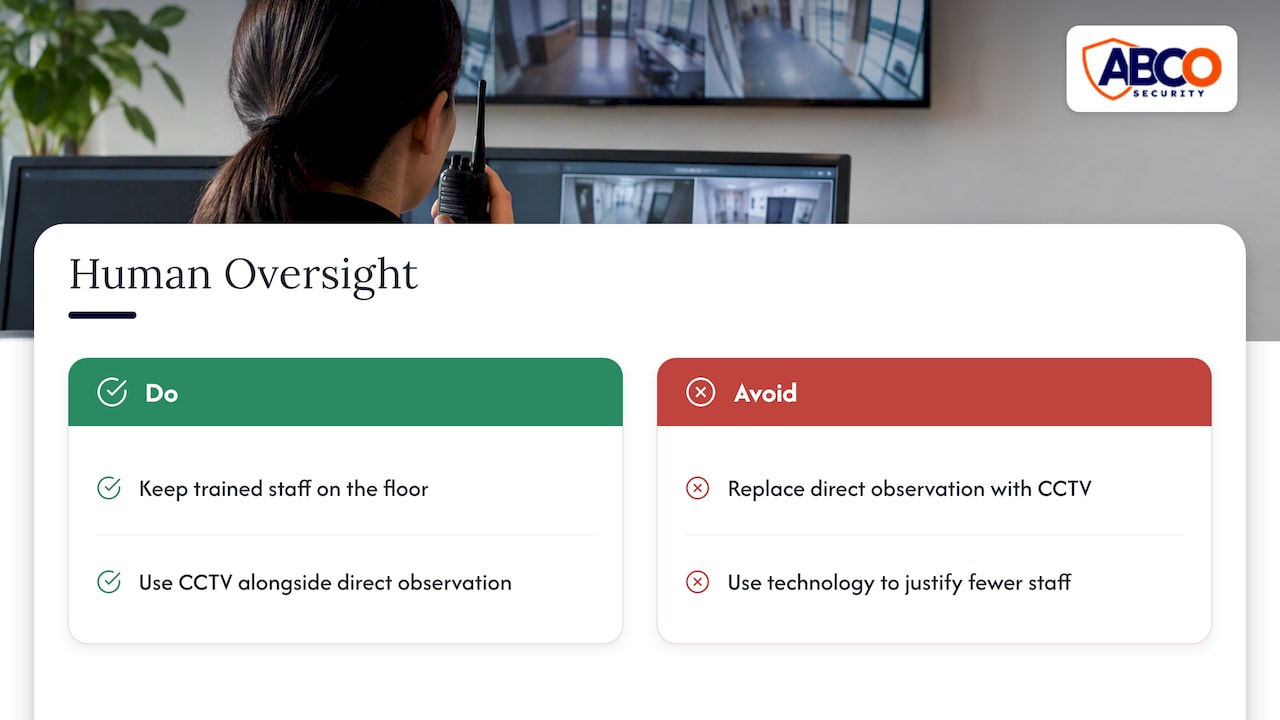
Software can shorten the time between an event and a decision. It does not replace the decision-maker, and in some Australian settings it must not.
In health care, AS 4485.2 (Security for Health Care Facilities) and AS/NZS 62676 (Video Surveillance Systems) are referenced in a Western Australian health policy that expects surveillance to be necessary, proportionate and used for legitimate safety purposes. The same policy states that CCTV monitoring in mental health services is used alongside direct visual observation, not instead of it. If you run a mental health unit in Victoria, the Chief Psychiatrist’s guidance on surveillance and privacy in designated mental health services is the page to read, including its points on reasonable expectations of privacy and informing people about surveillance.
If you are a healthcare administrator, that has a direct consequence for your PSIM or VMS business case. Neither product reduces the need for trained staff on the floor. The business case should show how the technology makes those staff better informed, not how it lets you roster fewer of them.
For broader compliance on camera use, see our summary of CCTV laws in Australia for businesses and homes.
Security of the security system
Both layers are IT systems, and both can be attacked. Three practical points apply whichever you choose.
Default credentials. Researchers at Edith Cowan University found that IP cameras often ship with factory-default passwords that are easily cracked, and that practitioners should change them at deployment. The same work notes that white-labelled products can share firmware across a range, so one flaw can reach many models. A PSIM that integrates hundreds of such cameras inherits that exposure.
Network segmentation. The Australian Cyber Security Centre’s principles for operational technology cyber security include strict network segmentation and recognise that OT data is highly valuable. Treat your camera and access control network accordingly: keep it separate from the corporate network, and limit what the integration layer can reach.
Physical protection. The ACSC’s Information Security Manual guidance on physical security applies defence in depth through successive layers of physical security. For your VMS or PSIM that means a locked, access-controlled server room and protected network devices in public areas. We cover this in server room access control.
Choosing by site type
Construction sites
Most construction sites need a VMS or a monitored camera service, not a PSIM. Sites are temporary, layouts change and the main risks are theft, unauthorised entry out of hours and vandalism. The answer is usually well-placed cameras, alarm monitoring, and a mix of static guards and patrols. Our construction site security plan walks through seven steps for building one.
Healthcare facilities
Large hospital campuses with many systems and a 24/7 control room are the classic PSIM case, because duress alarms, access control, CCTV and building systems need to be correlated and procedures audited. Smaller clinics rarely are. In both cases, the standards above keep people in the loop.
Corporate offices
A single-tenant office with access control and CCTV is generally well served by a VMS plus integrated access control. A multi-building portfolio managed from a central desk is where a PSIM starts to earn its keep. For out-of-hours coverage, our guide to after hours office security sets out a staged approach.
Events and retail
Events are temporary and crowd-driven, so a PSIM is rarely justified for one event. Retail businesses mostly need clear camera coverage, good recording and loss prevention practice. A solid VMS does that.
Our perspective
We see this decision from the operational end, not the software end. ABCO Security provides licensed static guards, mobile patrols, CCTV and alarm installation and monitoring, access control, and security risk assessments across Australia, and we work to ISO 9001 and ISO 30000 with more than 15 years in the industry.
Our view is simple. Technology earns its cost when it shortens the path from detection to a competent response. A PSIM can do that for a big, complex estate, but only if procedures are written, operators are trained and someone owns the integrations. A VMS does it for most other sites at far lower complexity.
So we start with a risk assessment, not a product. We ask what you are protecting, who threatens it and what response you can actually deliver at 2 am. Then we match cameras, monitoring, patrols and guards to that answer. If the answer is that you need a command layer, we say so. If it is that you need better cameras and a monitored response, we say that instead. A proactive approach means anticipating the problem, not buying the most expensive screen.
— Abco
How we help
If you want video that someone is actually watching, our A1 CCTV and alarm monitoring service puts licensed professionals behind your cameras and alarms. For installation and integration of cameras, access control and alarms, see our electronic security solutions. Where a physical presence is the better answer, we provide security guarding and mobile patrols.
Our Night Owl Service has a published starting price of from $5.45 per day. Other services are quoted to the site, so contact us with your site details and we will scope it.
A short decision checklist
Work through these before you speak to any vendor:
- List every security system on site: cameras, access control, intruder alarms, intercoms, building systems.
- Note how many are on separate screens today.
- Write the five incidents you most fear, and who should do what in each.
- Decide whether you have a staffed control room, and for how many hours.
- Count sites. One site and one control room rarely justify a PSIM. Many sites feeding one desk often do.
- Check your regulatory obligations, especially in health, where AS 4485.2 and AS/NZS 62676 are referenced in public health policy.
- Plan for change. Research on Australian high-reliability operations, such as Transgrid’s report on operational technology, describes how traditional project-based upgrades often lack the flexibility modern conditions demand. Choose an architecture you can extend in small steps.
For a wider view, our integrated security solutions guide looks at how these layers fit together.
FAQ
Is a PSIM better than a VMS?
Not as a general rule. They do different jobs: a VMS manages video, and a PSIM correlates video with other systems and guides the response. A PSIM is better only if you have the systems, the control room and the procedures to use it.
Can a VMS replace a PSIM?
Sometimes, for smaller estates. Many modern VMS platforms accept feeds from access control and alarms and can run rules and maps. If your needs go beyond that, such as many sites, many systems and audited workflows, a PSIM is more suitable.
Does a PSIM include a VMS?
Usually it connects to one rather than replacing it. The VMS records and serves the video, and the PSIM calls it up as part of an incident. Some vendors bundle both, so ask exactly what is included.
Do I still need guards if I have either system?
Yes, in most cases. Software detects and informs, but someone has to attend, verify and act. In health settings, policy treats CCTV as a support to direct observation, not a replacement for it.
Sources
- Securing Assets, Darksky
- PSIM versus VMS in security operations, Security Info Watch
- Closed Circuit Television Footage and Security Data Policy, WA Country Health Service
- Surveillance (CCTV) and privacy in designated mental health services, Victoria Health
- iCetana software a paradigm shift for public safety, Curtin University
- Robust Suspicious Behaviour Detection for Smart Surveillance Systems, QUT
- Evaluating IP surveillance camera vulnerabilities, Edith Cowan University
- Principles of operational technology cyber security, ASD’s ACSC
- Information Security Manual, Guidelines for Physical Security, June 2024
- Evolving Transgrid’s Operational Technology Capability
Recommended
about
avada factory
Sempery ultricies nibh at dolor cras urna eleifend nec. Atiam efficitur tempor.