Reception security is the combination of layout, technology and staff procedure that stops unauthorised people entering a building and protects the person at the front desk from harm. The highest-impact measures, in order, are engineering controls (sightlines, barriers, a receptionist retreat path), a digital visitor management system, a tested duress alarm, and trained staff procedures for check-in and escalation. Under model WHS laws, a person conducting a business or undertaking (PCBU) has a legal duty to assess these risks and control them, not just respond after something goes wrong.
TL;DR:
- Engineering controls such as clear sightlines and secure retreat paths are more reliable than administrative procedures for preventing unauthorized access.
- A digital visitor management system with zone-based access and CCTV with high-resolution facial identification effectively closes key gaps in front desk security.
- Regularly testing duress alarms, updating risk assessments, and involving staff in policy development are essential for maintaining a secure reception environment.
- Addressing routine vulnerabilities like lighting, clutter, and signage provides high returns and can be implemented quickly with minimal budget.
- Coordinating security systems and response protocols across the building enhances overall safety and ensures prompt, effective incident management.
Table of Contents
- What does reception security actually cover?
- How should staff handle visitors and threats?
- Which systems close the most front desk gaps?
- What does a reception risk assessment involve?
- What should you fix first, this week or this quarter?
- Where ABCO Security fits in this process
- Common reception risks and how they show up in practice
- Planning for fire, medical and evacuation emergencies at reception
- Connecting reception security to the wider building system
- Who reception staff should call, and when
- Privacy obligations when you deploy a visitor management system
- Managing deliveries and contractors without creating a gap
- Keeping reception security current
- Where to spend the first dollar
- Get a reception security assessment from ABCO Security
- Sources
- FAQ
What does reception security actually cover?
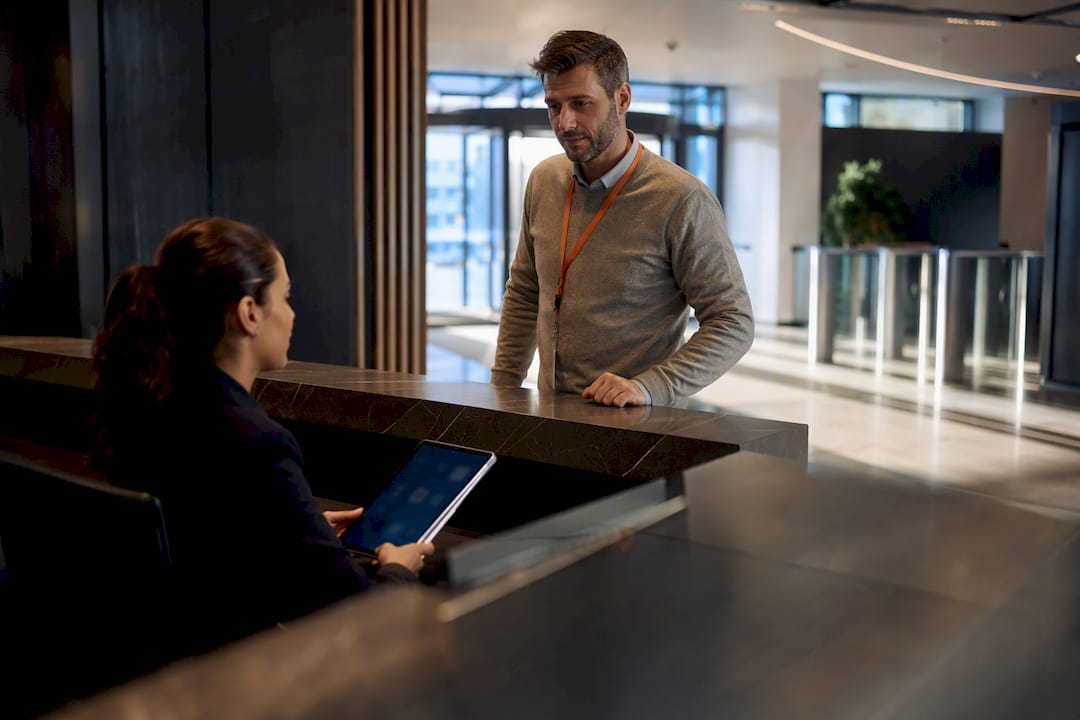
Front desk security duties go well beyond greeting visitors. A receptionist is usually the first and last line of defence against tailgating, aggressive visitors and unverified deliveries, often while juggling phones, mail and appointment bookings. That split attention is exactly why so many reception security procedures fail in practice: the design and technology can be sound, but if the person on the desk is distracted or unsupported, the gap reopens.
Engineering controls come before admin fixes
The hierarchy of control ranks elimination and engineering measures above administrative ones like signage or a policy binder, because they don’t rely on someone remembering to follow a rule under pressure. Safe Work Australia’s guidance is blunt about this: where you can’t eliminate the risk, engineering controls are the next most reliable option, with administrative controls and PPE filling the gaps.
Practically, that means:
- Position the reception desk so staff have clear sightlines to the entrance, the waiting area and any secondary access points.
- Specify a receptionist retreat or egress path, a direct, unobstructed route to a secure zone, and test it during fitout, not after move-in.
- Install laminated or shatterproof screens, raised counters, or a vestibule with an interlock for higher-risk sites where tailgating is a known problem.
- Improve lighting around the entry and waiting area, and remove loose objects (staplers, letter openers, unsecured signage stands) that could be grabbed and used as a weapon.
Comcare’s guidance on reception areas makes the retreat path the single most commonly missed requirement. Secure counters mean little if staff can be cornered with no way out.
Pro Tip: When briefing an architect or fitout contractor, ask them to walk the retreat path themselves, at normal speed, before sign-off. If it takes longer than a few seconds or crosses through a public area, redesign it.
How should staff handle visitors and threats?
Technology and layout only work if the people behind the desk know exactly what to do, moment to moment. Reception security duties should be written down, not assumed, and reviewed with the people who actually do the job.
- Limit non-reception tasks (filing, deliveries, personal calls) during peak visitor windows so staff attention stays on the door.
- Roster two people, or a buddy check-in with security, during after-hours or higher-risk periods rather than leaving one person exposed.
- Set a standard check-in flow: photo ID check, badge issue, and an escort for anyone heading past the lobby into working areas.
- Define escalation triggers in advance, at what point does a staff member call building security, and at what point do they call police?
- Run de-escalation training and periodic drills, then document what happened afterwards, including near misses.
SafeWork NSW notes that policies built with input from the workers who’ll use them see far better compliance than ones handed down without consultation. Reception staff usually know exactly where the gaps are; ask them before you write the procedure, not after an incident forces a rewrite.
Which systems close the most front desk gaps?
A paper sign-in book tells you who claimed to visit, not who’s actually in the building right now. That’s the core weakness a digital visitor management system fixes, capturing identity, issuing a time-stamped badge, and leaving a searchable audit trail your security team can pull in seconds during an evacuation or investigation.
- Visitor management system: replaces paper logs with identity capture, printed or digital badges, and an exportable record for audits or emergency headcounts.
- Access control: apply zone-based permissions so a visitor badge opens only the areas they need, with temporary credentials that expire automatically.
- CCTV: cover the entry, waiting area and any secondary doors, with resolution good enough for facial identification, not just movement detection, and a retention period that matches your policy and privacy obligations.
- Duress alarms: fit a discreet trigger at the desk, linked to monitoring or building security, and test it on a fixed schedule, not just when it’s installed.
Industry analysis of front-of-house security gaps consistently finds that digital VMS adoption closes the most common lobby weaknesses, unauthorised entry, tailgating and missing visitor records, while also speeding up emergency accounting. An untested duress button, though, gives you false confidence: Safe Work Australia’s guidance is clear that regular testing and staff drills matter as much as the hardware itself.
What does a reception risk assessment involve?
Under model WHS laws, a PCBU must manage the risk of violence and aggression at reception the same way it manages any other workplace hazard, through a documented, repeatable process, not a one-off gut check.
The steps are straightforward: identify hazards specific to your reception (a history of aggressive visitors, poor sightlines, an unlocked side entrance), assess the likelihood and severity of harm, select controls starting from the top of the hierarchy, implement them, then monitor and review on a set schedule. WorkSafe Victoria’s guide for employers frames this as an ongoing risk-management cycle, not a compliance form you file once.
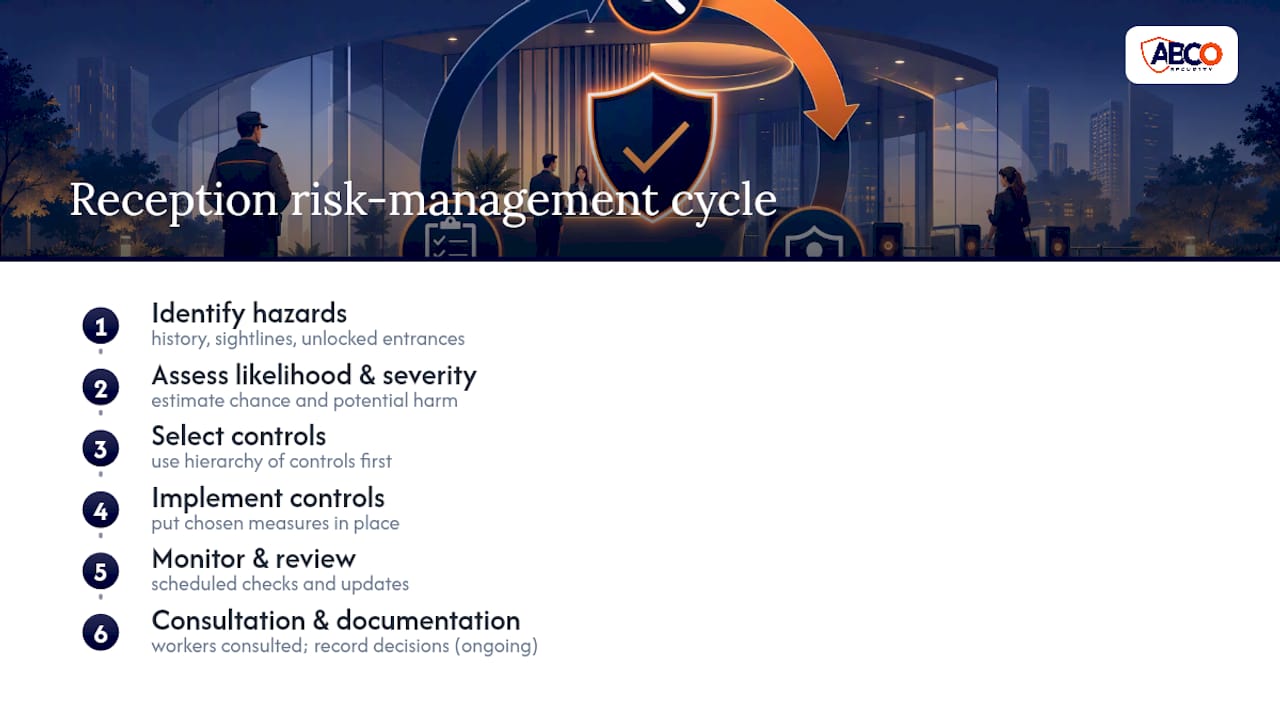
Consultation with workers and health and safety representatives isn’t optional box-ticking, it materially changes which controls actually get used. Record what was discussed and why a particular control was chosen; that record is your evidence of due diligence if an incident is later investigated. A locked door and a laminated screen are high-reliability controls; a laminated sign asking visitors to “please wait to be greeted” is not.
What should you fix first, this week or this quarter?
Not every fix needs a budget approval and a six-week lead time. Split the work into three horizons and you’ll get momentum without waiting on a full capital project.
- This week: improve entry lighting, clear loose objects from the counter, secure valuables out of sightline, and put up clear visitor signage.
- Short term (weeks to a couple of months): pilot a visitor management system at one site, install and test a duress alarm, reposition CCTV to cover blind spots.
- Medium term (this budget cycle): refit counters to the right height and material, add a vestibule or interlock where tailgating is a recurring issue, integrate access control across zones.
Track it with simple KPIs: incident and near-miss counts before and after, drill completion rates, and audit log completeness from your VMS. A one-site pilot also lets you measure throughput and reporting gains before committing budget to a full rollout.
Pro Tip: Run the “this week” list before you even scope the medium-term project. Cheap fixes buy you time and often reveal which technical investment matters most.
Where ABCO Security fits in this process
Abcosecurity has spent more than 15 years building integrated security programs across construction, healthcare and corporate sites, working to ISO 9001 and ISO 30000 standards. A site assessment typically produces a written risk register ranked by priority, a technical specification for visitor management and access control, and a testing and maintenance schedule for duress and CCTV systems, so decisions are documented, not improvised. Case studies and client outcomes for specific reception upgrades are available on request.
Common reception risks and how they show up in practice
Four risks account for most reception incidents: aggressive or distressed visitors, tailgating, unauthorised access attempts, and poorly controlled deliveries.
Aggression is the one most staff fear, and it’s rarely random, it usually escalates from frustration (a delayed appointment, a rejected request) into raised voices and, occasionally, physical confrontation. A calm, scripted response and a clear retreat path matter more here than any piece of hardware.
Tailgating, someone following an authorised person through a door without their own credential, is deceptively easy to miss because it looks like normal foot traffic. Vestibules and interlocks reduce it structurally; a staff culture of “challenge politely, every time” reduces it operationally.
Unauthorised access covers everything from a visitor wandering past reception into staff-only areas to a former employee attempting to badge in on outdated credentials. Zone-based access control and prompt credential deactivation close most of this gap.
Deliveries and contractors are the most overlooked category. A courier or trade contractor often gets waved through because challenging them feels awkward, yet this is one of the easiest routes for someone to move equipment, tools or people into a building without scrutiny. Treat delivery access with the same verification rigour as any visitor, not as an exception.
Planning for fire, medical and evacuation emergencies at reception
Reception is usually the building’s primary evacuation checkpoint, which makes it the wrong place to improvise during a genuine emergency. Staff there need a written, rehearsed role, not a general awareness that “there’s a fire plan somewhere.”
For fire and evacuation, reception staff typically hold or have quick access to the visitor log, so an accurate, real-time headcount at the assembly point isn’t guesswork. A digital visitor management system earns its keep here: a paper sign-in book left behind on a desk during an evacuation is worse than no record at all, because it creates false confidence that everyone’s been accounted for.
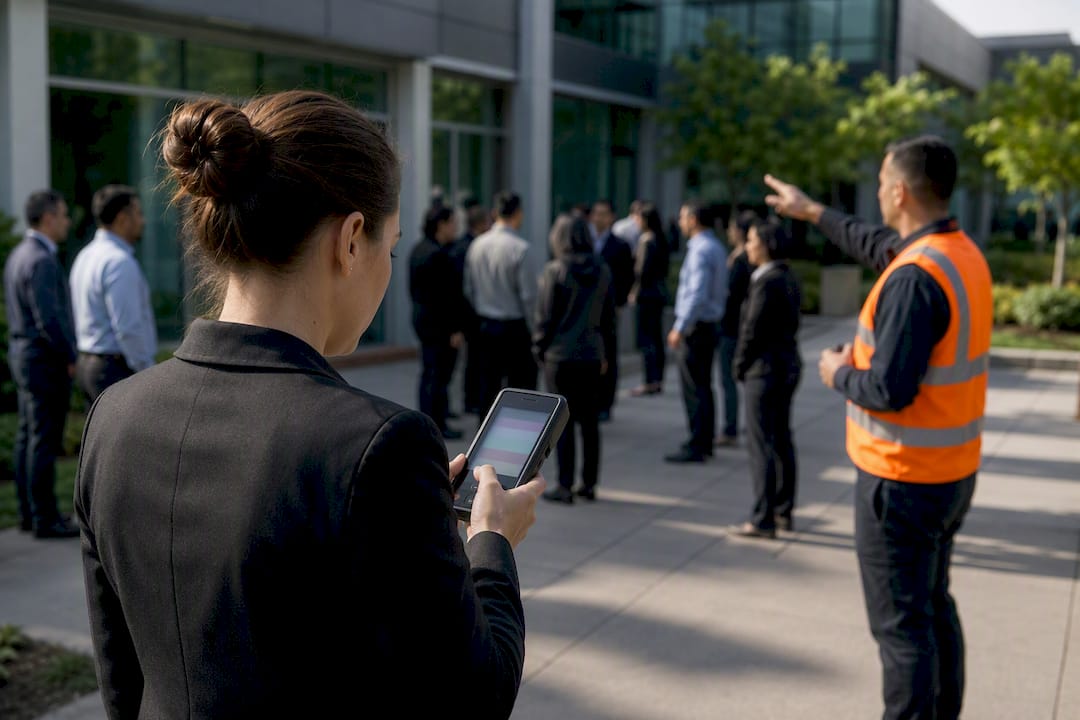
For medical emergencies, reception staff are often the first to notice a visitor or colleague in distress. They need to know the location of first aid kits and defibrillators, how to raise an internal medical response versus calling an ambulance, and who to notify once help is on the way.
Evacuation procedures should specifically address reception’s dual role: staff there both need to evacuate themselves and often need to stay at their post fractionally longer to confirm no one’s trapped in a public area. That’s a genuine tension, and it should be resolved in writing, with a defined point at which the receptionist’s own safety takes priority, rather than left to individual judgement in the moment.
Drill this scenario at least once a year alongside your standard fire drill, not as a separate afterthought.
Connecting reception security to the wider building system
Reception security measures fail when they’re designed in isolation from the rest of the building’s security and life-safety systems. A duress alarm that doesn’t route to the same monitoring centre as your main intruder alarm creates a blind spot exactly when speed matters most.
The practical fix is integration at the specification stage, not as a bolt-on later. Access control at reception should share a platform with access control for lifts, car parks and secure floors, so a single deactivated credential locks someone out everywhere, not just at the front door. CCTV covering the lobby should feed the same monitoring system as cameras covering loading docks and perimeter fencing, giving your security team one continuous picture instead of three disconnected ones.
Fire panels, duress alarms and access control increasingly sit on shared building management platforms, which means a reception upgrade is also an opportunity to close gaps elsewhere in the building’s systems. If you’re scoping a visitor management rollout, it’s worth reviewing your access control integration at the same time rather than treating them as separate projects a year apart.
This is also where a managed security provider adds value beyond installation, coordinating the different vendors and trades so the fire panel actually talks to the access system, rather than each contractor optimising their own component and leaving the integration to chance.
Who reception staff should call, and when
A reception desk without a clear communication protocol turns every incident into an improvised decision under stress. Staff need a short, memorised escalation chain, not a lengthy manual they’ll never read in the moment.
The chain typically runs: internal security or facilities first for anything short of an immediate threat to life, then police for genuine emergencies, with building management or the emergency services liaison notified in parallel rather than after the fact. Duress alarms should route directly to a monitored response, either an internal security control room or an external monitoring service, so staff aren’t relying on someone answering a phone call during a live incident.
Coordination with external responders works better when it’s rehearsed rather than assumed. If your building uses contracted static guards or mobile patrols, reception staff should know their names, shift patterns and direct contact method, not just “call the security company.” A managed security services arrangement typically includes this coordination as part of the contract, with agreed response times and a single point of contact rather than a generic hotline.
Documentation matters just as much as the call itself. Every escalation, whether it results in a police visit or a quiet resolution, should be logged with time, decision-maker and outcome. That record feeds directly into the risk assessment review cycle and gives you evidence of what’s actually happening at the desk, rather than what the policy assumes is happening.
Privacy obligations when you deploy a visitor management system
Capturing visitor names, photos and sometimes ID scans creates a privacy obligation the moment the system goes live, and it’s one facility managers frequently underestimate when they’re focused purely on security outcomes. A VMS is a database of personal information, and it needs to be treated that way from day one.
Set a clear retention period, most reception visitor data doesn’t need to be kept indefinitely, and a defined deletion schedule reduces both your compliance exposure and the damage if the system is ever breached. Limit who can access visitor records to people with a genuine operational need, rather than leaving the admin console open to the whole facilities team.
Signage matters too. Visitors should be told, before they hand over ID or have their photo taken, what’s being collected and why. The Office of the Victorian Information Commissioner provides practical guidance on retention, access controls and notification obligations that applies directly to reception visitor data, and it’s worth reviewing before you finalise a VMS specification rather than after deployment. Building this into your initial visitor management system scope avoids an awkward retrofit later.
Managing deliveries and contractors without creating a gap
Deliveries and contractor visits are routine enough that they often bypass the scrutiny a genuine visitor receives, and that’s precisely why they’re a common way for unauthorised people or items to enter a building. A courier badge or a hi-vis vest shouldn’t be treated as automatic proof of legitimate business.
Set a standard verification step for every delivery: confirm the recipient and expected shipment with the relevant department before waving someone through, rather than relying on the driver’s word. For contractors, require advance notice from the engaging manager, photo ID matched against that notice, and a visitor badge with the same access restrictions any other guest would receive.

Larger or recurring deliveries, loading docks, bulk freight, ongoing trade work, deserve their own procedure separate from the front desk, ideally with a dedicated access point that doesn’t route through the main reception at all. Where that’s not physically possible, log every contractor visit through the same visitor management system used for general guests, so there’s one consistent audit trail rather than two separate, harder-to-reconcile records.
Keeping reception security current
Reception security isn’t a project you finish, it’s a system you have to keep checking against reality. Threats change, staff turn over, and a layout that worked well two years ago might now have a blind spot nobody’s noticed because everyone’s used to it.
Schedule a formal audit at least annually, and after any incident, near miss, or major change to the building or its access points. That audit should walk through the same risk assessment steps used initially: are the hazards still the same, have the controls held up, has anything shifted in visitor volume or building use that changes the risk profile?
Testing schedules for duress alarms and CCTV should sit on a calendar, not rely on someone remembering. An alarm that fails silently for months because nobody tested it defeats the entire purpose of installing one. Review your visitor management system’s audit logs periodically too, not just when something goes wrong, patterns in the data (repeated visitors flagged as suspicious, unusual after-hours access attempts) often surface problems before they become incidents.
Feed findings back into the consultation process with reception staff and HSRs each time. Continuous improvement only works if the people doing the job daily have a real say in what changes next.
Where to spend the first dollar
If you’re weighing up where limited budget goes first, spend it on engineering controls before administrative fixes every time. A retreat path, a properly specified counter, or a tested duress alarm keeps working at 2am on a Friday when nobody’s paying close attention; a laminated procedure sheet only works if someone remembers to follow it under stress.
The best return per dollar usually comes from the cheapest tier: lighting, decluttering the desk, and fixing sightlines cost very little and address a surprising share of the risk on their own. Bigger projects, vestibules, full access control integration, deserve a business case built around near-miss data and consultation outcomes, not a hunch. When you brief finance, frame the ROI as incident reduction and reduced liability exposure, not abstract “safety culture”, numbers and documented risk assessments move budget approvals faster than good intentions do.
— Abco
Get a reception security assessment from ABCO Security
Everything in this guide, retreat paths, duress testing, visitor management, WHS-aligned risk assessment, comes together properly when it’s specified and installed as one coordinated system rather than assembled piecemeal over several years. Abcosecurity works to ISO 9001 and ISO 30000 standards across construction, healthcare and corporate sites, which means a reception upgrade gets scoped alongside your existing access control, CCTV and monitoring rather than bolted on separately.
A site assessment from Abcosecurity produces a prioritised risk register, a technical specification covering visitor management and access control, and a testing and maintenance schedule you can hand straight to your contractors or keep for your own compliance records. If your reception hasn’t had a proper risk assessment in the last year, or you’re planning a fitout and want the retreat path and sightlines specified correctly the first time, start with Abcosecurity’s integrated security solutions guide and request a site assessment.
Sources
- Aggression or violence: a guide for employers (WorkSafe Victoria)
- Consultation at work (SafeWork NSW)
- Visitor aggression — reception areas (Comcare)
- Preventing and responding to workplace violence and aggression (Safe Work Australia)
FAQ
What are the four main types of security controls?
The commonly used hierarchy runs elimination, engineering controls, administrative controls and personal protective equipment, with elimination and engineering ranked as more reliable than procedures or PPE alone.
Who is the biggest security company in Australia?
Australia’s security industry includes several large national providers alongside specialists like Abcosecurity, which focuses on integrated solutions, licensed guarding and monitoring for construction, healthcare and corporate clients rather than volume contracting.
What is the highest paid security guard job?
Specialised roles such as close protection, armed transit and senior site supervisor positions typically command higher pay than standard static guarding, reflecting the additional licensing, training and risk involved.
How much does a security guard earn in Australia?
Pay varies by state, licensing level and role type, with specialised or supervisory positions earning more than entry-level static guarding; current figures are best checked against Fair Work Ombudsman award rates for your state.
Do I need a visitor management system if I already have a sign-in book?
A paper log records who claimed to visit, not who’s currently in the building, and digital VMS platforms close that gap with time-stamped badges and an audit-ready record for emergencies and reviews.
Recommended
about
avada factory
Sempery ultricies nibh at dolor cras urna eleifend nec. Atiam efficitur tempor.