The right answer isn’t a fence product at all. It’s a combination of licensed static guards, mobile patrols, monitored CCTV and alarm response, access control at gated entry points, and, for larger or multi-site operations, an integrated managed solution running under a single contract. Which mix you need depends on a formal risk assessment aligned to ISO 31000 and HB167, not on guesswork or whatever a fencing brochure recommends.
TL;DR:
- Effective perimeter security combines licensed static guards, mobile patrols, monitored CCTV, access controls, and integrated solutions based on a formal risk assessment.
- Risk assessments should align with ISO 31000 and HB167, focusing on asset criticality, site features, and incident history to avoid over- or under-securing.
- Clear scope, compliance proof, and detailed reporting requirements are essential for contracts to prevent underperformance or misunderstandings.
- Costs depend on guard hours, monitoring level, technology complexity, and site size, with phased rollouts recommended for optimal operation.
- Ongoing maintenance, periodical reviews, and even re-assessment after incidents or significant site changes are necessary for effective, continuous perimeter security.
Table of Contents
- Service types explained: what each perimeter security service does and where it fits
- How do you decide which service mix you need?
- How do you specify and contract perimeter security services?
- Implementation: timeline, costs and practical on-site considerations
- Ongoing maintenance and continuous risk management
- Publisher perspective: what actually separates a good perimeter contract from a bad one
- How do you engage Abcosecurity for a perimeter security risk assessment?
- Sources
- FAQ
Service types explained: what each perimeter security service does and where it fits
Every one of these services solves a different problem, and most sites need at least two working together.
- Licensed static guards hold a fixed post, control who enters and exits, and provide the visible deterrence that stops opportunistic incidents before they start. On construction sites, they’re often the ones managing contractor sign-in and handover between shifts.
- Mobile patrols move between sites or zones on scheduled or randomised routes. Randomisation matters more than most managers realise. Predictable patrol timing is one of the easiest things for a determined intruder to map and exploit. Patrols also handle alarm verification, arriving to confirm a triggered sensor before police are called.
- CCTV with professional monitoring covers ground guards physically can’t. A monitored system detects movement, verifies it against footage in real time, and feeds evidence to police or insurers when something does go wrong. Integration with alarms is what separates a genuinely monitored system from a camera that just records to a hard drive nobody watches.
- Access control and gated-entry services manage credentials, vehicle movements and visitor logs at defined entry points. This is where a lot of healthcare and corporate sites get caught out. A swipe card system without a managed visitor process at the gate is a control with a hole in it.
- Integrated managed solutions bundle several of the above into one contract with a single point of accountability, shared KPI reporting, and defined escalation pathways when something goes wrong at 2am. For sites running guards, cameras and access control separately, this is usually where the biggest inefficiencies get found.
How do you decide which service mix you need?
Start with the risk assessment, not the shopping list. A properly run assessment aligned to HB167 and ISO 31000 looks at asset criticality, the number and location of access points, operating hours, and any incident history on the site. Skip this step and you’ll end up over-securing a low-risk storage yard while leaving a data centre under-resourced.
- Map risks to controls using the detect, deter, deny, delay, respond, recover model. A construction site at night might need deterrence (lighting, patrols) and delay (locked compounds), while a hospital emergency department needs detection and rapid response above almost everything else; understanding unique environmental risks like flooding can also influence perimeter choices, as explained in this equestrian arena flood risk guide.
- Check procurement fundamentals before any provider gets shortlisted: current Master Security Licence, valid ABN, staff screening records, adequate insurance, and evidence of a quality management system such as ISO 9001.
- Confirm sector experience. A provider who’s spent years on retail loss prevention may not understand construction site induction requirements or healthcare access protocols.
- Prioritise budget toward high-value assets and continuity risks rather than spreading resources evenly across a site. An even spread often means the genuinely critical assets are under-protected while low-risk zones are over-guarded.
Pro Tip: Run the risk assessment before you write the tender, not alongside it. Providers who quote against a vague brief tend to quote for the cheapest defensible service, not the right one.
Independent, vendor-neutral risk assessments that don’t come attached to an equipment sale tend to produce more honest recommendations, because there’s no incentive to over-specify.
How do you specify and contract perimeter security services?
A vague scope of works is the single biggest reason perimeter security contracts underperform. The fix is a detailed request for proposal covering exactly what’s expected and how it will be checked.
- Scope clarity: define coverage hours, specific duties at each post or patrol point, escalation triggers, and required response times in minutes, not “promptly.”
- Compliance evidence: require current licensing, public liability and professional indemnity insurance, documented training standards, and proof of a quality system such as ISO 9001.
- Reporting cadence: specify patrol logs, CCTV event logs, guard rosters and false-alarm handling procedures, with a fixed schedule for review meetings rather than ad hoc catch-ups.
- Mobilisation and substitution: require a written mobilisation plan, a policy for staff substitution during leave or turnover, and a right-to-audit clause so you can verify performance against the contract, not just take it on trust.
Government procurement panels increasingly favour contractors who deliver services directly rather than subcontracting, and who can demonstrate capacity across an extensive service range. That’s a useful benchmark for private-sector tenders too, since subcontracted guarding is harder to hold accountable when something goes wrong.
Implementation: timeline, costs and practical on-site considerations
Perimeter security rollouts follow a fairly consistent shape: risk assessment (one to three weeks depending on site complexity), procurement and contracting (two to six weeks), mobilisation (one to four weeks), then steady-state operation with review checkpoints built in from day one.
Cost is driven by four things above all else:
- Total guarding hours required and shift patterns.
- Monitoring tier (basic alarm response versus live CCTV monitoring with rapid dispatch).
- Technology integration complexity, particularly where access control needs to talk to an existing building management system.
- Site size, number of access points and any special access needs like restricted zones in a hospital.
On-site coordination matters as much as the contract itself. Inductions, up-to-date keyholder lists, agreed communications protocols, and clear alarm system integration with any existing BMS all need to be sorted before day one, not discovered on it.
Pro Tip: Budget for a staged rollout. Running the first four to six weeks with slightly heavier coverage lets you gather real operational data before locking in a leaner, optimised roster.
Ongoing maintenance and continuous risk management
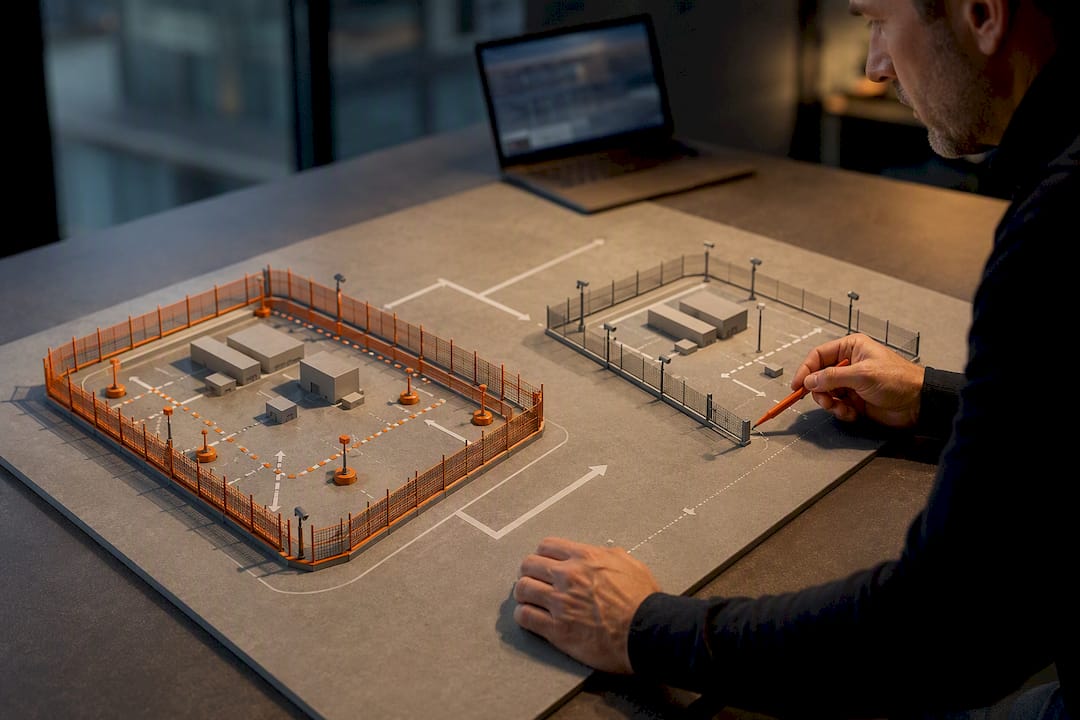
Perimeter security isn’t a set-and-forget purchase. It needs the same discipline as any other operational system.
- CCTV and access control hardware need scheduled maintenance checks, not reactive fixes after a fault is reported.
- Patrol rotas should be reviewed periodically and varied to avoid becoming predictable.
- Incident review and change control should tie back into the same ISO 31000 risk framework used at the outset, treating risk management as continuous rather than a one-off report.
- Key performance reports worth requiring: incident trend data, response times, false-alarm rates, and documented lessons learned from any real event.
Escalate to a full re-assessment after any significant incident, a change to site layout, or a shift in operating hours. A site that expands its footprint or moves to 24-hour operation has effectively become a different risk profile, and the original assessment no longer applies.
Publisher perspective: what actually separates a good perimeter contract from a bad one
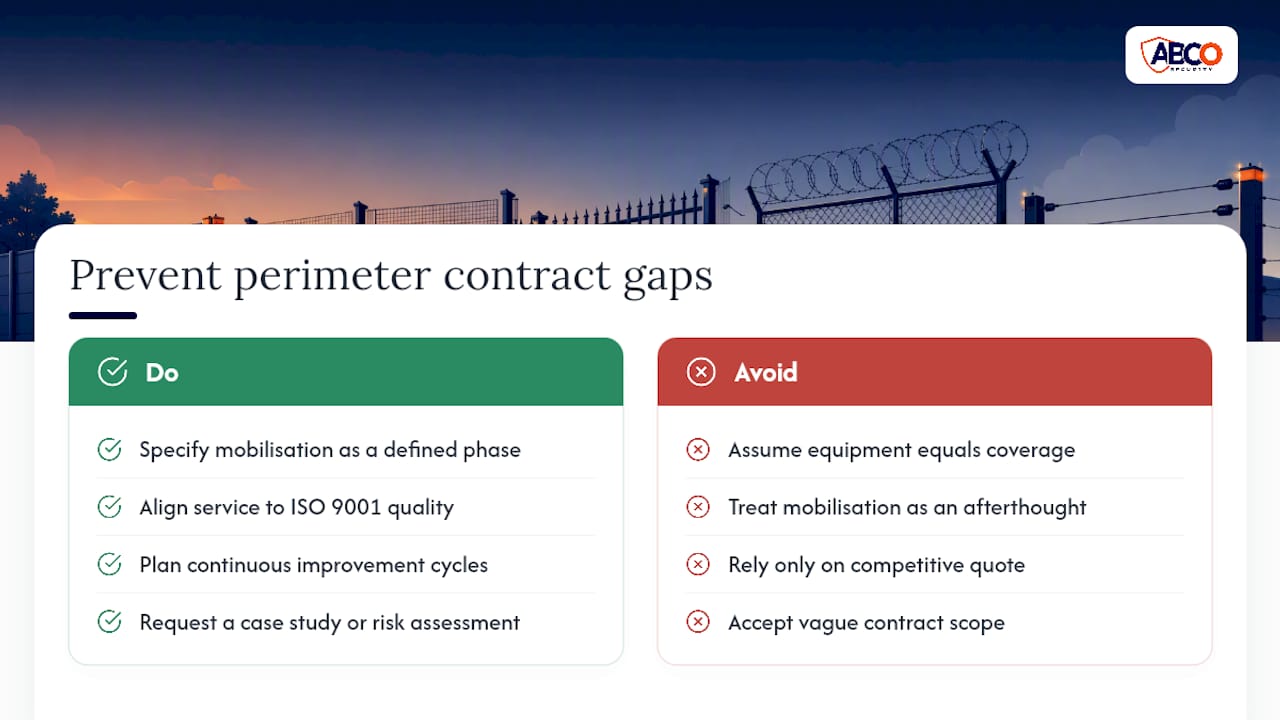
Most perimeter security failures seen in the industry aren’t caused by the wrong equipment. They’re caused by mismatched expectations between what a site manager assumed was covered and what the contract actually specified. Over years delivering guarding, monitoring and systems integration across various sites, the pattern repeats: a provider quotes competitively, wins the job, then the gaps show up in the first incident review.
Aligning service delivery with ISO 9001 quality management and treating mobilisation as a defined phase, not an afterthought, closes most of those gaps before they become a problem. Continuous improvement matters more than the initial setup. If you want a concrete look at how that plays out on a live site, consider requesting a case study from a construction or healthcare deployment, or a site risk assessment to identify potential gaps.
— Abco
How do you engage Abcosecurity for a perimeter security risk assessment?
Some providers run integrated perimeter security contracts covering licensed guarding, monitored CCTV and alarm response, access control, and evidence-based risk assessments, all under one accountable agreement instead of managing multiple separate suppliers. A single-contract structure offers practical advantages over piecing together guards, cameras and access control from different vendors: one point of contact, one set of KPIs, and one escalation path when issues arise.

The next step is straightforward. Request a site risk assessment, ask for a written mobilisation plan, and request references and evidence of current licensing before signing anything. Abcosecurity’s integrated security solutions guide for professionals walks through how that engagement typically starts and what to expect at each stage, from initial assessment through to steady-state operation.
Sources
FAQ
What Are the Main Types of Perimeter Security Services?
The core categories are licensed static guards, mobile patrols, monitored CCTV with alarm response, access control at gated entry points, and integrated managed solutions combining several of these under one contract.
Do I Need a Risk Assessment Before Contracting Security Services?
Yes. A formal assessment aligned to ISO 31000 and HB167 identifies which assets and access points carry the most risk, so you’re not paying for controls that don’t match your actual exposure.
What Licences Should a Security Provider Have?
At minimum, a current Master Security Licence, a valid ABN, and evidence of staff screening and appropriate insurance, criteria drawn from government procurement standards for security contracts.
How Long Does It Take to Mobilise a Security Contract?
Most contracts move from risk assessment through to steady-state operation within a few weeks to several months, depending on site complexity, technology integration needs and how many access points are involved.
How Often Should Perimeter Security Be Reviewed?
Reviews should happen on a set schedule plus immediately after any significant incident, site layout change, or shift in operating hours, since continuous risk management under ISO 31000 treats assessment as ongoing, not a one-off exercise.
Recommended
about
avada factory
Sempery ultricies nibh at dolor cras urna eleifend nec. Atiam efficitur tempor.