
Planning a memorable event requires more than a great venue; it demands a rock-solid security strategy. Successful security for an event is not about reacting to problems, but anticipating them. A robust plan ensures every guest feels safe from the moment they arrive.
This guide outlines how to build a security framework that protects your guests, assets, and reputation, drawing on expert practices from the Australian security industry.
Building Your Event Security Foundation
Whether you’re organising a corporate conference in Melbourne or an outdoor festival, the safety of your attendees is paramount. In Australia, event organisers are held to high standards. Providing a secure setting is a legal and ethical duty.
A security failure can lead to reputational damage, financial loss, and potential harm to guests. The process begins with a preliminary security audit to identify your event’s specific vulnerabilities.
A high-profile gala requires discreet surveillance and strict access control. A large concert, however, needs a visible presence focused on crowd management and perimeter integrity. Defining these needs early helps craft an effective and efficient security plan.
The Core Pillars of a Security Plan
An effective security strategy is built on key pillars that create a secure environment. These elements form the blueprint for your entire operation, ensuring no detail is overlooked.
A professional event security plan includes the following non-negotiable components to keep your event safe and compliant.
Core Components of a Professional Event Security Plan
| Component | Objective | Key Actions |
|---|---|---|
| Risk Assessment | Identify and evaluate potential threats before they happen. | Analyse the venue, guest profile, and event type. Brainstorm scenarios from unauthorised access to medical emergencies. |
| Personnel Allocation | Deploy the right people in the right places. | Determine guard numbers and placement. Assign specialists for roles like crowd control, static guarding, or mobile patrols. |
| Technology Integration | Use modern tools for monitoring and control. | Install and monitor CCTV cameras. Implement access control systems (e.g., wristbands, ticket scanners) to manage entry points. |
| Emergency Preparedness | Create clear, actionable response plans. | Develop protocols for medical incidents, evacuations, and security breaches. Coordinate with local police, fire, and ambulance services. |
These pillars provide a structured framework to manage threats and coordinate a swift, professional response.
Why Professional Expertise Matters
Engaging a professional Security Company in Melbourne provides more than just guards; it provides expertise. These specialists are adept at risk assessment and operational planning, ensuring compliance with all relevant Australian standards.
The Australian Security Industry Association Ltd (ASIAL), our industry’s peak body, emphasises using licenced and reputable providers for public safety.
Every security officer must hold the correct qualifications. You can learn more about the rigorous training in our guide on how to get a security licence in Australia. This ensures they are skilled in security protocols, customer service, and de-escalation, enhancing the guest experience.
By integrating security into your event planning from day one, you adopt a proactive mindset. This foresight prevents incidents before they start and demonstrates a genuine commitment to guest wellbeing.
A well-planned security foundation builds trust. When guests feel safe, they can relax and enjoy the experience you have created.
Book a consultation with our event security experts today.
How to Conduct an Event Security Risk Assessment
Before any personnel are on-site, the most critical work begins: the risk assessment. This is the bedrock of any solid security for event plan. It is a detailed analysis of potential issues tailored to your event and its unique Australian setting.
A thorough assessment requires thinking from all angles. A corporate gala in a Melbourne CBD high-rise faces different threats than a music festival in a regional park. The gala might face sophisticated gatecrashers, while the festival must manage crowd surges and remote medical emergencies.
The process involves inspecting the venue, identifying blind spots, and considering potential scenarios. This audit of risks and their potential impact informs a practical and effective plan.
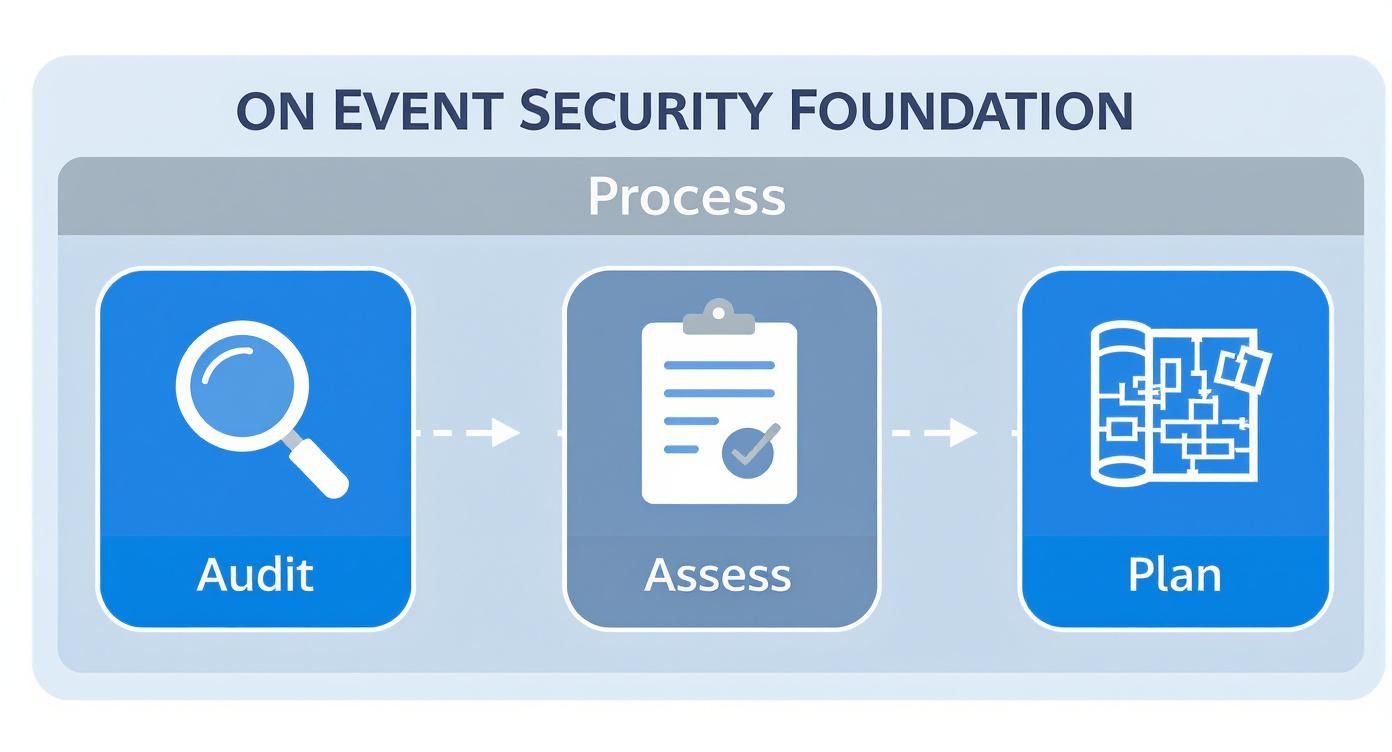
A strong security plan is a deliberate sequence of steps designed to ensure comprehensive coverage.
Identifying Potential Event Threats
Spotting threats is a structured analysis of realistic possibilities. By borrowing principles from a comprehensive risk management framework, risks can be broken down into clear categories.
Potential risks can be categorised as follows:
- Venue-Specific Hazards: Look for unseen access points, poorly lit car parks, or narrow corridors that could create dangerous bottlenecks.
- Crowd-Related Issues: This includes overcrowding, alcohol-fuelled altercations, medical emergencies, or organised protests.
- External Threats: Unauthorised entry is common, but also consider theft from vehicles or targeted external disruptions.
- Operational Failures: Consider backups for power outages, communication system failures, or key staff absences, which can create immediate security gaps.
Working through these categories provides a complete picture of your event’s unique risk profile.
Evaluating and Prioritising Risks
Once you have a list of threats, you must determine which ones require the most attention. A risk matrix is an effective tool for prioritising your resources.
A risk matrix plots each threat based on two factors:
- Likelihood: How probable is it that this will occur at your event?
- Impact: If it does happen, what is the potential harm to guests, staff, and your organisation’s reputation?
For example, a minor disagreement between two guests is likely but has a low impact if managed quickly. A stage collapse is highly unlikely, but the impact would be catastrophic. The matrix helps focus on high-priority risks.
A well-documented risk assessment is proof of your due diligence. It demonstrates to insurers, stakeholders, and regulators that you have taken all reasonable steps to ensure safety.
This prioritisation ensures your security budget and staff are focused where they can make the biggest difference. To assist with this crucial step, we have developed a practical event risk assessment template.
With a clear understanding of the risks, you can assemble the right team for the job.
Assembling Your Professional Security Team
Your security personnel are the face of your event’s safety plan. They are often the first point of contact for your guests and the first responders to any incidents. Selecting the right team is a critical decision.
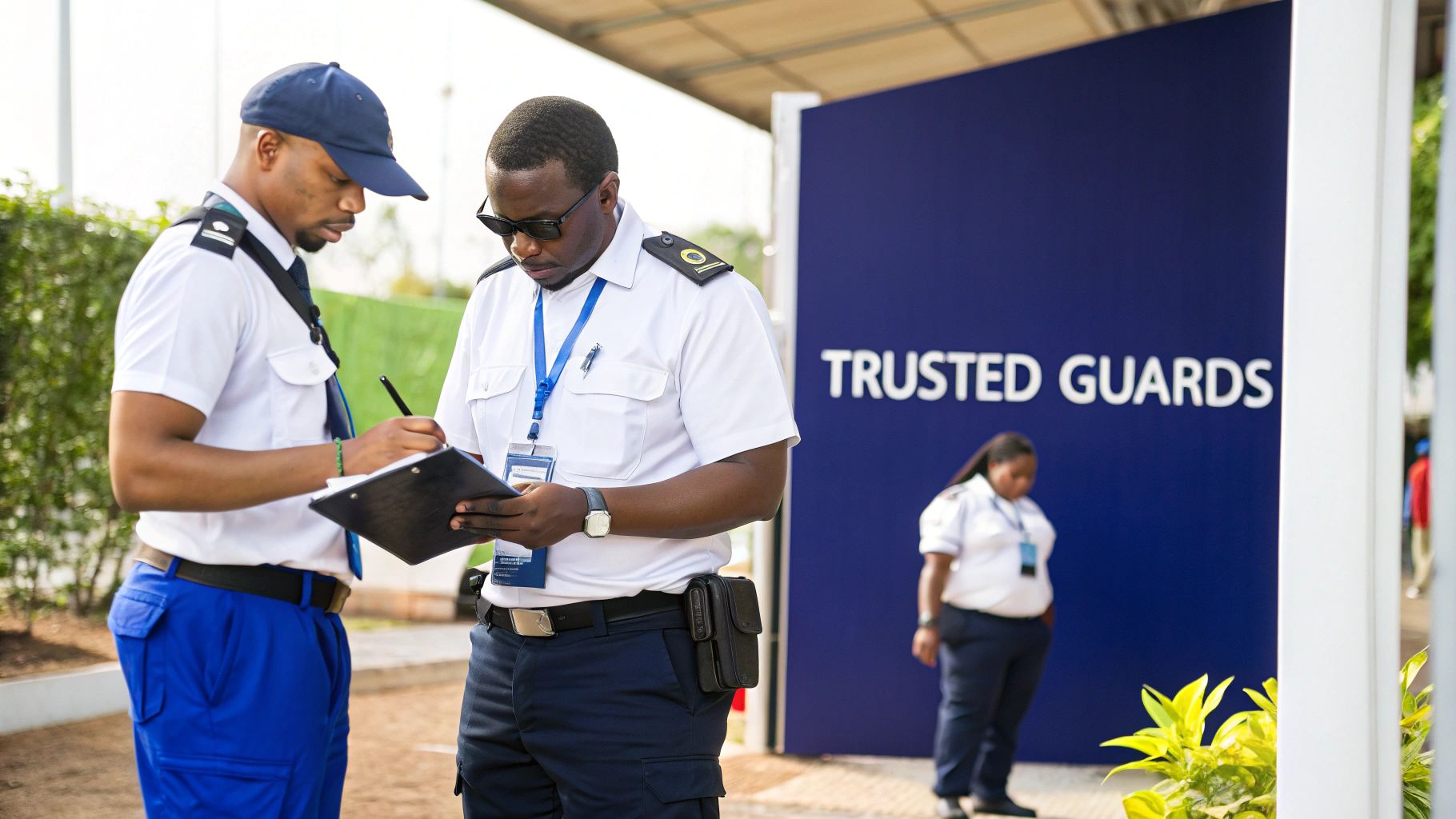
The quality of your security depends on the provider. A reputable Australian company supplies fully licenced, experienced professionals who understand the unique dynamics of live events. This is not a role for untrained staff.
Choosing the Right Security Roles
Effective security for event planning is about strategic deployment, not just numbers. A one-size-fits-all approach is ineffective. A good security partner will help determine the optimal mix of roles for your event.
Common security personnel roles include:
- Static Guards: These officers are your fixed security points at entry gates, VIP areas, or near high-value equipment. Their visible presence acts as a deterrent.
- Mobile Patrols: These teams cover larger areas like car parks, perimeter fences, and back-of-house zones, providing a dynamic layer of security.
- Crowd Controllers: This is a specialist skill essential for any large gathering. Licenced crowd controllers are trained to manage group dynamics and de-escalate situations.
A music festival would rely heavily on crowd controllers and mobile patrols. A corporate conference might only require a few discreet static guards to maintain a professional atmosphere.
Verifying Compliance and Licences
The Australian security industry is tightly regulated for a reason. As the event organiser, you are responsible for ensuring your security provider and their staff are fully compliant. Hiring an unlicenced company creates significant legal and financial risks.
Before signing any contract, verify the company’s master licence and the individual licences of the guards assigned to your event. This is a non-negotiable step for due diligence.
A professional firm will readily provide this documentation. They should also adhere to Australian standards for training and conduct. The ASIAL is an excellent resource for checking a provider’s credentials.
Establishing a Clear Command Structure
Even an experienced team needs clear leadership and communication. A defined command structure ensures information flows quickly to the right people, which is crucial in an emergency.
Your security plan must outline a simple hierarchy, including:
- An Event Security Manager
- Zone or shift supervisors
- Frontline security officers
This structure should be shared with your event staff, the venue manager, and local emergency services. Pre-event briefings are essential for aligning on communication protocols. Knowing what to look for when searching for event security near you will help you find a partner that delivers this level of organisation.
Using Technology to Enhance Event Security
On-the-ground personnel are essential, but modern event security is enhanced by smart, integrated technology. Technology acts as a force multiplier, enabling a smaller team to cover a large area, react faster, and maintain a clear record of events.
Strategic use of technology shifts your security posture from reactive to proactive, providing the oversight to identify and address potential issues before they escalate.
Optimising CCTV Surveillance
CCTV provides eyes across your entire venue simultaneously. Effective security for an event depends on strategic camera placement to eliminate blind spots and provide clear, actionable footage.
Key zones for camera coverage include:
- Entry and Exit Points: All official entrances, fire exits, and gates should be monitored to track movement and prevent unauthorised access.
- High-Traffic Areas: Food courts, merchandise stands, and main walkways are hotspots for crowd congregation where issues can arise.
- Sensitive Zones: Backstage areas, cash-handling points, and VIP lounges require dedicated surveillance to protect assets and individuals.
For larger events, an onsite control room with a dedicated operator is essential. This turns CCTV into a live intelligence hub, allowing for real-time observation and immediate dispatch. Learn more about professional security camera monitoring.
Implementing Modern Access Control
Controlling who enters your event and where they can go is fundamental. Modern access control systems offer a level of security and efficiency essential for complex events, moving beyond simple wristbands.
These systems use electronic credentials to validate entry, reducing the risk of counterfeit tickets and providing a precise, real-time headcount of attendees.
Your access control system is your first line of defence. It not only prevents unauthorised entry but also creates a seamless experience for guests, reducing queues and frustration.
Imagine a corporate conference where NFC badges grant access to specific seminars, or a music festival using QR codes on phones to manage thousands of attendees. This technology ensures only authorised individuals access restricted areas.
The Power of Coordinated Communication
Clear, instant communication is the backbone of event security coordination. Two-way radios connect every team member, from static guards at the main gate to roaming patrols on the perimeter.
This instant link allows for the free flow of information. A medical emergency can be relayed to the nearest team member in seconds. A suspicious person can be described to the entire team at once. Industry bodies like ASIAL highlight effective communication as a cornerstone of professional operations.
Direct lines to event managers, first aid crews, and venue staff are also vital. When everyone is on the same page, the entire operation functions seamlessly.
Book a consultation to design your customised security plan.
Mastering Crowd Management and Emergency Plans
Handling large crowds effectively is about guiding people, not just controlling them. The goal is to create a safe, flowing environment that prevents dangerous bottlenecks and reduces friction between guests.
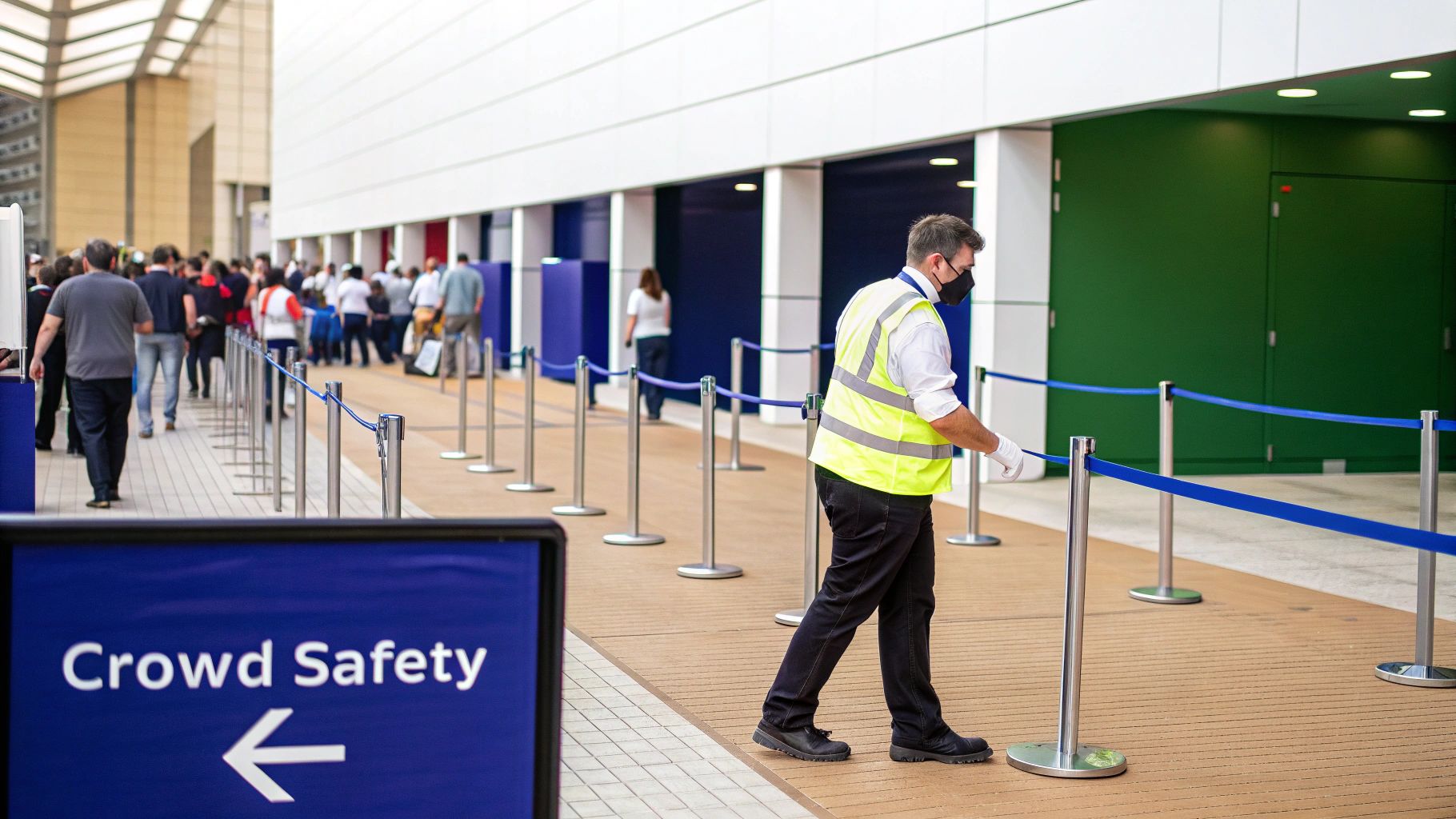
This proactive mindset is at the heart of any professional security for event strategy. It relies on careful planning, such as designing smart queueing systems, using clear signage, and placing personnel strategically to direct foot traffic.
Proactive Crowd Management Techniques
To prevent issues, it is important to anticipate crowd behaviour. An experienced security team understands the natural rhythm of an event and implements subtle yet effective strategies to manage it.
Simple measures often make the biggest difference. At a music festival, clear, well-lit pathways and friendly crowd controllers can prevent dense clusters of people from forming near the main stage.
Other practical techniques include:
- Staggered Entry and Exit: Using timed entry or opening multiple exits simultaneously disperses crowds and reduces pressure on single points.
- Active Monitoring: Using both CCTV and mobile patrols allows for early detection of overcrowding or distress.
- De-escalation Specialists: Placing guards trained in verbal de-escalation in high-friction zones, like bar queues, can resolve conflicts before they escalate.
These techniques are part of a comprehensive approach to keep things orderly without making guests feel overly policed.
Building a Comprehensive Emergency Response Plan
While prevention is the goal, preparedness is essential. A detailed Emergency Response Plan (ERP) is non-negotiable. It is your playbook for crises, tailored to your specific venue and event.
Your ERP must provide clear, step-by-step instructions for various scenarios. This ensures that in an incident, the response is coordinated and efficient, minimising harm.
An Emergency Response Plan is your event’s safety net. It transforms panic into procedure, giving your entire team the confidence to act decisively under pressure.
Your plan must include clear protocols for:
- Medical Emergencies: Procedures to contact onsite first aid, clear paths for paramedics, and manage the immediate area.
- Fire and Evacuation: Clearly marked evacuation routes, designated assembly points, and a communication chain with fire services.
- Security Threats: Actions for intruders, potential violence, or bomb threats, including lockdown procedures.
A key element is communication. It’s important to understand how to implement effective emergency notifications to keep attendees informed.
Coordination with Local Emergency Services
Your security team and ERP must be integrated with local emergency services. This involves pre-event briefings with local police, fire, and ambulance services to review plans and venue layouts.
This collaboration is vital. If emergency services are called, they will arrive with prior knowledge of the site and key contacts. This preparedness ensures a smooth, coordinated response.
Post-Event Review: Learning for a Safer Future
The work of event security doesn’t end when the last guest leaves. The post-event review is a critical phase for turning experience into an improved plan for the future.
This structured debrief should involve your security team leader, key event staff, and the venue manager. The goal is to honestly assess what worked well and identify areas for improvement.
Conducting an Effective Security Debrief
To be useful, the debrief must be based on facts, not just feelings. A professional security company in Melbourne will always prioritise this step for continuous improvement.
Key areas to analyse include:
- Incident Reports: Review every logged incident. Analyse response times, actions taken, and resolutions to identify patterns.
- Stakeholder Feedback: Gather input from guests and staff. Were queues managed effectively? Was the security presence reassuring or overbearing?
- Technology Performance: Did CCTV cameras have blind spots? Were there dead zones for two-way radios?
- Plan Execution: How well did access control processes work with a real crowd? Were emergency exit routes kept clear?
A structured post-event debrief is the best way to refine your security protocols. It transforms anecdotal evidence into a clear roadmap for making your next event even safer.
This process ensures your security measures evolve and improve with every event you run. It is a core principle of professional practice, championed by industry bodies like the Australian Security Industry Association Ltd (ASIAL).
Book your comprehensive security consultation today.
Event Security FAQs
Organising an event involves many security considerations. Getting it right is crucial for guest safety and legal compliance. Here are answers to some common questions from event organisers.
How Many Security Guards Do I Need?
There is no single formula for determining guard numbers. The correct amount is based on a thorough risk assessment tailored to your specific event.
A professional Security Company in Melbourne will analyse key factors:
- The Crowd: A concert with 10,000 attendees requires a different security posture than a corporate dinner for 200.
- The Venue: A large, open festival ground has different needs than an enclosed ballroom with a single entry point.
- The Vibe: The presence of alcohol, VIPs, or high-value items increases the risk profile and may require more personnel.
Based on this analysis, a customised plan is created to ensure you have the right people in the right places.
What Are the Basic Legal Security Requirements?
While specific rules vary by state, territory, and local council, a universal duty of care to provide a safe environment is a legal obligation across Australia.
This requires, at a minimum, a formal security plan and a documented risk assessment.
You must hire properly licenced security guards from a reputable, compliant company. If alcohol is served, guards must also have Responsible Service of Alcohol (RSA) training. Always consult with your local council and security provider to ensure all requirements are met.
How Can Security Improve the Guest Experience?
Excellent security should make guests feel welcome and safe, not policed. The best security teams excel at customer service, acting as friendly and helpful representatives for your event.
They can guide attendees, keep queues moving smoothly, and provide a reassuring presence. When guests feel looked after, they can relax and enjoy the event. This balance of safety and a welcoming atmosphere is a principle supported by industry leaders like the Australian Security Industry Association Ltd (ASIAL).
Ensure your next event is safe, compliant, and memorable for the right reasons. ABCO Security provides expert planning and professional personnel to cover every angle.
about
avada factory
Sempery ultricies nibh at dolor cras urna eleifend nec. Atiam efficitur tempor.