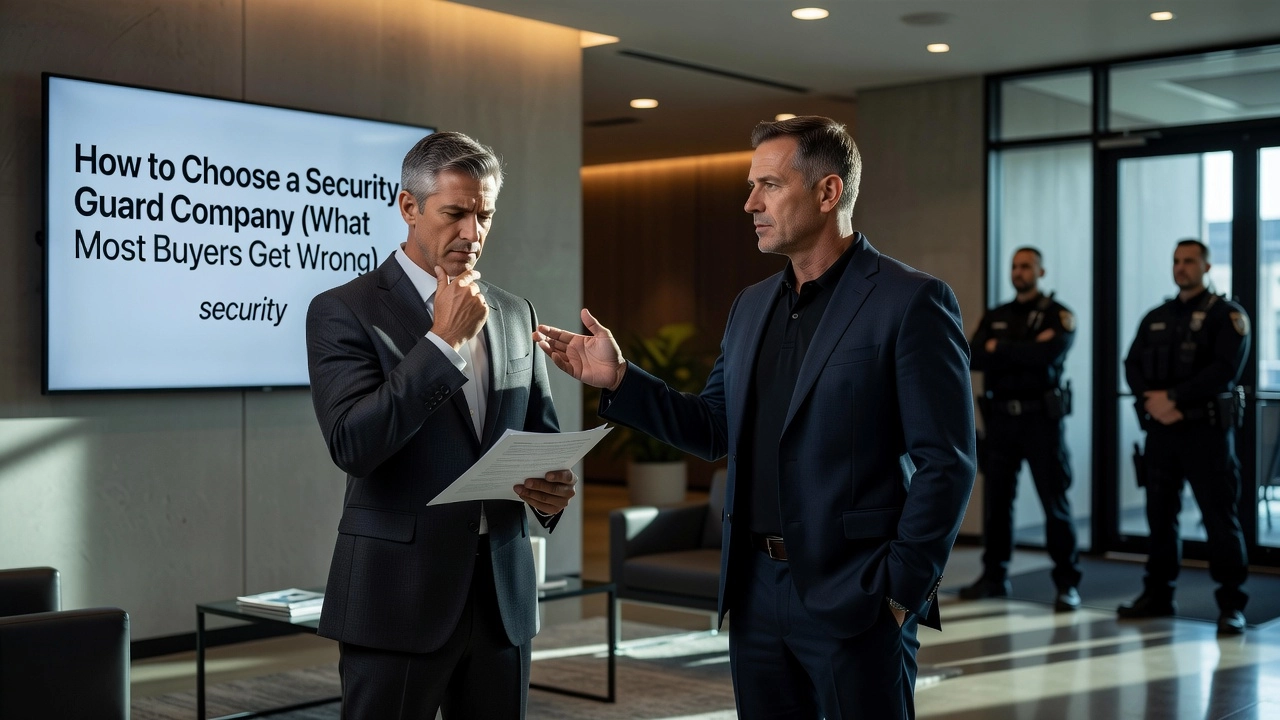
Most businesses assume that choosing a security guard company comes down to price and availability. They browse a few websites, collect some quotes, and sign a contract with whoever seems cheapest or most responsive. Months later, they are dealing with unreliable guards, poor communication, and security gaps that leave their property and people at risk.
The reality is that selecting the right security guard company is a strategic decision, one that requires understanding what separates a truly capable provider from one that simply looks good on paper. Most buyers focus on the wrong factors entirely, and the consequences can be serious.
In this post, we break down the critical criteria that actually matter when evaluating security companies. You will learn what questions to ask, which red flags to watch for, and how to assess whether a provider has the infrastructure, training standards, and accountability measures to deliver consistent results. Whether you are securing a commercial property, an event, or a corporate campus, this analysis will help you make a smarter, more confident hiring decision.
What Makes a Security Guard Company Worth Hiring
A reputable security guard company must hold a current licence compliant with state regulations, offer documented response protocols, and provide guards trained beyond the minimum Certificate II in Security Operations. Most businesses that regret their security provider made the decision on price alone, without verifying compliance credentials or service accountability structures.
I’ve found that most Melbourne businesses underestimate what they are actually procuring when they engage a security company. This is not a vendor relationship. It is a risk management contract, and the consequences of getting it wrong extend well beyond an invoice dispute.
Australia’s private security industry employs over 180,000 people and generates more than $11 billion in annual revenue, according to the ASIAL Security 2025 report. Scale does not equal quality. A market this large contains providers across a wide spectrum of compliance rigour, and most buyers lack the framework to tell them apart.
Following reforms introduced on 19 June 2025 under the Private Security and County Court Amendment Act 2024, Victorian licence holders must now complete refresher training to renew. Any provider who cannot confirm their guards meet this requirement is already a compliance liability, regardless of how competitive their pricing appears.
What follows covers four things: what you are actually buying, how to evaluate a provider’s credentials and infrastructure, what realistic pricing looks like, and which procurement mistakes create the most exposure. Each section is built around the question serious buyers should be asking before they sign anything.
What You Are Actually Buying When You Hire a Security Company
When you engage a security company, you are not buying a single service. You are selecting from a suite of distinct deployment models, each engineered for a specific risk environment.
Most people overlook this entirely. A client calls requesting “a guard,” when the actual requirement is a layered solution combining physical presence with CCTV and alarm monitoring and remote response capability. Relying on any single layer typically leaves exploitable gaps.
The four primary models break down as follows:
- Static guarding: A fixed-post officer providing continuous access control, deterrence, and incident response. Best suited to high-traffic corporate lobbies, hospitals, and gated facilities requiring a constant visible presence across professional security guard services.
- Mobile patrols: Officers conducting scheduled and randomised inspections across large or multi-site footprints. Because patrol routes are unpredictable, they complicate any pre-planned unauthorised access. Mobile patrol services distribute cost across a route, making them a practical, cost-efficient alternative to 24/7 static posts for lower-risk or larger perimeter sites.
- Event security: A time-bound deployment focused on crowd management, access control, and liability reduction for concerts, trade shows, and corporate gatherings. This requires specific crowd psychology training and resource scaling distinct from everyday static or patrol models.
- Integrated electronic monitoring: CCTV, alarms, and remote response bundled with physical guarding. As security patrol and static guarding analysis confirms, organisations that combine both physical and electronic layers achieve more comprehensive protection than either approach alone.
Critically, guards are not interchangeable personnel. I’ve found that buyers consistently underestimate how different the role requirements are across contexts. A concierge-trained officer managing front-of-house access at a commercial tower is handling hospitality protocols alongside security functions. A construction site security operative is managing perimeter integrity, equipment theft deterrence, and contractor access under entirely different conditions and licensing requirements. Deploying the wrong model against a given risk profile does not reduce risk; it creates a false sense of coverage.
Pro Tip: Before requesting a quote, document your site layout, peak occupancy hours, and the specific assets requiring protection. A credible provider will use this to recommend the right deployment mix, not simply default to the highest-margin option.
Why the Australian Security Market Has Changed Significantly
Australia’s physical security market is not holding steady; it is accelerating, and the providers operating in it are not equal.
The numbers confirm this directly. The Australian market was valued at USD 2,632 million in 2024 and is projected to reach USD 4,316.30 million by 2033 at a CAGR of 5.65%. That growth rate matters to buyers, not just investors, because rapid market expansion consistently widens the gap between high-capability providers and those simply meeting minimum licensing requirements to capture new contracts.
Globally, the outsourcing trend is unambiguous. Contract security grew 50% from USD 22 billion in 2014 to USD 33 billion in 2022, and the SIA-ASIS combined physical security equipment and services market reached USD 405 billion in 2023. Organisations are choosing specialist providers because building in-house capability is expensive, harder to scale, and difficult to keep current with fast-moving technology standards.
Post-2020 growth in Australia ran at 10% annually from 2021 through 2024, driven heavily by cyberattacks, data breaches, and digital transformation across government and BFSI sectors. I’ve found that this connection between digital threats and physical security is still underestimated by many SMB buyers. Physical access control and electronic monitoring are now integrated layers of the same risk posture, not separate procurement decisions. ABCO’s electronic security services and CCTV and alarm monitoring exist precisely because these functions now operate in parallel with on-ground personnel.
By 2026, hybrid security models have become the baseline expectation for credible providers. AI-powered video analytics, biometric access control, and integrated guard-plus-monitoring deployments are standard offerings from serious operators, not premium add-ons.
Most people overlook this when evaluating providers: large enterprises hold 60% of Australian physical security market spend, which means they have historically received the most rigorous service delivery. SMBs are the fastest-growing buyer segment entering this market right now. That growth does not come with automatic quality assurance. Apply enterprise-level vetting standards to every engagement, regardless of contract size or perceived scope.
The 5 Criteria That Separate Good Providers from Risky Ones
Not every provider operating in Melbourne’s security market is compliant, qualified, or equipped to protect your assets. Knowing how to separate credible operators from risky ones is the most important due diligence step you will take.
Licence Status and Industry Membership
Verify that any provider holds a current licence under Victoria’s updated private security framework. The Private Security Act reforms that took effect in June 2025 overhauled the registration system entirely, with a hard compliance deadline of 19 June 2026 for the transition to new licensing requirements. ASIAL membership adds another layer of assurance; it signals the provider meets training standards, carries appropriate insurance, and adheres to a recognised industry code of conduct. I’ve found that buyers routinely assume compliance without checking, and that assumption carries real risk in Melbourne’s competitive market where transitional non-compliance is a live issue right now.
Response Protocols and Guard Qualifications
Verbal commitments on response times are not enforceable. Ask for written service level agreements that specify alarm response windows, after-hours contact procedures, and incident escalation steps. On qualifications, Certificate II in Security Operations is the legal floor, not a mark of quality. Providers deploying guards with additional certifications in crowd control, first aid, or construction site protocols bring operationally ready personnel from the first shift.
Technology and Sector Experience
In 2026, guards operating without digital incident logs represent a measurable liability gap. A credible provider should integrate with CCTV and alarm monitoring systems, access control platforms, and structured reporting tools. Most people overlook this until an incident occurs and documentation is either missing or unenforceable. Equally, sector-specific experience matters. A provider with documented construction site security deployments, for example, arrives with site-appropriate protocols rather than adapting general procedures to a high-risk environment on your timeline.
Pro Tip: Request a sample incident report and a redacted SLA from any shortlisted provider before signing. If either is unavailable, treat that as a disqualifying signal, not a minor gap.
Security Service Types: When to Use Each
Not all security deployments are created equal, and defaulting to whichever service type you are most familiar with is how budgets get wasted. The table below maps each core service type to its intended environment.
| Service Type | Best For | Deployment Model |
|---|---|---|
| Static Guards | High-value assets, access control | Fixed post, 24/7 |
| Mobile Patrols | Large sites, cost-efficiency | Scheduled + reactive |
| Event Security | Crowd management, liability reduction | Event-duration only |
| Construction Security | Tools/plant theft, after-hours protection | Site-specific, project-duration |
| CCTV and Alarm Monitoring | Remote oversight, incident logging | 24/7 remote |
In my experience, the businesses that get the most value from their security budget are those that combine at least two service types rather than defaulting to a single static guard deployment. A practical example: a construction site running overnight mobile patrols alongside CCTV monitoring closes both the physical deterrent gap and the evidentiary logging gap simultaneously.
One compliance point that catches buyers off guard: event security engagements in Victoria require guards to hold a crowd controller licence under the Private Security Act 2004. Not every guard company carries this endorsement. Verify the specific licence class before booking, not after.
For construction site security, the risk profile is distinct. Tools, plant equipment, and materials represent high-value targets concentrated on a temporarily unoccupied site, making after-hours protection a non-negotiable rather than an optional upgrade.
Pro Tip: When requesting quotes, ask each provider to specify which licence classes their guards hold for the exact service type you need. A general security licence does not automatically cover crowd control or other specialist roles.
What Does a Security Guard Company Cost in Melbourne?
Most Melbourne security providers do not publish rate cards, and the ones that do are quoting before they understand your site. Pricing is always a function of risk profile, not a fixed hourly figure.
The variables that drive any legitimate quote include site risk assessment, guard qualification level (standard licence versus crowd control endorsement), shift composition (day, night, weekend, public holidays), and whether the engagement calls for static guarding, mobile patrol, or event security. Strip any one of those variables and the number is meaningless.
Procurement models also vary by buyer size. Large enterprises, which account for the majority of Australian security spend, typically negotiate SLA-based annual contracts with defined KPIs and performance clauses. SMBs generally engage on hourly or monthly retainer terms, which offer flexibility but less pricing leverage. Knowing which model fits your operation shapes how you approach the conversation.
I’ve found that the most expensive mistake buyers make is treating the lowest hourly rate as the lowest cost. Providers who cut margins on guard training, public liability insurance, or supervisory ratios create liability exposure that transfers directly to the client. Remediation after a serious incident, covering legal costs, insurance excess, and reputational fallout, routinely exceeds the initial savings many times over. The Security Services Industry Award 2020 sets a non-negotiable wage floor for licensed guards in Australia; any quote that appears to sit well below market is compressing somewhere else in the cost structure.
With approximately 18,000 security professionals employed across around 1,500 businesses nationally, Melbourne buyers have genuine choice. Use that leverage to demand transparency on guard licensing under Victoria’s Private Security Act 2004, documented training records, and supervision ratios, not just to push the hourly rate down.
Pro Tip: Request a site assessment before discussing price. Any credible security guard company will require one before quoting accurately. If a provider skips this step, that tells you something about how they operate.
Red Flags to Watch Before You Sign a Contract
I’ve found that Melbourne businesses most often raise these exact issues when describing why they switched providers, and in nearly every case, the warning signs were visible before the contract was signed.
Licence and membership verification come first. As of 19 June 2025, all private security activities in Victoria became fully licensed under the Private Security and County Court Amendment Act 2024. Any provider who cannot immediately produce a current Victoria Police business licence is operating outside the law. You can verify status directly through Victoria Police’s public register before you sign anything. ASIAL membership adds a further credibility layer; the association represents approximately 2,750 member organisations and functions as an Approved Security Industry Organisation under Victorian legislation. No certificate on request means walk away.
Absent incident documentation creates your liability, not just theirs. Without a written incident reporting and post-incident documentation process, your business inherits the exposure when something goes wrong. Reputable Victorian Government security contracts explicitly require suppliers to cover emergency incident response as a defined service obligation. If your provider has no documented procedure, that gap will show up in an insurance claim or legal dispute.
Generic deployment is an operational failure. Guards arriving without a site-specific induction or briefing pack signal that the provider runs a one-size-fits-all model. Victoria’s 2025 licensing reforms introduced refresher training and category-specific credential requirements precisely because operationally appropriate deployment matters. A provider ignoring this LHA cost guidance updated for 2025-26 is also likely cutting corners on pay compliance.
No SLA means no accountability. A contract without defined response times, escalation contacts, and a performance review cadence is not a security partnership; it is a casual arrangement dressed up as one.
Common Pitfall to Avoid
The most common mistake Melbourne businesses make is selecting a security company based on the lowest hourly rate, without asking for proof of ASIAL membership or reviewing their incident response documentation. That decision routinely costs more to fix than the initial savings ever justified.
I’ve seen this pattern repeat consistently: a business saves a few dollars per hour on their security guard contract, then faces an incident where the response was undocumented, the guard was undertrained, and the provider’s insurance was inadequate. The remediation costs, legal exposure, and reputational damage dwarf every cent saved.
Three actions prevent this outcome entirely.
Verify the licence independently. Before shortlisting any provider, request their current security licence number and confirm its validity directly with the Victoria Police Licensing and Regulation Division. Do not accept a PDF certificate from the supplier as sufficient. Independent verification takes minutes and closes the compliance gap that many businesses overlook when hiring security guards.
Request documentation before any commercial conversation. Ask every candidate provider for a sample incident report and a copy of their standard SLA. A mature operator produces both without hesitation. A provider who cannot supply either is telling you exactly what post-incident accountability will look like. The SLA should specify response times, escalation procedures, and guard replacement guarantees; anything vague is a liability.
Use the site assessment as a two-way evaluation. The questions a provider asks during their site visit reveal more than their proposal document ever will. Per documented pitfalls in security service selection, providers who arrive with pre-packaged solutions before understanding your site have already failed the assessment. A qualified operator asks about access points, shift handover protocols, and your highest-risk periods before they quote anything.
Frequently Asked Questions
What licences should a security guard company hold in Victoria?
All security companies operating in Victoria must hold a current business licence issued by the Victoria Police Licensing and Regulation Division under the Private Security Act 2004. Every individual officer must also hold a role-specific Security Industry Licence, covering classifications such as Security Guard, Crowd Controller, or Bodyguard, before performing any work on site. From 19 June 2025, the Private Security and County Court Amendment Act 2024 introduced mandatory refresher training for licence renewals across all three classifications, a material compliance change any buyer evaluating providers in 2026 should confirm. ASIAL membership remains voluntary but signals that a company maintains minimum insurance levels and complies with an independent code of practice, making it the practical trust benchmark in the industry.
What is the difference between static guards and mobile patrols?
Static guards are assigned to a fixed post, such as a building entry or critical asset, providing continuous visible presence and direct access control. Mobile patrol services deploy officers across one or multiple sites on scheduled or randomised routes, offering deterrence through unpredictability rather than fixed presence. Mobile patrols are more cost-efficient for lower-risk or geographically spread locations. Many organisations use both in combination to match coverage to their specific risk profile.
How much does it cost to hire a security guard company in Melbourne?
Costs are driven by guard qualification level, site risk, hours of coverage, and contract structure. SMBs typically engage on hourly or retainer models; enterprise clients negotiate annual SLA-based contracts. Always request a site assessment before accepting any quote.
What industries in Australia use security guard services most?
Government, banking and financial services, commercial real estate, construction, retail, and events are the dominant sectors. Residential, industrial, and transportation verticals are also significant and are forecast to grow through 2033 as Australia’s physical security market expands toward USD 4.3 billion.
How do I verify if a security company is ASIAL accredited?
Search the ASIAL member directory at asial.com.au by company name or location. For individual guard licence verification, use the Victoria Police Licensing and Regulation Division’s publicly searchable online register. A credible provider will supply their firm registration number without hesitation; reluctance to do so is a documented red flag when choosing a security company in Australia.
Conclusion
Choosing the right security guard company is not a decision to make on price alone. The businesses that get it right focus on what truly matters: verified licensing and training standards, clear accountability measures, consistent communication, and a provider with the infrastructure to deliver long-term reliability.
A cheap contract that falls apart in execution is never a bargain. The cost of security gaps, whether measured in property loss, liability, or damaged trust, far exceeds any upfront savings.
You now have the framework to evaluate providers with confidence, ask the right questions, and spot the warning signs before they become expensive problems.
Take the next step today. Audit your current security setup, revisit your provider criteria, and reach out to qualified companies using the standards outlined here. Your people and property deserve protection that actually works.
about
avada factory
Sempery ultricies nibh at dolor cras urna eleifend nec. Atiam efficitur tempor.