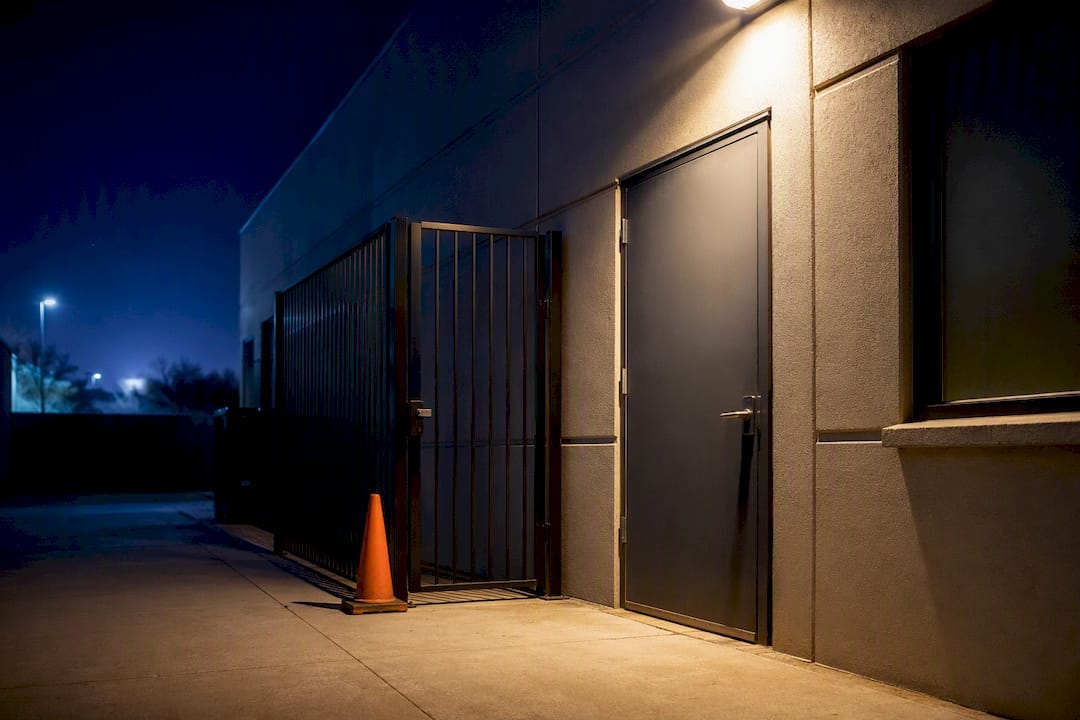
Motion-activated floodlights at entry points, paired with fixed dusk-to-dawn or LED coverage along paths and driveways, cover most residential security needs. Solar units suit low-traffic corners where mains power is impractical, and smart controls add convenience once the basics are sorted. Any work on household wiring needs a registered electrician and a check against Australian Standards before installation.
TL;DR:
- Motion sensors work best when placed near entry points to startle intruders, with pet immunity features reducing false triggers from small animals.
- LED floodlights should be aimed carefully to avoid creating shadows and should be balanced against energy consumption for effective security.
- Solar lights are suitable for low-traffic outdoor corners, but they cannot replace mains-powered fixtures in high-risk areas due to limited brightness.
- Proper lighting design follows CPTED principles by maintaining uniform brightness, avoiding glare, and preventing isolated light pools that reduce surveillance.
- All mains-connected fixtures require an electrical contractor and compliance with Australian standards, while smart controls need certification to avoid cybersecurity risks.
Table of Contents
- Security lighting types: what each one is actually for
- How to choose the right lights for your property
- Design rules that separate good lighting from wasted money
- Installing and maintaining security lighting the right way
- When lighting alone isn’t enough
- Get a professional review of your property’s security lighting
- Sources
- FAQ
Security lighting types: what each one is actually for
Not every fixture does the same job, and buying the brightest floodlight you can find often backfires. Here’s how the main security lighting types break down.
Motion sensors (PIR and microwave) trigger lights only when something moves, which makes them the sharpest tool for startling an intruder and drawing attention to entry points. Passive infrared (PIR) sensors detect heat signatures and work well for most home applications, while microwave sensors detect motion through thinner barriers and cover wider angles but cost more. Motion sensor lighting is effective at startling potential burglars when placed near doors, side gates, and small windows where someone might try to sneak in unseen. False triggers usually come from swaying tree branches, passing traffic, or poor sensor angling rather than faulty units, and most modern PIR sensors now offer pet immunity that ignores anything under a set weight or size threshold.
Floodlights throw a wide, high-lumen beam across open areas like driveways, backyards, or carports. They’re the workhorses of outdoor lighting, but a 5,000-lumen floodlight aimed at the wrong angle creates as many shadows as it removes. Balance beam spread against energy draw, particularly if the fixture runs on a dusk-to-dawn timer rather than a motion trigger.
Solar security lights avoid wiring altogether and suit fence lines, sheds, or garden paths where running a cable is impractical. Battery capacity and panel placement limit their output, and they generally can’t match the brightness of a mains-powered LED floodlight, so they work best as a secondary layer rather than your only line of defence at the front door.
Dusk-to-dawn photocell fixtures switch on automatically as light fades and stay on all night, which suits laneways, stairwells, and other zones where constant visibility matters more than a startle effect.
LED security lighting should be the default choice over halogen for almost every application now. LEDs last longer, run cooler, and use a fraction of the power. Lighting design guidance recommends warm white with a colour temperature at or below 3000K and a Colour Rendering Index (CRI) that is high enough to aid facial recognition, which renders skin tones and clothing accurately enough for a witness or camera to actually identify someone.
Smart and integrated lighting connects to app controls and often runs on protocols like Zigbee or Matter, letting you schedule scenes or get a phone alert when a sensor fires. Newer smart sensors offer local automations and features to reduce false triggers from pets, but uncertified imported devices can create compliance gaps and cybersecurity exposure, so stick to units carrying proper Australian certification.
Infrared (IR) illumination supports CCTV cameras that need to see in the dark without alerting anyone to the fact they’re being filmed, useful for covert monitoring of a driveway or side access.
Portable and temporary lighting covers night works, renovations, or events where permanent fixtures aren’t justified but visibility still matters.
How to choose the right lights for your property
Start by matching the fixture to the specific job, not the other way around.
- Identify the risk zone. A driveway needs different coverage to a side gate or a rear yard hidden from the street.
- Map the beam. Check mounting height and beam angle so fixtures overlap slightly and don’t leave dark gaps between them.
- Target the right brightness. Recommended lux levels are around those suitable for pedestrian paths, carparks, laneways, and entrances to aid visibility and facial recognition where you need to recognise a face.
- Decide on power. Mains wiring suits permanent floodlights and entry points; solar suits low-traffic corners; low-voltage systems reduce shock risk for garden runs. Avoid putting security lighting on shared circuits with heavy appliances, since an overloaded circuit can drop your lights exactly when you need them.
- Choose your controls. Motion sensitivity, timers, and smart scenes all change how the system behaves at 2am versus 8pm.
- Weigh purchase cost against running cost. A cheap fixture that fails within a year, or a vandal-prone housing on an exposed wall, costs more over time than a slightly pricier, hardier unit.
Pro Tip: Walk your property after dark before buying anything. Note where your eyes struggle to adjust between bright and dark patches. Those transition zones are exactly where an intruder would choose to stand.
Design rules that separate good lighting from wasted money
Crime Prevention Through Environmental Design (CPTED) principles argue that lighting exists to support natural surveillance, not just to make a yard glow. Good lighting design removes concealment and considers who actually benefits from the light rather than simply maximising lumen output.
- Keep light levels uniform across a zone. Sharp contrasts between bright and dark patches hide movement better than darkness alone.
- Favour warm white at 3000K or below with CRI 80 or higher wherever identification matters, such as front doors and driveways.
- Check obtrusive lighting controls under AS 4282 before installing anything that might spill onto a neighbour’s property, and confirm whether council approval applies.
- Position fixtures to eliminate CCTV blind spots, since a camera pointed straight into a floodlight glare records nothing useful.
One nuance often missed: lighting alone can be counterproductive if it creates an isolated bright pool with no sightline to a street or neighbour, because that isolates a resident rather than protecting them.
Installing and maintaining security lighting the right way
- Check every fixture carries an RCM or AS compliance mark and is rated for outdoor, weatherproof use before it goes anywhere near your wall.
- Use a dedicated circuit for critical fixtures rather than sharing one with air conditioners or other heavy draws.
- Mount lights out of easy reach where vandalism or accidental knocks are likely, and trim back any planting that will eventually block the beam.
- Clean lenses, replace batteries in solar units, and test sensor sensitivity every few months, updating firmware on any smart-connected fixture.
- Call a registered electrical contractor for any mains wiring work, and consider a CPTED or site audit if incidents keep happening despite decent lighting.
When lighting alone isn’t enough
Lighting deters and reveals, but it doesn’t record, verify, or respond. Once a property has real foot traffic, high-value stock, or a history of repeat incidents, lighting works best paired with CCTV, access control, or mobile patrols. Experience in integrated security programs suggests that a well-placed floodlight without a matching camera or patrol plan is only half a strategy.
— Abco
Get a professional review of your property’s security lighting
A single dark corner, an overgrown hedge blocking a sensor, or an outdated halogen floodlight burning through electricity for no security benefit are all things a proper site assessment picks up in minutes. If your property has had repeat incidents, sits on a construction site, or forms part of a broader commercial or residential complex, a lighting-only fix rarely closes the gap. Abcosecurity’s best-practice guidance for 2026 covers how lighting fits into a wider risk assessment alongside CCTV, access control, and patrol coverage, and it’s a solid starting point before committing to any new fixture. For sites with ongoing works or higher-value equipment, the construction site security technology guide walks through how lighting integrates with monitored access and surveillance across an active build.
Sources
- How to improve your home security | RACV
- Fact sheet: Designing better lighting | Community Crime Prevention Victoria
- CPTED lighting: the important role it plays | Smartsec Security
- The 2026 guide to motion sensors for Australian smart homes | Asthome
FAQ
What are the main types of security lighting?
The core categories are motion-activated (PIR and microwave), floodlights, solar-powered units, dusk-to-dawn photocell fixtures, LED and smart/integrated systems, plus infrared illumination for cameras and portable lighting for temporary use.
What is the best type of security light for a home?
Motion-activated LED floodlights at entry points combined with fixed dusk-to-dawn coverage along paths generally give the best balance of deterrence, visibility, and running cost for most homes.
What are the four main types of lighting used around a property?
For security purposes, the four most common categories are motion-activated, floodlight (fixed or dusk-to-dawn), solar-powered, and smart/integrated lighting, each suited to different zones and budgets.
What is the best type of lighting for security cameras?
Infrared illumination lets cameras capture usable footage in complete darkness without alerting anyone to the camera’s presence, while visible LED lighting with CRI 80 or higher works best when you need clear, colour-accurate footage for identification.
Do I need an electrician to install security lights?
Any fixture connected to mains wiring needs a registered electrical contractor, while low-voltage or solar units without hardwiring can often be installed without one, provided they’re placed and angled correctly.
Recommended
about
avada factory
Sempery ultricies nibh at dolor cras urna eleifend nec. Atiam efficitur tempor.