A compliant security services agreement in Australia must cover ten non-negotiable areas: scope of services, term and renewal, fees and payment, service levels and reporting, insurance and indemnity, licensing and compliance, subcontracting and staffing controls, transition and handover, dispute resolution, and privacy and data handling. Miss any one of them and you are exposed, whether you are the client or the provider.
Before reading further, do three things right now:
- Verify the provider’s licence with your state regulator (e.g. NSW Police Licensing & Registry, Consumer Affairs Victoria) and confirm it covers every service type in your scope.
- Request current certificates of insurance — public liability, workers’ compensation, and professional indemnity — and check expiry dates personally.
- Confirm a written transition plan exists before signing, covering handover of keys, access credentials, patrol logs and electronic records.
These three checks catch the majority of contract failures before they start. The ASIAL guiding principles are explicit: principals cannot transfer their non-delegable duty of care to a contractor, so independent verification is not optional. The Buying for Victoria procurement template offers a government-grade clause set that commercial clients can adapt as a drafting baseline.
Pro Tip: Print the ASIAL guiding principles and the Buying for Victoria template side by side before your first drafting session. Between them, they cover the structural and operational requirements that most commercial templates miss.
Key takeaways
A compliant Australian security services contract requires verified licences, specific SLAs with real remedies, written subcontracting controls, and an independent transition plan before any provider change.
| Point | Details |
|---|---|
| Verify licences and insurance first | Check the provider’s master licence and individual officer licences against the state register before signing. |
| SLAs need teeth | Specify response times, patrol completion rates and reporting deadlines, then attach service credits and remediation obligations. |
| Control subcontracting explicitly | Require written consent, flow-down obligations and direct licence verification for every subcontractor deployed. |
| Mandate a transition plan | Require a minimum handover period, transfer of all records and independent verification during changeover. |
| Abcosecurity for contract review | Abcosecurity reviews and drafts agreements using ASIAL-aligned, procurement-grade templates across all Australian sectors. |
Table of Contents
- What do security services actually cover, and how do you define scope?
- What core clauses does every security services contract need?
- What Australian laws and licences must a security contract reflect?
- What insurance and indemnity should you require?
- What pricing models and payment terms work best?
- How do you control subcontracting and staffing quality?
- How do you manage termination and transition without gaps?
- How should disputes and poor performance be handled?
- Practical clause bank and template resources you can adapt
- How to review an existing security services contract quickly
- What contract mistakes does Abcosecurity see most often?
- How Abcosecurity can help you get your contract right
- Sources
- FAQ
What do security services actually cover, and how do you define scope?
Scope ambiguity is the single most common source of contract disputes. A contract that says “security guarding services” without further definition gives the provider enormous latitude and the client very little recourse.
Common service categories to consider:
- Static guarding: fixed-post officers at entry points, reception desks or control rooms
- Mobile patrol: scheduled or random vehicle/foot patrols across one or more sites
- Alarm response: attending and assessing activated alarms within a defined response time
- Access control: managing entry systems, visitor management and credentialling
- Crowd and event control: licensed crowd controllers for public or private events
- Concierge and reception security: front-of-house roles combining customer service with security functions
- Mail and parcel scanning: x-ray or physical inspection of incoming deliveries
- CCTV monitoring: live or recorded monitoring from a control room
- Key-holding and patrol verification: custody of site keys and electronic verification of patrol completion
For each category you include, the contract should specify the site address, operating hours, minimum officer numbers on duty at any time, specific tasks the officer must perform, and explicit exclusions. That last point matters more than most clients realise. If you do not name what is excluded, a provider can argue it falls within scope, or conversely, that it was never agreed.
A site-by-site schedule attached to the main agreement is the cleanest approach. The schedule lists each location, the service type, hours, minimum staffing, and any site-specific requirements (e.g. armed escort, bilingual officer). The main agreement then governs the commercial and legal terms that apply across all schedules.
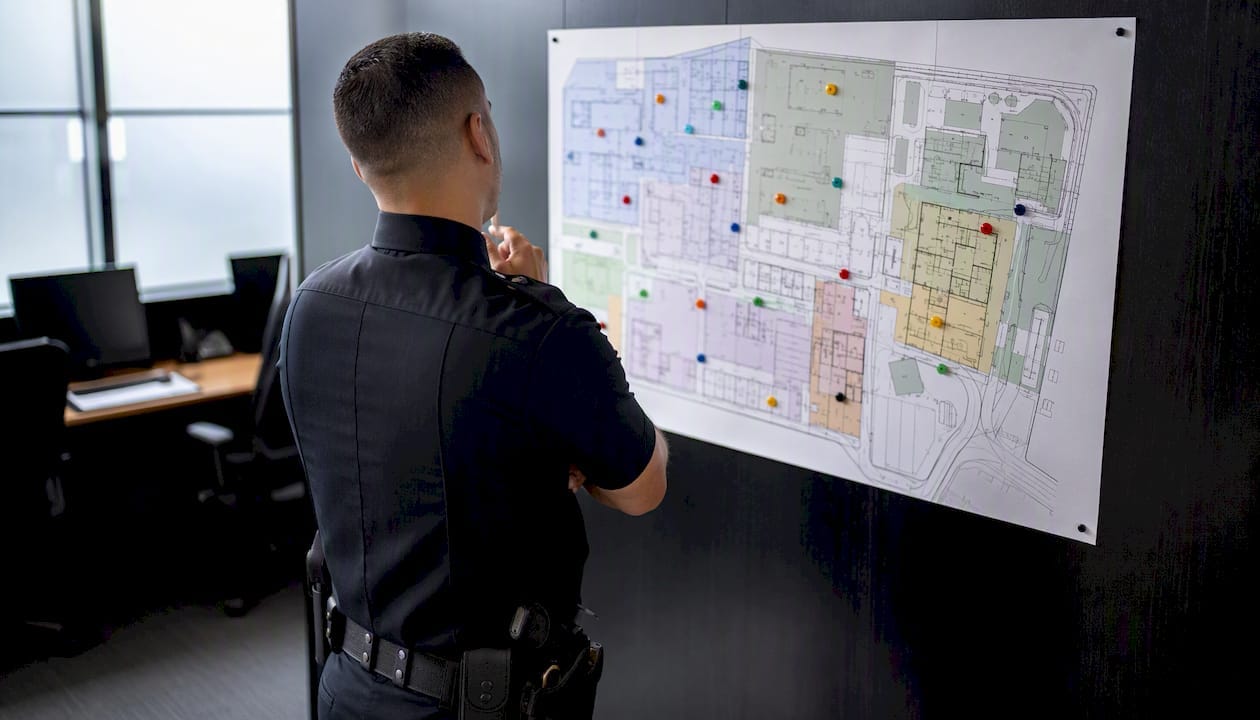
Pro Tip: Attach a site map or floor plan as an annexure for complex sites. Courts and arbitrators find it far easier to resolve scope disputes when the physical boundaries are documented visually, not just described in text.
For a detailed breakdown of what static guarding duties typically involve operationally, that context is worth reviewing before you draft the scope schedule.
What core clauses does every security services contract need?
The Lawpath security services agreement template identifies the baseline: service details, payment terms, performance standards, insurance, confidentiality and dispute resolution. That is the floor. A well-drafted agreement goes further.
Parties, definitions and term
Define the parties precisely (legal entity names, ABNs), set the commencement date, and specify whether the term is fixed or rolling. Rolling terms with automatic renewal are common but dangerous if notice periods are short. A 30-day notice period on a 12-month rolling contract can leave a client scrambling.
Service levels, KPIs and reporting
This is where most contracts are weakest. Specify:
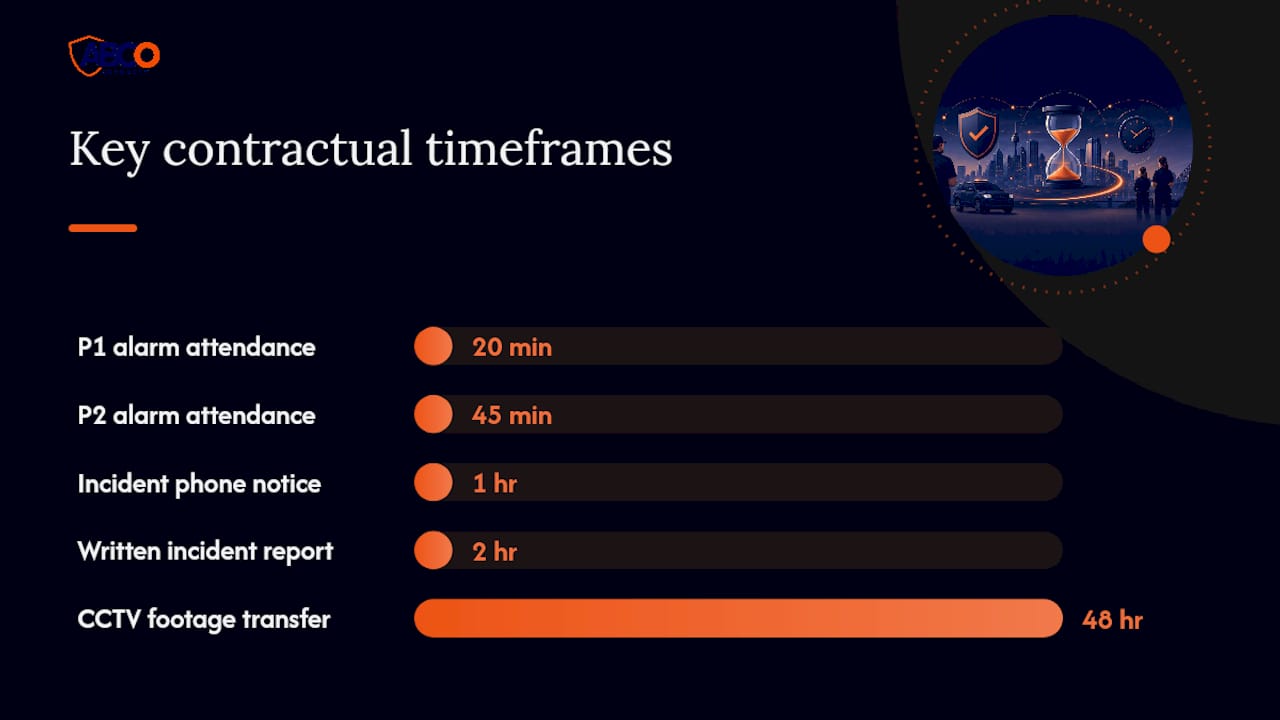
- Response times for alarm attendance (e.g. within 20 minutes for priority-one alarms)
- Patrol completion rates (e.g. 95% of scheduled patrols verified electronically each month)
- Incident report submission timeframes (e.g. within two hours of an incident)
- Monthly reporting format and delivery date
AS 4421:2023 sets the minimum operational and management requirements for guard and patrol services. Referencing it in your SLA clause gives the standard teeth: “The provider must at all times comply with AS 4421:2023 and provide monthly compliance evidence.”
Incident reporting and escalation
A sample clause: “The provider must notify the client’s nominated representative by telephone within one hour of any critical incident and submit a written incident report within two hours. Critical incidents include any use of force, medical emergency, criminal offence or significant property damage.”
WHS and fatigue management
The provider must comply with the relevant Work Health and Safety Act (Commonwealth or state, depending on the workplace) and maintain a fatigue management policy for officers working extended shifts. Require evidence of compliance annually.
Confidentiality, privacy and CCTV footage
Specify that CCTV footage recorded on client premises is the client’s property. The provider must not copy, retain or disclose footage without written consent. All personal information collected must be handled in accordance with the Privacy Act 1988 (Cth) and the Australian Privacy Principles.
Insurance and indemnity
Covered in detail below, but the clause must name minimum limits, require certificates before commencement, and mandate notification of any material change or cancellation.
Subcontracting
Express prohibition or written-consent regime. Covered in detail in the subcontracting section.
Force majeure
Define triggering events (pandemic, natural disaster, government-ordered lockdown) and the obligations during a force majeure period: notice within 24 hours, mitigation steps, and a right to terminate if the event continues beyond a defined period (typically 30 days).
Termination and transition
Covered in detail below.
Pro Tip: Include a “key personnel” schedule naming the site supervisor and account manager. If either leaves, the client gets written notice within 48 hours and approval rights over the replacement. This one clause prevents a lot of quiet service degradation.
What Australian laws and licences must a security contract reflect?
Every Australian state and territory has its own Security Industry Act. Officers must hold individual licences for the class of work they perform (e.g. crowd control, guard/patrol, monitoring centre operator). The provider must hold a master licence. Your contract must require both, verified before commencement and on an ongoing basis.
Key regulatory sources:
- State Security Industry Acts: NSW, VIC, QLD, WA, SA, TAS, ACT and NT each have separate licensing regimes. Licence classes, renewal periods and conditions vary.
- NSW Security Industry Act 1997: restricts indirect provision or brokering of security personnel, which directly affects how subcontracting arrangements must be structured and disclosed.
- AS 4421:2023: the national operational standard for guard and patrol services.
- Work Health and Safety Acts: Commonwealth WHS Act 2011 and state equivalents impose duties on both the client (as a person conducting a business or undertaking) and the provider.
- Privacy Act 1988 (Cth): governs collection and handling of personal information, including CCTV footage and visitor records.
- Security Services Industry Award 2020: sets minimum wages, penalty rates and conditions. Your payment clauses must accommodate award obligations or you risk underpayment exposure.
State-specific tailoring matters. Victoria’s Buying for Victoria template embeds probity and transition requirements that reflect Victorian procurement policy. NSW’s brokering restrictions mean subcontracting clauses need explicit disclosure and direct licence verification for every officer deployed. If your sites span multiple states, the governing law clause and compliance schedule must address each jurisdiction.
For a broader view of industry best practices that translate regulatory requirements into operational controls, that resource covers the operational side in detail.
This guide provides general information only and is not legal advice. For complex multi-jurisdictional agreements or matters involving significant liability, engage a solicitor with experience in security industry contracts.
What insurance and indemnity should you require?
Minimum insurance requirements for Australian security service contracts typically include:
| Insurance type | Typical minimum limit | When to increase |
|---|---|---|
| Public liability | $20 million per occurrence | High-traffic sites, crowded places, events |
| Workers’ compensation | Statutory (state-mandated) | Always required; no discretion |
| Professional indemnity | $5 million per claim | Monitoring, risk assessment, consulting roles |
Verify currency by requesting certificates of insurance directly from the insurer, not just from the provider. A certificate that has lapsed or been cancelled is worthless.
A sample insurance clause: “The provider must maintain, at its own cost, public liability insurance with a substantial minimum limit per occurrence, workers’ compensation insurance as required by law, and professional indemnity insurance appropriate to the services. The provider must provide current certificates of insurance before commencement and promptly upon renewal.
On indemnity: a mutual indemnity clause (each party indemnifies the other for its own negligence) is standard. Watch for clauses that require the client to indemnify the provider for the provider’s own acts. That is a red flag.
Limitation of liability clauses typically cap the provider’s aggregate liability at the fees paid in the preceding 12 months. For high-risk sites, negotiate a higher cap or carve out liability for gross negligence, wilful misconduct and personal injury from any cap.
Pro Tip: Ask your broker to review the provider’s certificate before signing. Brokers can spot exclusions, endorsements and sub-limits that a non-specialist will miss.
For practical guidance on verifying workers’ compensation currency, that resource walks through the certificate-reading process step by step.
What pricing models and payment terms work best?
Security services are priced in several ways, each suited to different operational needs:
| Pricing model | Best suited to | Key drafting point |
|---|---|---|
| Per-officer hourly rate | Variable-hours sites, events | Specify minimum call-out hours and overtime thresholds |
| Flat site rate (monthly) | Fixed-post, consistent hours | Define exactly what hours and staffing the rate covers |
| Monitoring retainer | CCTV or alarm monitoring | Specify response obligations included in the retainer |
| Blended rate | Multi-site, mixed service types | Attach a rate schedule per site and service category |
| Event/project rate | One-off events or construction phases | Define scope, duration and variation process explicitly |
Award penalty rates apply on weekends, public holidays and for overtime. The NetLawman security services contract includes fee schedules that account for public holiday penalty rates and suspension for non-payment. Your contract should do the same.
Payment terms to include:
- Invoicing frequency (weekly, fortnightly or monthly in arrears)
- Payment period (14 or 30 days from invoice date is standard)
- GST treatment (all fees are quoted exclusive of GST unless stated otherwise)
- Interest on late payment (typically the Reserve Bank of Australia cash rate plus 2–4%)
- Suspension rights: the provider may suspend services after written notice if payment is overdue by more than a defined period (e.g. 14 days)
- Variation and change control: any change to scope, hours or staffing must be agreed in writing before the provider is obliged to perform it
A sample payment clause: “Invoices are due and payable within 14 days of the invoice date. The provider may suspend services after providing seven days’ written notice of non-payment.”
For subscription-based or retainer arrangements, Guard Select’s subscription terms offer a useful reference point for how recurring payment obligations and cancellation rights can be structured.
How do you control subcontracting and staffing quality?
Subcontracting is where security contracts most commonly fail. A client signs with a reputable provider and finds unknown officers on site within weeks. The NSW Security Industry Act 1997 restricts indirect provision and brokering of security personnel, making transparent disclosure and direct licence verification non-negotiable in that state.
Subcontracting controls
- State whether subcontracting is prohibited or requires prior written consent.
- If consent is given, require the provider to disclose the subcontractor’s name, ABN, master licence number and insurance details before deployment.
- Include a flow-down clause: the subcontractor must be bound by the same licensing, training, WHS and confidentiality obligations as the primary provider.
- Reserve audit rights: the client may inspect subcontractor records and licences on reasonable notice.
- Require the primary provider to remain liable for all subcontractor acts and omissions.
Abcosecurity’s subcontractor statement sets out how these flow-down obligations operate in practice, which is useful context when drafting your own approval regime.
Staffing and vetting checklist
- Current individual security licence for each officer (verified against state register)
- National Police Check (no older than 12 months at commencement)
- Working with Children Check where applicable (schools, childcare, hospitals)
- Completion of required training (Certificate II or III in Security Operations as applicable)
- Uniform and identification standards documented and enforced
- Fatigue management policy in place and evidenced
- Key-person clause naming site supervisor with replacement approval rights
The ASIAL guidance is clear that principals retain responsibility for site safety. Relying on a provider’s self-reported compliance is not enough. Require electronic guard-tour verification and periodic independent audits.
How do you manage termination and transition without gaps?
Notice periods in security contracts typically run 30–90 days for convenience termination. Immediate termination rights should apply when: the provider’s licence is suspended or cancelled, a serious misconduct incident occurs, or the provider becomes insolvent.

The ASIAL guiding principles specifically address transition planning for crowded places, recommending that owners plan transitions carefully to avoid service gaps. That advice applies equally to any site where continuity matters.
Transition obligations to include in the contract:
- Return of all keys, access cards, fobs and site credentials on the last day of service
- Transfer of patrol logs, incident reports and CCTV footage archives to the client
- Participation in a site induction for the incoming provider (minimum two-week overlap recommended)
- Provision of a staffing continuity plan if officers are transferring under the Fair Work Act
- Electronic deactivation of provider-held access credentials within 24 hours of termination
A sample transition clause: “On expiry or termination, the provider must, within 48 hours: return all client property; transfer all incident records and patrol logs in electronic format; and participate in a minimum five-business-day handover period with the incoming provider. The provider must not solicit client staff or officers during the handover period.”
Pro Tip: Appoint an independent contract manager to verify the handover. A provider managing its own exit has an obvious conflict of interest. Independent verification during the transition period is the single most effective way to prevent service gaps.
How should disputes and poor performance be handled?
A staged dispute process gives both parties a genuine chance to resolve issues before costs escalate.
- Step 1 — Notice of breach: the client issues a written notice specifying the breach and requiring remedy within a defined cure period (typically 5–10 business days for operational failures, 30 days for systemic issues).
- Step 2 — Senior escalation: if the breach is not remedied, the matter escalates to senior representatives of each party for a face-to-face or video meeting within five business days.
- Step 3 — Mediation: if senior escalation fails, the parties refer the dispute to a mediator agreed between them or appointed by the Resolution Institute or LEADR.
- Step 4 — Termination or litigation: if mediation fails, the client may terminate for cause or commence proceedings in the relevant court.
Operational remedies to include alongside the staged process:
- Service credits: a defined credit (e.g. 10% of the monthly fee) for each month where KPIs are not met
- Remediation plans: the provider must submit a written remediation plan within five business days of any KPI failure
- Step-in rights: for critical failures (e.g. no officers on site), the client may engage a replacement provider at the defaulting provider’s cost
A sample dispute clause: “The parties must attempt to resolve any dispute through the staged process in clause [X] before commencing legal proceedings. Nothing in this clause prevents a party from seeking urgent injunctive or declaratory relief.”
Practical clause bank and template resources you can adapt
Ready-to-adapt snippets for the highest-risk clauses:
SLA and response times:
*”The provider must attend all priority-one alarm activations within 20 minutes of notification and all priority-two activations within 45 minutes.
Incident reporting:
“The provider must notify the client’s representative by telephone within one hour of any critical incident and submit a written report within two hours. Reports must include: time, location, persons involved, actions taken and any police reference number.”
Confidentiality and CCTV:
“All CCTV footage recorded on client premises is the property of the client. The provider must not copy, retain, share or use footage for any purpose other than performance of the services without prior written consent. On termination, all footage must be transferred to the client within 48 hours.”
Subcontracting approval:
“The provider must not subcontract any part of the services without the client’s prior written consent. Any approved subcontractor must hold all required licences, maintain equivalent insurance, and be bound by the same obligations as the provider under this agreement.”
Insurance:
“The provider must maintain public liability insurance of not less than $20,000,000 per occurrence and professional indemnity insurance of not less than $5,000,000 per claim. Certificates of currency must be provided before commencement and within five business days of renewal.”
Recommended template sources:
- Buying for Victoria security services template — procurement-grade, free, suitable as a drafting baseline for any Australian jurisdiction with tailoring.
- Lawpath security services agreement — lawyer-reviewed commercial template with standard clause coverage.
- NetLawman security services contract — includes fee schedules, penalty rates and suspension clauses.
- ASIAL guiding principles — not a template but an essential operational checklist to run against any draft.
Pro Tip: Start with the Buying for Victoria template as your structural base, then layer in the ASIAL guiding principles as an operational checklist. Any gap between the two is a clause you need to add.
How to review an existing security services contract quickly
Run this checklist against any contract you are asked to sign or renew:
- [ ] Provider’s master licence number is stated and verifiable against the state register
- [ ] Individual officer licence requirements are specified and verification is the provider’s obligation
- [ ] Current certificates of insurance are attached or required before commencement
- [ ] SLA metrics are specific (response times, patrol completion rates, reporting deadlines)
- [ ] Subcontracting is either prohibited or requires written consent with flow-down obligations
- [ ] A written transition plan is required on exit, with a minimum handover period
- [ ] Termination triggers include licence suspension and serious misconduct
- [ ] Data handling and CCTV ownership are addressed explicitly
- [ ] Dispute resolution follows a staged process before litigation
Red flags that require immediate negotiation:
- Open-ended subcontracting with no consent or disclosure requirement
- Insurance limits below $10 million public liability
- No independent verification of patrols (self-reported logs only)
- No incident escalation timeframes
- Termination only for convenience with long notice periods and no immediate triggers
- CCTV footage ownership not addressed
If you find three or more red flags, get specialist legal or operational review before signing. For a broader framework on reviewing private security contractor obligations, that resource covers the contractual due-diligence process in detail.
Pro Tip: Ask the provider to complete a pre-contract questionnaire covering licence details, insurance, subcontracting arrangements and transition experience. Their willingness to answer in writing tells you a lot before you even read the contract.
What contract mistakes does Abcosecurity see most often?
After 15 years of contracting across construction, healthcare, corporate and government sites, Abcosecurity sees the same failures repeatedly.
The most common: no transition plan. A client’s previous provider walks off site on day one of the new contract, and the incoming provider has no patrol logs, no site induction records and no access to the CCTV system. The gap is real and immediate. Abcosecurity’s standard onboarding process, described on the corporate onboarding page, includes a mandatory handover checklist that prevents this.
Second: inadequate subcontractor verification. Clients discover officers on site who have never been vetted against the contract’s licensing requirements. Abcosecurity uses electronic guard-tour verification and requires subcontractors to meet the same licensing, training and insurance standards as direct employees, with audit rights reserved.
Third: SLA clauses with no teeth. A contract might specify a 20-minute alarm response time but include no service credit, no remediation obligation and no termination right for repeated failure. The SLA becomes a target, not a commitment. Abcosecurity builds defined service credits and remediation plan obligations into every agreement, so underperformance triggers a documented response, not just a conversation.
The ASIAL guidance puts it plainly: principals cannot delegate their non-delegable duty of care. Independent verification, not provider self-reporting, is the standard Abcosecurity applies across every site it manages.
How Abcosecurity can help you get your contract right
Getting a security services agreement right from the start is far cheaper than fixing it after an incident.
Abcosecurity drafts and reviews security service contracts using procurement-grade templates aligned with ASIAL guiding principles, AS 4421:2023 operational standards, and state licensing requirements. The process is straightforward: you share your site details and any existing agreement, Abcosecurity’s team produces a risk summary identifying gaps and clause redlines, and you receive a contract ready for legal sign-off. For clients across construction, healthcare, corporate and government sectors, the integrated security solutions guide outlines the full scope of what a well-structured agreement should cover operationally. Request a contract review today and know exactly where your current agreement leaves you exposed.
Sources
- SECURITY CONTRACTS (ASIAL guidance)
- Security (Regulatory) legislation (NSW)
- Buyingfor
- Security Services Agreement | Lawpath
- AS 4421:2023 Guard and patrol security services
- Security services contract (NetLawman)
Adapt all templates to the governing jurisdiction of your contract. State licensing requirements, award obligations and procurement rules vary, and a clause that is compliant in Victoria may need revision for NSW or Queensland.
This article is general information, not a substitute for advice from a qualified lawyer. Consult a qualified legal professional about your own circumstances before acting on anything here.
FAQ
What should a security service contract include?
A security services contract must cover scope of services, term and renewal, fees and payment terms, service levels and reporting, insurance and indemnity, licensing and compliance obligations, subcontracting controls, transition and handover arrangements, dispute resolution, and privacy and data handling. The Lawpath security services agreement identifies these as the baseline clause categories for Australian agreements.
How long do security contracts usually run?
Most Australian security service contracts run for 12 months with automatic renewal on 30–90 days’ notice, though multi-site or government contracts often run 2–3 years with options to extend. The notice period for convenience termination is typically 30–90 days depending on site complexity.
What is the format of a security contract agreement?
A standard security services agreement includes a main body covering commercial and legal terms, with schedules or annexures for site-specific scope, fee rates, SLA metrics, and approved subcontractors. Government procurement models such as the Buying for Victoria template use this schedule-based structure.
Do security providers need a licence in Australia?
Yes. Every state and territory requires security providers to hold a master licence and individual officers to hold class-specific licences (guard, crowd controller, monitoring operator). Your contract must require licence verification before commencement and ongoing compliance. Licence suspension is a standard immediate-termination trigger.
How do you handle subcontracting in a security contract?
Either prohibit subcontracting outright or require prior written consent with full disclosure of the subcontractor’s licence, insurance and ABN. Flow-down clauses must bind the subcontractor to the same standards as the primary provider. Under the NSW Security Industry Act 1997, indirect provision and brokering of security personnel carries specific licence conditions that must be reflected in any subcontracting arrangement.
Recommended
about
avada factory
Sempery ultricies nibh at dolor cras urna eleifend nec. Atiam efficitur tempor.