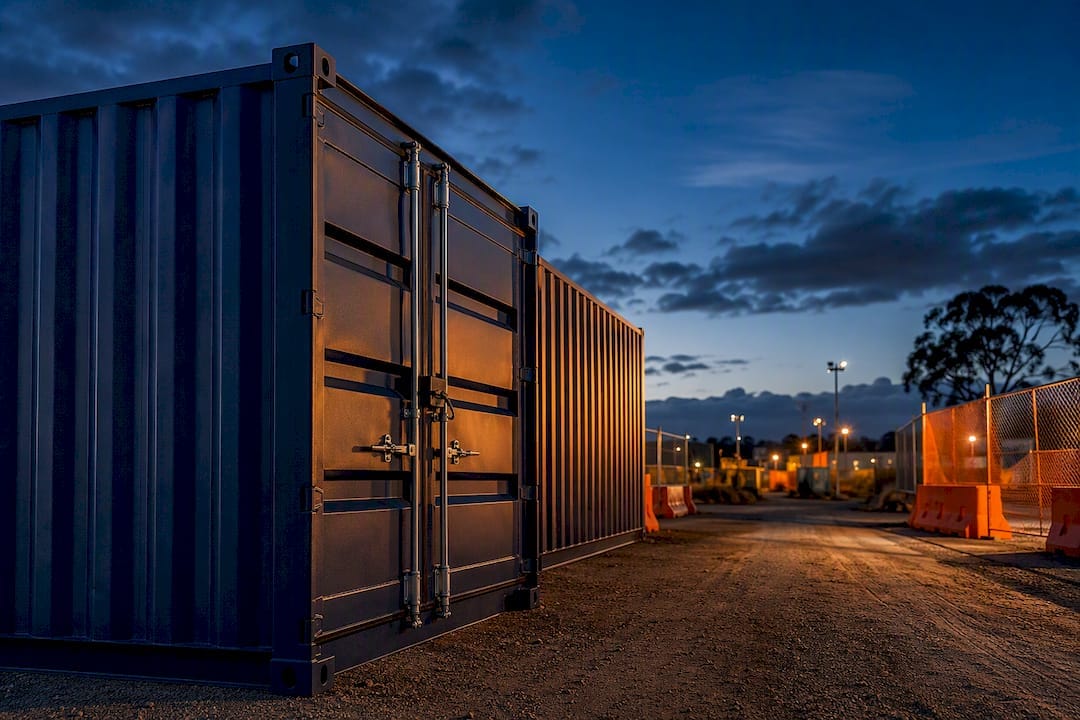
A single lock will not stop a determined thief, but a layered system will. The most effective shipping container security combines a shrouded lock and lockbox, door and hinge reinforcement, visible deterrents like lighting and signage, and a detection layer that alerts you the moment someone tampers with the box. For high-value cargo, remote sites, or long-term storage, pairing that hardware with a professionally monitored service, of the kind Abcosecurity builds for construction and industrial clients, closes the gaps that hardware alone leaves open.
TL;DR:
- Using a welded lockbox with a puck or disc lock significantly extends the time needed for thieves to break into a container, especially against bolt cutters.
- Proper site placement, such as positioning doors toward activity and lighting, can deter opportunistic theft more than higher lock ratings alone.
- Detection devices like vibration sensors, motion-activated cameras, and monitored alarms provide early warnings that mechanical locks cannot offer, especially in remote locations.
- Regular monthly inspections, including lock lubrication and battery checks, help identify hardware failures before they lead to theft or damage.
- High-value or remote sites should combine hardware with professional monitoring and risk assessment to address vulnerabilities that DIY solutions cannot effectively manage.
Table of Contents
- What does shipping container security actually involve?
- Which locks and lockboxes actually stop break-ins?
- How does site placement reduce container theft?
- Do you need alarms, cameras or GPS trackers too?
- What door and hardware reinforcement actually works?
- Why does cargo restraint matter for container security?
- What should a monthly security inspection cover?
- When does container security need a professional?
- Get a container security assessment done properly
- Sources
- FAQ
What does shipping container security actually involve?
Container security is not one product. It is a stack of measures that each close off a different way in, and the right combination depends on what is inside the box and how exposed it is.
Here is how the layers stack up, roughly in order of cost-to-impact ratio:
- Placement: positioning the container so its doors face away from fences or bush, and toward activity or sightlines. Free, and often the single biggest deterrent.
- Lockbox and puck lock: a welded steel box over the locking mechanism paired with a shackleless disc lock. Typically the highest-value spend for the money.
- Door and crossbar reinforcement: stops prying and leverage attacks on the door edges and hinges.
- Lighting: motion-activated floodlights around access points.
- Alarm or camera system: vibration sensors, door contacts, or a monitored camera feed.
- Perimeter fencing: for yards holding multiple containers or high-value stock.
- GPS tracking: for mobile or high-value cargo that moves between sites.
A low-risk residential container storing garden tools might only need a lockbox and puck lock. A construction site holding tools, generators, and copper fittings needs the lockbox, crossbar, lighting, and a monitored alarm at minimum. High-value or remote sites usually justify the full stack plus a professional monitoring contract, because the cost of a break-in outweighs the cost of prevention many times over.
Which locks and lockboxes actually stop break-ins?
Most container thefts target the padlock, not the steel. Attackers use bolt cutters or leverage bars on an exposed shackle, so removing that shackle from the equation is the single biggest upgrade you can make.
A welded lockbox is fitted permanently over the container’s locking bar and cannot be removed without cutting through steel, which takes far longer and makes far more noise than snapping a padlock. Bolted or tool-free lockboxes trade some of that resistance for portability, which matters if you are hiring a container short-term or moving it between sites. Static, permanent storage almost always calls for welded; containers that cross customs borders or get relocated regularly often do better with a bolted unit or a tamper-evident seal, since inspectors need reasonable access.
Inside the lockbox, a puck or disc lock removes the exposed shackle entirely. There is nothing left for bolt cutters or a crowbar to grip, which is why the welded lockbox plus puck lock combination is repeatedly recommended as the strongest cost-effective setup for static containers.
- Avoid cheap brass padlocks. They corrode, and a decent set of bolt cutters goes through them in seconds.
- Check the lockbox weld quality and drainage. Trapped moisture rusts the mechanism from the inside.
- Inspect the lock monthly. A stiff or corroded lock gets skipped, and a skipped lock is an open door.
Pro Tip: Insurers often treat a welded lockbox as a condition of cover for unattended container storage, so check your policy wording before you settle on a cheaper option.
How does site placement reduce container theft?
Where you put the container matters as much as what you lock it with. Thieves prefer targets they can work on unseen, so the goal is to remove that privacy.
- Position doors toward a driveway, office window, or well-lit area, not toward a back fence or tree line.
- Keep at least a few metres of clear space around the container so cameras and passers-by have a sightline.
- Run perimeter fencing with a locked gate around yards holding multiple containers or expensive plant.
- Fit motion-activated lighting at door height, angled to catch anyone approaching the lock rather than lighting the roof.
- Use visible signage referencing alarms or monitoring, even a basic sticker changes the risk calculation for opportunists.
A visible lockbox, a camera, and a sign warning of monitoring often deter opportunistic theft more effectively than a marginally higher lock rating, simply because most thieves are looking for the easiest target on the block, not a specific container.
Do you need alarms, cameras or GPS trackers too?
Mechanical locks buy you time. Detection technology buys you a warning and a chance at recovery, and the two do different jobs.
Vibration sensors and door-contact alarms trigger the moment someone starts working on the lock or door, well before they succeed. Motion-activated cameras add visual evidence and, on cellular models, push a live alert to your phone rather than waiting for someone to notice the footage later. Surveillance and tracking tools do not replace mechanical resistance, but they add notification and recovery capability that a lock alone cannot provide, which matters most on remote sites where nobody drives past after hours.
- Cellular cameras cost more to run (data or subscription fees) but work where there is no site Wi-Fi.
- GPS trackers matter most for containers that move between sites or carry cargo worth chasing if stolen.
- Battery-powered sensors need scheduled checks. A dead battery is a blind spot you will not notice until it is too late.
- Route alerts to a monitored service rather than just a phone notification if the site is unattended overnight. Abcosecurity’s construction site security monitoring service is built around exactly that escalation model.
False alarms are the main reason people disable systems within months, so it is worth spending time getting sensor sensitivity right when the system goes in, not after the third 3am call-out.
What door and hardware reinforcement actually works?
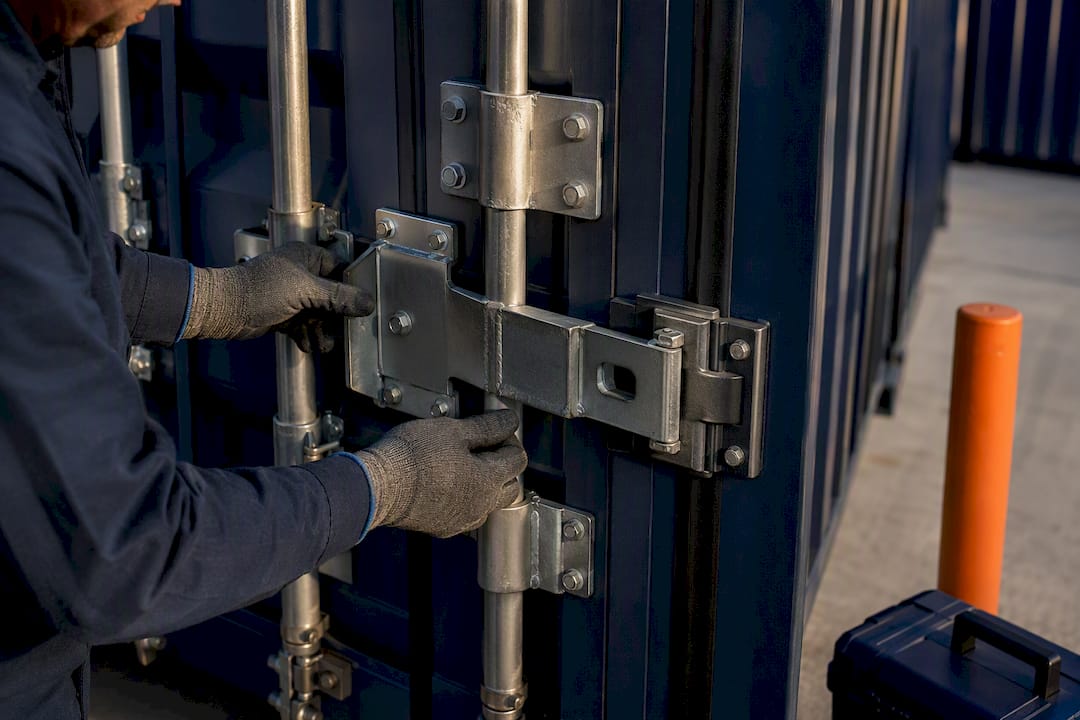
The lock is only as strong as the door it sits on. Older containers, especially, tend to have hinge and locking-rod weaknesses that skip the lock altogether.
A removable crossbar across both doors adds a second point of failure for anyone trying to pry the doors apart, and removable versions do not interfere with legitimate access or inspection. Hinge guards matter most on older units where hinge pins can be knocked out from outside, effectively bypassing the lock. Lock-rod protection covers the vertical bars that run the height of the door, stopping attackers from bending or cutting them to release the locking cams.
- Crossbars: removable suits containers still in active use; welded suits permanent storage.
- Hinge guards: check hinge pins for wear on any container older than five years.
- Lock-rod covers: retrofit kits exist for most standard container doors.
Professional installation is worth it for welded reinforcement, since a poor weld can crack under repeated door use or during transport handling.
Why does cargo restraint matter for container security?
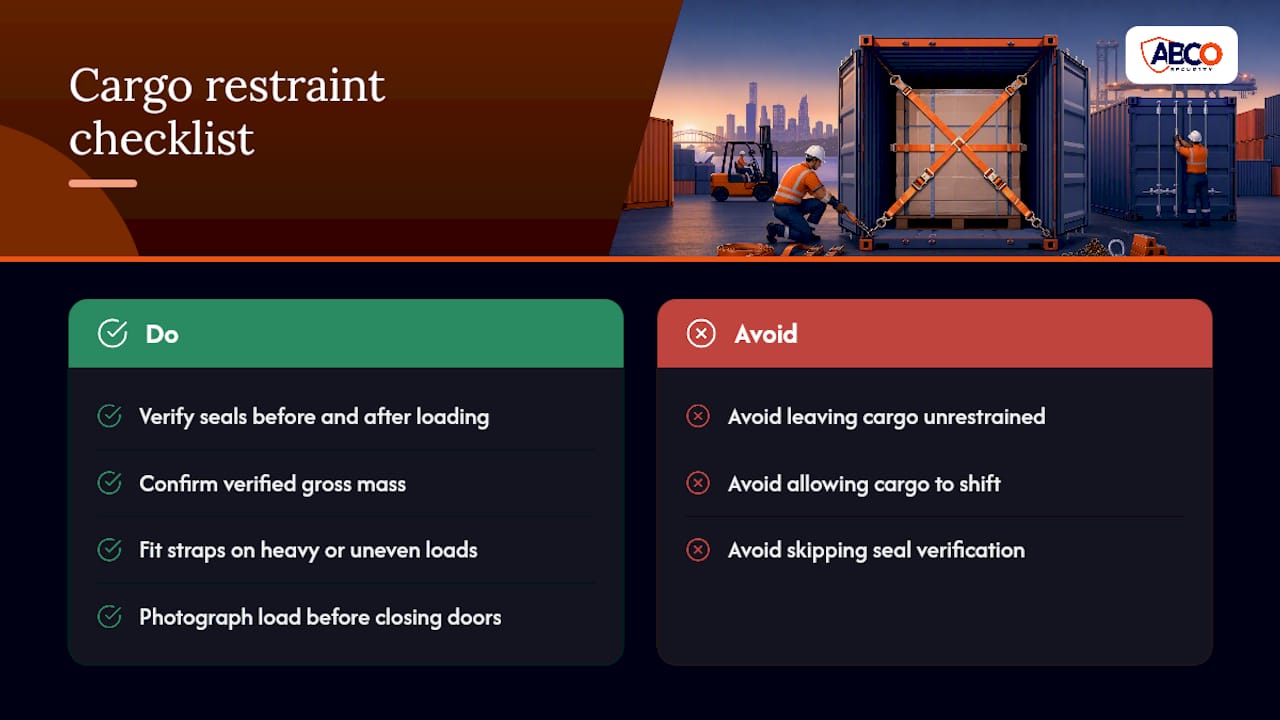
Security is not just about keeping people out. It is about keeping what is inside intact and where it should be. Cargo that shifts during transport can warp door panels, jam locking cams, and even force doors open before the container reaches its destination.
Poorly packed or unrestrained cargo shifting in transit is a recognised cause of container deformation and compromised door seals, which is why Australian logistics guidance treats load restraint as a security issue, not just a safety one. AS/NZS 3711.10:2024 sets the framework for handling and securing freight containers, including site stability and load restraint, and mirrors international handling protocols used across the shipping industry.
Poorly packed or unrestrained cargo can shift during transport, deforming containers and compromising the seals and locking mechanisms that keep them secure. Safe packing and load restraint are treated as core safety and security requirements across the Australian logistics chain.
The CTAA and NHVR safe loading guidance gives packers a practical checklist: verify seals before and after loading, confirm the verified gross mass, use safety straps on heavy or uneven loads, and photograph the load before closing the doors. That photo record matters twice over, once for transport safety, and again if you ever need to prove a claim.
What should a monthly security inspection cover?
Security hardware fails quietly. A rusted lock or a flat alarm battery gives you no warning until the night it matters, so a routine catches problems before they become losses.
- Weekly: walk the perimeter, check the lockbox and crossbar for tampering, and photograph the lock and door seals.
- Monthly: lubricate the lock mechanism, test the alarm and camera feed, and replace any low batteries.
- Before transport: check seal numbers against your paperwork, confirm the verified gross mass, and photograph the loaded and closed container.
Photo records and incident logs matter more than most people realise. They speed up insurance claims and give police something concrete to work with if a theft does happen.
When does container security need a professional?
DIY hardware covers most low and medium-risk situations. Ongoing monitoring, regulatory compliance obligations, or high-value cargo are where a professional service earns its cost, because remote alert response and documented risk assessment are hard to replicate with consumer-grade gear alone.
An integrated engagement typically starts with a site risk assessment, moves through hardware selection and installation, and ends in ongoing monitoring with a defined response protocol, not just a notification. Abcosecurity brings ISO 9001 aligned processes and more than 15 years across construction, healthcare, and corporate sites to that assessment, which is where a generic hardware purchase tends to fall short.
— Abco
Get a container security assessment done properly
Retrofitting hardware after a theft costs more than getting the setup right the first time, and most container break-ins share the same handful of weaknesses, as shown in the Doma Shipping and Travel case study. An exposed shackle, a dark unmonitored yard, a door that flexes at the hinge. Abcosecurity’s team assesses your specific site, fits the hardware that matches your risk tier, and backs it with monitoring that actually escalates when something trips.

Whether you need a one-off hardware upgrade or ongoing patrol and monitoring for a multi-container site, Abcosecurity’s integrated security solutions cover the full stack, from risk assessment through installation to 24/7 response. Construction sites juggling multiple containers full of tools and materials get particular value from a proper security risk assessment before any hardware goes on, since the right lock for a residential storage box is rarely the right lock for an active job site. Request a site assessment and get a tailored recommendation rather than guessing at what your container needs.
FAQ
What is the best way to secure a shipping container?
Combine a welded lockbox with a puck or disc lock, reinforce the doors with a crossbar, and add motion lighting and a monitored alarm. No single measure covers every attack method, but that combination addresses the most common ones.
What is the best anti-theft lock for a shipping container?
A puck or disc lock housed inside a welded lockbox is the strongest widely available option, because it removes the exposed shackle that bolt cutters and pry bars target.
What are the best practices for container security?
Position the container with doors facing activity, fit a lockbox and crossbar, add lighting and signage, inspect the hardware monthly, and add monitored detection for high-value or remote sites. High-risk sites benefit from a professional risk assessment rather than a guess at what hardware is enough.
How do they keep containers from falling off ships?
Onboard container ships, twist locks and lashing rods secure containers to the deck and to each other in stacks, following international handling standards. Onshore, the same restraint principle applies to cargo inside the container, where AS/NZS 3711.10:2024 governs safe handling and securing.
Recommended
about
avada factory
Sempery ultricies nibh at dolor cras urna eleifend nec. Atiam efficitur tempor.