

Prevent tailgating by pairing physical Zero Trust, verifying every person at every controlled entry, with layered technical and operational controls. No single gadget solves this: mantraps and detection sensors catch what policy misses, and staff training catches what hardware misses. Track detection-to-response time and badge compliance as your core metrics.
TL;DR:
- Physical measures like mantraps and detection sensors are most effective for preventing stealth tailgating, especially at high-value access points.
- Behavioral controls such as staff training, visitor pre-registration, and clear signage are essential for addressing cultural tendencies that enable piggybacking.
- Combining detection systems with integrated monitoring and staff response procedures significantly reduces the likelihood of successful tailgating incidents.
- Hardware-only solutions often fail if staff are untrained or disengaged, highlighting policy and training as the lowest-cost, highest-impact controls.
- A fully integrated, site-specific security plan that includes policy, staff engagement, and layered physical controls offers the best protection against tailgating risks.
Table of Contents
- What is tailgating prevention, and how does it differ from stopping piggybacking?
- How do attackers actually get through the door?
- What’s actually at risk when tailgating succeeds?
- What policy, people and process controls come first?
- Which technical controls suit which risk level?
- How do you roll this out without disrupting daily operations?
- What has Abcosecurity learned from putting this into practice?
- What do real tailgating incidents actually cost?
- Why do employees keep letting people through, even when they know better?
- Where does tailgating prevention fit in a broader security strategy?
- Is a mantrap worth the cost compared to a detection sensor?
- What security managers get wrong about tailgating prevention
- Get an integrated tailgating prevention plan for your site
- Sources
- FAQ
What is tailgating prevention, and how does it differ from stopping piggybacking?
Tailgating happens when someone follows an authorised person through a controlled door without that person’s knowledge or consent. Piggybacking is different: the authorised person knows the second individual is there and lets them in anyway, often out of politeness. Both defeat the same access control system, but they demand different fixes.
- Tailgating is a stealth problem. A door closer takes a few seconds to latch, and an intruder slips through that gap while the badge holder is already walking away. Detection sensors and mantraps are built for exactly this.
- Piggybacking is a behaviour problem. It happens at reception when a staff member holds the door for someone carrying boxes, or at a construction gate when a supervisor waves through a “mate from another crew.” No sensor fixes a culture of politeness. Training and clear signage do.
Getting this distinction right matters for budgeting. A data centre worried about stealth intrusion needs hardware first. A corporate office with a friendly, badge-swapping culture needs a policy rewrite and a training session before it needs a new door.
How do attackers actually get through the door?
Security teams see the same handful of tactics repeat across sites, whether it’s a hospital, a head office, or a construction perimeter.
- Door holding. Someone with an armful of files or a coffee tray approaches just as an employee badges in, and holds the door open out of habit.
- Uniform impersonation. A person in a hi-vis vest, courier jacket, or generic contractor uniform walks with purpose and nobody questions them.
- Delivery ruse. A “parcel drop” or “catering delivery” story gets someone past reception without a visitor badge.
- Side-gating. On construction sites, this means slipping in through a secondary gate or a gap in hoarding rather than the main checkpoint.
- Propped doors. Fire doors and loading dock doors get wedged open during busy periods and simply stay that way.
- Two-person rushes. Two people badge in almost simultaneously, with the second person timing their approach to the door’s swing rather than presenting their own credential.
Timing follows predictable patterns. Shift changes, lunch rushes, and event bump-ins create crowding at doors, and crowding is exactly when a following person blends in. Construction sites see the most attempts at the morning start and during material deliveries, when multiple trades are moving through the same gate. Corporate offices see it most at the 8:30 to 9:30am surge, when reception staff are processing a queue rather than watching each individual.
What’s actually at risk when tailgating succeeds?
The consequences scale with what sits behind the door. A tailgating event at a warehouse loading bay might mean stock theft. The same event at a data centre can mean physical access to racks holding client data, which is a breach with regulatory reporting obligations attached. In a hospital, an unauthorised person in a restricted ward is a direct patient safety issue, not just a security one.
Insurance and contract exposure follow close behind. Many commercial leases and client contracts specify minimum access control standards, and a documented tailgating incident can trigger a compliance review or void a claim if the facility can’t show it was following its own stated procedures. Physical access controls, mantraps, laser sensors, and biometric readers are the commonly recommended baseline precisely because insurers and auditors now expect to see them at higher-risk sites.
Tailgating also opens a door, literally, for insider threats. An employee who habitually lets people in without checking credentials is also the employee who won’t notice when the “regular contractor” is actually there to access a server room they have no legitimate reason to enter. The access log shows one valid badge swipe; the reality is two people walked through.
What policy, people and process controls come first?
Hardware without policy is a wasted budget. Before you spend on sensors, get the operational baseline right.
- Write tailgating and piggybacking into policy by name. A generic “no unauthorised access” clause doesn’t tell staff what behaviour to stop. Name both terms explicitly and attach disciplinary consequences for repeat piggybacking, since that’s a choice, not an accident.
- Train by role, not by generic module. Reception staff need scripts for handling delivery ruses. Site supervisors need scenario drills for side-gating. A single all-staff email about “security awareness” gets deleted, not absorbed.
- Pre-register every visitor. Visitors should be expected, badged visibly, and escorted, not signed in retroactively after they’ve already wandered the floor. A visitor management process that requires host confirmation before arrival closes the delivery-ruse gap almost entirely.
- Enforce one-person-one-credential. Anti-passback logic in your access control software should flag a badge used twice in quick succession at different doors, a strong tell that someone is sharing credentials or that a tailgating event just occurred.
- Use signage and territorial cues. A clearly marked “authorised personnel only, all visitors must be escorted” sign at a secure door changes casual behaviour more than most managers expect, because it removes ambiguity about whether holding the door is polite or a policy breach.
Pro Tip: Run a five-minute tailgating drill during your next fire evacuation rehearsal. Have a colleague attempt to follow someone through a controlled door without a badge, announced in advance to management only, and watch how many staff actually stop and challenge them.
Sites that skip this step and go straight to hardware tend to find their expensive sensors triggering constantly, because nobody told staff not to prop the fire door open on a hot afternoon.
Which technical controls suit which risk level?
Technology splits into two philosophies: stop the second person physically, or detect them and alert a human. Neither works alone, and picking the wrong one for your throughput needs creates its own problems.
- Mantraps and security vestibules. These interlock portals hold one person in a contained space and verify single occupancy, often using dynamic weighing to detect a second body even when only one credential is presented, before releasing the inner door. They suit data centres, labs, and cash-handling rooms, low-throughput, high-value zones where a few extra seconds per entry is an acceptable trade for near-total prevention.
- Optical turnstiles and infrared sensors. Devices like door-mounted infrared fields create a detection zone that flags when more than one person crosses after a single valid badge swipe, then integrate that alert directly with the access control system. These retrofit onto existing doors without the footprint of a full mantrap.
- AI video behavioural detection. Modern systems can be layered onto existing CCTV to spot a person following unusually close behind another through a doorway, correlating video with badge events. They need clear sightlines and some tuning to cut false positives from staff walking in pairs, but they scale across many doors without new hardware at each one.
- Biometric and multi-factor access. Fingerprint, facial, or card-plus-PIN combinations raise the bar for a stolen or shared credential, though they need a fallback process for enrolment failures and raise legitimate privacy questions that should be addressed in policy before rollout.
The trade-off is well documented: detection-only systems require a fast human response to be effective, while prevention-first hardware removes that dependency but costs more and slows throughput. A sensible middle path uses detection sensors at busy general entrances and reserves mantraps for the small number of doors guarding your highest-value assets. Choosing access control hardware that fits your actual foot traffic, not your worst-case fear, avoids buying a mantrap for a door 200 people use every morning.
How do you roll this out without disrupting daily operations?
- Assess and prioritise entry points. Rank doors by asset value and current exposure, a server room or pharmacy dispensary outranks a staff kitchen, and start your budget there.
- Run a short, scoped pilot. Pick one or two doors, run detection or a mantrap for four to six weeks, and define success upfront: fewer than a set number of unresolved tailgating alerts per week, or a specific badge compliance rate.
- Track the right KPIs. Measure tailgating events detected, detection-to-response time, badge compliance rate, and the false-alarm ratio, since a sensor nobody trusts gets ignored.
- Integrate with existing systems. Confirm the new hardware talks to your PACS and VMS platforms before rollout, not after, so alerts land in the same console your guards already monitor.
- Confirm operational readiness. Assign who responds to an alert, how fast, and what the escalation path is if the response fails, then schedule maintenance so sensors don’t drift out of calibration.
What has Abcosecurity learned from putting this into practice?
Tailgating prevention works best as an integrated model combining access hardware, 24/7 monitoring, security guards, and staff training into a unified system rather than separate purchases, ideally aligned with established quality standards. This approach aims to reduce documented crime rates on client sites over time.
The practical lesson from deployments across construction, healthcare, and corporate sites is that throughput and security pull against each other, and tuning matters more than the spec sheet. A detection sensor set too sensitive risks being switched off by frustrated staff shortly after installation. Engaging site staff early, and explaining why a door now beeps, prevents that failure before it starts.
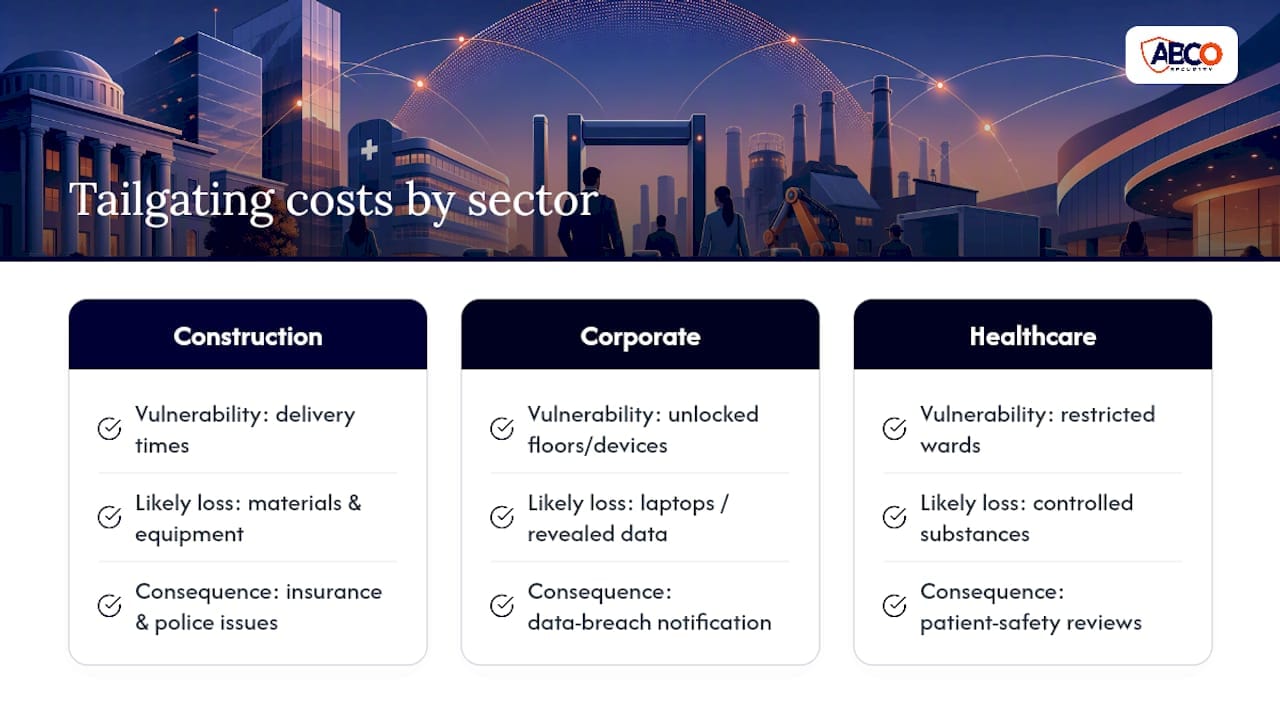
What do real tailgating incidents actually cost?
Consider the pattern across sectors, since most serious tailgating incidents follow a similar shape.
A construction site with an open perimeter and a single manned gate is vulnerable at material delivery times, when several trucks and unfamiliar drivers arrive together. An unauthorised person following a delivery crew through the gate can access stored materials or equipment potentially worth significant amounts., and because the entry point wasn’t monitored electronically, there’s often no record of when or how they got in, which complicates both the insurance claim and the police report.
In a corporate office, a tailgating incident is rarely about theft of physical goods. It’s about what an unattended laptop or an open server rack reveals before someone notices an unfamiliar face. A compromised device removed from an unlocked floor can trigger a data breach notification obligation, well beyond the value of the device itself.
Healthcare facilities carry the sharpest consequence. An unauthorised person in a restricted ward isn’t a hypothetical, it’s a direct risk to patient safety and to controlled substances stored on that floor. These incidents tend to trigger internal reviews that look specifically at whether visitor escorting procedures were followed, because that’s usually where the failure sits.
The common thread across all three: the technology gap is rarely the root cause. It’s almost always a door that was propped, a badge that was shared, or a visitor who was never properly registered.
Why do employees keep letting people through, even when they know better?
Most tailgating isn’t malicious. It’s social pressure winning against a rule that feels petty in the moment. Holding a door for someone carrying boxes feels rude to refuse, and challenging a stranger in a uniform feels confrontational in a workplace culture built on politeness, not suspicion.
Diffusion of responsibility makes it worse in busy environments. When ten people walk through reception in two minutes, each individual assumes someone else, reception staff, a colleague, security, already checked the person behind them. Nobody did.
There’s also a status effect. Staff are far less likely to challenge someone who looks senior, confident, or dressed like a contractor with the right hi-vis colour, than someone who looks out of place. Attackers who understand this dress the part deliberately, which is why uniform impersonation remains one of the most effective social-engineering tactics against physical sites.
The fix isn’t lecturing staff about vigilance in the abstract. It’s giving them a low-friction, low-confrontation script: “Sorry, can I just scan you through?” said as a routine courtesy rather than an accusation, removes the social cost of enforcing the rule. Sites that normalise escorting and badge-checking as standard reception procedure, rather than an exception reserved for suspicious-looking people, see far better staff compliance because nobody feels singled out for asking.
Where does tailgating prevention fit in a broader security strategy?
Tailgating prevention shouldn’t sit as an isolated project bolted onto an existing system. It’s one layer in a broader perimeter strategy that also includes CCTV coverage, guard patrols, and commercial property security systems covering the building envelope as a whole.
The integration point that matters most is the access control platform itself. A tailgating sensor that fires an alert into a separate, unmonitored log is functionally useless. That alert needs to land in the same monitoring console your guards or off-site monitoring team already watch, alongside CCTV feeds and alarm events, so a real response happens inside minutes rather than being discovered during a weekly report review.
Site design plays a role too. Reception layout, queue management, and even where visitor badges get issued all shape whether tailgating opportunities exist in the first place. A reception desk positioned so staff can see the door from their seated position prevents far more tailgating than a sensor mounted on a door nobody’s looking at.
For multi-site organisations, consistency across locations matters more than perfection at any single site. A construction company running five sites with five different visitor procedures will always have one site that’s the weak link, and that’s the one an opportunistic intruder finds. Standardising the policy layer, even where hardware budgets differ by site, closes that gap without requiring every location to have a mantrap.
Is a mantrap worth the cost compared to a detection sensor?
The honest answer depends entirely on what’s behind the door. A mantrap costs considerably more to install and slows every legitimate entry by several seconds, a real cost when hundreds of staff pass through daily. That expense is justified for a handful of doors guarding genuinely high-value assets: server rooms, pharmacy dispensaries, cash rooms.
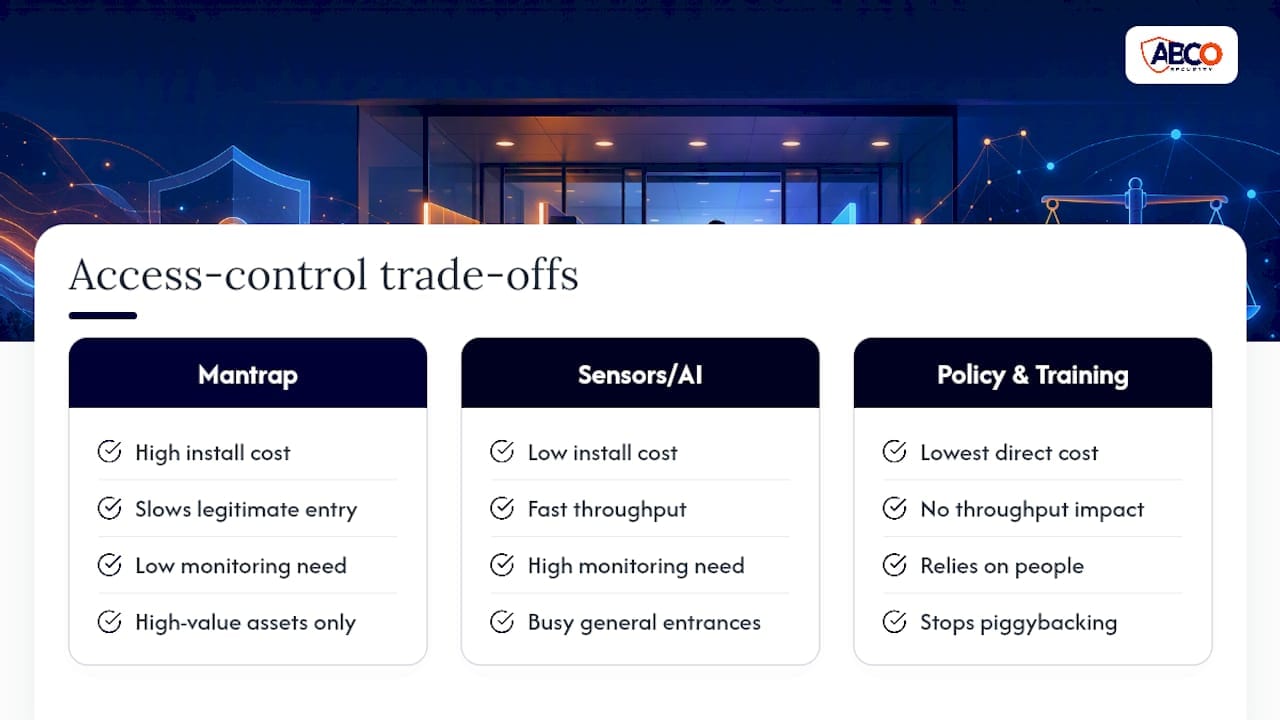
Detection sensors and AI video analytics cost less upfront and retrofit onto existing doors without new construction, but they carry an ongoing cost that’s easy to underestimate: someone has to monitor the alerts and respond fast enough for the response to mean anything. A sensor that fires and nobody acts on for twenty minutes has prevented nothing.
Policy and training carry the lowest direct cost of any control on this list, and arguably the best return, because a workforce that reflexively challenges an unbadged stranger stops incidents that no hardware would have caught, particularly piggybacking, which technology can’t detect at all. The realistic budget for most organisations isn’t choosing one option. It’s spending most of the budget on policy and training, reserving detection sensors for busy general entrances, and reserving mantraps for the small number of doors where the asset value genuinely justifies the slower throughput and higher install cost.
What security managers get wrong about tailgating prevention
The conventional advice treats tailgating as a technology problem with a technology answer: buy a sensor, install a turnstile, done. That framing sells hardware, but it misreads where most incidents actually happen. The doors people prop open, the visitors nobody escorts, the badges shared out of convenience, none of that gets fixed by a sensor sitting unused in a cupboard because nobody budgeted for the install.
What gets underrated is staff buy-in. A detection system that generates alerts nobody responds to is worse than no system at all, because it creates a false sense that the risk is managed. The physical Zero Trust principle, verify everyone, every time, only works when the people at the door actually believe in it, not just when the sensor above their head does.
If you’re prioritising one thing this quarter, make it the policy and training layer, not the hardware order. Get tailgating named explicitly in policy, run one realistic drill, and fix your visitor escorting process. Hardware then closes the gaps that policy genuinely can’t reach, rather than trying to substitute for a culture that hasn’t been built yet.
— Abco
Get an integrated tailgating prevention plan for your site
There’s a real cost to piecing this together yourself: one vendor for sensors, another for guards, a third for monitoring, and nobody owning the gaps between them. These services benefit from being run as one integrated build: access control hardware, mantrap and vestibule installation where justified by risk, 24/7 monitoring, licensed guards, and staff training, delivered against ISO 9001 and ISO 30000 standards to help keep compliance documentation in order for audits and tenders.

That single-provider model matters most at the handover point. A sensor that alerts into a monitoring console your own guards already watch gets a genuine response, not a log entry reviewed a week later. If you manage a construction site, healthcare facility, or corporate office and want a properly scoped assessment of where your tailgating risk actually sits, start with Abcosecurity’s integrated security solutions guide and request a site risk assessment.
Sources
- Tailgating and piggybacking definition and prevention – TechTarget
- SecureDoor High Security Portals & Interlocks | Entrance Control
- Ambient
FAQ
What is an example of tailgating?
A common example is someone without a badge following an employee closely through a swipe-card door before it closes, often while carrying boxes or wearing a uniform that discourages questions.
What is the most effective way to handle a tailgater?
Politely but firmly ask the person to badge in themselves or check in at reception, then report the incident so security can review camera footage and confirm whether it was a genuine breach.
What are some safety tips for tailgating?
Never hold a secure door open for someone you don’t recognise, challenge unbadged individuals with a simple courtesy question, and report propped-open fire or loading doors immediately rather than assuming someone else will.
What is tailgating security?
Tailgating security refers to the combined policy, training, and technical controls, such as mantraps, infrared sensors, and access control integration, used to stop unauthorised people entering behind an authorised badge holder.
Recommended
about
avada factory
Sempery ultricies nibh at dolor cras urna eleifend nec. Atiam efficitur tempor.