
Temporary fencing is a modular, usually open-mesh barrier. Hoarding is a solid, self-supporting wall, often built where a site meets a footpath. If your site is set back from the public and the main risk is casual entry, mesh fencing usually does the job. If you front a busy street, a school or heavy foot traffic, expect hoarding, and expect your council to ask for it. Either way, the barrier is only as good as its design, installation and upkeep.
This guide sets out the practical differences, the Australian rules that shape the choice, and how to make either option work as real access control.
TL;DR
- Temporary fencing is open and modular. Hoarding is solid and self-supporting, and is the usual choice next to footpaths and busy frontages.
- Councils set the detail: footpath hoardings in Perth, for example, must be at least 1.8 m high and leave at least 1.5 m clear for pedestrians. Check your own council before you order.
- Neither type is automatically more secure. Climbability, gaps underneath, wind loads and weak joints decide how well a perimeter works.
- Whatever you install needs inspection, including after severe weather, and a security plan behind it.
- A barrier deters. Guards, patrols and monitored cameras cover what a barrier cannot.
Table of Contents
- What each one actually is
- Temporary fencing vs hoarding at a glance
- When open temporary fencing is the right call
- When hoarding is the right call
- Solid does not mean sightless
- The Australian rules behind the choice
- Wind, weather and public safety
- Neither option is automatically more secure
- A quick way to decide
- Making the perimeter work after dark
- Fencing, hoarding and what sits behind them
- Need the perimeter watched as well as built?
- FAQ
- Sources
What each one actually is
The terms get mixed up on site, so it helps to use the definitions councils use. Blue Mountains City Council’s temporary fencing and barrier policy describes three categories:
- Open fencing: often modular and portable, such as mesh panels on stands with couplers.
- Solid fencing (hoarding): solid self-supporting panels, used alone or with an overhead protective structure.
- Overhead structures: gantries that protect people below from falling debris.
So “hoarding” is not a different product category from fencing in the eyes of regulators. It is the solid end of the temporary barrier family. In everyday trade talk, “temporary fencing” means the open panels and “hoarding” means the solid wall, and that is how this article uses them.
Temporary fencing vs hoarding at a glance
| Factor | Open temporary fencing | Solid hoarding |
|---|---|---|
| Construction | Modular mesh panels, couplers, stands or bases | Solid panels, often plywood or similar approved cladding, self-supporting or fixed to scaffold or a gantry |
| Visibility | You can see through it, so passers-by and your own patrols can see in | Blocks the view unless vision panels are built in |
| Public protection | Marks the boundary and keeps people out | Marks the boundary and screens dust, noise and activity from the street |
| Wind | Mesh lets wind through, but added construction wrap catches it and may need extra bracing | Solid face takes full wind load, so engineering and footing matter |
| Typical setting | Suburban and domestic sites, large perimeters, set-back sites | Town centres, CBD frontages, footpaths, schools, high pedestrian traffic |
| Approvals | Often simpler, but check council and the work health and safety regulator | Engineering design commonly required, plus a council permit where it occupies public land |
| Branding and finish | Limited unless wrapped | Good surface for hoarding graphics, artwork and information |
The table shows tendencies, not laws. Your site, your council and your risk assessment decide.
When open temporary fencing is the right call
Mesh fencing earns its place when the perimeter is long, the site is set back from the footpath, and the priority is stopping casual entry while keeping things visible. A few practical reasons:
- Natural surveillance. Anyone walking past, and any patrol vehicle, can see activity inside. That helps after hours.
- Speed and flexibility. Panels can be moved as the site footprint changes through stages of the build.
- Lower wind load. Open mesh passes wind through. Adding construction wrap for dust control changes that, and may need extra bracing, so treat wrapped fencing as a different design problem.
The risk with mesh is that it is easy to under-specify. WorkSafe NSW’s Site Security Checklist says fencing should have a minimal gap underneath, be built to prevent footholds and deter climbing, and avoid reo mesh or mesh openings wider than 75 mm. The same checklist asks you to check that pallets or other materials are not stacked beside the fence where someone could use them as a ladder. Those are small details that decide whether a fence is a barrier or a suggestion.
When hoarding is the right call
Hoarding makes sense when the public is right on your boundary. It screens the works, protects pedestrians from activity behind it, and can carry information and artwork. Where it fronts a busy street, many councils require it, and some require it in specific forms.
The City of Perth’s Hoarding, Gantry and Scaffold Guidelines give a good picture of what a council can ask for:
- Hoardings on footpaths must be at least 1.8 m high.
- They are generally clad in a minimum of 16 mm waterproof plywood or another approved material.
- They must leave at least 1.5 m clearance for pedestrians.
- They must have 1.0 m x 1.0 m chamfered corners to keep sightlines clear.
- In areas of low ambient light, the hoarding must be lit to a minimum average of 3.5 lux from sunset to sunrise.
- In the CBD, they should have a high standard of finish, with viewing windows and information panels to reduce the visual impact on the street.
These are City of Perth requirements. Other councils set their own figures, so treat them as an example of the level of detail to expect, not a national rule.
Solid does not mean sightless
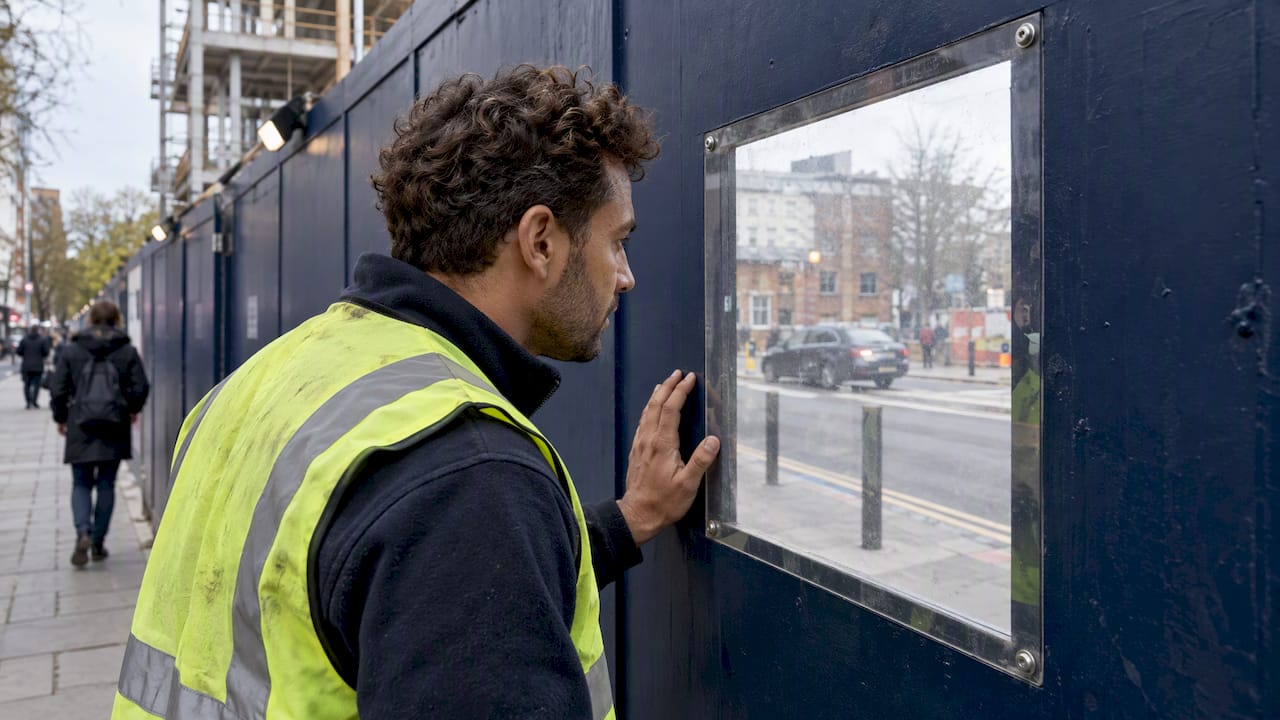
Hoarding creates a blind spot for drivers and pedestrians. Blue Mountains City Council’s policy says solid fencing must not obstruct sightlines for pedestrians or traffic, and sets vision panels of at least 600 mm x 600 mm, placed at least every 20 metres. Those panels also let your site team and passing patrols see problems early. They are a safety feature and a security feature at once.
If your hoarding faces an office precinct or retail strip, its appearance matters too. Clear directional graphics, entry points and detour signage help people move around the works, and the same thinking behind good wayfinding design applies to a temporary frontage: pedestrians should never have to guess where the safe route is.
The Australian rules behind the choice
The choice is not purely a preference. Several layers of regulation apply, and they differ by state and council.
Standards
AS 4687 is the main Australian standard for this equipment. AS 4687.2:2022 sets minimum requirements for the design, installation and performance of temporary fencing and temporary pedestrian barriers that protect the public. AS 4687.1:2022 treats temporary fencing and hoarding as temporary barriers intended to limit unauthorised access to restricted areas, and covers their design, installation, testing and storage. Ask your supplier which parts of the standard their panels and installation meet, and get that in writing.
Work health and safety duties
Security is a legal duty, not just a loss-prevention matter. In Western Australia, Regulation 298 of the Work Health and Safety (General) Regulations 2022 requires a person with management or control of a construction site to ensure, so far as is reasonably practicable, that the site is secured from unauthorised access, according to WorkSafe WA’s construction site security information sheet. Other jurisdictions have their own regulations, so confirm what applies in your state with the local regulator.
WorkSafe WA also says security fencing should be high enough to deter entry, difficult to climb and to crawl under, able to withstand expected wind and scaling loads, and designed so panel joints and gates do not become weak points. Where securing the site is not practicable, hazards must be isolated within the workplace.
Council permits and engineering
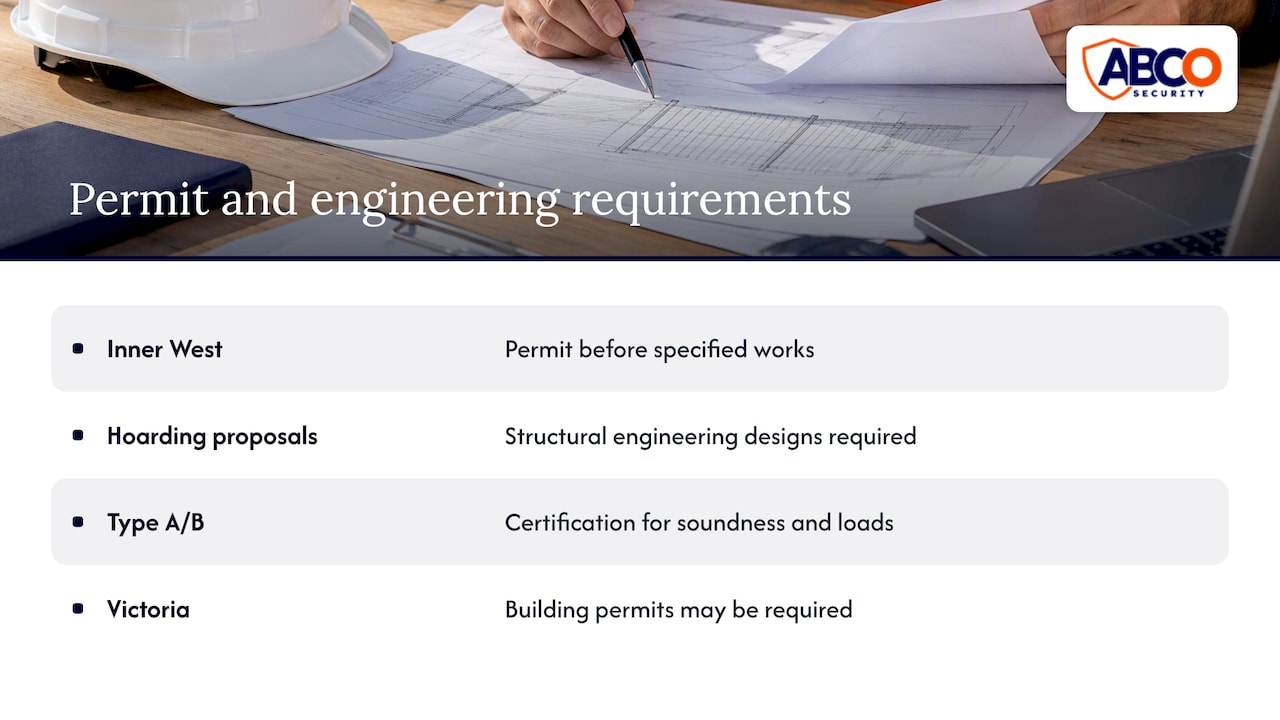
If the barrier occupies a footpath or road reserve, expect a permit. Inner West Council in New South Wales states that a hoarding and temporary fencing permit is required before hoarding or fencing is erected for specified occupations, under section 138 of the Roads Act 1993 and section 68 of the Local Government Act 1993. It also requires structural engineering designs for all hoarding proposals, and certification for Type A and B hoardings that the structures are sound and can carry the required loads.
In Victoria, WorkSafe notes that building permits may be required for some temporary site structures, including fences and hoardings, and that duty holders should check with the relevant authority.
Build the permit lead time into your site establishment program. Lodging late is a common reason a fence goes up in the wrong form or the wrong week.
Wind, weather and public safety
Temporary structures fail in storms, and the public is the one at risk. WorkSafe Victoria’s guidance on temporary site structures lists hoardings and site fences among the structures that must be safe for workers and the public. It says they should resist severe-weather uplift and lateral wind loads for the specific site, and comply where applicable with the Building Code of Australia, relevant Australian Standards and accepted engineering principles. It also advises having a competent person verify them once erected, with regular inspections and further checks after severe weather.
The practical implications:
- Solid hoarding catches more wind. Footings, bracing and ballast need engineering, not guesswork.
- Wrapped mesh behaves like a sail. If you add construction wrap or shade cloth for dust, ask the installer to confirm the bracing.
- Check joints and gates. These are where temporary perimeters usually give way, to wind or to people.
- Keep a record. Inspection dates, findings and repairs show the duty holder acted.
Neither option is automatically more secure
It is tempting to assume a solid wall is safer than mesh. It is not that simple. A UK trade publication’s piece on construction site perimeter security makes the point that neither mesh fencing nor solid hoarding is automatically safer: the choice should reflect site risks, and perimeters should be properly installed, kept in good order and reviewed as conditions change.
Here is how that plays out in practice:
- Solid hoarding hides what is happening behind it, so someone inside can work unseen unless you add cameras, lighting and patrols.
- Mesh invites people to look in, which is good for surveillance, but it can show off plant and materials worth stealing.
- Both can be climbed if materials are stacked against them or the panels are low.
- Both have gates, and a gate is only as strong as its lock and the discipline of the people using it.
WorkSafe WA also makes the point that a sign alone may not deter an uninformed member of the public. The barrier has to work as an access-control measure that resists climbing, crawling underneath, wind and weak gates or joints.
A quick way to decide
Work through these questions in order.
- Where does the public pass? If the boundary is on a footpath, road reserve or school route, plan for hoarding and a permit. If it is set back, open fencing is usually enough.
- What does your council require? Read the hoarding policy and permit conditions before you price anything.
- How exposed is the site to wind? High, open, coastal or elevated sites need engineering for either type, and more so for solid panels.
- What are you protecting? Plant, copper, fuel and tools call for strong perimeters plus detection and response. Dust and noise control point toward wrap or solid panels.
- How will it be watched? Decide whether you need visibility through the fence for patrols, or cameras covering a solid face.
- How long will it stand? Longer programs justify heavier, better-finished solutions and a formal inspection routine.
Making the perimeter work after dark
Most theft and unauthorised entry happens when nobody is there. That is where a barrier needs support. Good practice, drawn from the guidance above, includes:
- Lighting that meets council requirements and lets cameras and patrols see the line.
- Keeping materials away from the fence so it cannot be climbed.
- Controlled, logged entry points rather than several informal gates.
- Regular perimeter walks, with a record of faults and repairs.
- A written plan that ties the fence, the cameras and the people together.
We cover those pieces in more depth in our guides to construction site access control, the 7 steps to build a construction site security plan and a construction security risk assessment. If theft is the main worry, our five quick fixes are a good start.
Our view: the fence is the first layer, not the whole answer
After more than 15 years working with construction managers, we see the same pattern. The fence-or-hoarding decision gets plenty of attention at establishment, and the question of who is watching it after 5 pm gets far less.
Our approach is proactive: assess the site’s risks first, choose the barrier to suit, then add the layers that make it work, such as licensed guards, mobile patrols, monitored CCTV and alarms, and access control. A fence slows someone down. People and technology notice, decide and respond.
We work to ISO 9001 and ISO 30000, and we operate 24/7 across Australia. For site managers, that means one provider can look at the perimeter, the entry points and the night-time risk together, instead of leaving each to a different contractor.
Whichever barrier you choose, ask one question before you sign off the installation: if someone cut, climbed or lifted it at 2 am, who would know, and how fast would someone respond?
Abco
Fencing, hoarding and what sits behind them
Once the barrier is chosen, the security question becomes how to monitor and respond. Options include on-site security guarding, mobile patrols that check the perimeter at set intervals, and CCTV and alarm monitoring covering gates and the fence line. If you are weighing how to run a full program, our construction site security management guide walks through roles and routines, and our page on CCTV placement to AS 4806 explains where cameras do the most good.
Need the perimeter watched as well as built?
We provide integrated security for construction sites across Australia: licensed guards, mobile patrols, monitored CCTV and alarms, access control and security risk assessments. Our Night Owl Service is listed from $5.45 per day, and our Construction Site Security Services page sets out what we can cover for your site. Tell us about your perimeter and we will recommend the layers that suit it.

To discuss your site, start at abcosecurity.com.au.
FAQ
What is the main difference between temporary fencing and hoarding?
Temporary fencing is usually open and modular, such as portable mesh panels. Hoarding is solid, self-supporting panelling, used alone or with an overhead protective structure, as Blue Mountains City Council describes it. Hoarding is typically used where the public is close, such as footpaths and busy frontages.
Do I need a permit for hoarding or temporary fencing?
Often, yes, when the barrier occupies a footpath or road. Inner West Council, for example, requires a permit for specified occupations and structural engineering designs for all hoarding proposals. Rules vary by council and state, so check with your local council and work health and safety regulator before you order.
How high does a hoarding need to be?
It depends on the council. The City of Perth requires footpath hoardings to be at least 1.8 m high, generally clad in at least 16 mm waterproof plywood or other approved material, with at least 1.5 m clearance for pedestrians. Your council may set different figures.
Is hoarding more secure than mesh fencing?
Not automatically. Security depends on height, climbability, gaps underneath, wind resistance and the strength of joints and gates. Solid panels hide activity from the street, so they usually need lighting, cameras or patrols behind them to be effective after hours.
How often should a temporary fence or hoarding be inspected?
WorkSafe Victoria advises regular inspections, a check by a competent person once the structure is erected, and further inspections after severe weather. Set a routine for your site and record the findings and repairs.
Sources
- Temporary fencing (hoardings) policy, Blue Mountains City Council
- Hoarding, Gantry and Scaffold Guidelines, City of Perth
- Hoarding and temporary fencing permit, Inner West Council
- Temporary site structures, WorkSafe Victoria
- Construction site security information sheet, WorkSafe WA
- Site Security Checklist, SafeWork NSW
- AS 4687.2:2022 temporary fencing and hoardings
- AS 4687.1:2022, Standards Australia
- Wayfinding design for offices
Recommended
about
avada factory
Sempery ultricies nibh at dolor cras urna eleifend nec. Atiam efficitur tempor.