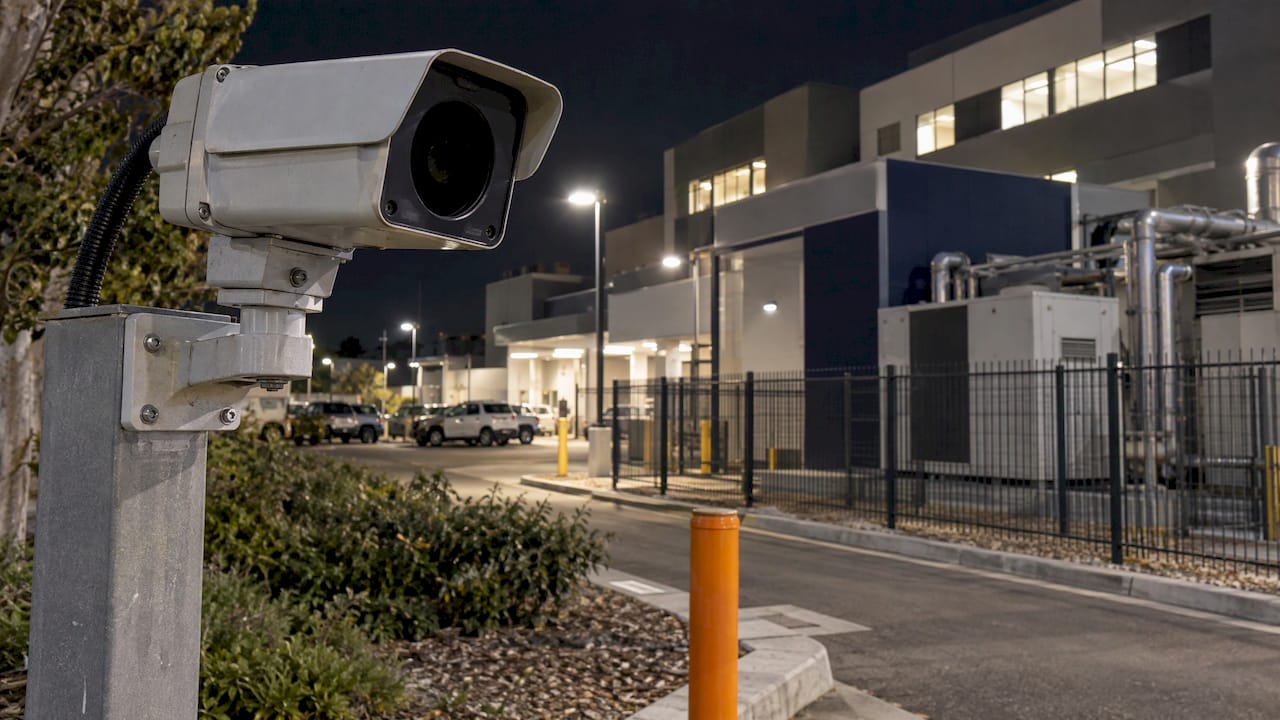
Thermal security cameras detect heat instead of light, so they pick up people and vehicles in total darkness, glare and smoke, when a standard camera has nothing to show. They work best as the detection layer of a wider system: the thermal camera raises the alert, a visible-light camera supplies the evidence, and a monitoring team decides what happens next. That is how we approach them at ABCO Security, with licensed professionals and 24/7 monitoring behind the camera, because a camera that raises an alarm nobody verifies is only half a security measure.
This guide is for site managers, facility managers, event organisers and retail owners who want to know what thermal cameras can do, where they belong and what to settle before you specify one.
TL;DR
- Thermal cameras form an image from heat, so they work in total darkness and are less affected by glare, shadows and light fog than visible cameras.
- They are detection tools. They show a person’s shape and size but not a face or clothing colour, so pair them with a visible camera for identification.
- Best fits: construction sites, yards, car parks, loading docks and perimeters where lighting is poor and a false alarm is costly.
- Placement, glass and analytics settings decide whether a thermal system performs well or raises nuisance alarms.
- If you record people, Australian privacy and workplace surveillance rules apply, and they differ by state.
Table of Contents
- How a thermal security camera works
- Thermal versus visible cameras: complementary, not rivals
- Where thermal cameras earn their place
- How well do they work in rain, fog and smoke?
- Specifying thermal: the decisions that matter
- Reducing false alarms
- Privacy and surveillance rules in Australia
- Our perspective
- Getting thermal detection working on your site
- FAQ
- Sources
How a thermal security camera works
Every object above absolute zero gives off infrared radiation. A thermal camera’s sensor contains one tiny heat detector (a microbolometer) for each pixel, and the camera’s computer turns each reading into a colour, as a research brief from RTI International explains. Cooler areas appear blue or purple and warmer ones red, orange or yellow.
For security, the useful part is contrast. A person, a vehicle engine or a lit cigarette is warmer than a cold fence line, a dark paddock or a concrete slab at 3 am. Axis Communications describes thermal cameras as offering reliable detection and verification regardless of visibility, including in adverse weather and light.
A useful way to think about the difference comes from ACTi’s thermal surveillance white paper: a visible-light camera is often evidence-first, while a thermal camera is often event-first. One tells you who did it. The other tells you that something is there.
Thermal versus visible cameras: complementary, not rivals
FLIR’s comparison of the two technologies puts it plainly: visible cameras remain the cost-effective choice for identification and evidentiary standards, while thermal is the best choice when you need long detection ranges, bad-weather performance and dependable night-time video analytics.
| Need | Thermal camera | Visible-light camera |
|---|---|---|
| Detect a person in total darkness | Yes, no lighting needed | Needs lighting or active infrared |
| Cover a long boundary with few cameras | Strong at long range | Shorter effective range at night |
| Resist glare, shadows and headlights | Not affected by visible light | Affected |
| Identify a face or number plate | No | Yes |
| Record clothing or vehicle colour | No | Yes |
| See through glass | No, glass reflects infrared | Yes |
The last row matters. The UK’s National Protective Security Authority notes that glass acts like a mirror for infrared, so a thermal camera cannot see through a window, and that thermal imagers can classify a target as a person, vehicle or animal but cannot identify it. Aim thermal cameras at open ground and boundaries, not through shopfronts or office glazing.
Where thermal cameras earn their place
Construction sites
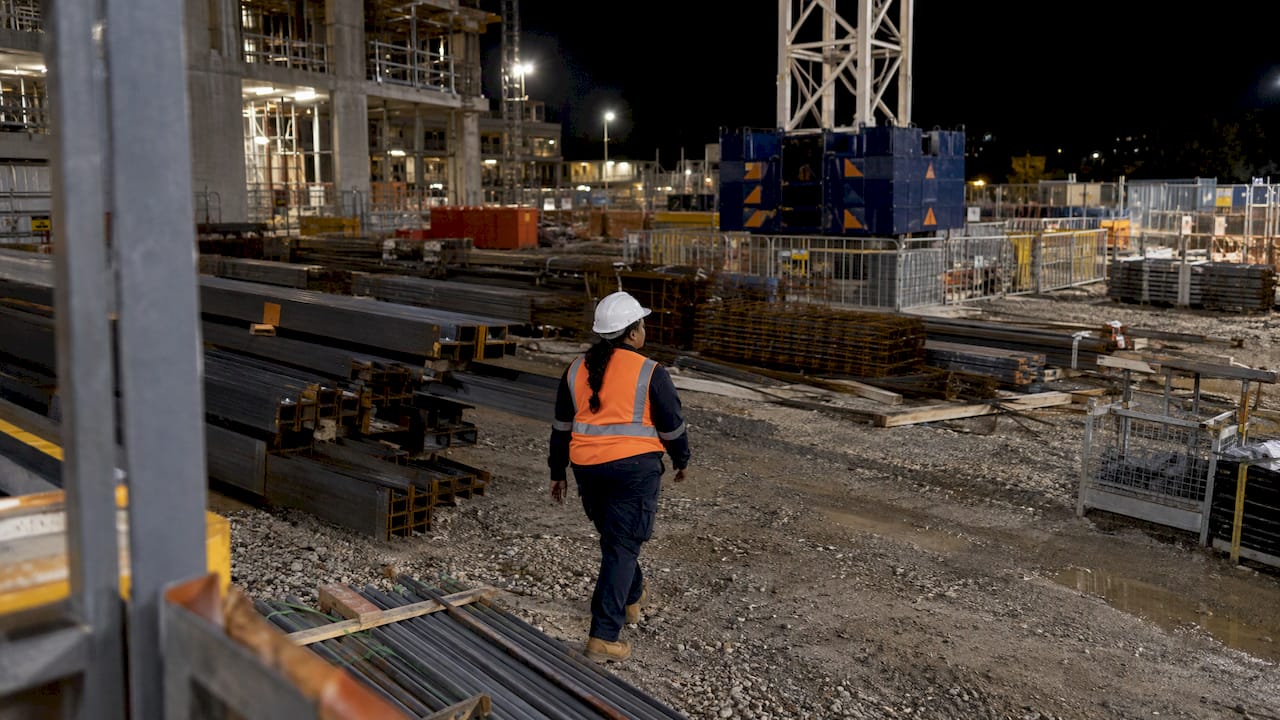
A building site at night is dark, cluttered and full of materials worth stealing. Thermal cameras suit perimeters, laydown areas and crane bases because a person crossing the boundary stands out against cold ground and steel. With analytics in the camera, the system can alert only when a human or vehicle enters a defined zone, not when a tarp flaps. Our construction site security services combine guarding, patrols and electronic systems, and our construction site security plan guide shows how detection fits into the broader plan.
Industrial yards, car parks and large retail precincts
Long boundaries and loading docks are expensive to light and expensive to cover with many cameras. Thermal’s long range means fewer cameras for the same distance, which is why it is common in perimeter protection. Our industrial security system guide covers how facility managers layer these tools.
For retailers, thermal belongs outside: the rear lane, the loading dock, the car park after hours. Inside the shop, where you need to identify who took what, visible cameras and good lighting do the job.
Corporate offices and healthcare grounds
For offices and hospital campuses, thermal is a perimeter and after-hours tool: car parks, plant areas, rooftops and fence lines. It does not replace internal CCTV or access control, which exist to know who is on site.
One point for healthcare managers: do not specify thermal cameras as a fever-screening tool. A 2021 Australian study found three infrared thermography systems had weak correlation with oral temperature, and the national COVID-19 health advisory committee advised that thermal scanning has important limitations as a screening method. Security detection and clinical measurement are different jobs.
Events
Temporary events such as festivals, outdoor concerts and sporting precincts have large, poorly lit boundaries, and thermal helps spot people in restricted areas after dark or in crowds of vehicles. Inside a crowd, the work is done by trained people, which is why event security rests on professional event security staff with technology in support.
How well do they work in rain, fog and smoke?
Better than visible cameras, but not magic. Thermal cameras see through light fog and rain more effectively, and FLIR reports that detection range typically drops 20 to 40 per cent in moderate rain, while dense fog with visibility under 100 metres can cut range by 50 to 80 per cent. Plan your coverage with that margin, not with the best-case range on a datasheet.
The NPSA guidance says thermal imagers are passive sensors that sense differences in heat, not light, which is why smoke, haze and dust do not blind them the way they blind a visible camera. Australian conditions such as summer dust, smoke haze and dark rural or outer-suburban sites are where that matters most.
Specifying thermal: the decisions that matter
1. Design to detection, not identification
The industry measures thermal performance with Johnson’s criteria: detection needs roughly 1.5 pixels across a target, recognition about 6 and identification about 12, as a buying guide from a US distributor sets out. The guide advises designing to detection range and using a visible-light PTZ camera (one that pans, tilts and zooms) for identification after thermal detection. A resolution of 384×288 is the working mid-range for perimeter surveillance, with the lens sized to the distance you need to cover.
2. Position cameras across the threat path
The NPSA advises placing perimeter thermal cameras so their field of view runs parallel to the boundary and perpendicular to an intruder’s likely movement, so targets cross the frame sideways. That layout gives the highest probability of detection and the lowest false-alarm rate. A camera looking straight down a fence line sees a person approaching as a small, slow-changing blob.
3. Choose the right analytics
Thermal analytics work well on moving people and vehicles. Irisity’s documentation advises thermal cameras where lighting is limited or one camera must cover more than 80 metres, but warns against rules for stationary targets such as a parked vehicle, an abandoned object or colour search, because the image has no colour and little detail. Contrast between target and background drives reliability, and it changes with temperature, humidity and distance, so confirm the vendor’s distance specifications for your conditions. You can read the guidance in Irisity’s best practices.
4. Link detection to verification and response
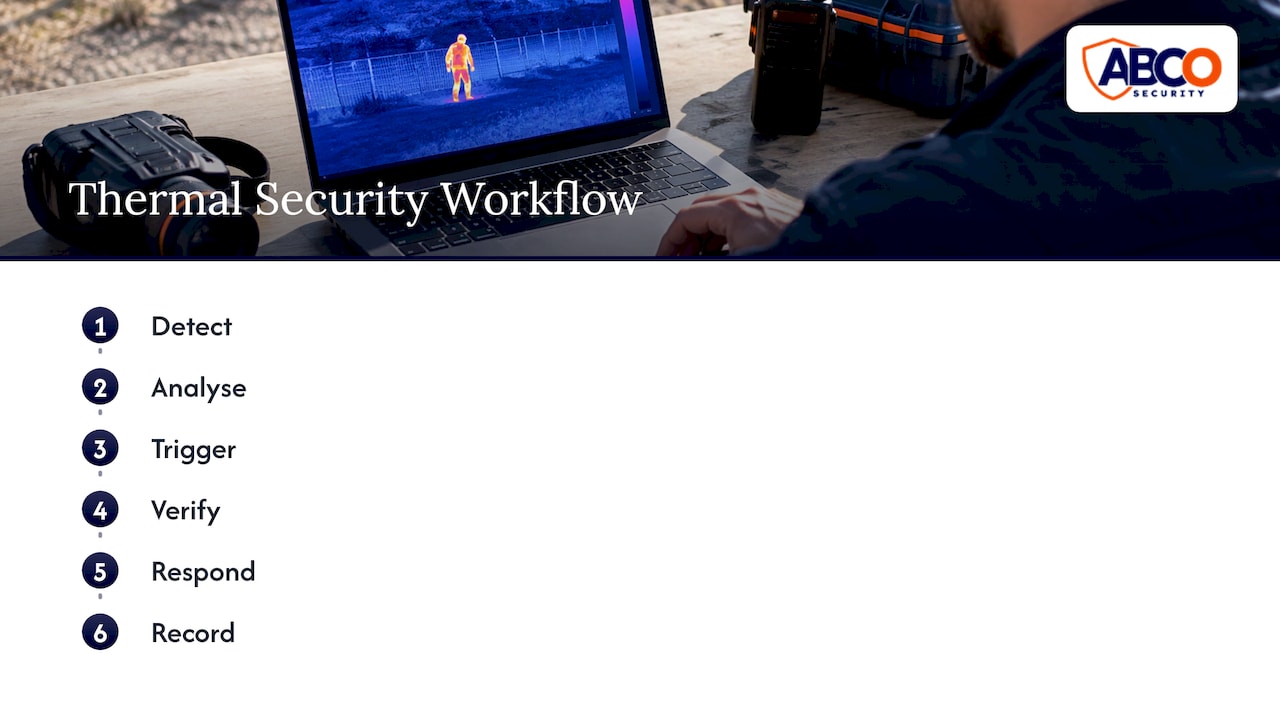
This is where thermal systems succeed or fail. Axis describes the typical chain: when someone enters a defined area, the thermal camera sends an alert and triggers a PTZ camera to provide visual video, and it can activate a loudspeaker to deter the intruder. ACTi’s white paper sets out a six-step workflow: detect, analyse, trigger, verify, respond and record. The verify and respond steps need people, whether that is your own control room or a monitoring provider.
Thermal video behaves like any other IP camera stream, so it can feed an existing recording or video management system. Dual-sensor cameras can send both thermal and visible streams, and FLIR’s PT-Series AI SR is an example of a unit combining a 640×512 thermal sensor with a 4K visible sensor and onboard human and vehicle detection.
5. Plan the project properly
A thermal system is a designed installation, not a box you hang on a pole. Cabling, power, mounting height, lens choice and network capacity all affect results. A design-led approach to camera planning, such as the process described in this guide to planning video surveillance, starts with the site’s risks and the applicable rules before any hardware is chosen.
6. What affects cost
There is no single price for a thermal system in Australia. The main cost drivers are the number of cameras the perimeter needs, sensor resolution and lens, whether you add a visible PTZ for identification, mounting and power works, network and recording capacity, and the ongoing cost of monitoring. Because range and analytics decide how many cameras you need, a site assessment before quoting saves money more than any single hardware choice.
Reducing false alarms
Thermal cameras are less susceptible to false alarms from shadows, sun reflections, changing light, insects and swaying foliage than visible cameras, according to FLIR, and Axis notes that combining high image contrast with motion detection keeps false alarm rates down. They are not immune. Warm vents, lights, hot roofs and machinery can create static heat sources, and small animals or moving trees can still trigger alerts. The same buying guide recommends masking static heat sources and allowing time to tune the analytics. Irisity adds that some cameras’ automatic sensitivity adjustments can cause rapid contrast changes that trigger nuisance alarms, so ask the camera vendor how to control or disable them.
The practical result: a thermal camera is only as good as its setup and the team reading its alerts. Monitored verification, where an operator checks the alert against visible video before dispatching, keeps your guards and patrols attending real events.
Privacy and surveillance rules in Australia
Thermal cameras are not banned for security use in Australia, but what they record can still be personal information. Axis points out that thermal images alone are generally not enough to identify a person, which makes them a good choice where privacy is a concern. Even so, treat the system as surveillance and follow the rules.
- Privacy Act. The OAIC states that organisations covered by the Privacy Act 1988 must comply with the Australian Privacy Principles for personal information collected through a camera, including telling people their image may be captured and securing or destroying recordings when no longer needed. The Act covers government agencies and organisations with annual turnover above $3 million, and state and territory surveillance laws apply as well. See the OAIC’s security camera guidance.
- Workplace surveillance. A Victorian parliamentary inquiry reports that NSW and the ACT require employers to give employees advance notice of workplace surveillance, and the ACT also requires a stated purpose, consultation and data protection. It also notes that the first tranche of Privacy Act reforms, passed in late 2024, did not address workplace surveillance.
- Retention. Decide how long you keep footage and when it is destroyed. Our guides on CCTV laws in Australia and CCTV retention periods walk through the practical side.
Rules differ by state and change, so confirm your obligations with a lawyer or your state regulator before you install across multiple sites.
Our perspective
Thermal cameras are one of the best detection tools a site can have, and one of the most misunderstood. The camera does not stop anything. It tells someone that something is there.
That is why we treat the camera as the start of a chain: detection, verification, response and a record. Our electronic security solutions, A1 CCTV and alarm monitoring, mobile patrols and static guards are built to work as one chain, backed by 24/7 monitoring and licensed professionals, so an alert becomes a decision and not just a notification.
We work to ISO 9001 and ISO 30000 and have more than 15 years in the industry across construction, healthcare, corporate, retail and events. Our view is simple: start from the risk on your site, then choose the technology that answers it.
Abco
Getting thermal detection working on your site
If you manage a site where darkness, long boundaries or theft are the problem, start with a risk assessment and a clear picture of what happens after an alert. We offer electronic security solutions and A1 CCTV and alarm monitoring across Australia, with mobile patrol services to attend verified events. For overnight cover, our Night Owl Service is listed from $5.45 per day.

To talk through your site, start at abcosecurity.com.au.
FAQ
Can a thermal camera identify an intruder?
No. Thermal cameras show shape, size and movement, so they can classify a target as a person, vehicle or animal, but not a face or clothing colour. For identification, pair thermal detection with a visible-light camera, ideally a PTZ that is triggered by the thermal alert.
Do thermal cameras work through glass?
No. Glass reflects infrared like a mirror, so a thermal camera behind a window sees its own surroundings and not what is outside. Mount thermal cameras outdoors or in open areas, and use visible cameras for areas behind glass.
Are thermal cameras legal in Australia?
Yes, for security use, but the footage can be personal information. Organisations covered by the Privacy Act must follow the Australian Privacy Principles, and state laws such as NSW and ACT workplace surveillance rules may require notice to staff. Check the rules for each state you operate in.
Are thermal cameras better than night vision cameras?
For detection, usually yes. Thermal needs no light, covers longer distances and is less affected by glare and shadows. Night vision cameras that rely on infrared lighting suit short-range recognition, which is why the two are often combined.
Sources
- Thermography and Computer Vision: Lab 58 Technology Research Brief, RTI International
- Thermal imaging, Axis Communications
- Thermal cameras white paper, Axis Communications
- Thermal Surveillance White Paper, ACTi
- Visible vs. Thermal Security Cameras, FLIR
- PT-Series AI SR, FLIR Australia
- CCTV guidance, NPSA
- How to Choose the Right Thermal Security Camera, IP Security Depot
- Irisity best practices
- Body temperature agreement study, PubMed Central
- Thermal scanning advice, NCHRAC
- Security cameras, OAIC
- Inquiry into workplace surveillance, Parliament of Victoria
- Videoüberwachung planen
Recommended
about
avada factory
Sempery ultricies nibh at dolor cras urna eleifend nec. Atiam efficitur tempor.