Good warehouse security is layered. You fence and light the perimeter, control who can enter each zone, verify alarms with cameras, put people on site or on patrol after hours, and review the whole arrangement whenever your stock or risks change. No single camera, lock or guard does the job alone. Below is how those layers fit together, what Australian regulators say about them, and a checklist you can work through this week.
TL;DR
- Build in layers: perimeter, access control, CCTV and alarms, then people (guards or patrols). Gaps appear where layers don’t talk to each other.
- Start with a written risk assessment and repeat it when you bring in high-value stock or after any incident.
- Night is the main exposure. Lighting, monitored alarms and a response plan matter more than extra cameras.
- CCTV carries legal duties: notify people, avoid private areas like break rooms, and keep devices patched.
- Treat staff safety as part of security. Safe Work Australia expects controls for people working alone or at night.
Table of Contents
- Start with a risk assessment, not a shopping list
- Secure the perimeter and the building shell
- Control who goes where
- CCTV and alarms that someone actually watches
- Warehouse night security: guards, patrols or both
- Warehouse security checklist
- How to turn it into a warehouse security plan
- Our perspective: integration beats gadgets
- Where we can help
- FAQ
- Sources
Start with a risk assessment, not a shopping list
Most warehouse security problems come from buying equipment before knowing what you are protecting. A site that moves pallets of building materials has a different profile from one holding pharmaceuticals or electronics.
A useful assessment answers five questions:
- What is valuable, and where is it? Stock, tools, vehicles, fuel, data, cash.
- Who has a legitimate reason to be on site, and when? Staff, drivers, cleaners, contractors, visitors.
- How would someone get in, or get stock out? Side fences, dock doors, tailgating, a staff member’s own vehicle.
- What happens between an alarm and a response? Who sees it, who attends, how long it takes.
- What did past incidents, near misses and stocktake variances show?
Assessments are not one-off. Industry practice cited by ASIAL’s code of practice is that security risk work should be done by people with relevant security risk qualifications, such as a Certificate IV or Diploma in Security Risk Management, and reviewed when the threat environment changes. New high-value inventory or an incident are the obvious triggers.
NSW Police frame the goal well in their business break-in guidance: increase the chance an offender is identified and increase the effort needed to get in. Every measure below serves one of those two aims.
Secure the perimeter and the building shell
The perimeter is your first delay. It rarely stops a determined thief, but it buys time and gives cameras and guards something to work with.
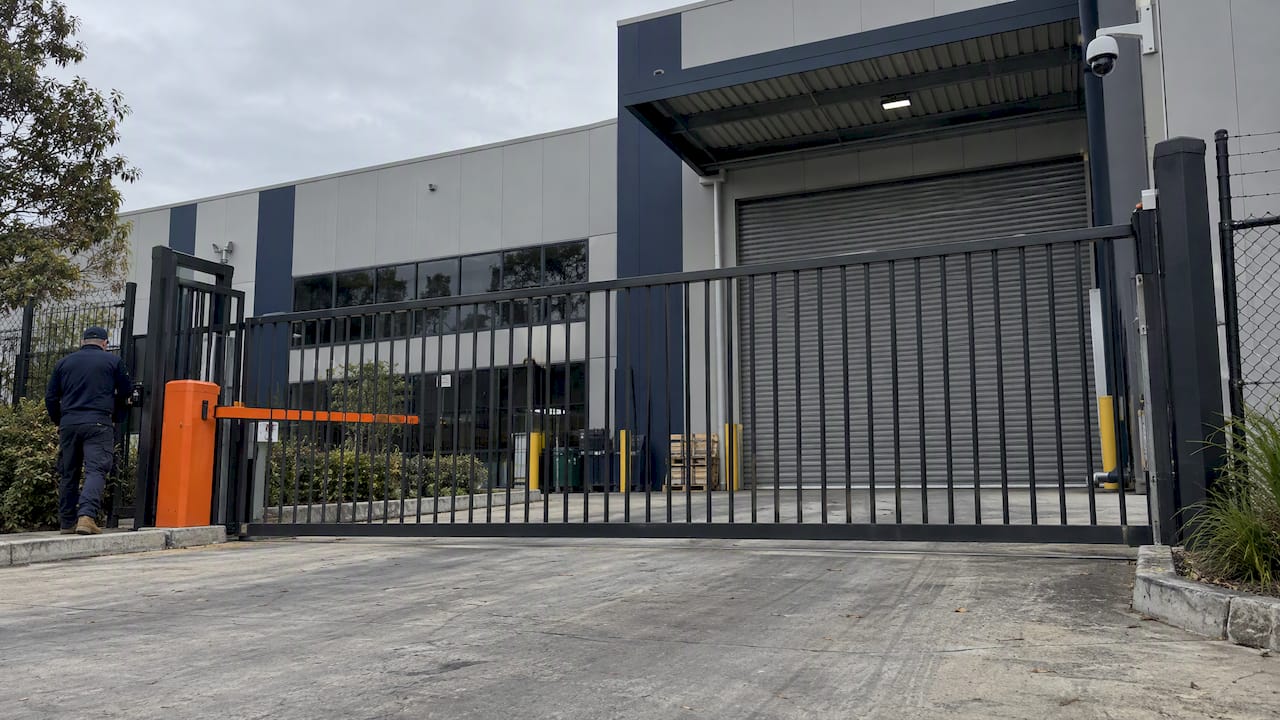
- Fencing and gates: check the side and rear boundaries, not just the front gate. Contractor entries and after-hours vehicle access are common weak points.
- Lighting: bright, even lighting at docks, yards and entries. Sensor lighting helps staff and makes intruders visible. Safe Work Australia lists high-visibility lighting, including sensor lighting among the control measures employers should consider.
- Doors and locks: NSW Police recommend quality single-cylinder deadlocks that comply with the Australian Building Code on doors, as set out in their break-in advice.
- Glass: laminated glass or shatter-resistant film on windows and doors slows entry through glazing, again per NSW Police.
- Safes: cash and small high-value items belong in a safe made and installed to Australian/New Zealand Standards and anchored to a sturdy fixture or the ground so it cannot simply be carried away.
Keep cash holdings low. NSW Police’s robbery prevention guidance advises keeping cash to a workable minimum and designing counters so unauthorised people can’t reach back-of-house areas. Both ideas apply to a trade counter or dispatch office at a warehouse.
Control who goes where
Theft in warehouses is not only an outside job. Access control limits the damage from lost keys, ex-employees, unfamiliar contractors and curious visitors.
Zone the building
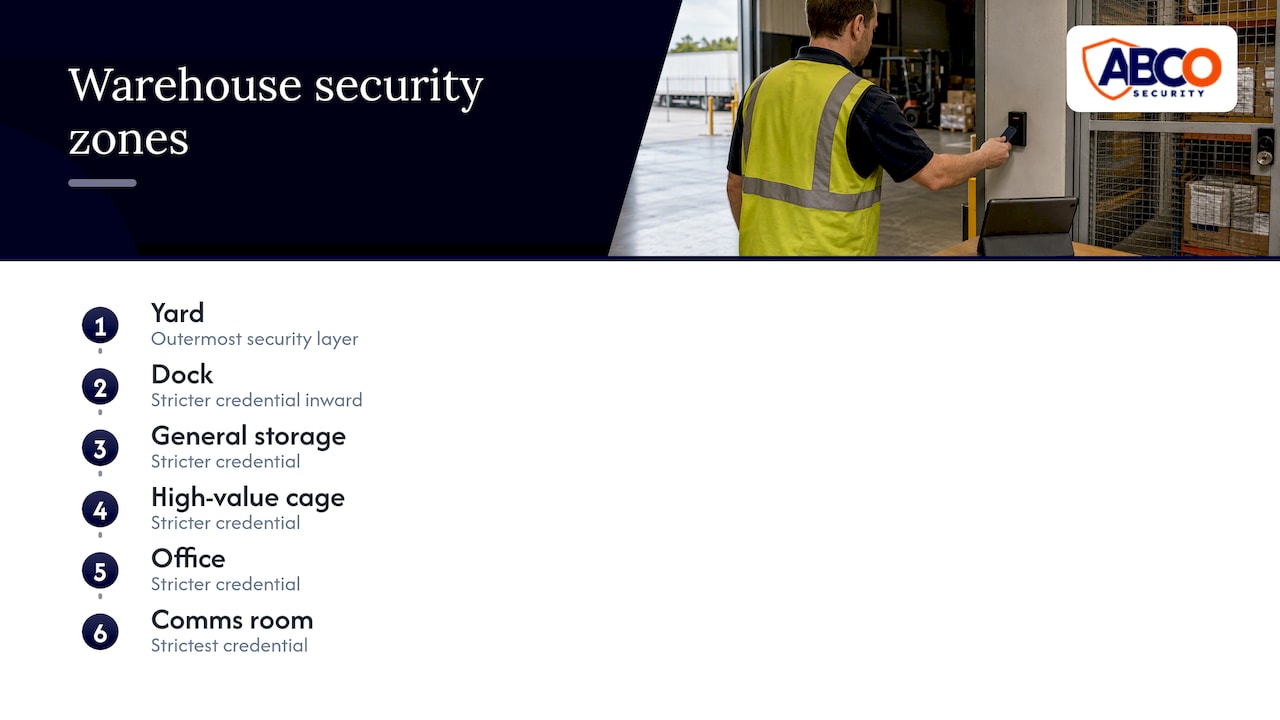
Divide the site into zones with different rules: yard, dock, general storage, high-value cage, office, comms room. Each step inward should need a stricter credential. The Australian Cyber Security Centre describes this as defence in depth: successive layers, defined security zones for sensitive infrastructure such as server rooms, and access limited to authorised people. Their guidance also notes that screens should be positioned or shielded so passers-by can’t see them through windows.
Replace keys with credentials you can revoke
Swipe cards, fobs or mobile credentials create an audit trail and can be cancelled in minutes. Safe Work Australia also points to swipe-card access for secure employee facilities. For a deeper look at standards-based design, see our guide to factory access control in Australia, which applies equally to warehouse floors and docks.
Manage visitors, drivers and contractors
- Sign everyone in and out, and issue visible passes.
- Escort drivers or confine them to a driver’s lounge and a defined dock area.
- Book contractors in advance and verify identity at the gate.
- Check outgoing loads against paperwork, and inspect packages leaving the site.
- Block tailgating at doors and boom gates, where one credential lets two people in.
Reduce internal loss
Background checks on new staff, clear written policies on theft, limited access to high-value stock and regular cycle counts all reduce internal loss. They also make a theft easier to trace when it does happen.
CCTV and alarms that someone actually watches
Cameras are only as good as what happens after they record. Footage reviewed the next morning tells you what you lost. A monitored system can stop the loss.
A sound design includes:
- Cameras covering gates, dock doors, the yard, aisles with high-value stock and the cage, positioned for both deterrence and usable identification.
- Intrusion alarms on doors, roller shutters, roof access and internal zones, linked to a monitoring centre.
- Video verification, so an operator can see whether an alarm is a possum or a person before deciding to dispatch a response.
- A written escalation list: who is called, in what order, and who holds keys.
Our guides cover the detail: security systems with cameras, commercial security system installation and commercial alarm monitoring services.
Keep the cameras themselves secure
A camera is a networked computer. The Australian Cyber Security Centre has published an alert on a critical vulnerability in certain Hikvision IP cameras (CVE-2021-36260), which could allow a remote attacker to take over a vulnerable device through its web server. The lesson is not about one brand. Cheap retail systems are often installed once and never patched. Whoever installs your system should also own firmware updates, change default passwords and keep recorders off the public internet.
Know your privacy obligations
CCTV is regulated by more than your intentions. Three points matter for warehouse operators:
- The Privacy Act doesn’t specifically cover workplace surveillance, but employers must follow relevant Commonwealth, state and territory laws, as the OAIC explains. State surveillance laws differ, so check yours.
- A statutory tort for serious invasions of privacy has applied since June 2025 and reaches beyond organisations covered by the Privacy Act.
- Facial recognition is a particular risk. The OAIC found that Bunnings breached Australians’ privacy with a facial recognition tool, citing proportionality, necessity and transparency.
In practice: post clear notices, keep cameras out of break rooms and change areas, limit who can view and export footage, and set a retention period. WorkSafe Victoria’s guide for employers also stresses balancing security tools with privacy and OHS duties. Our overview of CCTV laws in Australia is a good starting point, but get legal advice for your specific state if you plan anything beyond standard cameras.
Warehouse night security: guards, patrols or both
Most break-ins happen when nobody is there. Night and weekend coverage is where technology and people must work together.
| Option | Best for | Limits |
|---|---|---|
| Static guard | High-value stock, busy docks, 24-hour operations, sites needing constant presence | Highest ongoing cost, covers one site |
| Mobile patrol | Lower-risk sites, multiple sites, alarm response and gate checks | Presence is intermittent between visits |
| Monitored CCTV and alarms | Every site, as the detection layer | Needs a response plan to act on what it sees |
| Combination | Most medium to large warehouses | Needs one coordinated plan |
A common pattern is monitored alarms and video as the always-on layer, mobile patrols for random checks and alarm attendance, and a static guard during higher-risk periods such as stock peaks or after an incident. ASIAL has a code of practice for mobile patrols that shows how the service should be delivered, which is useful when you write a contract. Our explainer on what mobile patrol security involves covers the practical detail.
Check licences before you sign
Security licensing in Australia is state and territory based. As ASIAL’s licensing page explains, most jurisdictions require both businesses and individuals to hold licences, and activities such as guarding, patrolling and monitoring are covered. Ask any provider for licence numbers for the business and for the guards who will attend your site.
Protect the people working at night
Security is also a workplace safety duty. Safe Work Australia expects employers to put controls in place for workers exposed to violence and aggression, particularly when they work alone or at night. Its guide recommends duress and communication alarms that are regularly tested. If you have a lone forklift driver or dispatcher on a night shift, they should have a way to call for help and a check-in routine.
Warehouse security checklist
Use this as a quick audit. Anything you can’t tick is a candidate for your plan.
Perimeter and building
- Fences and gates intact on all sides, including side and rear
- Even lighting at docks, yard and entries, with sensor lighting where useful
- Quality deadlocks on external doors, roller doors secured
- Laminated glass or film on vulnerable glazing
- Safe anchored and certified, cash kept to a minimum
Access
- Warehouse divided into zones with different permissions
- Credentials that can be revoked, with an access log
- Visitor, driver and contractor sign-in, passes and escorts
- Outgoing loads and packages checked
Detection and response
- Cameras covering gates, docks, yard and high-value areas
- Intrusion alarms monitored, with video verification
- Written escalation list, keyholder details up to date
- Cameras patched, default passwords changed, recorders off the open internet
People and process
- Guards or patrols matched to your risk assessment
- Licences checked for provider and individuals
- Duress alarms tested, lone-worker routine in place
- CCTV notices posted, privacy-sensitive areas excluded
- Risk assessment reviewed after incidents or new high-value stock
How to turn it into a warehouse security plan
A plan doesn’t need to be long. One to three pages that people actually read beat a binder nobody opens.
- Record the risk assessment: assets, threats, and the weak points you found.
- Set priorities: fix cheap, high-impact items first, such as lighting, locks and visitor control.
- Choose the layers: decide what is handled by hardware, what by people, and who monitors.
- Assign owners: a named person for access control, for CCTV and for incident response.
- Define response times: what happens in the first five minutes after an alarm.
- Train staff: ASIAL’s 2025 summary stresses a culture of security awareness, regular audits and technology integrated with human presence, rather than disconnected tools.
- Review: schedule an audit at least once a year and after any incident.
Our perspective: integration beats gadgets
We see the same pattern across construction sites, corporate buildings and industrial sites. A client has cameras here, a keypad there and a guard at the gate, yet the gaps sit between those pieces. Footage nobody watches, an alarm with no response plan, an access system that never gets updated when contractors leave.
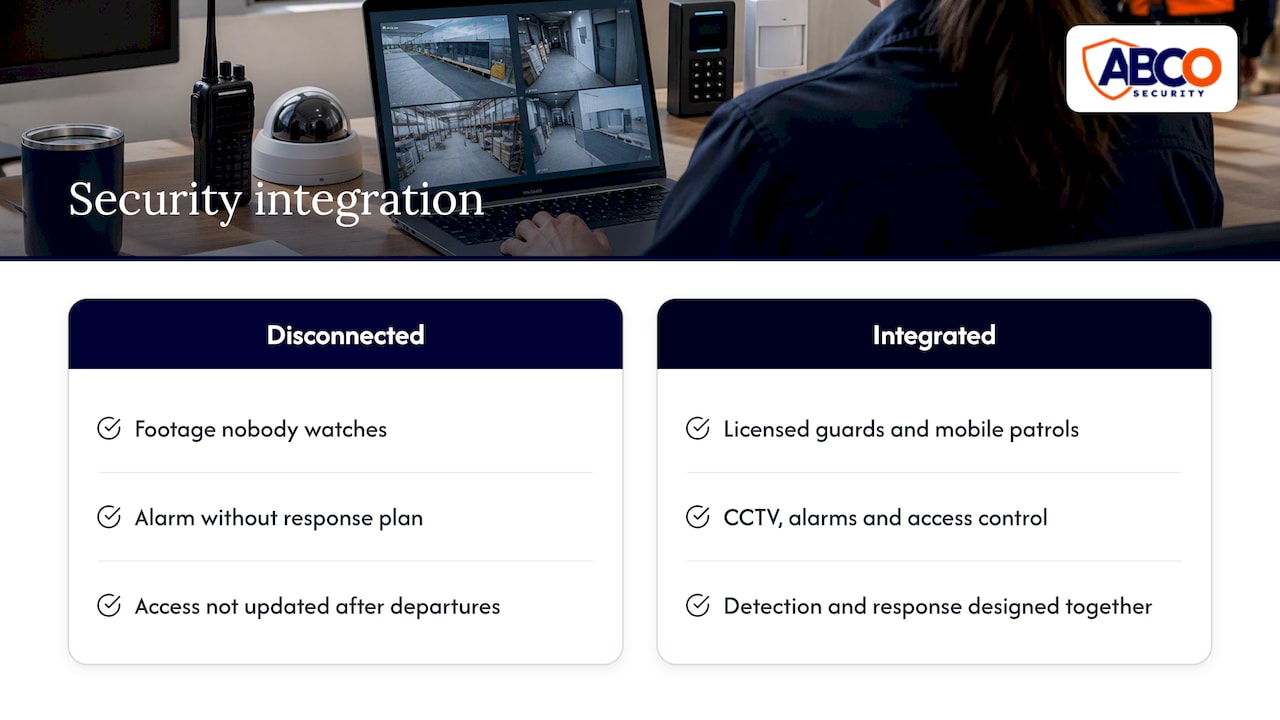
Our approach is proactive rather than reactive. We combine licensed guards and mobile patrols with CCTV, alarm monitoring and access control, so detection and response are designed together. We work to ISO 9001 and ISO 30000 standards and have more than 15 years in the industry, which shapes how we document risk, train people and report to clients.
Our advice for a warehouse manager is to begin with the night. Work out what happens at 2 am if a roller door is forced, and design backwards from there. If the answer depends on someone noticing a recording tomorrow, there is a gap to close.
— Abco
Where we can help
If you want a second pair of eyes on your site, we provide security risk assessments, guarding and patrols, mobile patrol services, CCTV and alarm monitoring and electronic security solutions across Australia. Our Night Owl Service starts from $5.45 per day, and pricing for other services depends on your site, so get in touch with your site details and operating hours.
FAQ
What are the most important warehouse security measures?
Start with a risk assessment, then build layers: perimeter fencing and lighting, access control with zones, monitored CCTV and alarms, and guards or patrols for after-hours cover. Policies matter as much as equipment. Visitor control, load checks and staff awareness close many gaps that hardware cannot.
Do warehouses need security guards?
Not always. Lower-risk sites may be well served by monitored alarms, video verification and mobile patrols. Sites with high-value stock, 24-hour operations or a history of incidents often justify a static guard. Your risk assessment should decide, and you can adjust it as the risk changes.
Is it legal to use CCTV in a warehouse?
Generally yes, but you must follow privacy and surveillance laws that vary by state and territory. Notify staff and visitors, keep cameras out of areas with a reasonable expectation of privacy such as break rooms, and be cautious with facial recognition. Seek legal advice for your state before expanding surveillance.
How often should I review my warehouse security plan?
At least annually, and whenever something changes: new high-value inventory, a layout change, a new contractor arrangement or a security incident. Each of those can open a gap your earlier assessment did not cover.
Sources
- NSW Police: break-ins and business safety
- NSW Police: robbery prevention
- Safe Work Australia: preventing workplace violence and aggression
- Australian Cyber Security Centre: guidelines for physical security
- Australian Cyber Security Centre: Hikvision IP camera vulnerability
- ASIAL: code of practice
- ASIAL: mobile patrols code of practice
- ASIAL: security 2025 summary
- ASIAL: security licensing
- WorkSafe Victoria: aggression or violence guide for employers
- OAIC: workplace monitoring and surveillance
- OAIC: statutory tort for serious invasions of privacy
- OAIC: Bunnings facial recognition determination
Recommended
about
avada factory
Sempery ultricies nibh at dolor cras urna eleifend nec. Atiam efficitur tempor.