X-ray and manual bag checks are not rivals. X-ray is faster and better at spotting concealed items inside closed bags, while a hands-on search is cheaper to start, works on any container and is the step that settles what an X-ray flags. For most construction sites, offices, hospitals and events in Australia, the right answer is a manual search policy run by trained people, with X-ray added only when your risk and throughput justify the cost.
This guide is for the manager who has to decide: a site manager worried about tool theft, a facility manager tightening entry, or an event organiser staring at a queue of 8,000 people. It covers what each method does, where each fails, and how to choose.
TL;DR
- X-ray is best for high volumes and for seeing inside closed bags. Manual searches are best for open, bulky or awkward items and for resolving anything the machine flags.
- Official guidance treats the two as complementary: an X-ray without a documented manual follow-up gives a false sense of security.
- Choose by threat, throughput and staffing, not by what looks most impressive at the gate.
- Whatever you pick, write the procedure down, train the people doing it and tell visitors and workers in advance.
Table of Contents
- What each method actually does
- X-ray vs bag checks at a glance
- Why you cannot rely on technology alone
- What X-ray can and cannot tell you
- Choosing by setting
- Our perspective
- How to set up bag checks that work
- Where our services fit
- FAQ
- Sources
What each method actually does
X-ray screening
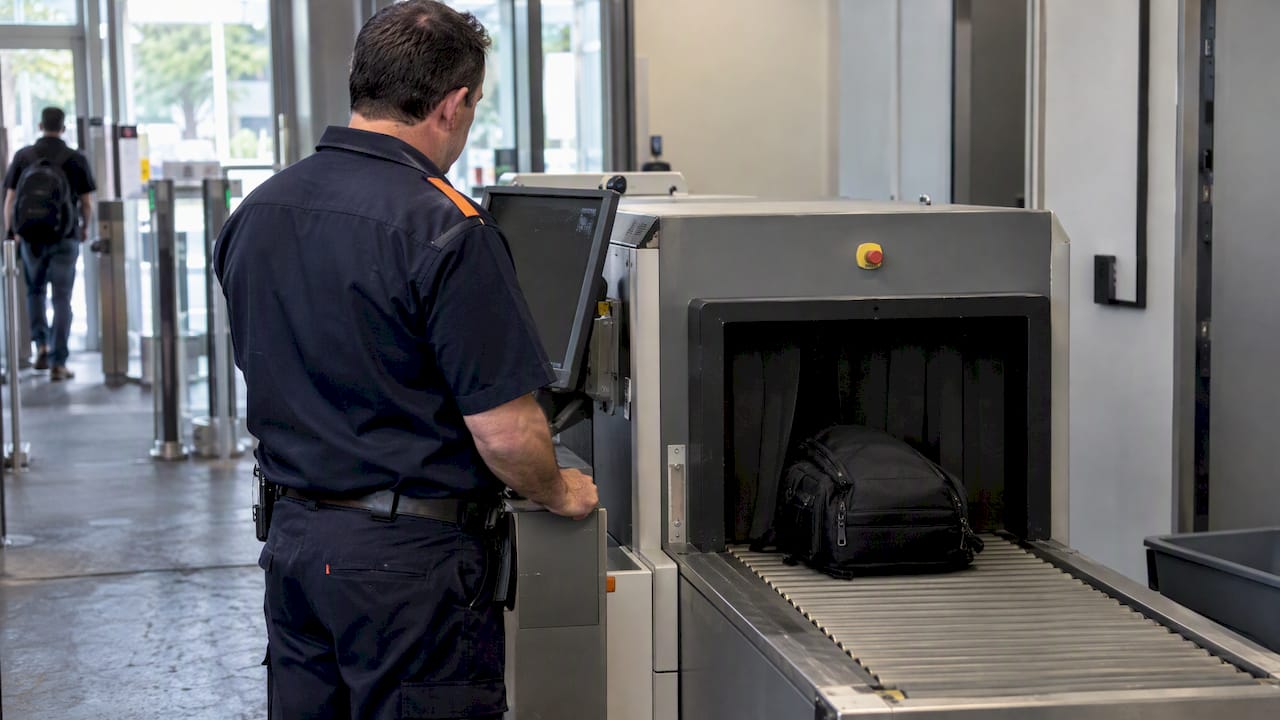
An X-ray unit passes a bag through a tunnel and shows the operator an image of its contents by density and shape. It lets staff see inside a closed backpack without touching anyone’s belongings, which makes it less intrusive than a hands-on search. Airports use it at scale: Melbourne Airport, for instance, describes its CT x-ray lanes and body scanners as part of a standardised screening process across its terminals.
It has limits. Security guidance on employee and vendor inspection programs notes that the size of the machine’s aperture limits what can be screened. A backpack or handbag is fine. A tool bag, a roll of cable or a crate is not.
The human side matters as much as the hardware. The UK’s national protective security authority notes that X-ray operators need continuous, recurrent training and often face high false-alarm rates. An image is only as useful as the person reading it.
Manual bag checks
A manual check means a trained officer looks through a bag, usually with the owner present, following a set procedure. It needs no equipment, so you can start it tomorrow. It works on open, oversized or irregular containers where an X-ray tunnel will not fit, and it is the standard way to resolve an alarm when an X-ray image is inconclusive.
The downsides are real too. The same guidance describes manual searching as more staff-intensive and more invasive than X-ray. It is slower per person, it depends heavily on the officer’s consistency, and it can feel confrontational if the process is not explained well.
X-ray vs bag checks at a glance
| Factor | X-ray screening | Manual bag check |
|---|---|---|
| Upfront cost | High: equipment, space, power, maintenance | Low: trained staff and a written procedure |
| Speed per person | Fast once set up | Slower, varies by officer |
| Sees inside closed bags | Yes, as an image | Only by opening them |
| Oversized or open items | Limited by aperture | Works well |
| Privacy and intrusiveness | Less intrusive | More intrusive if poorly handled |
| Staff skill needed | Image interpretation, recurrent training | Procedure, communication, consistency |
| Resolves its own alarms | No, needs a manual follow-up | Yes |
| Flexibility for temporary sites | Poor | Excellent |
Why you cannot rely on technology alone
The most common mistake we see described in the research is buying the machine and skipping the process. The UK guidance on screening makes the point plainly: technology should only go in when it adds real, measurable value to your security strategy. Before you buy, you need maintenance arrangements, space to isolate a suspect item, and a training program so staff can read images and resolve alarms safely.
An Australian security researcher makes a related argument about screening automation. Craig Donald’s work through Edith Cowan University argues that automation can distract screeners or produce false alarms, and that context-aware human judgement stays critical, because an item or behaviour that is harmless in one setting can be a threat in another.
That is the point of an alarm-resolution procedure. If an X-ray flags a bag and your officer does not know what to do next, the machine has achieved nothing. A short written rule fixes it: who opens the bag, where, with whom present, what happens to a prohibited item, and who is told.
What X-ray can and cannot tell you
X-ray shows shape and density, not intent. It will not tell you a person is nervous, carrying something for someone else, or planning to remove stock at the end of a shift. It also does not always give a clean answer on specific items such as cash.
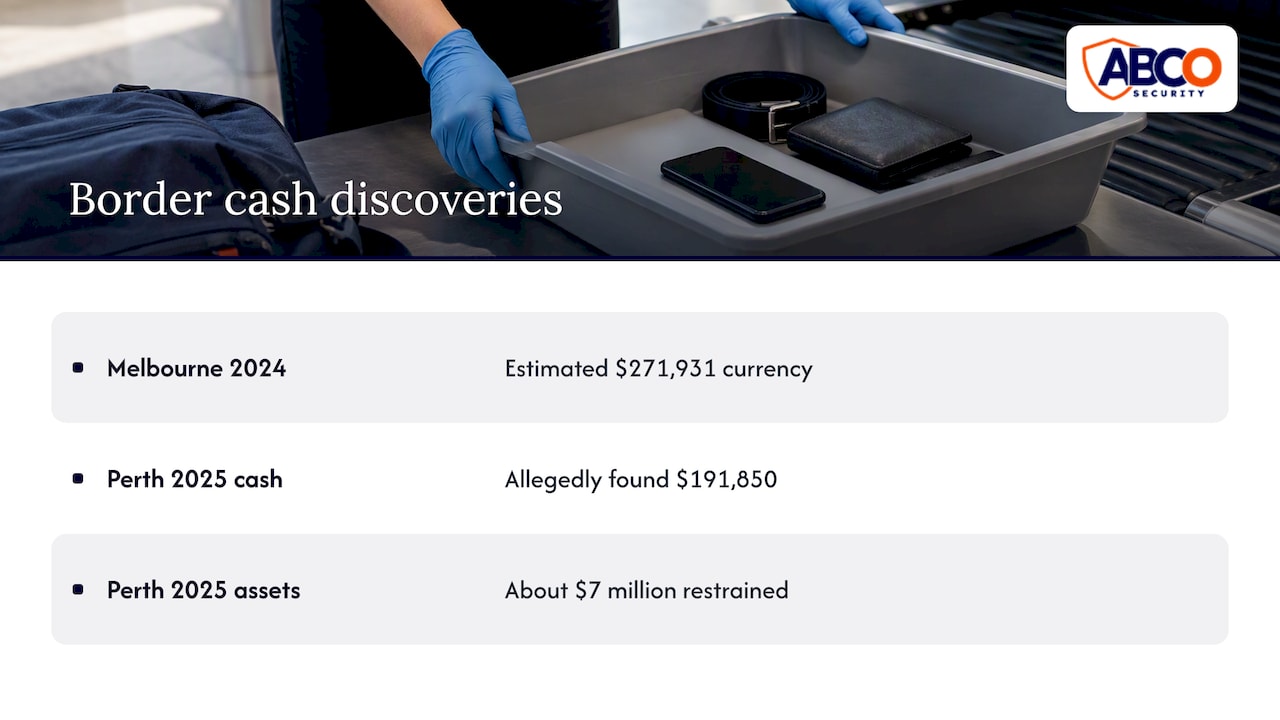
Australian border enforcement shows this well. The Australian Border Force says it works with biosecurity officers to x-ray or inspect baggage and cargo, and it pairs technology with intelligence profiling, behavioural analysis and detector dogs. In July 2024, officers at Melbourne Airport found bundles of currency concealed in a woman’s clothes and footwear during a physical examination of her luggage, a total of an estimated $271,931. In 2025, a search of a woman’s luggage and clothing at Perth Airport allegedly found $191,850 and led to the restraint of about $7 million in assets.
The lesson for a private site is the same as at the border: a layered approach beats any single tool. Technology assists, and a hands-on step catches what is hidden in clothing or deliberately layered to evade a machine.
A note on radiation
Workers and visitors sometimes ask whether screening is safe. ARPANSA, Australia’s radiation regulator, says body scanners used at Australian airports for passenger screening do not pose a health risk. Those are passenger body scanners, a different thing from a bag X-ray cabinet. If you install bag X-ray equipment on your own premises, check licensing and safety obligations with your state or territory radiation regulator and the supplier before purchase.
Choosing by setting
Construction sites
Most construction sites should start with manual checks. Sites are temporary, entry points move, and the main loss is tools, materials and copper rather than weapons. Workers carry tool bags, cable drums and ute loads that do not fit an X-ray tunnel at all.
The better investment is a controlled gate, a sign-in process, locked storage and a guard who knows the site’s rules. Our guides on preventing tool theft with check-in and locked storage and quick fixes to prevent construction site theft walk through the practical steps, and our construction site security plan covers where a bag search policy fits.
Housekeeping helps here too. A clear, well-lit entry with no clutter makes both searches and sign-in quicker and safer, and a basic industrial cleaning safety checklist is a useful reference for keeping walkways and search areas free of hazards.
Corporate offices and healthcare
In an office or a hospital, an X-ray unit at reception is rarely justified. Threat levels are lower, visitor flow is steady rather than surging, and staff and patients do not expect airport-style screening. The UK guidance notes that manual searches are the primary method where X-ray is not feasible or justified for low-threat environments, small offices being the example.
What works better is a risk-based visitor process: verified identity, badges, escorted access to sensitive areas and a clear policy for when a bag may be checked. See our checklists on visitor badges and visitor management policy. Start with a security risk assessment to learn whether your threat profile calls for anything more.
Events and festivals
Events are where the trade-off bites hardest, because the question is throughput against security. A venue manager’s guide to patron screening warns that using high-throughput metal detectors without supplementary X-ray screening for bags increases the risk of prohibited items getting in. If you skip X-ray, you accept more risk and need to compensate with more intensive, potentially slower, manual search protocols.
In practice, that means three decisions before gates open:
- Set the bag policy first. A clear, small-bag or no-bag rule cuts search time more than any machine, and it must be published on the ticket and the website.
- Count the lanes you need. Divide expected arrivals in your peak 30 minutes by how many bags one officer can check in that time, then add lanes for accessibility and for re-searches.
- Plan the queue. Shade, barriers, signage and a fast lane for no-bag patrons keep tempers down and keep the search consistent.
Our festival security planning playbook, crowd control strategies and event security guide cover entry design in more detail.
Retail and loss prevention
For retail, bag checks are usually staff exit checks rather than customer screening, and they raise employment and privacy questions. A written policy that staff agree to in advance, applied the same way to everyone, is essential. Our bag search policy guide includes sample scripts, signage and three metrics to track.
Airports and transport hubs
Airport screening is regulated and run to government requirements, so it is a different category from private-site security. If you are interested in how that environment works for travellers and workers, we cover it in our Melbourne airport security guide.
Our perspective
We get asked about X-ray because it feels like the serious option. Our view, after more than 15 years in the industry, is that the question to ask first is not which machine, but which risk.
Most of the losses our clients face are quiet ones: tools leaving a site in a work bag, stock leaving a back door, an unverified visitor wandering a ward. A machine does not stop those on its own. A trained, licensed officer at a controlled entry point, working to a written procedure, does, and that is why we put the procedure ahead of the equipment.
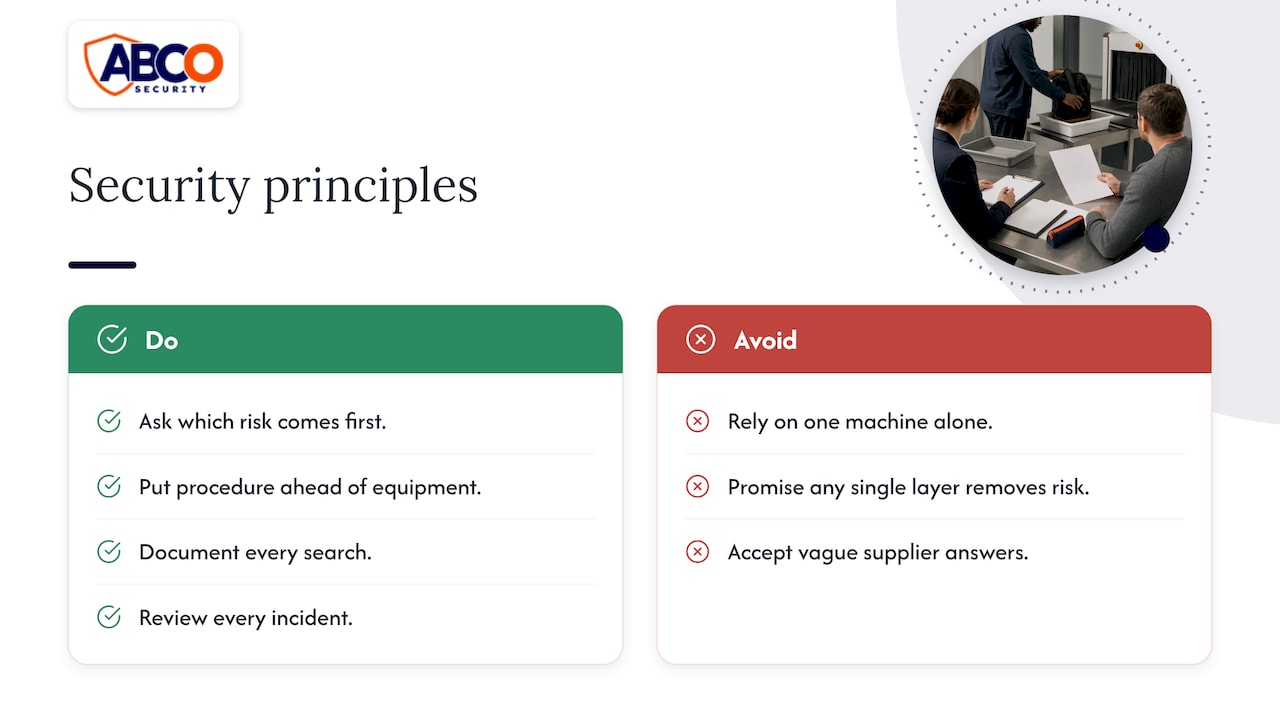
We would add technology where it earns its place. That might be CCTV and alarm monitoring, access control or a patrol pattern that makes entry points unpredictable. We would never promise that any single layer removes risk. We work to ISO 9001 quality management practices, and for us that means every search is documented, every flagged item has an owner and every incident is reviewed so the process improves.
If you are weighing up X-ray, ask the supplier three questions: who will read the images, what happens when something is flagged, and what does it cost to maintain over five years? If the answers are vague, start with trained people and a clear policy, and add equipment when the data shows you need it.
— Abco
How to set up bag checks that work
Whether you use X-ray, manual searches or both, the same foundations apply.
- Define the purpose. Are you stopping theft, weapons, alcohol, or prohibited goods? The answer changes the method and the signage.
- Write the policy. State who may be searched, when, by whom and what happens if someone refuses. Refusal usually means denied entry, not a confrontation.
- Tell people first. Put it in site inductions, employment documents, ticket terms and on signs at the gate.
- Train for consistency and courtesy. Officers should use a short, calm script and apply the rule to everyone, not a selection.
- Have an alarm-resolution step. Where does a flagged bag go? Who is present? What is recorded?
- Measure it. Track items found, average time per person and complaints. Adjust if queues grow or findings drop to zero.
- Review the risk regularly. A site’s threat profile changes as it moves from excavation to fit-out, or as an event grows.
Where our services fit
If you need people to run the process, our licensed security guards can staff gates and entry points and carry out searches to your written policy. For out-of-hours coverage, mobile patrols check that perimeters and storage areas stay secure, and CCTV and alarm monitoring adds a second pair of eyes at the gate. Building sites can start with our construction site security services.
For night-time cover, our Night Owl Service is listed from $5.45 per day. To talk through a screening approach for your site or event, start from our main site.
FAQ
Is X-ray better than a manual bag check?
Neither is better in every case. X-ray is faster and less intrusive for closed bags at high volume, while a manual check is cheaper to set up and handles oversized or open items. Most sites that use X-ray still need manual searches to resolve anything the machine flags.
Can an X-ray machine detect cash?
It shows density and layering, so bundles of notes can stand out in a bag, but it is not a dedicated cash detector. Australian Border Force combines it with profiling, behavioural analysis, physical examination and detector dogs. Travellers must declare AUD$10,000 or more in cash, or the foreign equivalent, on arrival or departure.
Do small offices need X-ray screening?
Usually not. In low-threat settings such as small offices, manual searches and a sound visitor management process are the practical option, and equipment only makes sense if a risk assessment shows a clear need. Start with the assessment, then decide.
Is airport X-ray screening safe for passengers?
ARPANSA states that body scanners used at Australian airports for passenger screening do not pose a health risk. If you have a medical concern, such as an implant or pregnancy, ask the screening staff or your doctor before you travel.
Can a private employer search workers’ bags?
Only with a clear, lawful policy that workers know about, such as one in their contract or site induction. Seek advice from an employment lawyer or your state’s workplace regulator before introducing searches, and apply the policy evenly.
Sources
- Introduction to PAS 127:2014 Checkpoint security screening of people and their belongings
- NPSA: Screening people and their belongings
- PARAS: Employee and Vendor Physical Inspection Programs
- Is there a core set of skills for visual analysis across different imaging technologies? (Edith Cowan University)
- Venue Managers Guide for Evaluating Patron Screening Solutions
- Airports and seaports (Australian Border Force)
- Woman fined at Melbourne International Airport for carrying $270k in undeclared cash
- Perth Airport luggage search leads to CACT restraint of about $7 million in WA assets (AFP)
- Airport passenger screening and health (ARPANSA)
- Security and screening (Melbourne Airport)
Recommended
about
avada factory
Sempery ultricies nibh at dolor cras urna eleifend nec. Atiam efficitur tempor.