
Professional 24/7 back-to-base monitoring costs about A$30–A$60 a month for a standard residential system and about A$50–A$150 a month for commercial monitoring in Australia. That monthly fee is only one part of ownership cost, because equipment, installation, maintenance, storage and any patrol attendance sit on top of it.
The popular advice is to shop for the cheapest monthly fee and add cameras later. That advice gets the decision backwards. A low CCTV monitoring service price can mean nobody verifies the alarm, nobody attends, or the patrol is billed separately when you need it most.
Price the incident pathway instead. Work out who sees the event, how quickly they confirm it, who they call, and who physically attends. Once that pathway is clear, the monthly number starts to make sense.
CCTV Monitoring Service Price Bands in Australia
For 2026 budgeting, start with the bands, then test your site against them. The Castle Security 2025 guide to security monitoring costs places professional 24/7 back-to-base monitoring at approximately A$30–A$60 per month for a standard residential system, while broader commercial monitoring estimates range from about A$50–A$150 per month.
Those monthly figures are a recurring operating cost on top of equipment and installation. A basic camera or alarm package may cost roughly A$300–A$800 before monitoring, whereas a more complete multi-camera system can require approximately A$1,200–A$3,000 upfront, according to the same guide. Commercial installed CCTV is estimated at roughly A$700–A$1,500 per camera, with a four-camera small-business deployment commonly costing about A$2,200–A$5,300.
Australian CCTV Monitoring and Install Price Bands
| Cost item | Typical range | What it covers | What it leaves out |
|---|---|---|---|
| Residential 24/7 back-to-base monitoring | A$30–A$60 per month | Standard home alarm and camera signals to a monitoring centre | Hardware, patrol attendance, excess call-outs |
| Commercial back-to-base monitoring | A$50–A$150 per month | Business alarm and CCTV monitoring; grade and camera count change the fee | Guard dispatch, maintenance, extra storage |
| Basic camera or alarm package | A$300–A$800 upfront | Entry hardware before monitoring starts | Installation complexity, ongoing fees |
| Multi-camera system upfront | A$1,200–A$3,000 | A more complete small system | Poles, civil works, long cable runs |
| Commercial install per camera | A$700–A$1,500 per camera | Camera supply and install for a typical commercial job | Analytics licences, wireless backhaul, lighting |
| Four-camera small business | A$2,200–A$5,300 installed | A common small-shop or office deployment | Monthly monitoring and maintenance |
Every row is a benchmark, not a quote. Camera count, monitoring-centre grade, alarm verification, escalation procedures, mobile patrol integration, video storage, communications and the required response arrangement move a site between rows. A compact shop with four wired cameras and keyholder notification sits low. A warehouse needing verified video, backup communications and dispatch sits higher.
GST treatment must be written on the quote, in plain words. Ask whether each figure is including GST or excluding GST, and whether patrol attendance, storage upgrades and call-outs attract extra charges. If you're bundling access control with cameras, compare subscription structures carefully, and a resource such as Nimbio pricing can help you see how recurring access fees are presented before you sign.
These national bands apply across Melbourne, Sydney, Brisbane, Perth and surrounding cities within a practical service radius. Don't expect a separate city price list to explain a big gap between quotes. The gap usually comes from response inclusions, cable distance, access difficulty and monitoring hours.
Before you compare installers, read the breakdown behind the CCTV installation cost so hardware and labour aren't blended into one vague line. Pick the closest row in the table for your site. Then test that row against response and contract terms before you treat it as your budget.
Practical rule: If two quotes share the same monthly fee but only one names who attends, they're not the same service.
Why Monitoring Labour Sets the Fee
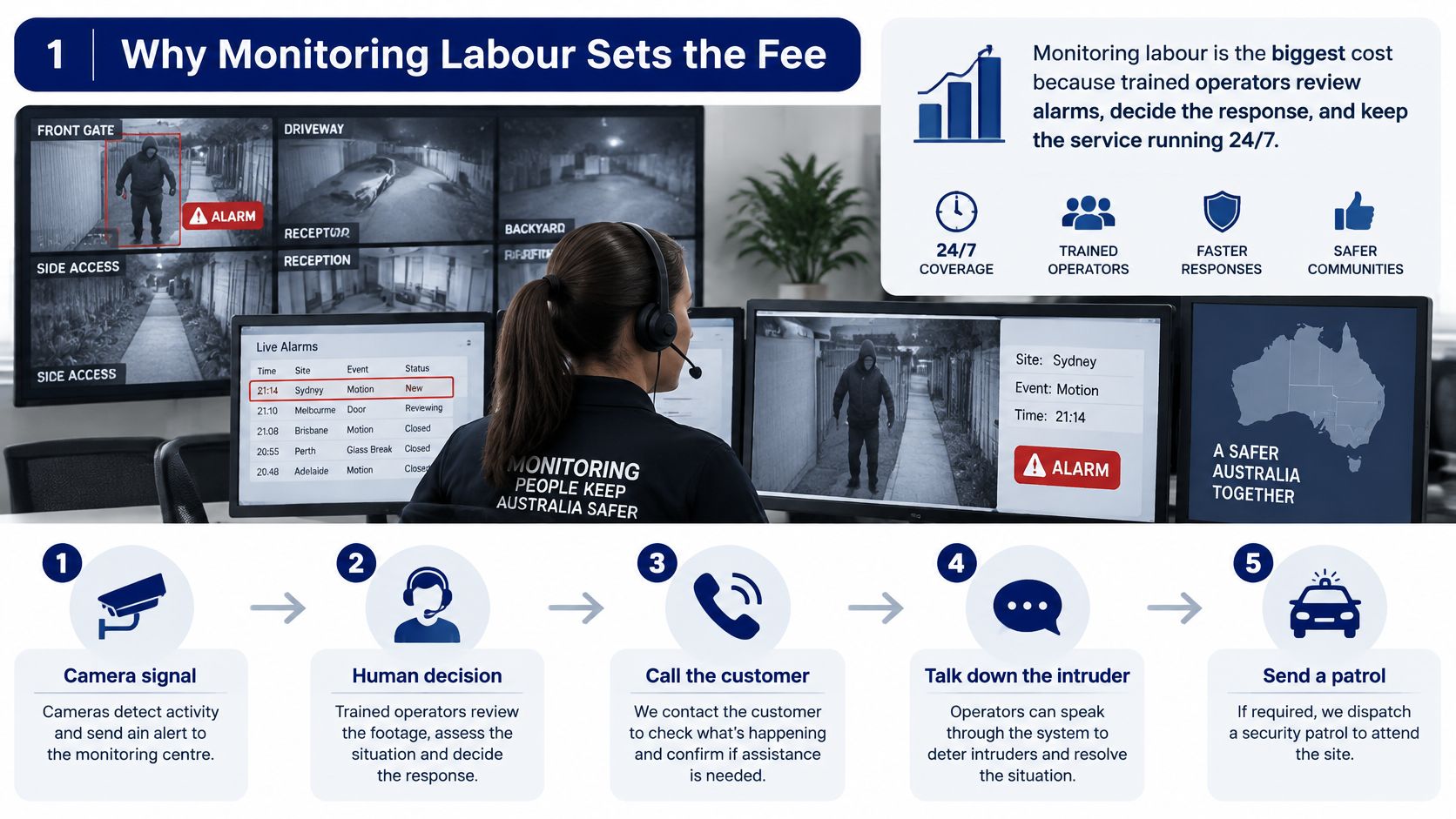
Think of the control room like a staffed switchboard. A camera or sensor raises a hand, then a person decides whether to call you, use audio talk-down, contact police or send a patrol. You're paying for that decision being made quickly and correctly at 2 a.m., not just for a feed arriving on a screen.
The cost evidence from public systems shows why staffing dominates. An Australian Institute of Criminology review found that monitoring staff represented approximately 70% of ongoing costs in the Fairfield City Council CCTV system, while annual operating costs for selected Australian systems ranged from AUD 85,000 in Toowoomba to AUD 900,000 in Sydney. Those are public-system operating totals, not a private monthly quote, and you should use them only to understand scale.
What a Sound Quotation Separates
Active monitoring costs more than passive recording for a simple reason. It needs shift cover, documented procedures, audit trails, supervision and redundancy when an operator is sick or a centre has a fault. Passive recording mainly buys infrastructure, storage and maintenance, while 24/7 active monitoring, video verification, audio talk-down, incident assessment, escalation and patrol dispatch buy people's time.
A clear quote separates these lines so you can see where the money goes:
- Integration and communications: Camera and analytics setup, plus the connection that carries signals
- Storage and control-room hours: Retention, monitoring coverage and event verification
- Escalation and response: Named contacts, response attendance and after-hours call-out
- Maintenance: Fault handling and scheduled system checks
Say a small industrial unit gets twelve alarm events a month, mostly from staff errors and wildlife near a roller door. Each event still needs an operator to open the clip, check the live view, log the outcome and decide whether to escalate. The camera count hasn't changed, but the workload has, and workload is what drives the fee.
Licensing sits inside that labour cost too. In Queensland, a person working as a monitoring security officer must hold a Queensland security provider Class 1 licence, and the Queensland Government licence page lists a single-function, unrestricted Class 1 licence at $376.20 for one year and $744.60 for three years, plus a $47.35 criminal history check fee and a $113.30 fingerprinting fee for an original application.
Demand service levels in writing before you sign. Ask for acknowledgement time, verification time, escalation time, maximum response target and the number of included incidents, then compare proposals using an annualised cost per monitored site. If you're weighing DIY alerts against a centre, the monitored versus self-monitored comparison helps you test who does this work when you're asleep or on a plane.
A low monthly price can hide capped events, slower escalation or a patrol billed on top. Once the labour lines and service levels are visible, a higher fee often stops looking expensive. It starts looking like the quote that included the work.
Response Tiers from Signal to Patrol
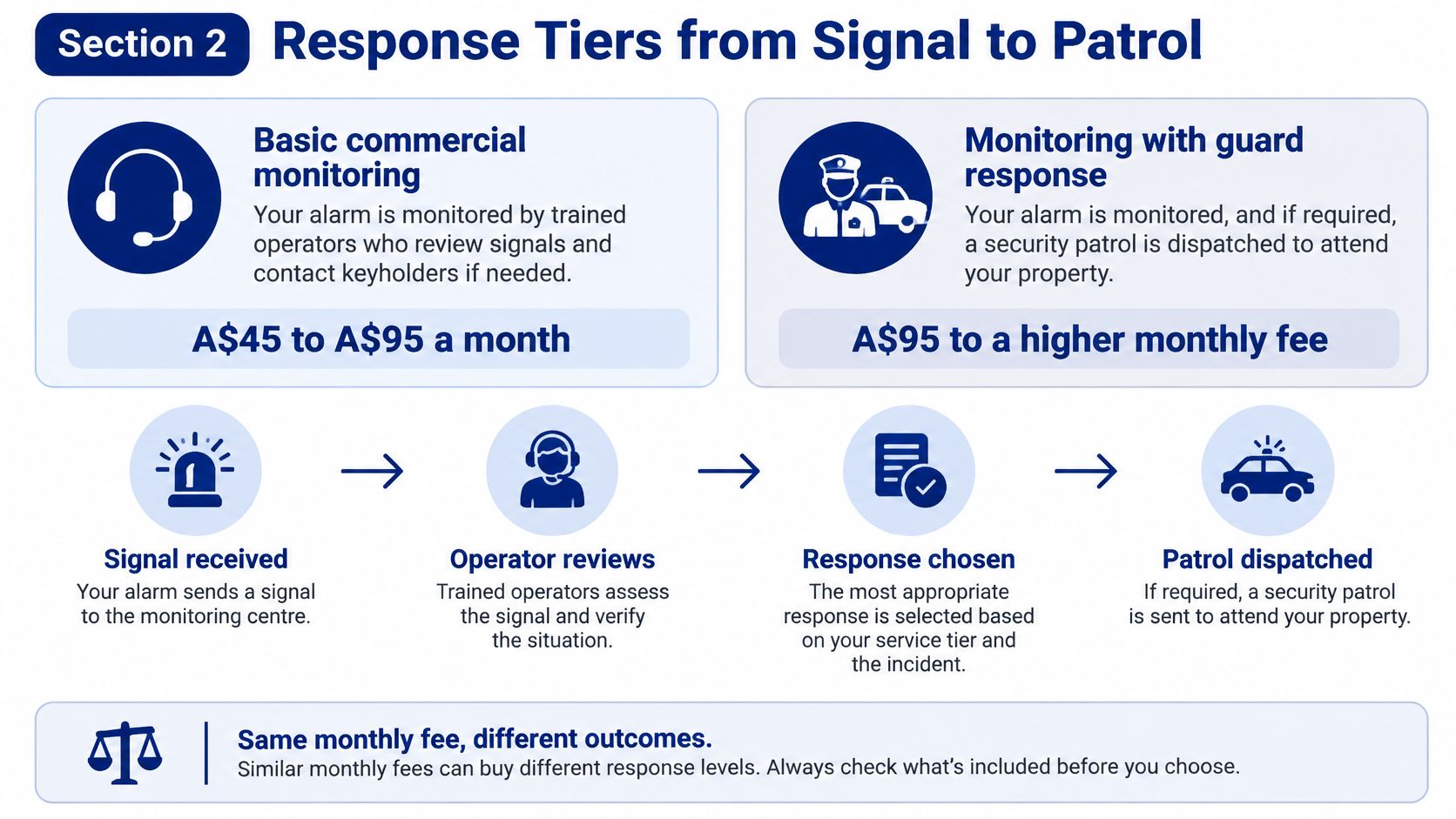
Two quotes can look similar on price and deliver very different outcomes at midnight. One may log a signal and text a keyholder. Another may verify video, challenge the intruder by speaker and dispatch a guard. The monthly fee alone won't tell you which one you've bought.
A recent NSW commercial security cost guide places basic commercial monitoring at $45–$95 per month and monitoring with guard response at $95–$170 per month, while separate equipment, installation, maintenance, attendance and contract charges may apply. That split is the key lesson. Physical response is a separate cost layer, even when it's bundled into a higher tier.
Price to Response Pathway
| Tier | What the operator does | Published monthly band | Physical response |
|---|---|---|---|
| Signal forwarding only | Logs the alarm and notifies a keyholder | Low end of published bands | None included |
| Basic commercial monitoring | Graded centre handles alarm signals | A$45–A$95 | Police or keyholder notification; guard usually extra |
| Verified video monitoring | A person checks footage before escalating | Mid to upper commercial range; confirm on quote | Escalation after confirmation |
| Monitoring with guard response | Verifies, then dispatches a patrol | A$95–A$170 | Patrol attendance; check what is included versus call-out |
| Continuous live watch | Operators view cameras through the shift | No firm published monthly figure; priced on quote | Human assessment; high false-alarm load |
| Event-triggered verification | Opens video only on alarm or analytic | Often better value than live watch; confirm on quote | Escalation after a confirmed event |
Continuous live watching isn't automatically better value. Operators can drown in quiet hours and false alarms, and attention drops when nothing happens for long stretches. A well-designed event-triggered service opens video on an alarm or analytic, verifies what's there, then escalates, which cuts noise and keeps attention on real incidents.
For a broader view of how live intervention fits a safety program, you can explore real-time safety monitoring benefits and then map those ideas back to your own escalation list. The technology only helps if the next step is agreed. Someone still has to call, challenge, attend or involve police.
For each tier, ask four direct questions:
- Who is contacted first: You, a site manager, police or a patrol
- Patrol inclusion: Whether Mobile Patrols are included or charged per attendance
- False alarms: What happens after repeat false alarms and who pays
- Failure cover: Whether monitoring continues during internet or power failure
Backup communications and a graded monitoring centre are price steps, not slogans. A second path, such as mobile data failover, costs money because it keeps signals moving when the main connection fails. Read how mobile patrol benefits change the outcome after verification, especially for unoccupied sites.
Circle the tier that matches the harm you're trying to stop. After-hours entry at a retail tenancy needs fast verification and a person who can attend and secure the door. An unoccupied construction compound needs the same, plus a patrol that can reach the gate safely. If the tier leaves you organising the response, price that accordingly.
Sample Packages for Homes and Businesses
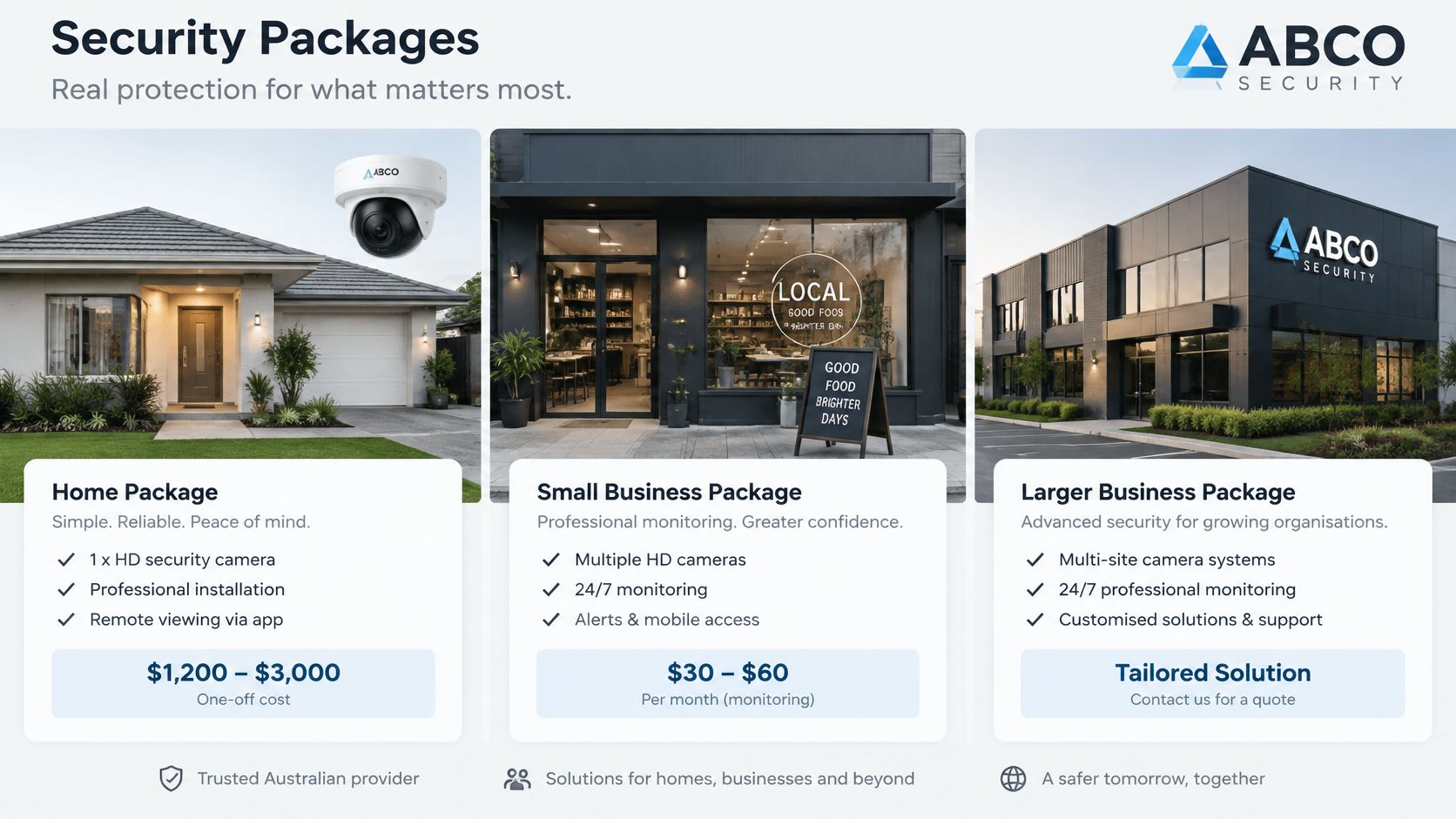
A low monthly fee can cover the signal reaching a monitoring centre while leaving the patrol that attends as a separate charge. Compare packages by tracing the incident pathway: monitoring, verification and physical response. The image summarises a typical residential and business package comparison, not a provider's price list.
Three Worked Benchmarks
- Home package: A compact house with a small multi-camera set costs A$1,200–A$3,000 upfront, plus A$30–A$60 a month for monitoring. That is A$360–A$720 a year in monitoring, before maintenance. Confirm how many days of cloud footage are retained. A patrol call-out may cost extra if attendance is not included, even on an unlimited 24/7 residential plan with coordinated patrol response, such as ABCO Night Owl. Check how many attendances the plan covers.
- Small retail shop: Four cameras at a Melbourne shop, or a similar suburban strip in Sydney, Brisbane or Perth, cost about A$2,200–A$5,300 installed. Commercial monitoring at A$50–A$150 a month adds A$600–A$1,800 a year. Confirm that the fee includes verified after-hours escalation. Mobile Patrols may be charged per attendance unless the response tier includes them.
- Strata foyer or small office: A typical planning range is A$700–A$1,500 per installed camera, with commercial monitoring at A$50–A$150 a month. Costs depend on the camera count and the monitoring arrangement. Confirm that the manager can obtain controlled footage exports. A SIM or NBN failover may cost extra to keep foyer signals reaching the monitoring centre during an outage.
Worked Package Benchmarks Not ABCO List Prices
| Package | Upfront | Monthly monitoring |
|---|---|---|
| Home or residential package | A$1,200–A$3,000 | A$30–A$60 |
| Small retail shop, four cameras | A$2,200–A$5,300 installed | A$50–A$150 |
| Strata foyer or small office | A$700–A$1,500 per installed camera | A$50–A$150 |
The short video below helps show how camera placement relates to day-to-day use. Consider coverage and the monthly fee separately.
Treat these figures as planning sums, not firm quotes. Cabling, access, lighting and footage retention affect the installed cost. For each quote, write down what monitoring covers, how an incident is verified, and whether a patrol attends or is charged separately.
Construction compounds and multi-building sites need a separate scope. Temporary power, wireless links, dust, changing fencing and patrol distance can all affect the job. Use the home, retail and strata figures for small fixed premises.
Pricing for Sites Events and Strata
The cheapest monthly fee can leave the most expensive part out: a patrol that attends. Price the incident pathway first, from detection and operator verification through to physical response. Camera count matters, but it does not show whether anyone will reach an unoccupied yard or how quickly.
Commercial foyers and offices may need after-hours alarm verification alongside daytime concierge and reception cover. Ask how the control room hands an incident to the person on site, and who can authorise entry.
- Dominant cost driver for offices: After-hours alarm volume, lift and foyer access rules, and who can authorise entry
Construction sites have changing perimeters, temporary power and wireless links, and equipment that may need protection. The patrol route matters too: a verified alert has little value if the responder cannot reach the compound safely. Use this guide to construction site security monitoring to define the site conditions, then request a quote based on the compound rather than a standard shop package.
- Dominant cost driver for construction: Power, connectivity, perimeter length and patrol access
Events usually require security for a defined period, including load-in, show days and bump-out. Temporary cameras or monitoring can be paired with security guarding and crowd control. Confirm which hours require a live operator, which require recording only, and whether a patrol is included or charged separately.
Retail monitoring should match trading hours and opening and closing procedures. Set out how the team verifies an entry alert, who is contacted before police, and whether a patrol can attend if the premises are empty.
- Dominant cost driver for retail: Entry points, trading hours, false-alarm rate and closing response
Strata and gated communities need clear rules for common-area footage: why it is collected, who may view or export it, and how long it is kept. More cameras and longer retention add privacy responsibilities as well as storage requirements.
More footage isn't automatically more security. It's more personal information your organisation has to protect, explain and eventually delete.
The OAIC security camera guidance says organisations covered by the Privacy Act generally must notify people before recording them, secure recorded personal information, and destroy or de-identify it when no longer needed. Workplace CCTV also intersects with state and territory surveillance laws, which differ by jurisdiction. Ask each bidder to specify who handles signage, access controls, retention schedules and footage requests, and include those responsibilities in the quote.
Maintenance Extras and the Three-Year Cost
Routine upkeep is where a tidy monthly fee starts to grow. The Securitec security system cost guide places routine CCTV maintenance at about A$180–A$450 for a small-system health check and approximately A$450–A$1,500 for a multi-camera preventive visit, excluding significant replacement parts. It also estimates commercial CCTV at roughly A$650–A$2,200 per camera, with integrated multi-site security deployments reaching A$12,000–A$85,000 or more.
Those figures explain why a monitoring-only arrangement can sit near the lower end of the recurring range. Commercial or higher-risk sites pay more when monitoring connects to graded centre requirements, alarm verification, patrol dispatch, fault management and multiple locations. If maintenance isn't included, budget for it separately instead of hoping cameras will keep working untouched.
Extras That Sit Outside the Advertised Fee
Check each quote for charges that commonly sit outside the headline number:
- Communications: Mobile data, SIM costs or failover when the main connection drops
- Storage and licences: Extra retention days and analytics licences
- Attendances: After-hours call-outs and false-alarm patrol attendances
- Contract terms: CPI rises, minimum terms and GST added at the end
The full lifecycle is wider than cameras and a subscription. An Australian Institute of Criminology cost review identifies cabling, camera purchase and installation, poles and civil works, lighting, data storage, monitoring staff, cleaning, replacement cameras, system upgrades, standard operating procedures, audits, insurance, and legal or governance work as distinct cost categories. A remote compound or multi-building estate costs more than a compact office because it needs longer cable runs or wireless backhaul, environmental protection, power resilience and more complex response rules.
Public-sector practice treats monitoring as a continuing liability, not a one-off install item. That review notes a Queensland grant document explicitly separates capital equipment, installation, storage subscriptions and continuing CCTV monitoring costs. Private buyers should copy that discipline, even for a single tenancy.
Six Step Check for Every Quote
- Write the annual monitoring fee: Multiply the monthly figure by twelve
- Add preventive maintenance: Use the planned visit rate, and align it with the CCTV camera maintenance service scope you need
- Add patrol attendances: Use a realistic yearly number if attendance is excluded
- Add communications and storage: Include failover and any extra retention days
- Note GST and rises: Record GST treatment, minimum term and any CPI clause
- Compare service targets: Put acknowledgement, verification, escalation and arrival targets beside the price
Then ask for a three-year total-cost schedule. It should show installation, monthly monitoring, connectivity, storage retention, preventive maintenance, replacement assumptions and response charges separately. Add video resolution, frame rate, retention days, analytic trigger types, alarm verification method, backup communications and system uptime targets so a cheap quote can't shift essentials into exclusions.
Confirm that monitoring and response personnel are licensed for the state where your site operates. Ask for documented procedures, incident reporting and relief coverage in writing. For standards context rather than pricing, refer to the Australian Security Industry Association Limited, then judge each bidder on its own licence, procedures and references.
Say a small business compares two proposals over three years. The cheaper monthly fee may lose once you add preventive visits, several patrol attendances, failover communications and longer retention for insurance. The dearer fee may already include verification and a clearer response target, which is why the three-year schedule is the document that decides the quote.
Request that schedule from ABCO Security Services Australia with your camera count, operating hours, retention needs and required response. You'll get a clearer comparison than any headline monthly price can give you. Bring the same schedule to every bidder so you're comparing the same job.
If you need a monitored system where the verification, escalation and patrol pathway are priced in plain language, talk to ABCO about a site-specific assessment and a three-year cost schedule for your home, business, construction site, event or strata property. Visit ABCO Security Services Australia to request a quote that separates installation, monitoring labour, maintenance and physical response before you commit.
about
avada factory
Sempery ultricies nibh at dolor cras urna eleifend nec. Atiam efficitur tempor.