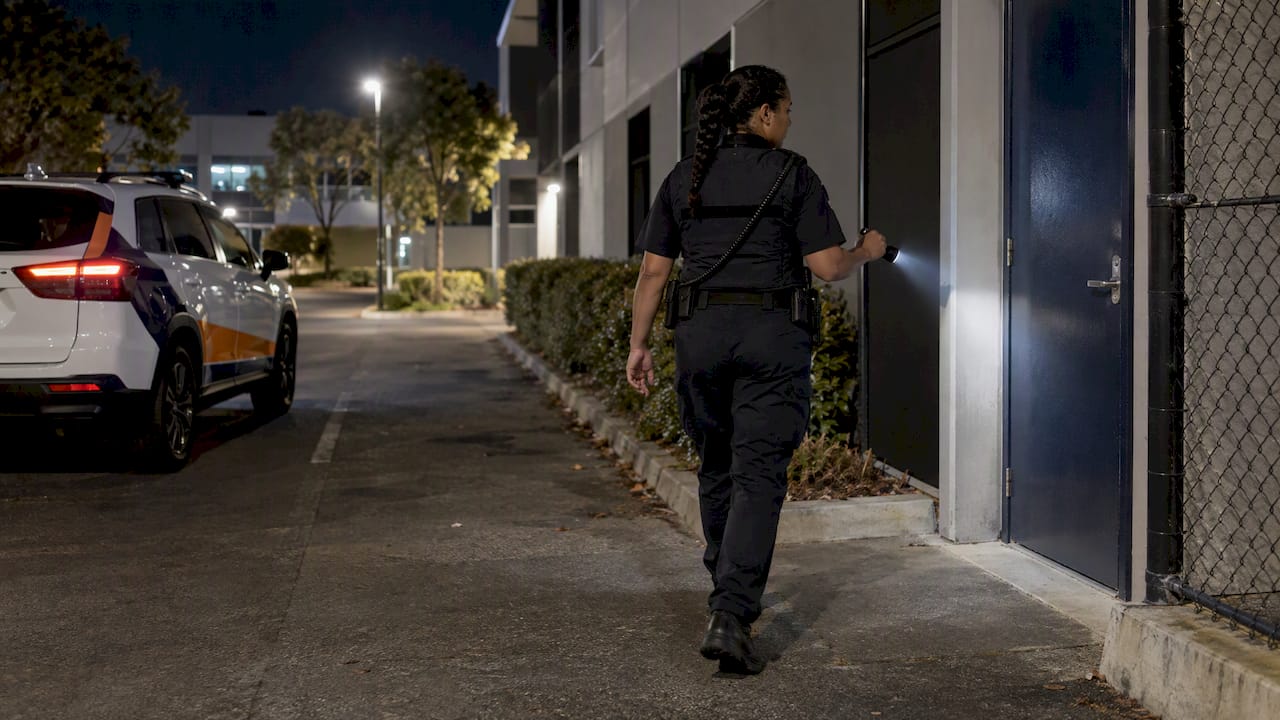
Mobile patrols give a site visible deterrence, regular inspections, a quick check when something looks wrong and flexible cover, all without paying for a guard to stand on the premises all night. They suit sites that need an after-hours presence but not a person on post every minute. They are not a replacement for static guards where a threat is constant, and they do not replace police. This guide sets out what the benefits are, where the evidence stops and how to decide whether patrols fit your site.
TL;DR
- A marked vehicle visiting at unpredictable times deters opportunistic crime, and research on preventive patrol links it with a small but real reduction in crime.
- Each visit is also an inspection: open gates, damaged fencing, unlocked doors, hazards and failed lighting get found and reported.
- Patrols share one officer and vehicle across several sites, so they usually cost far less than continuous static guarding.
- Patrols work best when frequency and timing follow your actual risk, and when they sit alongside CCTV and alarm monitoring.
- Patrols cannot arrest, fine or enter private property without permission, so know what you are buying.
Table of Contents
- What a mobile patrol is
- Benefit 1: Visible deterrence
- Benefit 2: Every visit is an inspection
- Benefit 3: Risk-based coverage
- Benefit 4: Faster response than waiting for a callout
- Benefit 5: Flexible coverage across site types
- Benefit 6: Lower cost than continuous static guarding
- Benefit 7: Support for your other security measures
- Where patrols fall short
- How to decide if patrols fit your site
- Perspective: why we build patrols around risk, not routes
- Getting patrol cover for your site
- FAQ
- Sources
What a mobile patrol is
The industry body ASIAL defines a mobile security patrol as a service in which officers travel between multiple sites that are physically apart from one another within a set period. According to ASIAL’s Mobile Patrols Code of Practice, alarm responses, escorts, and unlocking or locking up premises can form part of the patrol function.
Put simply, a licensed officer in a marked vehicle works a route. At each stop they check the property, record what they find and move on. If you want the basics first, our page on what mobile patrol security is covers them. The rest of this article is about what that arrangement does for you.
Benefit 1: Visible deterrence
Most property crime is opportunistic. Someone tries a gate, looks for unattended tools or tests a side door. A marked vehicle, a uniformed officer and a torch moving along the boundary change that person’s calculation.
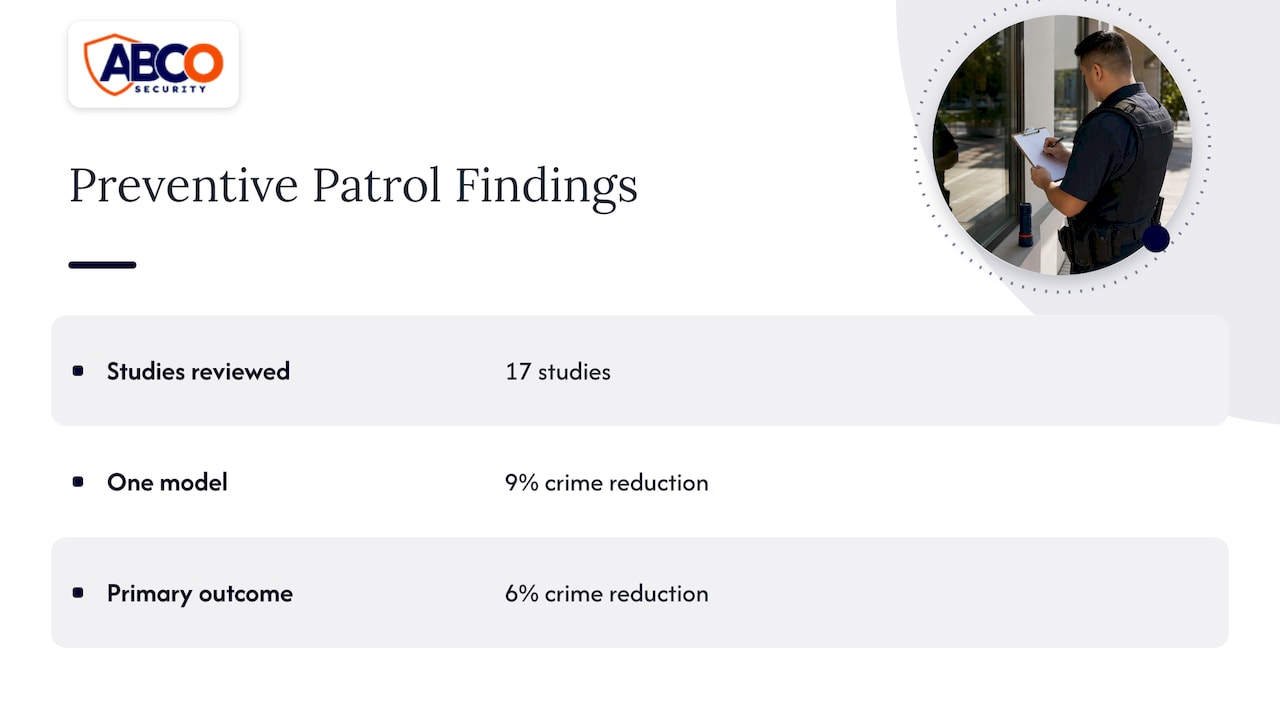
There is evidence behind this, with sensible limits. A 2024 systematic review and meta-analysis of 17 studies found that increased preventive patrol was associated with a small reduction in crime: 9% in one model and 6% on the primary outcome measure. The authors found no significant evidence that crime simply moved elsewhere. They also concluded that patrols should do better when they are targeted at the places and times where crime concentrates.
That last point matters more than the headline figure. A small average effect is not a reason to doubt patrols. It is a reason to design them properly: patrol when your incidents happen, not on a fixed habit that offenders can learn.
A local example shows the same logic in practice. Wyndham City in Victoria ran the Truganina Security Patrols Trial from 10 November 2025 to April 2026, using two marked vehicles every night from 10 pm to 6 am. The aim was a visible after-hours presence, proactive checks and incident reporting. It is a public-sector example rather than a commercial site, but the principle carries over.
Benefit 2: Every visit is an inspection
A patrol is not only a deterrent. It is a regular set of eyes on your property when nobody else is there.
ASIAL’s code says patrols can carry out external, intermediate and internal inspections at random times, with checks verified through proof of service. Typical findings on a night round include:
- gates or roller doors left open or unlatched
- damaged fencing or signs of attempted entry
- lights or cameras that have failed
- water leaks, fire hazards and blocked exits
- vehicles or people loitering where they should not be
Finding a failed floodlight on Tuesday night is far better than discovering on Thursday morning that it was the way in. For facility managers this is often the quiet benefit that justifies the whole service: you get a dated record of the state of your site, not only a response when something goes wrong.
Reports you can use
Ask what you receive after each visit. Good reporting covers the time of arrival, what was checked, anything abnormal and any action taken. Proof of service, such as GPS or checkpoint scans, lets you confirm the patrol happened. Over weeks, the reports show patterns: which gate is repeatedly found open, which night has the most loiterers. That is the information you need to adjust patrol timing.
Benefit 3: Risk-based coverage
A properly run patrol starts with a risk review, not a route sheet. The ASIAL code requires a risk review before patrol services start. It lists hazards such as violence, robbery, fatigue, traffic risks, and slips or falls. It says the assessment should be done by trained, experienced and appropriately licensed personnel and revisited when threats change. Hazards and changing threats are identified through site inspections, route assessment, equipment and vehicle checks, discussions with workers and a review of incident reports.
For you, that means the patrol plan can follow your risk. A construction site with copper and power tools on hand has a different profile from a medical centre car park or a retail strip. Our security risk assessments approach starts from the same idea: understand the site, then choose the mix of measures.
Benefit 4: Faster response than waiting for a callout
When an alarm activates at 2 am, someone has to look. If nobody is nearby, the delay can be long. A patrol already working a defined area can often reach the site sooner than a vehicle dispatched from further away, and the officer can check the premises and report what they see.
Be realistic about what that response is. Wyndham City states that its patrols do not replace police or emergency services, cannot arrest people or issue fines, and cannot enter private property without permission. A commercial patrol operating under a client contract has different access, because the client authorises entry, but the broader limit holds: the officer observes, deters, reports and calls police when needed. They are not a substitute for the emergency services.
The strongest setup pairs patrol with monitoring. A monitored alarm or camera detects the event, the control room verifies it and a patrol attends. Our guides to business security monitoring services and monitored burglar alarm systems explain how that chain works. Response times depend on where your site is and where the vehicle is when the alarm trips, so ask any provider for realistic figures for your address, not a blanket promise.

Benefit 5: Flexible coverage across site types
Patrols are adjustable in a way that a fixed post is not. You can change the number of visits, the hours and the tasks as your needs shift.
| Site type | Common patrol use | What to ask for |
|---|---|---|
| Construction site | Night and weekend checks of perimeter, storage, plant and site fencing | Visits timed around when theft happens, gate and container checks |
| Healthcare facility | After-hours car park checks, escorts to vehicles, door and access checks | Officers briefed on site rules, calm and respectful conduct |
| Corporate office | Lock-up and unlock, alarm response, building checks | Key and access procedures, clear reporting |
| Retail premises | Checks after closing, roller door and rear laneway inspection | Visits at closing and early morning, alarm attendance |
| Events | Pre-event and post-event site checks, overnight cover of equipment | Staged cover alongside crowd management staff |
| Industrial site | Yard, fence line and gate checks | Route that covers blind spots |
Flexibility also works over time. A site might need three visits a night during a vulnerable build stage, then one once the building is locked up. A fixed static post cannot scale down as easily.
Construction sites in particular
Building sites sit empty for long stretches, hold valuable materials and often have temporary fencing. That makes them a natural fit for patrols between shift end and shift start. Our construction site security services are built around that gap, and our guides on construction site theft prevention and tool theft cover the physical measures that work with patrols: locked storage, check-in processes and lighting.
Benefit 6: Lower cost than continuous static guarding
This is the benefit most buyers care about. A static guard is paid for every hour they stand on your site. A patrol officer shares their shift across several clients, so you pay for the visits you need, not for continuous presence.
The saving is real only when the risk suits it. The comparison is straightforward:
| Factor | Mobile patrol | Static guard |
|---|---|---|
| Presence | Intermittent, at set or random times | Continuous |
| Cost structure | Per visit, per night or per contract | Per hour of post |
| Best for | Low to moderate after-hours risk, large or spread-out sites | High-risk sites, access control, reception, crowd management |
| Weak point | Gaps between visits | Cost, and a fixed field of view |
Many sites use both: a static guard during high-risk hours or for access control, and patrols for the rest of the time. If you are weighing the two, our page on security guarding explains when a fixed post earns its cost.
Prices vary by region, frequency, travel time and whether alarm response is included, so a quote based on your address and patrol schedule is the only reliable figure. For the lowest entry point, our Night Owl service is listed from $5.45 per day.
Benefit 7: Support for your other security measures
Patrols are strongest as one layer in a set. Cameras record, alarms detect, patrols verify and act. When a patrol officer is known to check a site, the alarm system is more useful too, because someone is available to attend a signal and confirm it. Our guides on commercial video security systems and security systems monitoring show how the layers connect. For an overview of your options, see security systems for businesses.
Where patrols fall short
A fair assessment includes the limits:
- Gaps between visits. If an offender knows when a patrol comes, they can work around it. Random timing narrows that window.
- No continuous observation. A patrol will not see a break-in that starts and finishes between visits. Cameras and alarms cover that.
- Limited powers. Officers cannot arrest in the way police can and should not put themselves at risk. They observe, report and call for help.
- High-risk sites. Where there is an ongoing threat, valuable stock or large crowds, a fixed post is usually the better answer.
The research points the same way: patrol works best when it is concentrated where and when crime happens, not spread thinly. Weisburd and colleagues conclude that deterrence is likely to be strongest when patrol dosage rises and activity is informed by crime patterns, rather than relying on unfocused random coverage. Random timing still has value for unpredictability, but it should sit inside a plan shaped by your incident history.
How to decide if patrols fit your site
- List your incidents. Note what has happened, when and where: forced entry, graffiti, theft, alarm false triggers.
- Find the risky hours. Most incidents cluster in a few windows. Patrols should be concentrated there.
- Check your layers. Do you have working cameras, alarms and lighting? Patrols work better when they do.
- Decide the response you need. Do you want only inspections, or alarm attendance and lock-up too?
- Ask about licensing and reporting. Officers must be licensed in the state where they work, and you should receive a record of every visit.
- Review monthly. Use the reports to move visits to where they matter.
Perspective: why we build patrols around risk, not routes
We see the same mistake across many sites: a patrol bought as a fixed number of visits, with no link to what is actually happening. A route sheet is not a security plan. The sites that get the most from mobile patrols are the ones where we start with a risk assessment, match visit times to incident patterns and then pair the patrol with monitoring so there is something to verify.
Our approach is proactive and technology-led. We operate 24/7 across Australia, work to ISO 9001 and ISO 30000 standards, and have more than 15 years in the industry across construction, healthcare, corporate and retail settings. That experience shows in small details: how an officer reports a gate found open, how a pattern of near misses gets raised before it becomes a loss and how patrol frequency is lowered when a site is safer, not left to run forever.
Mobile patrol is not the answer to everything. When a site needs a person on post, we say so. When patrol plus monitoring does the job at a fraction of the cost, we say that too.
— Abco
Getting patrol cover for your site
Our mobile patrol services cover scheduled and random patrols, alarm response and lock-up checks for construction, healthcare, corporate, retail and industrial sites. If you want a lower-cost nightly option, the Night Owl service is listed from $5.45 per day, with 12-month and 24-month plans also on that page.

For a tailored quote, tell us your address, your hours of concern and your incident history, and we will recommend a patrol schedule and the monitoring that should sit behind it. You can start from our home page. If you manage an office, our guide to after-hours office security shows how a rollout works.
FAQ
Is mobile patrol cheaper than a security guard?
Usually, yes, because the officer’s time is shared across several sites instead of fixed to one. You pay for visits, not for continuous presence. The right choice still depends on risk: where a threat is constant, a static guard may be the better value.
How often should a site be patrolled?
There is no single answer. It depends on your incident history, the value of what is on site and the hours when problems occur. Start with the riskiest hours, review the reports after a month and adjust. Research on patrol suggests concentrating effort where and when crime clusters.
Can a mobile patrol officer arrest someone?
Not in the way police can. Patrol officers observe, deter and report, and they call police for serious matters. Councils running patrol trials state clearly that patrols do not replace police or emergency services and cannot issue fines.
Do mobile patrols respond to alarms?
Many do, and it can be part of the service. A patrol that is already nearby can attend, check the site and report what they find. Confirm with your provider whether alarm response is included and what the typical response time is for your location.
Do patrols work without cameras or alarms?
They still deter and inspect, but you lose detection between visits. Pairing patrol with monitored cameras or alarms gives you both detection and a physical response, which is why we recommend them together.
Sources
- Mobile Patrols Code of Practice, ASIAL
- Truganina Security Patrols Trial, Wyndham City
- Can increasing preventive patrol in large geographic areas reduce crime? 2024 systematic review and meta-analysis
Recommended
about
avada factory
Sempery ultricies nibh at dolor cras urna eleifend nec. Atiam efficitur tempor.