A camera records a theft. It doesn't stop one, verify an alarm, or make a staff member safer in the moment. That's the confusion at the centre of buying Retail Security Systems in Australia. The equipment matters, but only when each part is assigned the job it can do, and a person owns what happens next.
Why Retail Now Carries the Theft Load
Say you're reviewing last quarter at a mid-sized centre. The loading dock lost stock after close, a specialty store lost small items near the door, and supermarket staff faced threats on two Friday nights. Those are three different failures, and one extra dome camera fixes none of them on its own.
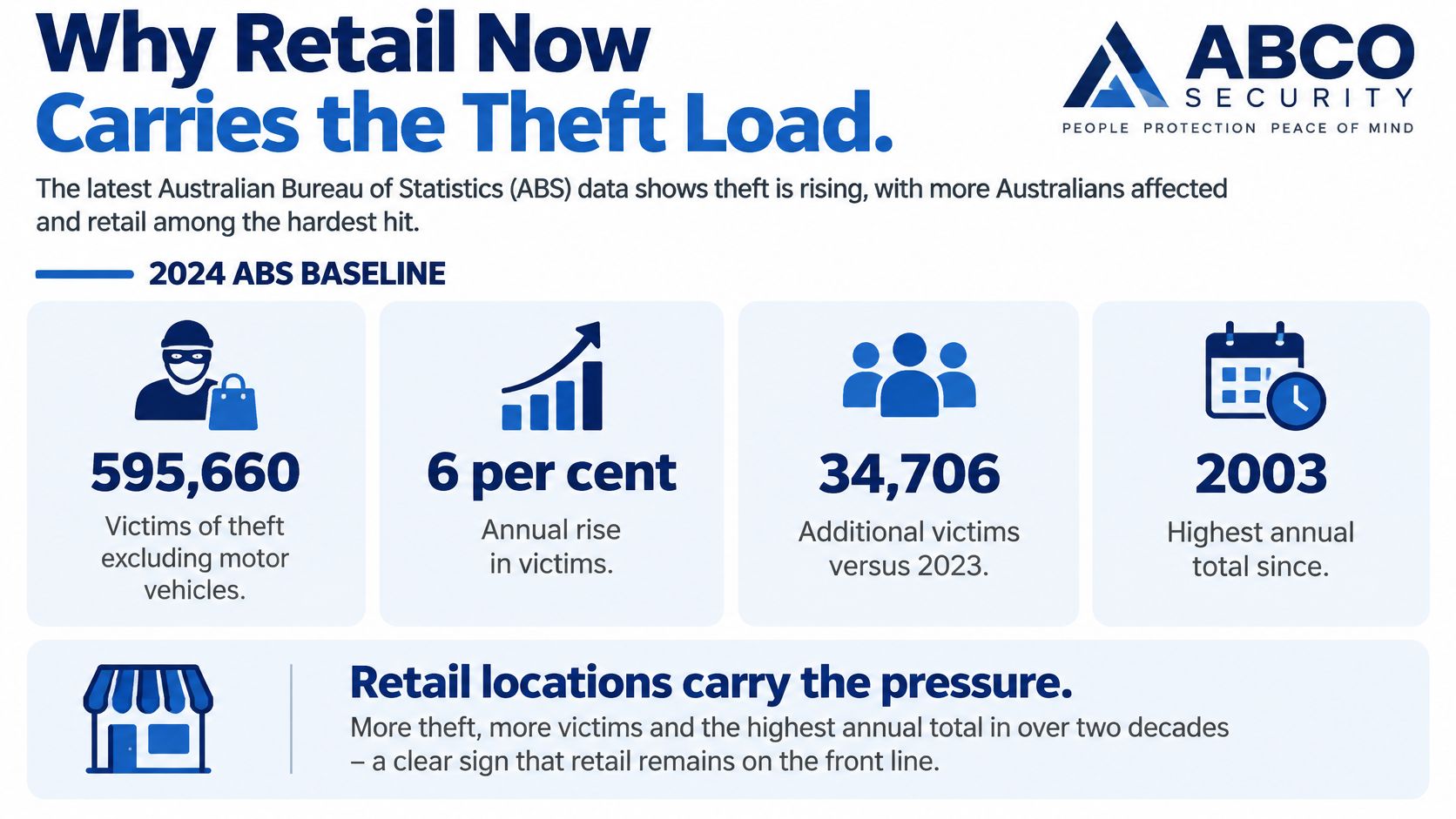
The Australian Bureau of Statistics media release on theft reaching a 21-year high recorded 595,660 victims of theft excluding motor-vehicle theft in 2024, a 6% increase, or 34,706 additional victims, compared with 2023, and the highest annual total since 2003. Retail locations accounted for 45.1% of theft victims in 2024, compared with 32% in 2010, after rising from 38.3% in 2021 to 41.6% in 2022 and 44.7% in 2023.
Those figures count police-recorded victims, not every incident. Treat them as a floor for reported risk, not your store's full loss. Even as a floor, they show theft concentrating where stock, customers, cash handling and public access meet.
Four Jobs in Order
A useful Retail Security system does four jobs in order. It deters opportunistic behaviour, detects an event, verifies whether the event is real, and escalates to someone authorised to act. If any step is missing, name the gap before you buy anything else.
Think of a centre as a small town. The public mall is the street, where visibility and staff presence shape behaviour. The stockroom is a locked house, where named access matters. The cash office is the bank, where restricted entry, duress alarms and audit trails matter most. One camera specification can't cover all three well.
- CCTV: records who, where and when.
- Monitored alarms: detect intrusion or duress and start escalation.
- Access control: restricts doors and logs named entry.
- Analytics and remote monitoring: flag exceptions for a person to verify.
- People: deter, support staff, attend and preserve evidence.
That separation helps operators in Melbourne, Sydney, Brisbane and Perth, and in surrounding cities within about 200 kilometres, avoid buying a technology ladder. Start with the locations carrying theft, intimidation or after-hours exposure, then match a control to each one. Repeat offending also needs evidence and coordination, which is why a joined view of organised retail crime in Australia belongs in the same plan as cameras and alarms.
Match spend to where theft, intimidation and after-hours exposure actually sit, not to where a catalogue says the next upgrade should go.
Which System Closes Which Retail Risk
Find your worst current failure first. Then read across the table. Buying the row that sounds newest usually leaves the original loss untouched.
Retail Security Systems and the Risk Each One Closes
| System | Best used for | Does not do | Pair with |
|---|---|---|---|
| CCTV | Entries, tills, high-shrink aisles, incident evidence | Stop a theft on its own | Human review and a written escalation |
| Monitored alarms | Closed hours, docks, plant rooms, duress | Replace a person during trade | Verification before dispatch |
| Access control | Stockrooms, cash offices, IT and plant | Watch the shop floor | Audit of users and after-hours alarms |
| Video analytics | Loitering, after-hours motion, queue or crowd build-up | Justify a stop without a person checking | Operator verification |
| Electronic article surveillance | Tagged goods at the door | Untagged, internal or high-care loss | Staff response procedure |
| Remote monitoring | Multi-site after-hours watch and escalation | On-site confrontation | Mobile patrol or rapid response |
CCTV works best when it's designed for identification at a choke point. A wide shot down an aisle may show movement, but an entry view at eye height is more likely to show a face. Put the high-grade view at the door, till and known high-shrink fixture, then use overview cameras only for movement and layout context.
Alarms answer a different question. A door sensor or duress button tells you something needs checking now, especially in a closed store, dock or plant room. It doesn't tell a monitoring operator whether a cleaner forgot a code or an intruder forced entry, so verification by camera, call-back or sequential signals should happen before dispatch. For weak rear doors, the physical detail matters too, and advice to reinforce door strikes with 3-inch screws is a useful reminder that a sensor on a flimsy frame only reports a failure faster.
Access control closes the quiet loss many managers miss. A stockroom, cash office, IT cupboard or rooftop plant door should open for named users only and log each entry. Shared codes destroy that value, so remove leavers quickly and review unusual after-hours entries. A practical starting point is the door list and user roles in a guide to access control systems for business, adapted to your tenancy and centre rules.
Video analytics is a filter, not a decision maker. It can alert an operator to loitering in a fire exit, movement in a closed tenancy or a crowd forming at entry gates. A person still confirms the clip before staff approach anyone. Electronic article surveillance is narrower again. It deters tagged stock leaving through pedestals at the door, but it won't solve untagged grocery loss, refund fraud or staff-enabled theft.
Applying the Table by Format
A Melbourne specialty tenancy losing small, high-value items at the door needs article surveillance, two identifying cameras and a shared centre officer during peak hours. A full analytics suite adds alerts without changing the door procedure, so the door controls come first.
A Sydney Shopping Centre Security problem centred on the dock and car park after close points elsewhere. Use dock access control, monitored alarms on tenancy rear doors, lighting checks and Mobile Patrols for perimeter attendance. More domes over quiet aisles won't inspect a roller door or move on a vehicle testing entries.
Brisbane and Perth supermarkets and convenience stores with thin late-night staffing need staff safety before stock recovery. Put a visible officer in known hot hours, put duress buttons where staff stand, and make the rule plain that no one chases. Camera views should produce short, timed clips that can be handed to police without hours of searching.
Geography changes the licensing check, not the logic. Geelong and Ballarat follow Victorian settings, Wollongong and the Central Coast follow New South Wales, the Gold Coast and Sunshine Coast follow Queensland, and Mandurah follows Western Australia. Never assume one national licence covers a guard or firm in every state.
Before ordering: Write the hot spot, the hours it happens, who verifies it and the response time you'll accept. Equipment choices get clearer after those four lines exist.
A centre promotion may need short-term Event Security for queue control and entry counts while the permanent camera design stays unchanged. That's proportionate. Temporary people for a temporary crowd is often better than permanent technology bought for three busy days a year.
Licences and Privacy Tests Before You Buy
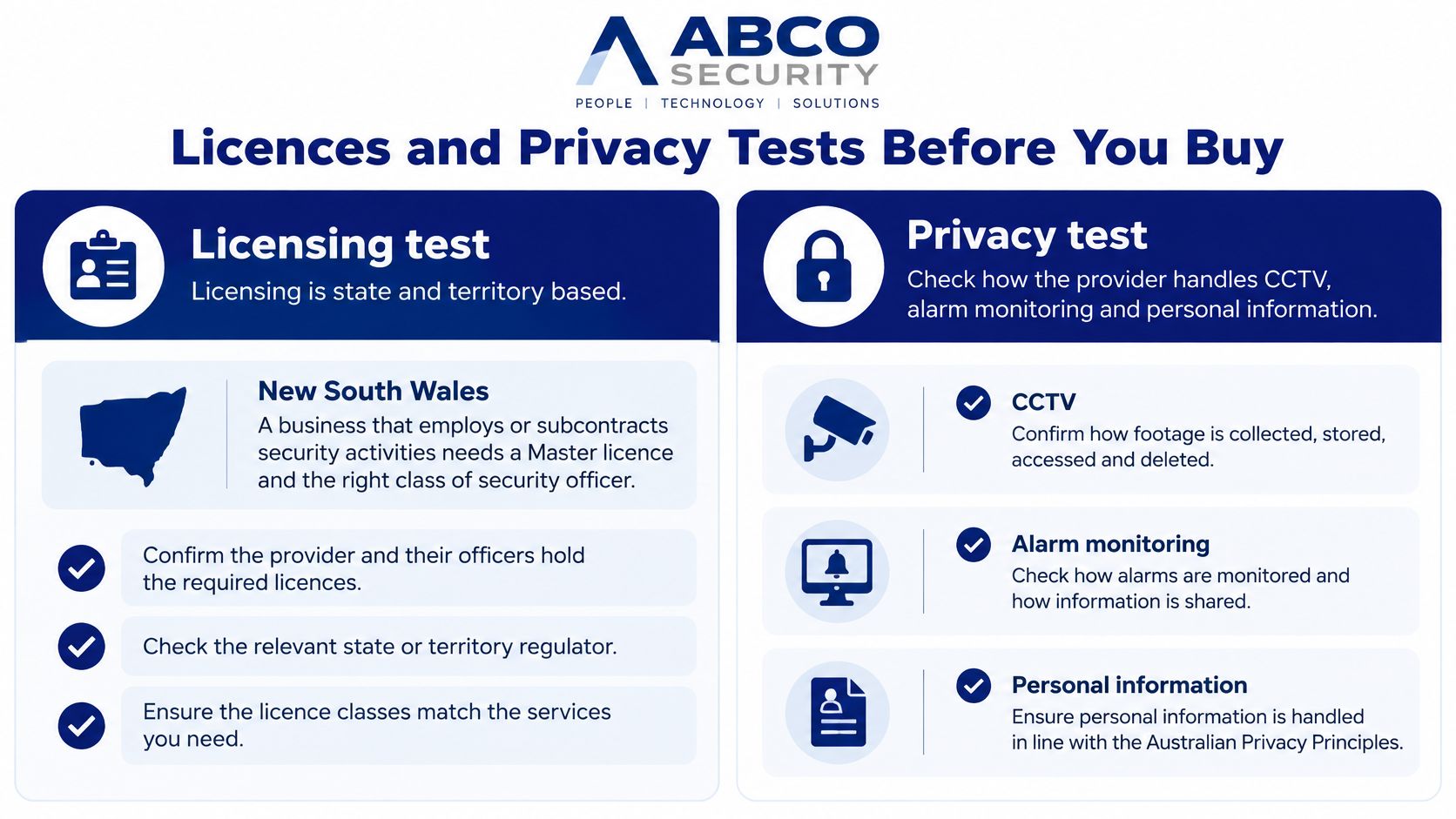
Before comparing prices, check two things: whether the people doing the work hold the required licences, and whether the system will collect information lawfully. A licence is specific to its jurisdiction and the work being performed.
Licence Checks Before Retail Security Staff Are Rostered
| Jurisdiction | Business authority | Officer requirement | Duty limit |
|---|---|---|---|
| New South Wales | Master licence | Class 1 or Class 2 individual licence | Confirm the master licence covers the number of officers you plan to roster on each shift |
| Victoria | Private Security Business Licence | Licensed or registered worker | Confirm both the business and each officer meet the requirements |
| Western Australia | State security licence | Certificate II in Security Operations for a security officer | Armed or close-protection work needs further certificates |
| Other states and territories | That jurisdiction's security business authority | Matching individual licence class | Confirm the relevant business and individual licences before rostering |
In New South Wales, a business that employs or subcontracts security activities needs a Master licence, and each worker needs the relevant individual class. In Victoria, guarding businesses need a Private Security Business Licence, and workers must be licensed or registered. In Western Australia, a security officer applicant completes Certificate II in Security Operations. Crowd control, armed duties and close protection require further training and authority.
Apply the same checks to Shopping Centre Security, Concierge Security, Gatehouse Security and Mobile Patrols. Keep licence records before the first shift and check expiry dates when staff change. A Security Company in Melbourne should not be assumed to meet requirements in Sydney, or vice versa.
The short video below can help prompt a discussion about what officers may do on site before you sign a scope.
The Privacy Test Is Stricter for Faces
The OAIC checklist for considering facial recognition in retail settings classifies facial images and biometric templates used for automated identification or verification as sensitive information under the Privacy Act. It says retailers generally need valid consent unless a narrow exception applies. The checklist also explains that these systems collect sensitive information about everyone captured, including people who are not matched, and recommends documenting a risk assessment before deployment.
Facial recognition therefore changes the privacy test. It collects biometric information from customers who may never be on a watchlist, while ordinary CCTV records images without using biometric templates to identify people. Before deployment, assess whether the system is necessary and proportionate, document its purpose and retention period, and clearly tell customers that facial recognition is operating.
Testing should cover accuracy under the store's lighting, camera angles and likely obstructions, as well as demographic diversity. Limit watchlist access, encrypt templates, record searches and delete information when the purpose ends. A false match can lead to an unjustified stop or exclusion, creating both discrimination and staff-safety risks.
Assess less intrusive options first, including standard CCTV, security personnel and staff training. The OAIC's Bunnings determination treated facial recognition as high risk to privacy and found convenience alone did not justify its use.
For most Retail Security Systems in Australia, start with cameras, trained people and clear procedures, then judge whether those controls address the actual risk. Spend should reflect incident frequency and staff safety, not a technology ladder that assumes facial recognition is the next step after CCTV. Ordinary camera placement, signage and retention also need care under CCTV laws in Australia, even when no biometric template is created.
How Guards Patrols and Cameras Share One Chain
More surveillance isn't the same as less harm. The C-Store report on NSW retail theft rising 10.4 per cent states NSW recorded 32,835 steal-from-retail-store incidents in the 12 months to June 2026, approximately 90 incidents per day, and the offence category increased 10.4% over the two years to June 2026.
That frequency doesn't automatically justify more cameras everywhere. It justifies ranking sites and trading periods by incident frequency, violence risk, store layout, staffing levels and response time. A quiet store with poor after-hours evidence needs a different first spend from a busy store where staff are already being threatened.
The chain below keeps people and technology in one sequence, so an alert doesn't end as unused footage.
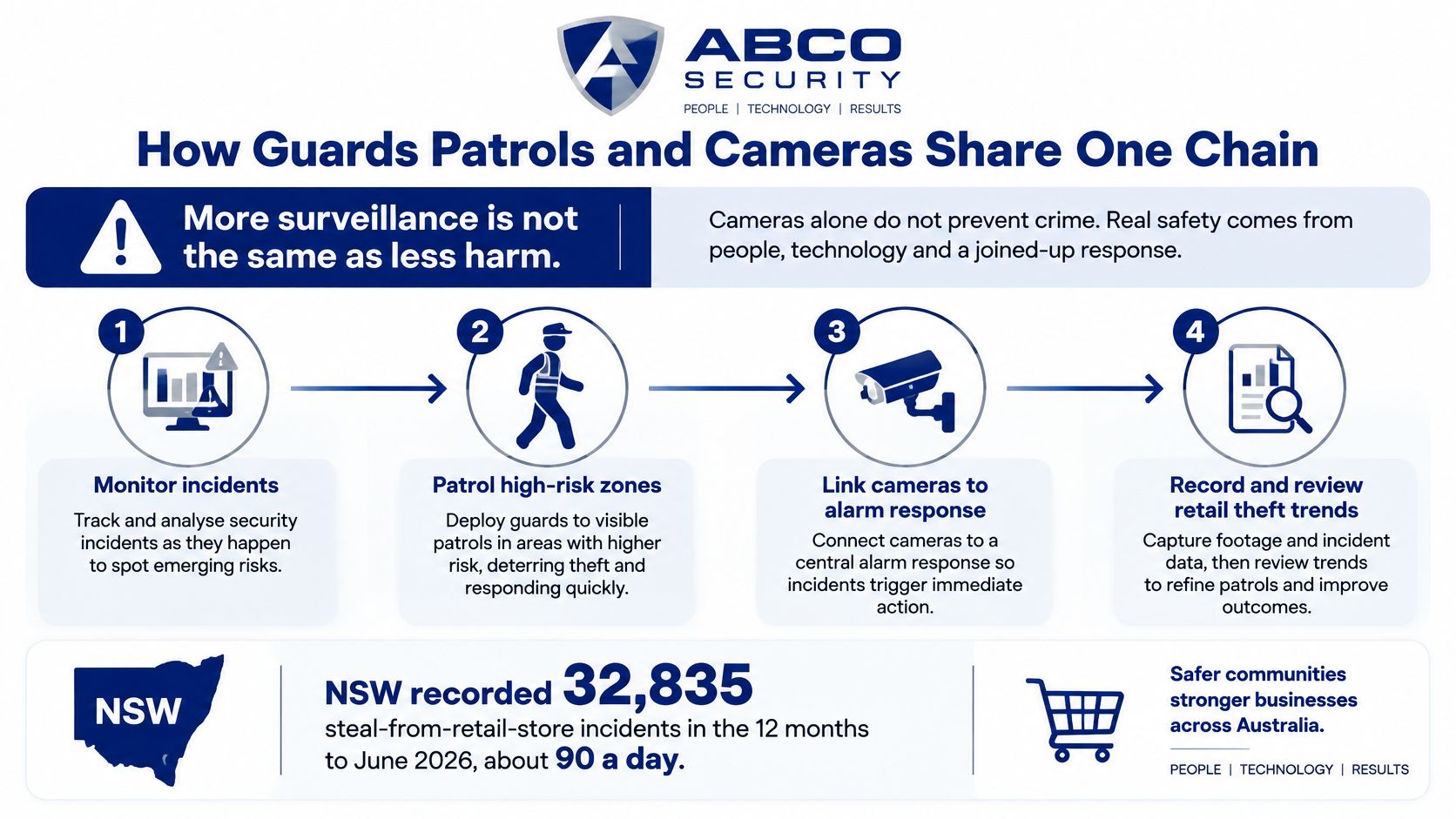
One Chain From Door to Attendance
- Visible presence during trade: Static Security Guarding at entries and high-risk departments deters opportunistic theft and gives staff a trained person to call before a dispute escalates.
- Evidence at choke points: Cameras capture a face, clothing and time at entries and tills, while staff write down the direction of travel and any vehicle detail.
- No-chase rule: Staff don't pursue into car parks or streets. They observe from safety, activate duress if threatened and preserve the clip and till record.
- Verification: The control room or manager checks the alarm or analytic alert, separates false alarms from live events and decides who attends.
- Patrol attendance: Mobile Patrols check car parks, loading docks and perimeters outside trading hours, inspect doors and report damage a fixed camera might only glimpse.
- Rapid response: A verified intrusion or duress event escalates to patrol attendance or police with the address, entry point, description and video reference ready.
Each role has a boundary. A static officer deters, supports staff and holds evidence for police, but can't be in the car park and at the entry at once. A patrol officer can physically walk the dock, test a gate and see fresh damage, but isn't a constant deterrent inside a store. A control room operator decides and documents, and shouldn't flood a site with attendance for every unverified motion alert.
Say a bottle shop reports abusive groups late on Fridays but has clear entry footage and no after-hours break-ins. Put Security Guarding in those hot hours first and train staff on refusal, withdrawal and duress. Camera upgrades won't lower the temperature of a confrontation that's already happening in front of the counter.
Say instead that a hardware store finds rear fences cut on Monday mornings and can't tell when it happened. Put cameras, dock lighting, alarm zoning and patrol checks first. The gap is detection and attendance outside trade, not a visible officer during Saturday trade.
A centre promotion uses the same chain under crowd pressure. Event Security manages queues and entry flow, cameras cover pinch points and the control point decides when a manager or police are needed. The faces change, but verify before escalate still applies.
Measure the chain by outcomes a manager can review. Track time to verify, repeat incidents at the same fixture, false alarm causes, duress events and whether police received a usable package with times, descriptions and exported clips. Hours of stored video prove storage capacity, not safety.
What Changes the Price and the Return
The Griffith University report on the 2024 ANZ Retail Crime Study estimated Australian retailers lost A$7.79 billion to retail crime in the 2024 financial year, equivalent to almost 2% of turnover. That's a study estimate of economic impact, not a police victim count and not your store's shrinkage rate. Use it for scale, then price from your own incident pattern.
There's no honest universal quote for a centre, a supermarket and a two-person specialty store. The quote moves with how many views need identification, how alarms are monitored, how many doors are controlled and how many people-hours you're buying in hot periods.
Cost Drivers for Australian Retail Security Systems
| Cost driver | What pushes it up | How to keep it proportionate |
|---|---|---|
| Cameras and coverage | Identification-grade views on every aisle | Entries, tills and known hot spots only |
| Monitoring grade | 24/7 A1 verification versus self-monitor | After-hours or multi-site sites that cannot self-respond |
| Analytics licences | Per-camera alerts and watchlists | Human-verified alerts, not facial recognition by default |
| Access-control doors | Cash office, dock, plant and tenancy doors | Doors that protect stock, cash or critical plant |
| People on site | Static hours across all trading | Peak hours and sites with confrontation risk |
| Mobile response | High patrol frequency on low-risk nights | Frequency set by verified alarms and dock exposure |
| Compliance work | Biometric privacy assessment and retention | Ordinary CCTV unless biometrics are necessary |
Camera grade is often oversold through count. Ten overview cameras can cost more to install and store than four well-placed identification views, while giving police less usable evidence. Spend first where a person must pass, pay or handle high-shrink stock, then add overview only if blind movement between those points causes real investigative gaps.
Monitoring is a labour decision disguised as a technology line. Self-monitoring sends alerts to an owner or manager who may be asleep, driving or serving customers. A1-grade monitoring gives a staffed centre and immediate escalation, which suits multi-site operators and high-risk after-hours sites. Analytics licences then add per-camera cost, so apply them to doors, docks and closed areas rather than every view.
Access control grows door by door. Each reader, lock, door contact and cabling run adds cost, especially in older centres with poor cable paths or shared tenancy walls. Protect the cash office, dock, stockroom and critical plant first. A low-value storeroom may need only a monitored door contact and a sound lock.
People are usually the largest recurring cost, so rostering must follow risk. Static hours across every trading hour waste money in quiet periods, while peak-hour coverage can protect staff when intimidation occurs. Mobile patrol frequency should reflect verified alarms, perimeter exposure and nearby after-hours activity, not a standard package copied from another suburb.
A small specialty store might justify door contacts, a few identification cameras, monitored closing alarms and after-hours response. A supermarket or shopping centre will usually spend more on peak-trade officers, evidence quality, dock access and coordinated patrols. Comparing those quotes line by line without the risk pattern misleads everyone, so use a site-specific CCTV installation cost breakdown only after camera tasks and monitoring are defined.
Return also needs plain language. Look for fewer repeat incidents at the targeted fixture, shorter verification times, fewer false dispatches, less staff exposure to confrontation and footage police can use. Baseline shrinkage notes, incident counts and duress calls for 90 days before comparing vendors, then review the same measures after deployment. Where violence is the problem, the return is safer staff and uninterrupted trading, not a guaranteed recovery of stock.
How to Choose a Provider and Keep It Working
Compare two providers against the same eight checks. A polished equipment demonstration cannot show who responds to an alarm at 2 a.m. or how staff handle an escalation.
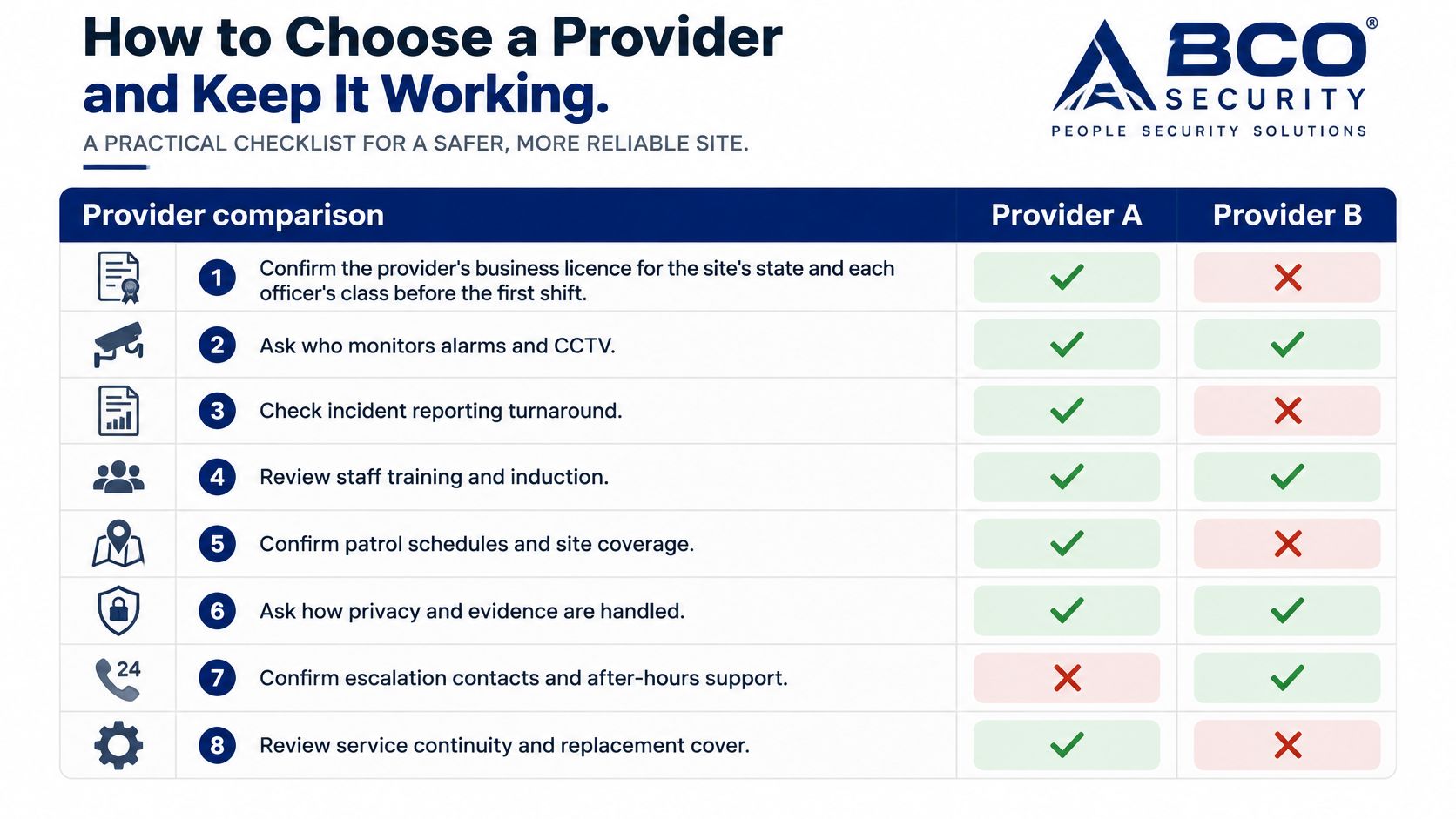
- Licence evidence: Confirm the business licence required in the site's state and each officer's licence class before the first shift.
- Monitoring path: Ask who monitors alarms and CCTV, how events are verified, and how a confirmed incident reaches a patrol or police.
- One escalation path: Static guards, mobile patrols and the control room should share contact details, codes and an incident-reporting format.
- Evidence specification: Agree on identifying camera views at entries and tills, footage retention, and who can export recordings.
- Biometrics gate: Treat facial recognition as a separate privacy decision, not an upgrade to CCTV. Test ordinary cameras, trained staff and tighter procedures first. Consider facial recognition only if a privacy impact assessment shows it is necessary and proportionate.
- Duty fit: Match retail security to the shop floor, gatehouse security to a logistics entry, concierge security to a corporate foyer, and construction security to a build beside an operating store.
- Maintenance terms: Specify camera cleaning, alerts for failed devices, removal of former staff from access systems, and regular false-alarm reviews in the contract.
- Quality proof: Ask for ISO 9001 or an equivalent quality system, plus references from a similar retail site or centre.
Incident records should be accurate and protected. If the records are unreliable, managers may roster staff against the wrong pattern. Website teams also need accurate traffic reports, including keeping fake visitors out of analytics, but that is separate from choosing a retail security provider.
Deploy and Maintain the System
Deployment isn't finished when devices appear on a screen. It's finished when each control has been tested under the conditions where it'll be relied on, and the results are signed and filed.
Four Go-Live Checks
- Set and test views: Position cameras at identification height on entries, tills and hot spots. Review faces in opening light, midday glare and closing light, then adjust exposure and angle before sign-off.
- Test the alarm path: Trigger each intruder zone and duress input. Confirm the signal reaches the monitoring centre with the right zone name, then confirm who calls the site, patrol or police.
- Enrol access users: Add named users, test their permitted doors and times, confirm denied entries appear in the log and check that after-hours alarms route correctly.
- Run an escalation drill: Guards, Mobile Patrols, managers and the control room work through one theft, one duress event and one after-hours alarm. Time the verification step and fix unclear contacts immediately.
Keep the sign-off with licence evidence, camera maps, privacy notices, retention settings and monitoring instructions. If a manager changes, that file prevents the system becoming a set of passwords and assumptions. It also helps a new tenant understand which doors and cameras are centre assets and which are tenancy assets.
A dirty lens, bumped bracket or shelf moved in front of a camera can defeat the design without any fault alarm. Maintenance therefore follows the operating chain, not just the device list. Book recurring checks through a defined CCTV camera maintenance service or internal owner, and log the person, date and result for every test.
Minimum Maintenance Cadence for Retail Security Systems
| Task | Frequency | Owner |
|---|---|---|
| Camera cleaning and field-of-view check | Monthly | Provider technician |
| Alarm and duress test with verified response | Monthly | Monitoring provider |
| Access-control user audit and leaver removal | Monthly | Property manager |
| False-alarm and response-time review | Quarterly | Operator and provider |
| Footage retention and export audit | Quarterly | Privacy or compliance lead |
| Escalation drill with guards and control room | Twice yearly | Security manager |
| Full system and licence review | Annual | Property manager |
Treat repeated false alarms as a design fault, not background noise. Find whether a sensor faces moving signage, a door doesn't latch in wind or cleaners lack correct access. Fixing the cause protects response credibility when a real event occurs.
Review footage access with the same discipline. Export only the incident window, record who requested it and store police copies separately from general staff drives. Wider sharing increases privacy risk and makes later evidence harder to account for.
Arrange a Retail Security Review
Start this week with the zone carrying the loss or safety problem. Name the fixture, door, dock or trading period in one sentence, then pick the system row that closes that failure.
Add a person only where verification, confrontation support or after-hours attendance requires one. Stop the conversation if facial recognition is proposed before the privacy test is passed, and ask what ordinary CCTV, staff training or guarding would achieve instead.
Then ask one provider to price monitoring, patrols and maintenance as a single operating service, so the quote matches the chain you'll run. ABCO Security Services Australia can scope Retail Security for stores and centres from Melbourne, Sydney, Adelaide, Perth and Brisbane, including Security Guarding, Mobile Patrols and monitored alarms.
Bring last quarter's incident notes, a floor plan and your current monitoring arrangement. A useful review names the licence, the response path and what won't be installed, then leaves you with a smaller, testable plan rather than a larger equipment list.
ABCO Security Services Australia provides licensed Security Guarding, Mobile Patrols, Shopping Centre Security, CCTV and monitored alarm support for retail stores and centres, with scopes matched to the site, state licence and escalation path. Visit ABCO Security Services Australia to arrange a retail security review using your incident notes and floor plan.
about
avada factory
Sempery ultricies nibh at dolor cras urna eleifend nec. Atiam efficitur tempor.