You've locked the site, the fixed cameras cover the office and main gate, and then the risk moves. A new laydown area opens at the back fence, materials arrive after hours, and that's where the theft starts.
A mobile surveillance camera solves that gap only if it's judged correctly. For a Security Company Melbourne operators trust, the test isn't resolution on a spec sheet. It's verified detection to response under degraded conditions, plus lawful handling every time the unit moves.
What a Mobile Surveillance Camera Is and the Four Main Types
Say a fenced construction site in Melbourne loses tools from a new laydown area the fixed network never reached. Cabling another camera across active works is slow and expensive, and the area will shift again next month.
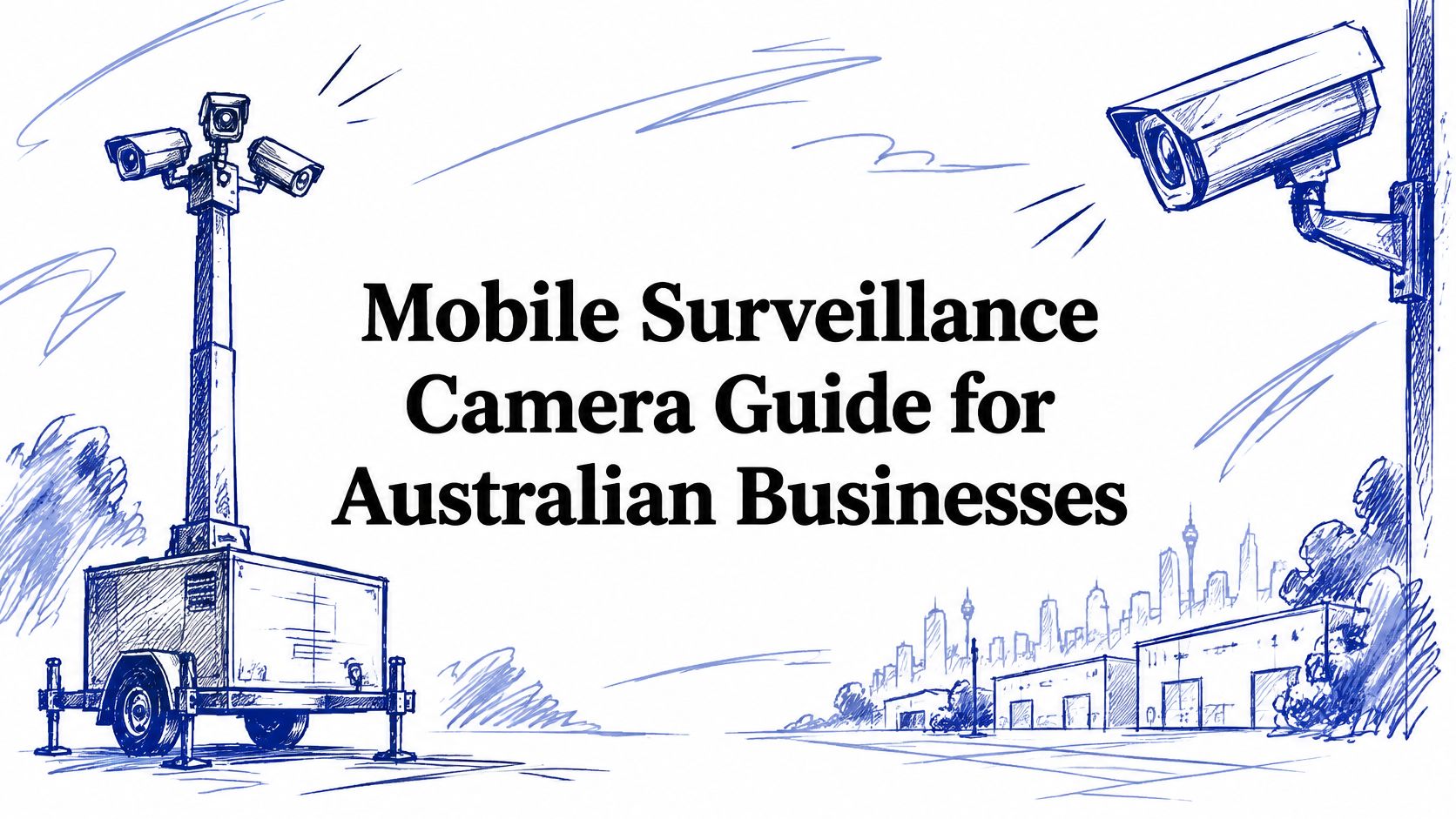
A mobile surveillance camera is a CCTV unit built to move, so coverage follows the risk rather than the cabling. Every practical system has five parts, a camera head, power source, transmission link, recorder and monitoring point. Remove one and you've got hardware, not protection.
Australia's own enforcement history follows the same logic. The Transport for NSW 2011 Mobile Speed Camera Review records that Victoria conducted Australia's first mobile speed camera trial in 1985, and by the 2011 national comparison programs delivered approximately 9,300 enforcement hours per month. The point transfers to commercial sites. Relocatable units target changing locations instead of relying only on permanent infrastructure.
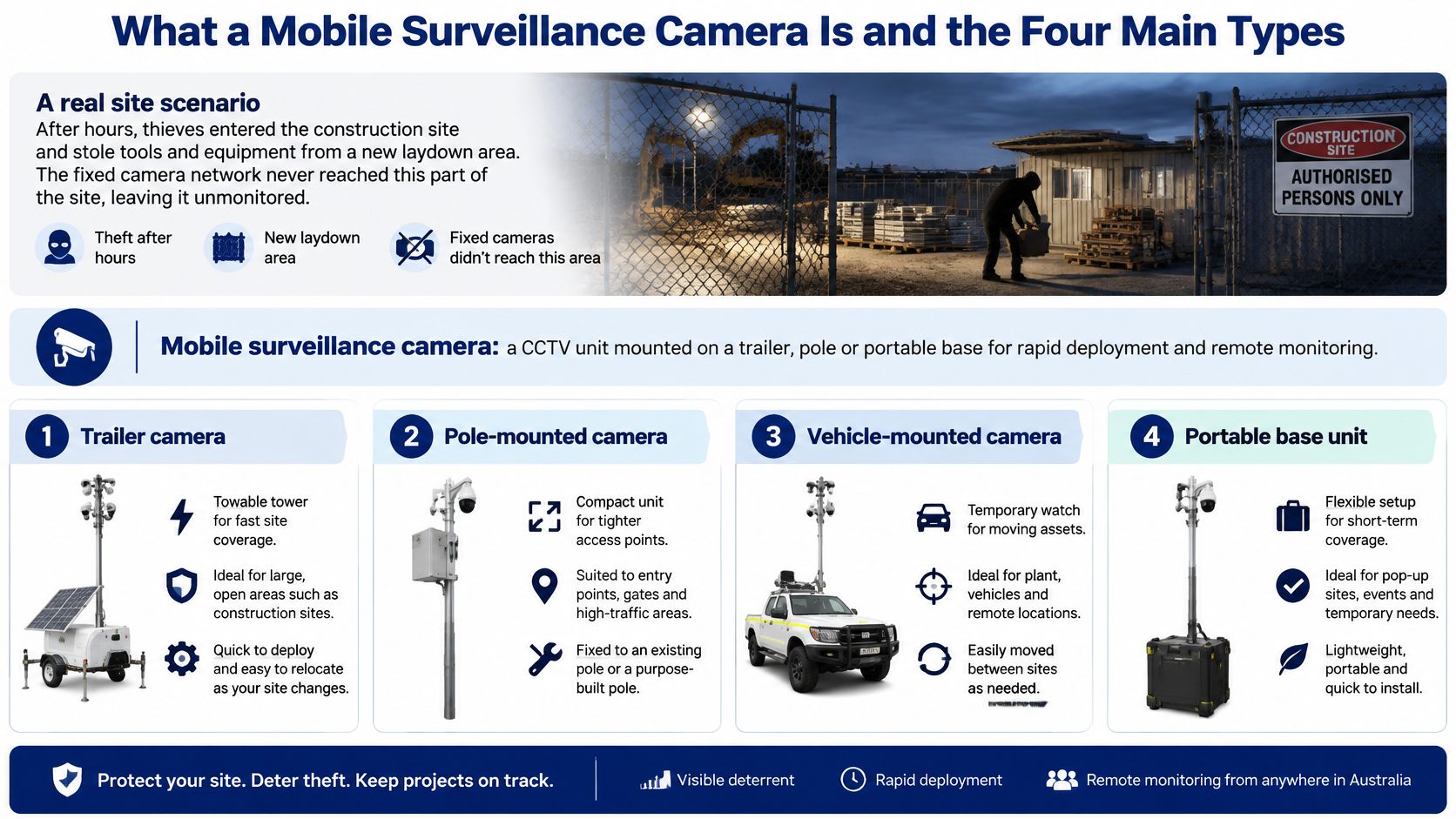
Mobile Surveillance Camera Types Compared
| Type | Typical power | Setup time | Best for | Main limitation |
|---|---|---|---|---|
| Vehicle-mounted | Vehicle battery or alternator | Minutes | Patrol routes and roadside perimeters | Limited height and tied to one vehicle |
| Trailer-mounted | Generator, solar or battery pack | Under an hour on a prepared pad | Construction sites and events | Needs secure parking and a towing vehicle |
| Pole-mounted | Mains, solar or battery | Hours, depending on mounting work | Car parks, laydown yards and long perimeters | Needs a fixed mounting point, so less mobile |
| Drone-based | Onboard battery | Minutes to launch | Large sites and rapid aerial checks | Limited flight time, weather and aviation rules apply |
I would match type to site with three questions. How far must it move, how long must it run unattended, and what power and signal exist at the exact spot? If you can't answer all three on site, don't accept a quote yet.
A trailer tower that cannot be parked securely or powered through winter is not mobile coverage. It's a relocation problem you've bought early.
How Power, Connectivity, Sensors and Analytics Work Together
These four groups decide whether the camera still works at 2am on a Sydney or Perth site with no mains supply. Assess each by what fails when it breaks, not by the brochure feature list.
Power and Connectivity Checks
- Battery autonomy: Get autonomy in hours under full night load, including infrared, heaters and transmission, and size solar for the shortest winter days in that region.
- Generator discipline: If a generator backs the unit, write down fuel checks, service intervals and who attends a low fuel alarm.
- Tamper protection: Specify locked, tamper alarmed battery housings, because exposed batteries become the target.
- Cellular reality: Test carrier coverage and signal strength where the mast will stand, not at the site office, and allow for external high gain antennas and data plan limits.
The ACT Auditor-General report on CCTV management records imagery from mobile public safety cameras transmitted over 4G through a secure Spectre system to remote, protected servers. That model avoids trenching cable, but it makes bandwidth and coverage design constraints. Use encrypted VPN or equivalent secure transport, and align the setup with documented communication protocols so operators know how alerts and footage move.
Edge Recording and Sensors
A local edge recorder keeps full resolution footage when the cellular link drops. Your specification should state codec, frame rate, resolution, storage capacity, overwrite behaviour, time synchronisation and export integrity. Without those details, "wireless capable" tells you nothing about evidentiary value.
Sensors then decide what deserves attention. Passive infrared detects movement, infrared night vision supports identification after dark, and thermal imaging separates a person from vegetation or wind blown debris. Say a rural pole unit triggers nightly on wallabies crossing a fence line. Thermal detection tuned to human shape and a restricted zone cuts those false alarms while still catching a person at the gate.
Analytics add rules such as line crossing, loitering and vehicle detection. More rules don't mean better security, they often mean more false positives for an operator to clear. Power loss stops analytics entirely, and link loss stops alerts unless edge recording holds the evidence until the connection returns.
Owned Units or Managed Service Compared
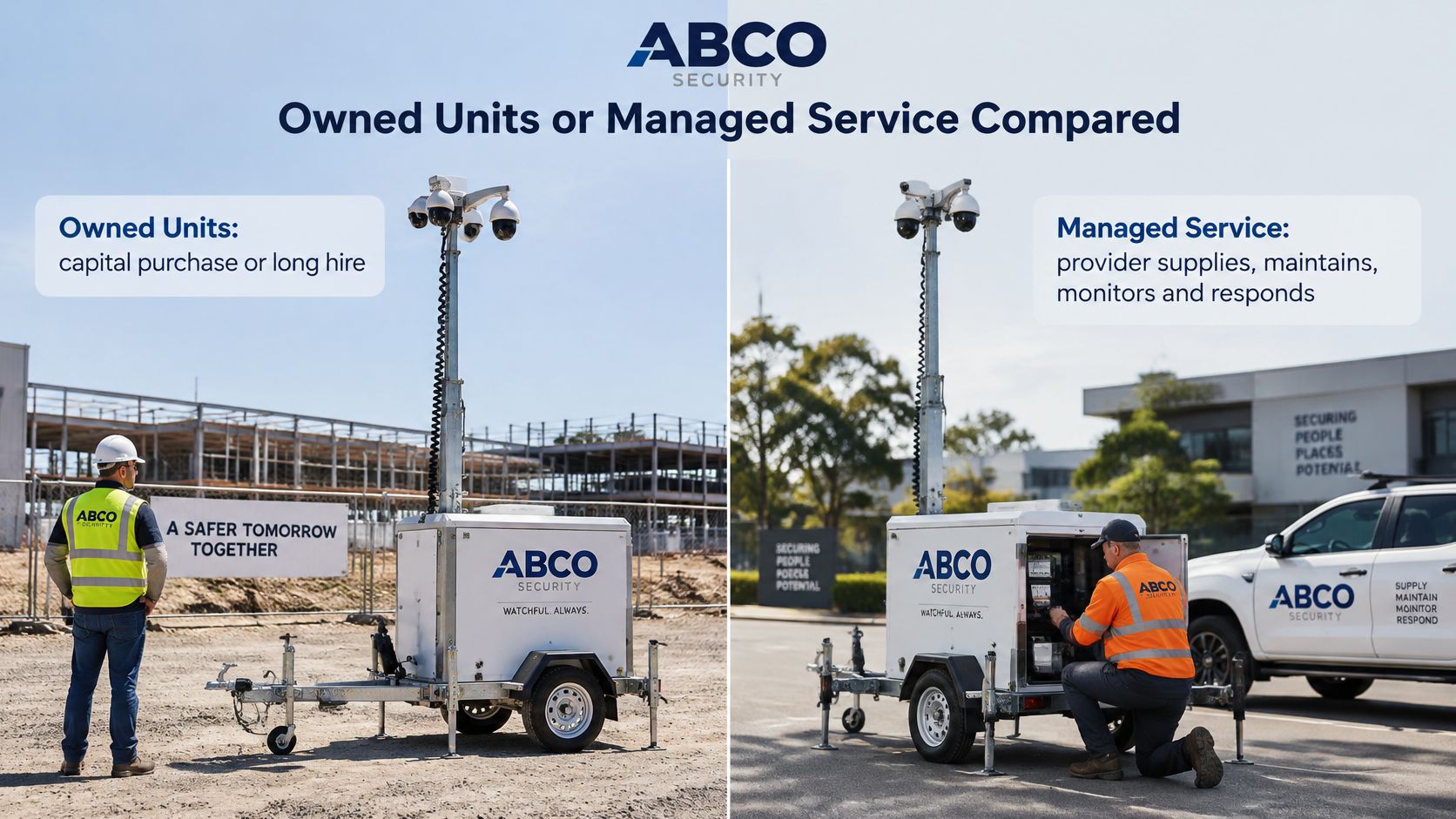
On a multi-site project, a camera can be recording while nobody is responsible for checking its status or acting on an alert. Before choosing a purchase or service contract, decide who owns each task when the unit goes offline, triggers a false alarm overnight or needs to be relocated.
Owned units are purchased or hired for the long term and managed by your staff. A managed service supplies and maintains the equipment, with monitoring and response defined by contract. The cameras may look identical; responsibility for keeping the full detection-to-response chain working is what differs.
Owned Versus Managed Service by Factor
| Factor | Owned units | Managed service |
|---|---|---|
| Upfront cost | High capital outlay or long hire | Monthly fee with little capital outlay |
| Control over footage | Internal control, subject to contract and privacy obligations | Access and custody set by contract |
| Maintenance and health checks | Internal responsibility | Provider responsibility under the agreement |
| Monitoring and response | Separate arrangements may be needed | May include monitoring and mobile patrols, as specified in the contract |
| Licensing | The organisation must ensure any staff performing regulated security work hold the required licences | Confirm the provider's business authority and the licences of staff performing regulated work |
| Best fit | Long-term deployments with staff to manage equipment and alerts | Temporary or multi-site deployments needing contracted monitoring or response |
A Sydney civil contractor operating three sites over 18 months needs to account for more than the camera purchase. With owned units, someone must manage health checks, data plans and repairs, and arrange monitoring or patrols separately if required. A managed service can bring those duties under one agreement, but the response commitment still needs to be tested against the site's requirements.
Licensing still applies when cameras form part of a security operation. ASIAL licensing guidance explains that Australian security licensing is administered at state and territory level, and most jurisdictions require both businesses and individual workers to be licensed. Check the business authority and each worker's licence category for the duties and location, including guarding, gatehouse work, event security or mobile patrols.
Set out response times, uptime and health-check reporting, footage access and export, and maintenance intervals in the contract. A hybrid arrangement can suit organisations that own equipment but outsource monitoring. As one option, ABCO Security Services Australia offers A1 Grade CCTV and alarm monitoring with immediate escalation, remote viewing and construction security, so you can keep owned hardware while outsourcing monitoring.
How Mobile Cameras Connect to Patrols and 24/7 Monitoring
A camera that alerts without a staffed response creates volume, not protection. Queensland privacy guidance, summarised in the Office of the Information Commissioner Queensland privacy technology guidance, warns security measures must reflect how recordings are collected, including wireless transmission and portable storage. I judge the whole chain by verified detection to response performance under degraded conditions.
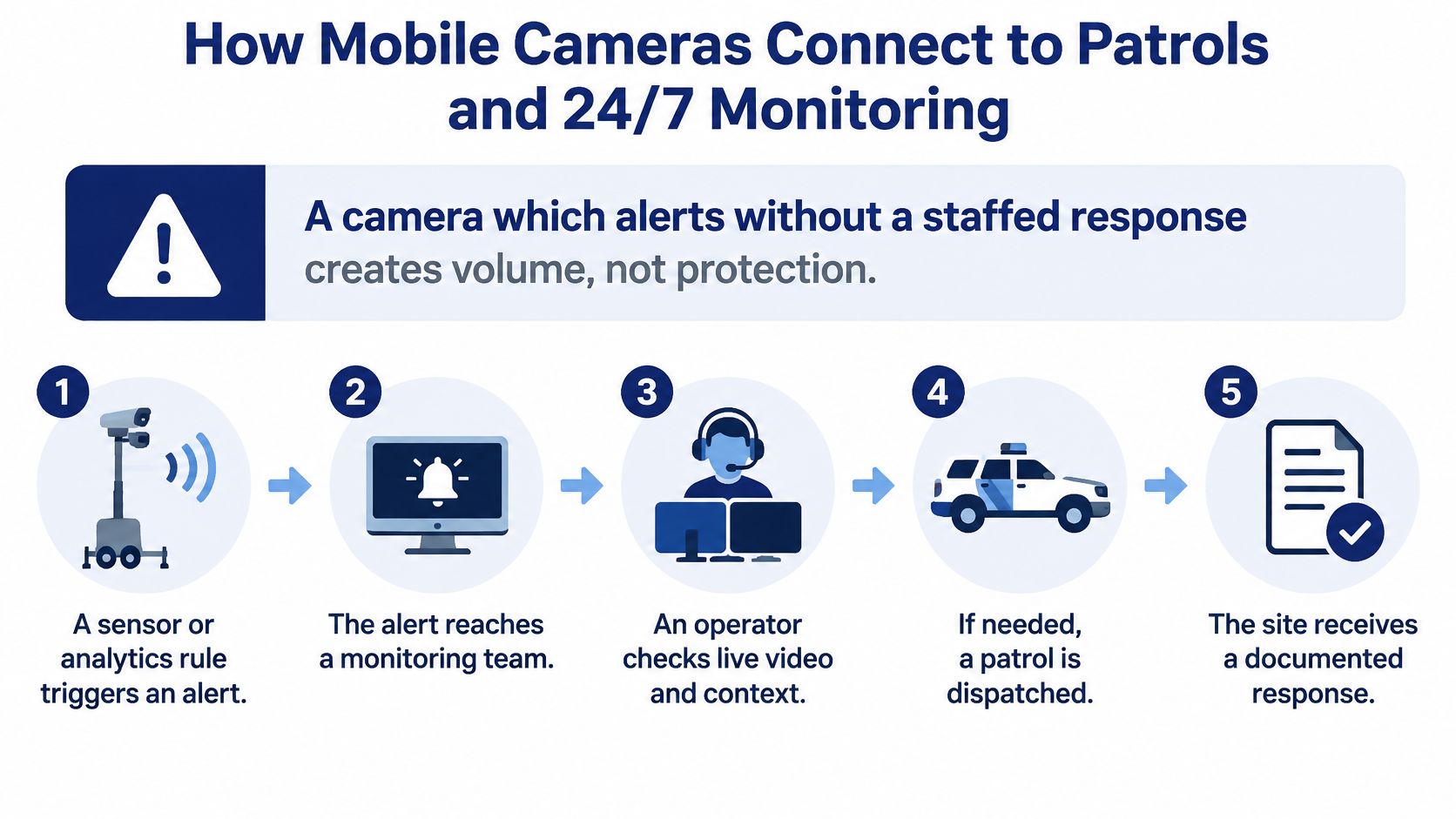
The Alert to Attendance Workflow
- Trigger: A sensor or analytics rule fires, because detection must start with a defined event, not continuous human watching.
- Transmission: The alert reaches a 24/7 monitoring centre, because someone accountable must receive it immediately.
- Verification: An operator checks live video for person or vehicle, time and restricted zone, because context separates intrusion from nuisance.
- False alarm logging: The operator records the cause, such as wind, animals or lighting, because patterns drive tuning.
- Escalation: A verified alert goes to the nearest mobile patrol with site instructions and licence confirmed, because attendance must be lawful and briefed.
- Attendance: The patrol arrives within the contracted response time, because delay changes the outcome.
- Evidence record: Staff log camera location, activation time, reference and export time, and preserve the original, because footage may be needed later.
- Review: Supervisors tune rules and health check intervals after incidents, because repeated faults need correction, not repetition.
remote guarding services either add value or expose gaps. Ambiguous alerts need clearer zones and criteria, offline alarms after a cellular drop need edge recording and health alerts, and paper-only response times need audited attendance records. Each failure point has a fix, but only if it's measured.
Say wind moves vegetation at a Perth industrial site overnight. The operator verifies movement only, logs it, and holds the patrol. When a person enters the restricted compound, the operator escalates at once and the patrol attends with the camera reference and access instructions.
Measure this: Track minutes from verified detection to patrol arrival during weak signal, bad weather and low battery warnings, not just on a clear demonstration day.
Sector Use Cases for Construction, Retail, Events and Strata
After-hours copper theft on a Brisbane construction site tests more than camera coverage. The setup needs to detect activity, keep working through a cellular interruption and support a patrol response. A trailer tower can monitor compounds, fuel stores and laydown areas, but its value depends on the response plan and footage being available when an incident occurs.
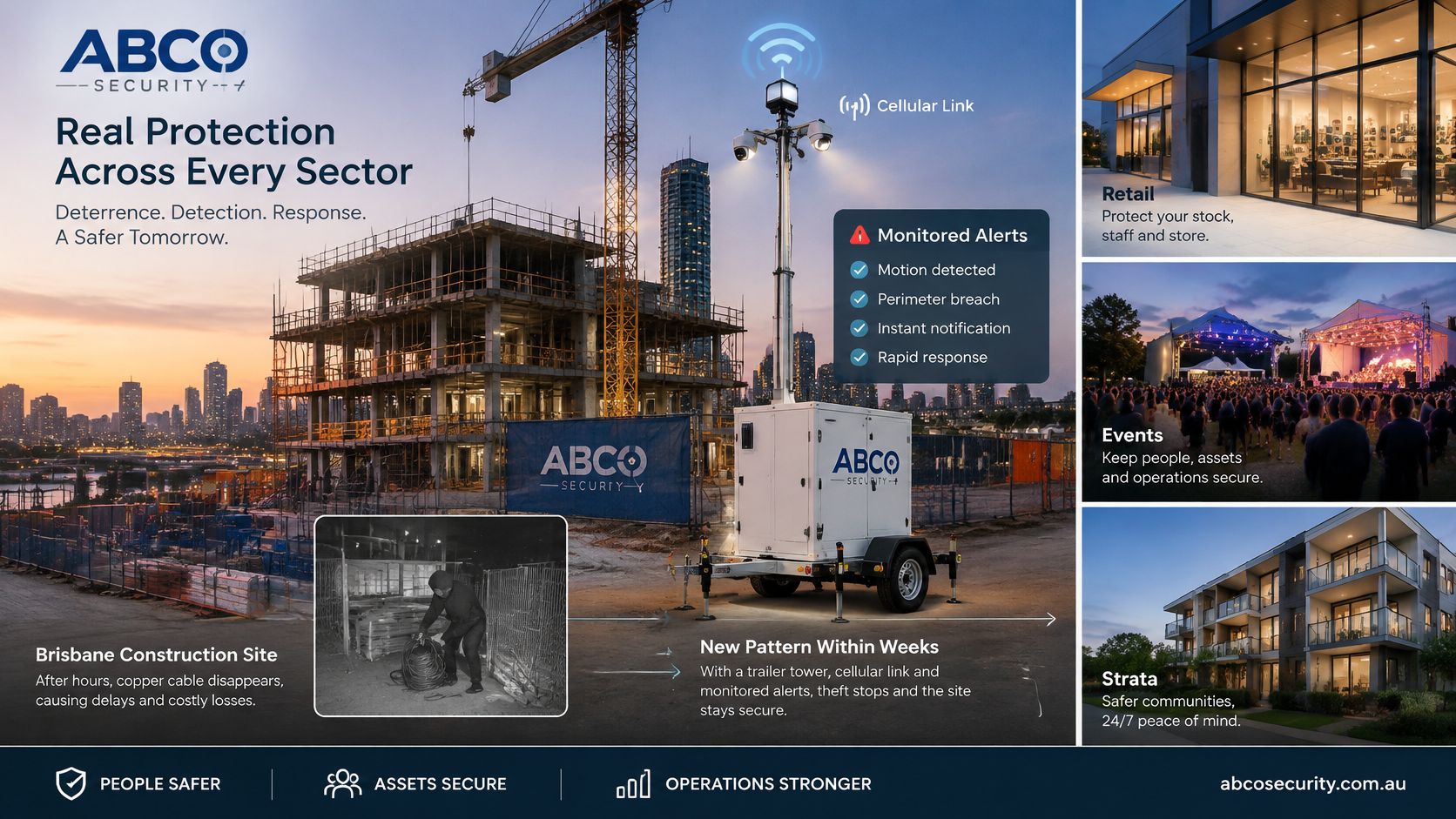
Construction sites change as work stages open and close. Construction site security monitoring should account for each relocation, including revised camera coverage and escalation instructions. Pairing the camera with mobile patrols gives the monitoring team a response option when an alert is verified.
Sector Risks and Service Pairings
| Sector | Main risk | Typical setup | Service pairing |
|---|---|---|---|
| Construction | Material theft and after-hours access | Trailer tower with cellular link and alarm | Construction security with mobile patrols |
| Retail and shopping centres | Loading-dock intrusion and after-hours incidents | Pole or vehicle units with edge recording | Retail security |
| Events | Crowd safety and perimeter breaches | Trailer units on temporary power, with drone overview checks where lawful | Event security and crowd control |
| Strata and gated communities | Car park misuse and unauthorised gate access | Pole-mounted cameras linked to access control | Concierge and reception coverage, with mobile patrols |
For retail sites, loading docks, rear lanes and car parks may need coverage before shopfronts. A submission by the Shopping Centre Council of Australia says retail CCTV is used to deter and detect antisocial and criminal incidents. It also describes footage being used in police investigations, criminal trials and coronial inquests. Keep camera records and footage handling aligned with site procedures, including authorised access and preservation of original files.
The short video below shows a tower deployment in practice and can help frame a supplier discussion.
At events, trailer units can monitor perimeters and back-of-house areas, while drones provide short overview checks where lawful. Event security staff remain responsible for managing crowds, entries and incidents on the ground. In strata, pole cameras can cover gates and car parks, while concierge and reception coverage or mobile patrols provide a human point of contact for access exceptions. At every relocation, reassess camera views and privacy requirements for the new position.
Cost and Return on Investment Drivers
Exact prices vary by configuration and supplier, so compare written quotes rather than published estimates. A useful quote separates the full deployment cost into five buckets, because a cheap trailer can become expensive once response and compliance are added.
Five Cost Buckets to Price
- Equipment: Purchase or hire of the trailer, pole unit, cameras, mast, sensors and deterrent lights or speakers.
- Mobilisation: Delivery, installation, commissioning and every later move between sites or positions.
- Connectivity: SIMs, data plans, antennas, cloud access and any excess data charges from frequent live viewing.
- Monitoring and patrols: Control room fees, verified alarm handling, patrol attendances and after hours escalation.
- Compliance overhead: Signage, privacy assessments, retention storage, access administration and incident exports.
Our separate guide to CCTV installation cost is a useful comparator for fixed work, but mobile units need relocation priced in. Each move can reset aiming, analytics zones, signage and privacy checks. If a quote treats relocation as a minor extra, ask what's excluded.
A Worked Return Calculation
Work the return as avoided losses plus reduced guarding hours plus insurance or contract benefits, minus total deployment cost. Use your own figures over the same period. Don't borrow a supplier's assumed theft reduction.
Say a construction or retail site has repeated after hours theft. List incidents, loss value and patrol hours for six months before installing a monitored trailer, then list the same items for six months after. Break even moves earlier when incidents fall and fixed nightly patrols reduce, and later when frequent relocations, false alarm attendances or extra storage consume the saving.
Hidden costs distort many business cases. False alarms consume patrol time, relocation triggers new privacy work, and footage kept beyond the retention plan increases storage and access risk. A short, well scoped deployment with a clear end date usually shows the clearest return, while open ended hire needs quarterly reviews against incidents, uptime and response records.
If nobody can show incidents and guarding hours before and after, you don't have a return calculation. You've got an opinion attached to an invoice.
Privacy Compliance and Buyer Checklist for Mobile Cameras
Mobility increases compliance risk. Every relocation can change the notice people receive, the purpose of recording, who's captured, the wireless exposure and the state or territory rules that apply. Treat a move as a new deployment, not a minor adjustment.
The OAIC security camera guidance says organisations covered by the Privacy Act must notify people before recording, secure footage, and destroy or de-identify personal information when it is no longer needed. Queensland guidance adds controls for wireless recordings, including encryption in transit, access restrictions and audit trails. Those duties should sit inside your broader data privacy security measures, not in a separate camera folder nobody reviews.
Site Procedure at Every Relocation
Put signage where people enter the recorded area, stating recording is occurring and who to contact. Set a retention period tied to incident needs, assign named access roles, and complete a privacy impact assessment before repositioning. Check whether the new view captures neighbouring homes, public footpaths, staff break areas or another tenant's operations.
Employment arrangements also need care. The Fair Work Ombudsman Security Award MA000016 summary covers patrolling, protecting, screening, watching or guarding people or property, including operating a security control room or monitoring centre. It separately excludes installing, maintaining or repairing electronic alarms or monitoring systems, so separate guarding and monitoring duties from technical installation work in contracts and rosters.
Maximum Visibility Versus Minimum Necessary Collection
Visible towers can deter, but maximum visibility isn't always the lawful or effective choice. Aim for minimum necessary collection that still verifies the risk. Privacy masking suits neighbouring properties, fixed cameras suit stable choke points, human review suits ambiguous analytics, and shorter retention suits low incident sites where old footage has little value.
In Melbourne, Sydney, Brisbane, Perth and surrounding areas within operating reach, the same principle applies. Local licensing, site conditions and who is recorded change faster than the hardware. A competent provider explains those changes before the mast goes up, then documents them after each move.
Ten Point Buyer Checklist
- Licences verified per state: Confirm the business authority and individual licence categories for guarding, patrols, monitoring and event duties.
- Battery autonomy proven: Require worst month calculations using night load, local solar conditions and backup arrangements.
- Carrier coverage tested on site: Record signal results at the proposed mast position and identify antenna or carrier alternatives.
- Edge recording specified: Confirm resolution, frame rate, storage, overwrite behaviour, time synchronisation and export integrity.
- Tamper detection fitted: Check alarms for power loss, cabinet opening, mast movement, camera obstruction and offline status.
- Written response times agreed: Define verification, dispatch and attendance measures, plus reporting when targets are missed.
- Export and audit trail demonstrated: Test who can view, copy and release footage, and confirm every access is logged.
- Signage and privacy assessment completed: Approve notice wording, camera view, masking, purpose and retention before activation.
- Maintenance intervals scheduled: Set health checks, cleaning, battery and generator servicing, firmware review and fault attendance times.
- Review date set for hire: Reassess incidents, false alarms, uptime, cost and whether the risk still justifies the unit.
Use the checklist in the supplier meeting and ask the provider to evidence each answer. If a supplier can't demonstrate export integrity, degraded condition performance or licence verification, I would not proceed on price alone. The next step is a site specific assessment covering position, power, signal, response route, privacy view and end date.
If you need a mobile surveillance camera deployment connected to licensed patrols, monitored escalation and documented privacy controls, talk to the team about the right setup for your site in Melbourne, Sydney, Brisbane, Perth or a surrounding area. Visit ABCO Security Services Australia to request an assessment and a written, site specific recommendation.
about
avada factory
Sempery ultricies nibh at dolor cras urna eleifend nec. Atiam efficitur tempor.