Your contractor is waiting at an airport gate, the supervisor has checked the roster, and the worker presents a valid identification card. Then someone asks whether that card permits unescorted entry into this particular zone. If nobody can answer from the airport's approved procedures, the job should stop at the gate.
Aviation security requirements work as a chain of controls, not a collection of guards, cameras and passes. For Australian airports and their contractors, reliable compliance means matching each task to the airport's approved arrangements, checking the person's authority, and retaining evidence that the control worked.
Mandatory Aviation Security Requirements at a Glance
| Control area | What must be in place | Primary source | Applies to |
|---|---|---|---|
| Transport security program | Approved program with airside and landside zone map | Aviation Transport Security Act 2004 | Security-controlled airports and prescribed operators |
| Passenger and staff screening | Compulsory screening before entry to terminal secure areas; prohibited items stopped | Department of Home Affairs requirements | All persons entering terminal secure areas |
| Checked baggage screening | All checked baggage screened after check-in; alarms resolved before loading | Airport and airline procedures under Home Affairs requirements | Airlines, ground handlers and screening contractors |
| Personnel security checks | ASIC issued after AusCheck background check for unescorted secure-area access | Aviation Transport Security Regulations 2005 | Staff, contractors and pilots needing unescorted access |
| Airside access control | Credential matched to person, zone and escort status before entry | Airport transport security program | Airport employers and contractors |
| Incident response | Documented escalation arrangements; AFP response where applicable | Airport transport security program and AFP arrangements | Airport operators and guard providers |
| Records and audit trails | Logs of access, exceptions, training and alarm resolution | Airport transport security program and applicable audit requirements | Participants responsible for those activities |
Australia's modern framework commenced in March 2005 under the Aviation Transport Security Act 2004 and Aviation Transport Security Regulations 2005, extending regulation across approximately 180 airports and 170 airlines, according to the parliamentary aviation-security report.
How the controls connect
- The program sets the framework. It establishes the site's security arrangements and responsibilities.
- Personnel checks establish eligibility. The gate team must still verify the authority for the proposed entry.
- Physical controls and screening enforce boundaries. Each entry pathway needs the appropriate checks.
- Records demonstrate performance. A procedure without evidence of execution is difficult to defend.
Think of each control as a lock on a different door. Sound screening doesn't compensate for an uncontrolled contractor entrance, and a valid credential doesn't resolve an escort requirement.
For projects involving drone activity, Ace Aviation Aerospace Academy's guidance can help teams plan safer drone flights near aerodromes. Keep flight-planning decisions separate from permission to enter airport premises.
Start by marking which control areas apply to your operation. Obtain the governing document for each before choosing equipment or writing guard instructions.
Who Sets and Enforces the Rules
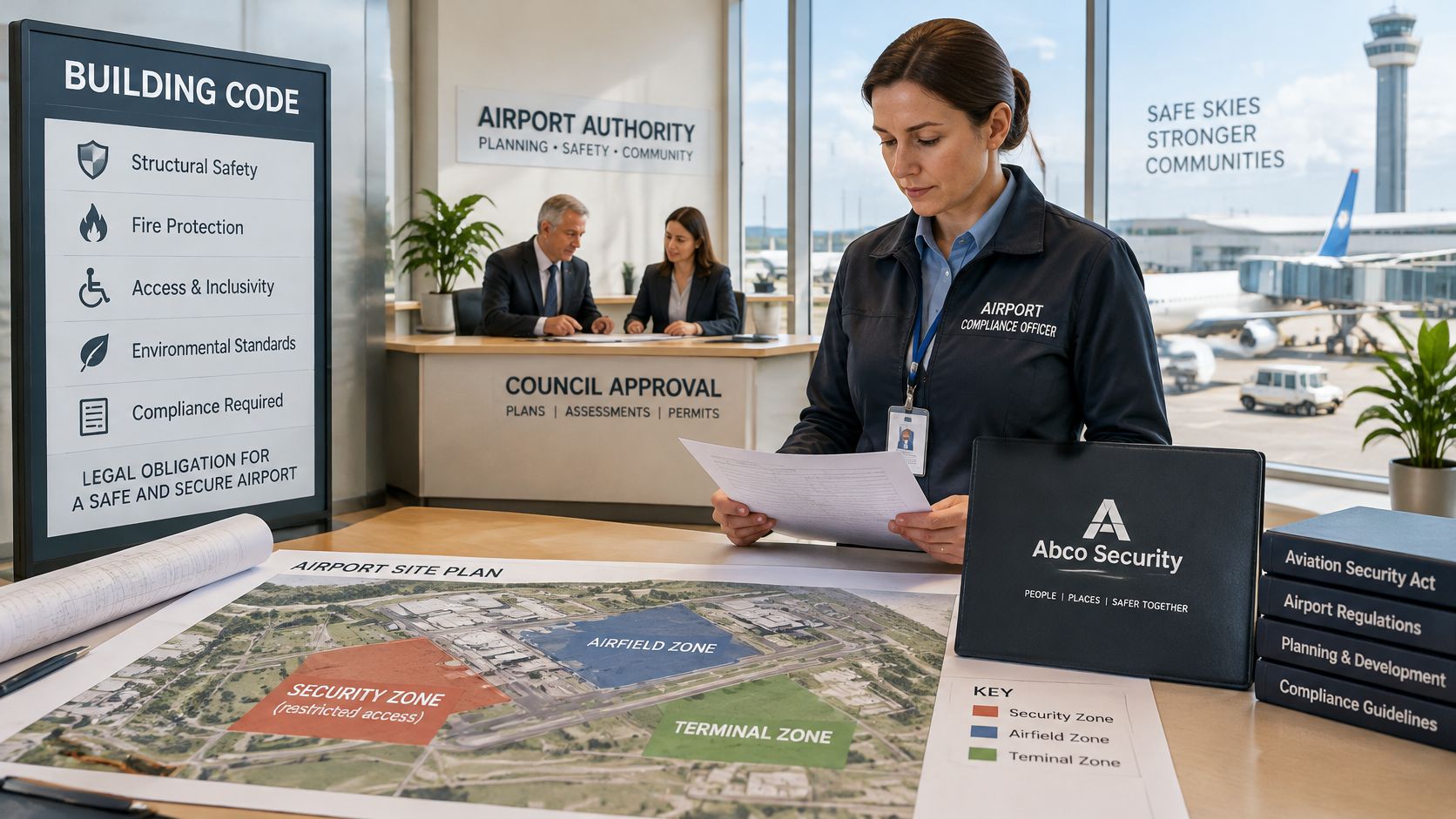
Airport contractors need an authority map, not just a folder of policies. Treat the national legislation like a building code, the approved airport program like a site-specific approval, and the operating instructions like the plan workers use on the ground.
Use the site plan alongside the procedures when allocating responsibilities.
Match the authority to the decision
- Department of Home Affairs: Sets aviation-security outcomes and screening requirements.
- AusCheck: Undertakes background checking behind ASIC applications through the authorised issuing arrangements.
- Civil Aviation Safety Authority: Provides pilot security-status and identification guidance.
- Airport operator: Maintains the approved transport security program, site maps and local zone rules.
- Contracted service provider: Converts assigned responsibilities into trained, supervised and documented work.
Australia applies the ICAO Annex 17 security standard through its national framework. Contractors should work from the applicable Australian obligations and approved airport arrangements, rather than treating an international standard as a substitute operating manual.
The Australian Air Passenger Travel Guide explains that screening is compulsory for passengers on screened air services and that prohibited items cannot pass the screening point. A private guard managing a queue or checking an invitation doesn't replace authorised aviation screening.
Different responsibilities at the same entrance
Say an organiser holds a corporate function at an airport facility. Event Security staff may manage arrivals and direct visitors, while authorised airport personnel control the secure boundary and screening staff resolve screening exceptions.
That division needs to be written into the event plan. Otherwise, a helpful employee can accidentally turn an invitation check into an unauthorised access decision.
Charter customers also need to distinguish operational safety questions from premises security. Approved Jets' safety questions for your charter broker provide a useful starting point for discussions with the flight organiser, without replacing airport entry arrangements.
Use the following video as supporting material in a broader aviation-security briefing.
The national framework also includes an all-hazards direction, with cyber obligations requiring careful attention to the applicable regulations. Don't assume every proposed requirement has already become an enforceable site duty.
For every gate, screening lane and contractor activity, name the decision-maker and approving authority. If the supervisor can't identify whose rule applies, the instruction isn't ready for deployment.
Technical Controls for CCTV, Access, Perimeter and Screening
Start technical assurance with a walk-through, not an equipment inventory. A camera can be online while recording an unusable image, and a functioning reader can still grant the wrong permission.
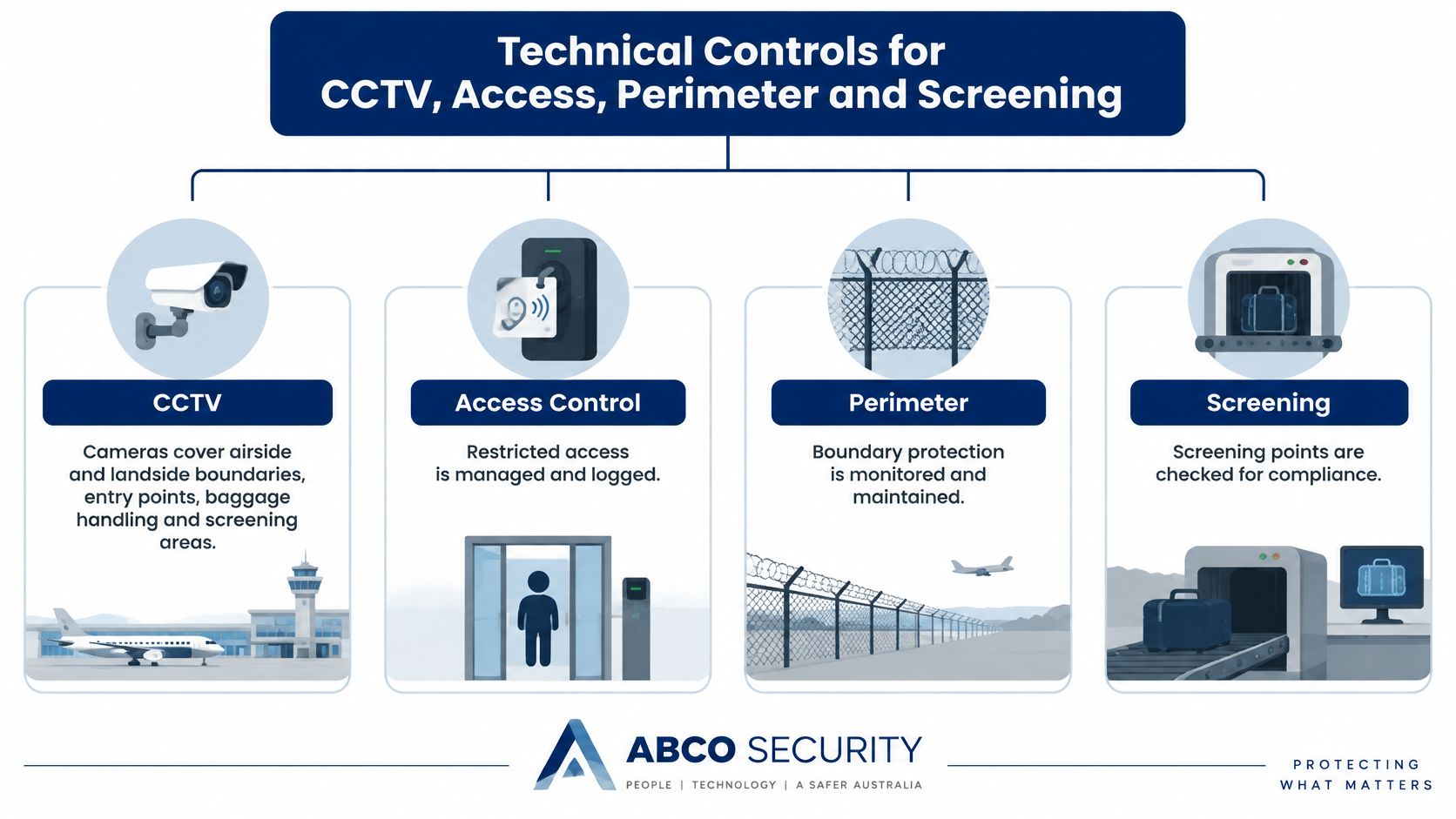
The diagram groups the technical controls that should be tested together.
CCTV and access-control assurance
For CCTV, use the approved program and risk assessment to establish coverage of airside and landside boundaries, entry points, baggage handling and screening areas. These are design and verification priorities, not a claim that every airport has an identical camera specification.
Test whether an operator can identify the relevant person or activity under actual lighting conditions. Record the retention setting, playback process, export permissions and response when a camera stops recording.
For access control, test each controlled boundary, including service doors that staff may regard as secondary. Electronic readers, where specified, should enforce role-based and time-limited permissions, with prompt removal when the person's authority ends.
A review of access-control systems for Australian facilities should include the whole transaction: permission, entry attempt, door status, alarm and operator action. A green reader light alone proves very little.
Perimeter protection and screening performance
- Boundary protection: Check fencing, gates, lighting and intrusion detection against the site's arrangements. Document patrol routes, the required frequency and response expectations.
- Equipment assurance: Keep equipment checks and faults visible to the control room. Define the temporary control when equipment is unavailable.
- Alarm handling: Give operators a clear process for assessment, escalation and closure. Don't let an unresolved alarm disappear into a shift handover.
The Department of Home Affairs screening guidance states that screening applies to everyone entering an airport terminal's secure area, including passengers, children, aircrew, workers and escorts, as well as assistance animals and pets; body scanners are the preferred personnel-screening technology, with walk-through metal detectors an alternative.
Refusing screening prevents access beyond the screening point. Teams need airport-specific procedures for equipment checks, alarm resolution and communication, rather than improvising exceptions when queues grow.
Practical rule: Throughput is an operating objective, not permission to waive an unresolved security check.
Access platforms, video systems and remote-viewing accounts are also digital assets. Include account permissions and configuration control in technical assurance, rather than treating cyber security as someone else's task.
Walk a selected entry point this week. Ask the operator to demonstrate detection, assessment, response and the resulting record, including what happens when the normal system fails.
Personnel Controls for Checks, Passes and Training
| Credential | What it authorises | Escort requirement |
|---|---|---|
| ASIC, red, airside security zone | Unescorted access when valid, properly displayed and supported by airport authorisation | No visitor escort when the access conditions are met |
| ASIC for other secure areas | Unescorted access to the relevant secure area, subject to local permission | No visitor escort when the access conditions are met |
| Visitor Identification Card, VIC | Visitor entry under the airport's visitor arrangements | Direct supervision by an ASIC holder |
| Aviation Identification, AVID | Aviation security-status identification, not unescorted secure-area access | Does not remove applicable escort and visitor-pass requirements |
An ASIC is not a universal airport access pass. The background-check process supports eligibility, while the airport's permissions determine whether the holder may enter the particular area for the proposed work.
A parliamentary review of aviation personnel security reported approximately 80,000 ASICs in circulation in 2013, then expected to rise to about 120,000, and noted that employment-applicant and contractor criminal-history checks typically identified a disclosable record in about 7% of cases.
Those are historical findings, not a current card count or a prediction about your workforce. The practical lesson is to maintain disciplined onboarding rather than treating the card application as an administrative formality.
Verify permission at the point of entry
- Match the person: Compare the photograph and identity details with the individual presenting the credential.
- Check validity: Confirm expiry and status using the airport's approved process.
- Check the destination: Verify the work requires entry to the requested zone.
- Apply the escort rule: Confirm who will supervise a visitor and how supervision will continue during the task.
- Close the lifecycle: Remove local access after termination or loss of authority, and record exceptions.
The Aviation Transport Security Regulations specify ASIC display requirements, including valid red ASIC display in airside security zones, and require airport security guards at airports with regular public transport operations to hold and display a valid ASIC while on duty.
The CASA security requirements for pilots distinguish an ASIC from an AVID: the latter does not authorise unescorted access to secure areas. Don't accept a pilot's aviation identification as proof of local entry permission without checking the applicable arrangement.
Train for decisions, not card recognition alone
Use short scenarios in security-awareness training. Ask what happens when a visitor's escort leaves, a cardholder requests a different zone, or a worker presents a damaged credential during a busy handover.
Staff should demonstrate display-rule checks, suspected misuse escalation, relevant alarm-resolution actions and emergency responsibilities. A signed attendance sheet doesn't establish that a person can make the correct entry decision.
VolunteerBadge's discussion of nonprofit compliance through watchlist screening offers a useful comparison between initial checking and ongoing governance. It isn't a substitute for aviation-specific background checks or airport permissions.
A current card can still be presented for an unauthorised journey. Train the guard to check the journey, not just the plastic.
Emergency Response and Incident Escalation
The airport's transport security program sets out incident-response arrangements. Guard instructions must turn those arrangements into actions that staff can carry out under pressure, including when the supervisor is unavailable or the normal communications channel fails.
In 2024–25, the Australian Federal Police achieved a 91% airport-incident response-time result against a 90% target, including Priority 1 responses within 10 minutes, according to its annual performance statement. This is a reported policing measure, not a guaranteed arrival time for an individual site.
Use a clear escalation sequence
- Recognise and protect. Identify the incident and secure the immediate area within training and authority. Don't touch or move a suspicious item to clear a walkway.
- Notify the supervisor. Give the exact location, observed behaviour, immediate hazards and actions already taken.
- Inform airport operations and the duty manager. Use the approved contacts and confirm the message was received.
- Call police where required. Follow emergency arrangements without delaying urgent assistance while working through internal approvals.
Immediate threats may require simultaneous notifications. The sequence shouldn't become a reason to wait for management permission when emergency assistance is needed.
Prepare for the incidents staff actually encounter
Unattended items, unauthorised entry, unresolved screening alarms, suspected pass misuse and disruptive behaviour need distinct response instructions. Avoid a generic direction to investigate, which can send an untrained guard towards an avoidable hazard.
For Mobile Patrols, test the approach route to the boundary and identify where responding personnel can meet airport staff. Patrol officers should know their access limitations and how to preserve the scene until authorised responders arrive.
Build emergency-response procedures around practical communications: location naming, radio coverage, backup contacts and handover responsibilities. Record decisions and preserve relevant footage without circulating sensitive material unnecessarily.
As an operating recommendation, schedule tabletop exercises and suitable live drills at least annually, or more often where the approved program requires. Record attendance, scenario outcomes, corrective actions and the person responsible for checking that each action has been completed.
Documentation and Audit Evidence to Keep
An approved transport security program is an operational control document, not a statement of good intentions. It should allow a reviewer to follow responsibility from the airport's arrangements through to the worker's instruction and resulting record.
The Aviation Transport Security Act 2004 requires prescribed participants to maintain written approved programs addressing coordination, security technology, equipment, procedures, incident response and protection of compliance information; a security-controlled airport's program must also include a map identifying airside, landside and applicable security zones.
Records to keep and how often to review them
These are recommended operating review intervals, not universal statutory retention periods. Apply any stricter requirement in the approved program or applicable instrument.
| Record | What it proves | Recommended review |
|---|---|---|
| Transport security program and zone maps | How security is run and where zones begin and end | At airport or regulator review cycles, and after layout changes |
| ASIC issue, expiry and deactivation register | Credentials are current and local access is removed when eligibility ends | Monthly reconciliation against the access system |
| Access-control exception log | Escorted entries, refused entries and unusual access attempts | Weekly |
| Screening alarm-resolution log | Alarm outcomes and authorised resolution | Each shift |
| CCTV recording and retention check | Recording, image usability and retention meet the program | Daily spot checks and monthly full test |
| Training and competency records | Staff were prepared before deployment and refreshed on schedule | Before deployment and at each refresher date |
Make the evidence reliable
Keep logs tamper-resistant through restricted editing, named user accounts and an auditable correction process. Don't overwrite an inaccurate entry without preserving who corrected it and why.
Use consistent timestamps and location names across access logs, CCTV exports and incident reports. Otherwise, the reviewer may be unable to establish whether apparently related records describe the same event.
For Security Guarding and Gatehouse Security providers, regulatory compliance documentation should include controlled post instructions, revision history, staff acknowledgements and records of temporary arrangements. Remove superseded instructions from operational use rather than leaving them beside the current version.
Audit test: Select an entry point and a worker. Trace the permission, competency record, entry transaction and any associated alarm through to closure.
Put missing evidence in the corrective-action register, with an owner and completion check. Don't recreate records afterwards as though they were made at the time.
Regulator reviews can compare operational evidence with the approved program, and non-compliance can lead to enforcement under the Act. Confirm current audit powers and penalties with Home Affairs before relying on a particular provision or figure.
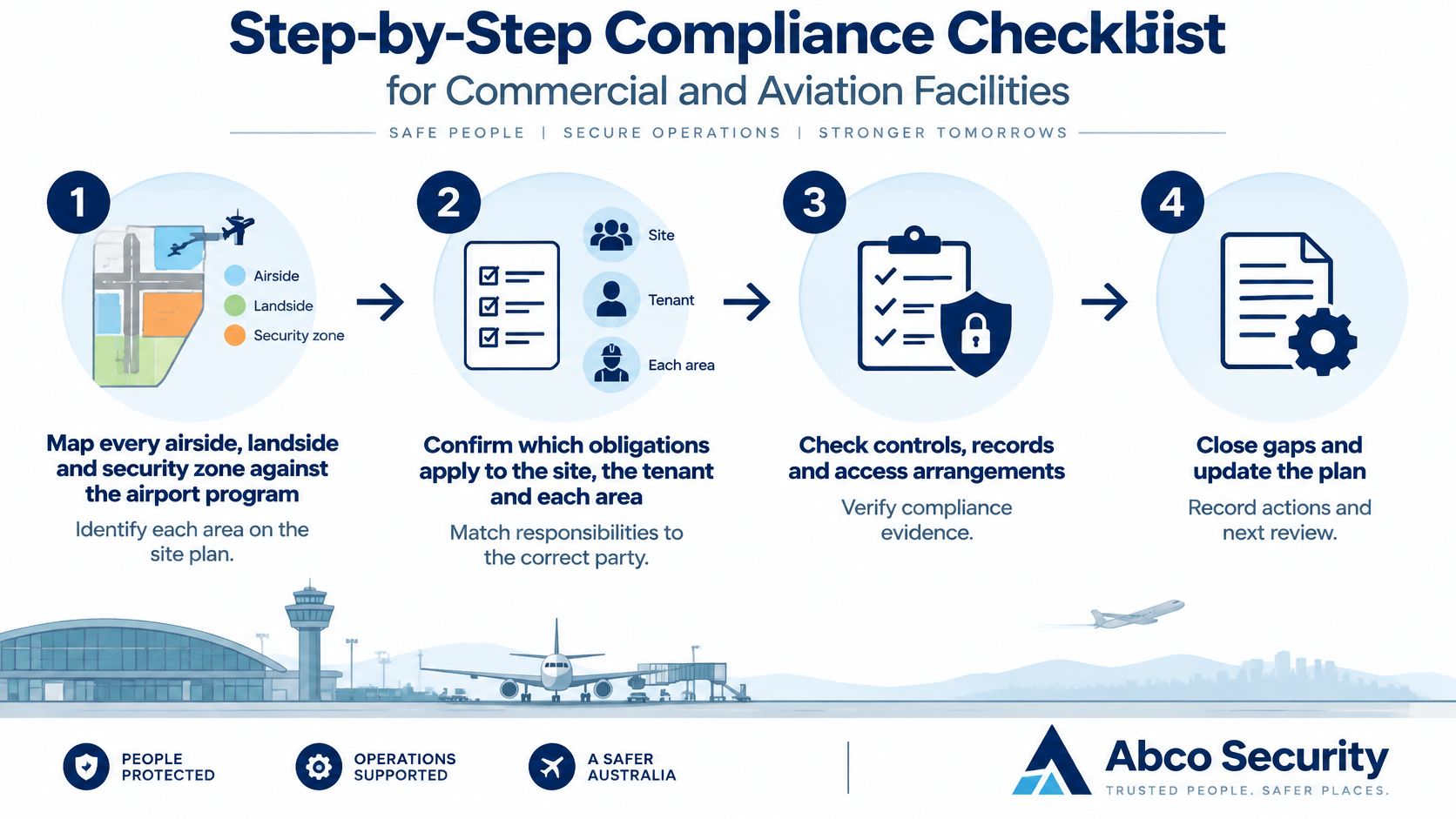
Step-by-Step Compliance Checklist for Commercial and Aviation Facilities
Use a signed work pack to turn inspection findings into accountable decisions. The sign-off should identify the reviewer, the evidence inspected and any unresolved limitation, rather than marking a task complete.
The visual summarises the workflow; the detailed checks should address the actual site boundaries and responsibilities.
Verify the physical and personnel arrangements
Map the site against the approved program. Mark airside, landside, security zones and every transition used by workers or deliveries. Finish with a signed boundary-verification record.
Allocate obligations. Identify what belongs to the operator, tenant, employer and subcontractor, including after-hours coverage. Record acceptance in a signed responsibility schedule.
Build the credential register. Match workers to permitted destinations and escort arrangements, including temporary workers. Retain a signed reconciliation showing unresolved discrepancies.
Test camera coverage. Review entry points and relevant baggage or cargo areas under realistic operating conditions. Save authorised test evidence and a signed coverage assessment.
Challenge access-system behaviour. Test permitted entry, refused entry, removed permissions and exception logging without compromising live operations. Complete a signed test sheet with fault references.
Validate screening interfaces. Confirm who screens, who manages queues and who refers exceptions to authorised personnel. Have the responsible parties sign the site-specific procedure.
Confirm competency before rostering. Check that assigned personnel can demonstrate their tasks and understand escalation limits. Obtain a signed deployment-readiness record.
Separate cyber readiness from confirmed legal duties
The Home Affairs transport-sector transition paper records that the Transport Security Amendment (Security of Australia's Transport Sector) Act 2025 became law on 28 March 2025, introducing an all-hazards framework, while detailed aviation cyber requirements were still being developed as of January 2026. That dated position should not be treated as confirmation of which requirements apply today.
Complete an interim cyber-readiness review. Inventory security devices and platforms, review privileged accounts, clarify vendor responsibilities, test backup communications and define incident-reporting triggers. Exercise a scenario involving unavailable access control or video, then sign a readiness record that separates existing duties from forthcoming or unconfirmed requirements.
Assign the audit cycle. Give every record and corrective action a named owner, review date and closure standard. Approve a signed assurance schedule.
For commercial premises near airports, apply the boundary, responsibility and credential checks to freight interfaces, car parks and landside facilities. Proximity alone doesn't establish aviation-security obligations, but an overlooked connection to a controlled area can change the assessment.
Adding guards or cameras won't fix exposed administrator accounts or untested fallback communications. Resolve the weak link before purchasing another layer.
Choose an Integrated Security Provider for Aviation Sites
A low hourly rate is useful only if the provider can deliver the required post safely and consistently. Compare bids against the same scope, including relief coverage, supervision, reporting, technical support and the limits of each officer's authority.
A contractor experienced in Retail Security or Construction Security may offer useful skills, but that experience doesn't establish competence for an airport assignment. Ask how the provider will translate the airport's requirements into deployment-ready instructions.
Tender criteria that can be verified
- Officer licensing: Verify the current state or territory security licence and relevant activities for every assigned officer.
- Airport credentials: Check appropriate ASIC holding and local permissions for personnel assigned to relevant secure-area duties.
- Documented competency: Request evidence covering screening support, access decisions and emergency responsibilities, without confusing support work with authorised screening.
- Site-program capability: Ask for an example of how the provider controls post instructions and incorporates airport map changes.
- Quality management: Assess a documented system such as ISO 9001, checking certification scope where certification is claimed.
- Comparable references: Request references for similar airport or air-cargo assignments, with client permission.
Compare the operating model, not the brochure
| Selection issue | Fragmented arrangement | Integrated arrangement to test |
|---|---|---|
| Alarm ownership | Monitoring staff notify several disconnected contacts | Named controller coordinates the agreed response |
| Evidence | Separate logs with inconsistent locations | Linked incident references and controlled evidence handling |
| Staffing changes | Replacement officer receives a generic induction | Competency and site permissions verified before assignment |
| System outage | Contractor waits for technical support | Approved temporary controls and escalation are activated |
Ask who owns an incident from detection to closure. Then request a demonstration involving a failed reader, unavailable camera or visitor whose escort cannot continue.
The guide to integrated security solutions provides a useful basis for comparing guarding, monitoring and electronic controls as an operating model. Require proposed response arrangements to be supported by staffing, access permissions and tested communications, rather than an unsupported promise of rapid attendance.
Service scope may include Security Guarding, Gatehouse Security and Mobile Patrols, with Concierge Security for reception interfaces and Event Security for functions. Shopping Centre Security may be relevant to separate retail-property operations, but it shouldn't blur airport security responsibilities.
For buyers searching for a Security Company Melbourne, or assessing providers in Sydney, Brisbane, Perth and surrounding cities within a 200km radius, verify local mobilisation and supervision capacity. ABCO offers these service categories across those locations; confirm the specific airport scope, personnel availability and operating boundaries during procurement.
ABCO Security Services Australia offers integrated guarding, patrols, monitoring and access-control support for commercial and aviation-related operations. Request a site compliance review through ABCO Security Services Australia, bringing your approved procedures, zone maps and contractor responsibilities so the review can identify control gaps and assign practical corrective actions.
about
avada factory
Sempery ultricies nibh at dolor cras urna eleifend nec. Atiam efficitur tempor.