The Office of the Australian Information Commissioner received 595 data breach notifications from July to December 2024, up 15% on the preceding period, according to its data breach dashboard announcement. For a security operation, regulatory compliance documentation isn't a folder of policies. It's the evidence that staff checked licences, handled information properly and made defensible decisions when something went wrong.
Why Security Files Exist in Australia
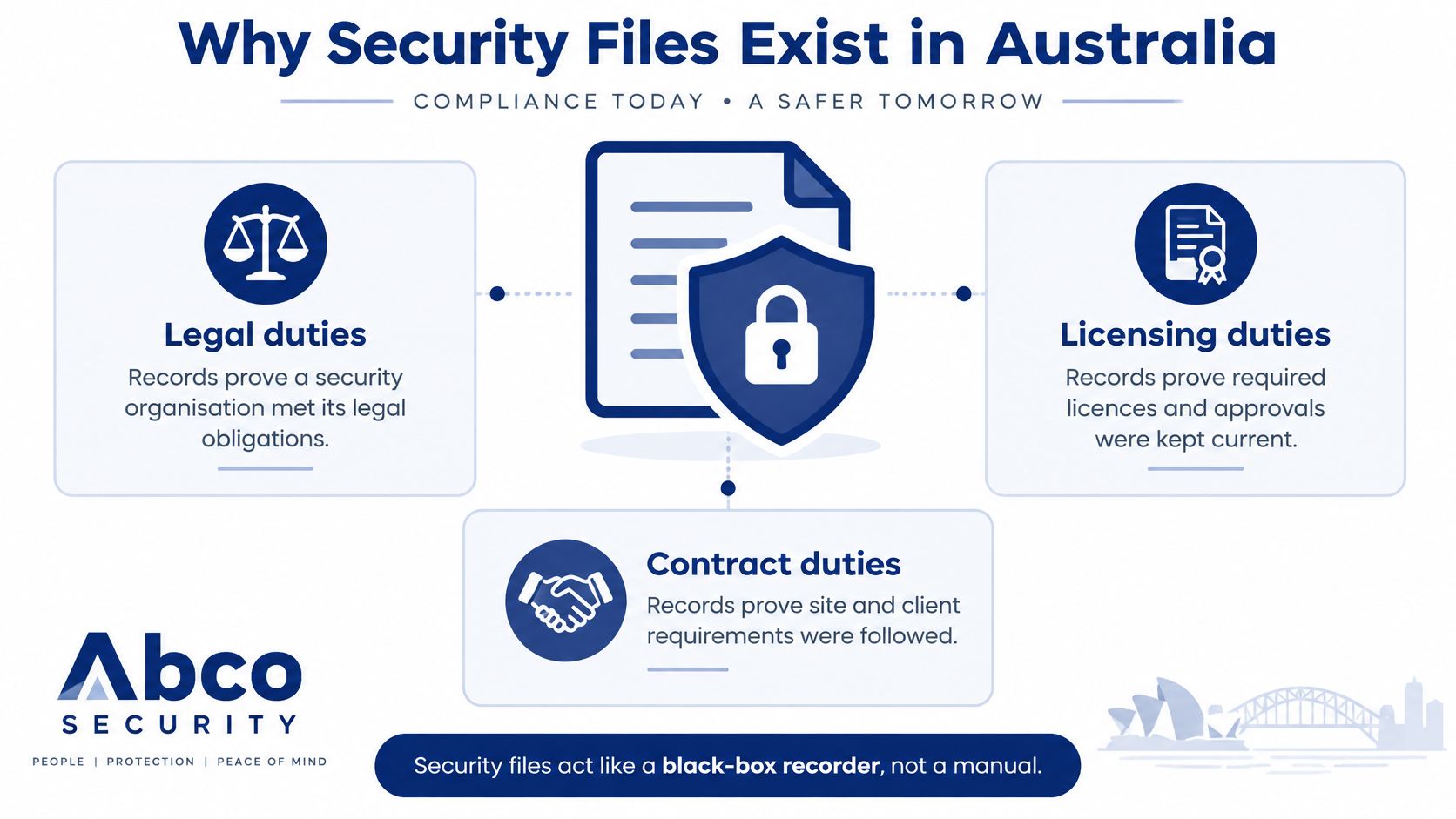
Regulatory compliance documentation is the set of records that demonstrates how a security organisation met its legal, licensing and contractual duties. Think of it as a black-box recorder, not a manual left on a shelf. It should connect the instruction, the person who acted, the event and the decision that followed.
Say a mobile patrol officer finds a loading-dock door unsecured at a commercial building. The officer records the location, checks for immediate danger, contacts the control room and follows the site's escalation instructions. Those records explain the physical-security response.
Now suppose the officer also finds a visitor register containing personal details outside the reception desk. The supervisor must consider a separate information-security issue. Closing the door doesn't resolve the exposed register, and an incident report that says only “site secured” won't explain what happened to that information.
Separate the event from the compliance decision
A useful file distinguishes observed facts from assessment and approval. The officer records what they found; the supervisor documents the operational response; the privacy lead assesses whether personal information was compromised.
For organisations covered by the Privacy Act, the Notifiable Data Breaches scheme adds assessment and notification obligations. Staff shouldn't assume that every misplaced document is automatically notifiable, or that recovering it automatically ends the matter. The file needs the reasoning, including what information was involved, who might have accessed it and what remedial action achieved.
The same distinction matters for Security Guarding and Mobile Patrols in Melbourne, Sydney, Brisbane and Perth. A forced door, an unauthorised visitor and an exported CCTV clip may belong to the same occurrence, but they raise different questions.
- Legal evidence: Record the applicable obligation and the action taken to meet it.
- Licensing evidence: Show that the person was authorised for the actual duty performed.
- Contract evidence: Preserve the site instruction, escalation record and client communication.
- Corrective evidence: Identify who fixed the problem and how the supervisor checked completion.
Make the file usable during a shift
A new account manager should be able to retrieve an officer's authorisation, the current site instruction and the relevant incident evidence without chasing unrelated email chains. Give each site a document index, and give each incident a reference that connects its reports, exports and approvals.
Practical rule: A policy describes what staff should do. A completed, reviewed record shows what they actually did.
The working tools are straightforward: a document catalogue, a retention schedule, a list of sector triggers, an audit checklist and sample wording. Each should help the next person make a safe decision, rather than merely add another attachment.
Documents Every Security Operation Must Hold
Security compliance documents and what they prove
Use this catalogue as an operational baseline. Confirm the applicable state, employment and contract requirements before treating any row as a universal legal obligation.
| Document | What it proves | Owner | Must exist by |
|---|---|---|---|
| Individual private security licence | The activity that person may perform | Operations or compliance | Before deployment |
| Security business or labour-hire licence | Personnel are supplied lawfully where licensing applies | Director or contracts lead | Contract start and each renewal |
| Client contract and site instructions | Scope, escalation and reporting duties | Account manager | Mobilisation |
| SOPs and safe work procedures | How the task is done on that site | Supervisor | Before work and after any change |
| Risk assessment | Hazards found and controls chosen | Site supervisor | New site, new hazard or review date |
| Training and competency record | Skill matches the duty | Training or HR lead | Before unsupervised work |
| Incident and patrol log | What happened and the response | Officer, then supervisor | Each shift and each incident |
| CCTV and alarm log | The system event and who viewed or exported it | Control room | Alarm, export or complaint |
| Visitor and access-control record | Who entered and when | Concierge or gatehouse | Each entry |
| Breach-assessment file | Whether the incident was notifiable | Privacy lead | When a potentially eligible breach is suspected |
A complete catalogue entry identifies the actual record, not just its category. “Training” isn't enough. Record the task, the evidence of competence, the person who checked it and any restriction on deployment.
The owner maintains the record and resolves gaps. That doesn't mean the owner must create every entry. An officer can write a patrol report while the supervisor remains responsible for reviewing exceptions and arranging follow-up.
The must exist by column prevents retrospective paperwork from becoming normal practice. A site instruction written after a complaint doesn't establish what the officer was told before the shift.
Connect the records on a shopping-centre night
Consider a hypothetical Melbourne shopping-centre shift. Before deployment, operations checks the officer's licence and authorised activity. During patrol, the officer records an aggressive approach towards a retailer.
The control room locates and exports the matching camera footage. Before handover, the supervisor reviews the incident account, confirms the escalation and records any unresolved action. Those connected records explain authorisation, observation, evidence preservation and oversight.
- Name the licensed activity: Don't reduce a licence check to a tick beside “licensed”. Crowd-control authority and static-guard authority aren't interchangeable.
- Identify supplied personnel: Subcontracted Gatehouse Security and Concierge Security staff need their own personnel records, not just their supplier's company brochure.
- Match duties to forms: Event Security needs event escalation records; Security Guarding needs site-specific instructions; Mobile Patrols needs a clear visit and exception log.
When comparing Event Security, Security Guarding and Mobile Patrols services, ask how each duty generates records the client can retrieve. A practical security incident reporting process should connect those records rather than leave them in separate systems.
Include the end of the equipment lifecycle
The catalogue should also identify who approves disposal of devices containing operational information. A retired recorder, access-control computer or reception workstation can still hold sensitive records.
For an overseas comparison, Beyond Surplus's resource on how to recycle banking equipment securely in Atlanta is relevant to that disposal question. It isn't Australian legal guidance; use the lifecycle perspective to prompt local checks on asset identification, data removal and disposal evidence.
How Long to Keep Each Record
Keep risk assessments and safe work method statements for the period required by the WHS regulations that apply in the relevant jurisdiction. Model provisions and proposed amendments do not automatically apply at every site, so check the enacted requirements.
CCTV needs a separate decision. There is no single national retention period for every site. Set a routine period that matches the lawful purpose, applicable requirements and contract, then specify what suspends automatic deletion.
Retention and legal-hold schedule
Use this schedule to set working rules, then check any statutory minimums that apply. A contract cannot authorise destruction that another obligation prohibits.
| Record | Routine retention | After a notifiable or investigated incident | Disposal proof |
|---|---|---|---|
| Risk assessment or SWMS | For the period required by the applicable WHS regulations | Preserve for the period required by applicable obligations and any active investigation | Approved destruction or archive note |
| CCTV footage | Shortest period meeting the lawful purpose, contract and APP 11 | Hold until investigation requirements end and relevant insurer and legal releases are obtained | Export log, or a same-day gap note if footage is missing |
| Alarm and access logs | While needed for patrols, payroll or the contract, subject to applicable obligations | Hold with the incident file | De-identification or deletion approval |
| Incident and patrol reports | Contract term plus any live investigation and applicable obligations | Keep with the investigation file | Named approver and date |
| Training records | While the person is engaged and competence remains relevant, subject to applicable obligations | Hold if competence is in issue | Archive, then approved destruction |
| Licence-check record | Current licence term plus evidence supporting deployment checks | Preserve if deployment is disputed | Replacement record and approval; don't retain excess identity documents |
| Visitor logs | Short operational window unless another purpose requires retention | Hold with the incident | De-identification when the purpose ends |
| Breach-assessment file | Long enough to demonstrate timely assessment and the decision | Retain for the OAIC or client matter and applicable obligations | Restricted access and later destruction approval |
Stop deletion before evidence disappears
A legal hold suspends routine disposal for identified records. Record its scope, reason, authoriser, custodians and release conditions. Then confirm that the people controlling each system have applied it.
For a construction incident assessed as notifiable, the incident owner should identify relevant gatehouse entries, surveillance, induction evidence, communications and witness details. Facilities, HR, contractors and insurers may hold different fragments. Index them without copying everything into an unrestricted folder.
For a retail privacy complaint, preserve the relevant export history and access records as well as the footage under review. Limit the hold to incident material, rather than retaining unrelated recordings indefinitely.
A preservation instruction only works when someone confirms that automatic deletion has stopped.
For each export, record who copied it, the camera and time range, the format, the storage location and permitted users. Preserve the original export and any player needed to view it. Record later transfers separately.
If footage failed, was overwritten or never covered the area, write a same-day gap note. State what was requested, what was unavailable, why, when the gap was discovered and which alternative evidence exists. Do not suggest that anyone reviewed missing footage.
Use CCTV storage requirements to frame system questions, and coordinate personnel records with HR. The resource on records retention with HR Management 365 offers a separate HR-focused perspective. Apply the Australian obligations relevant to the records when setting the schedule.
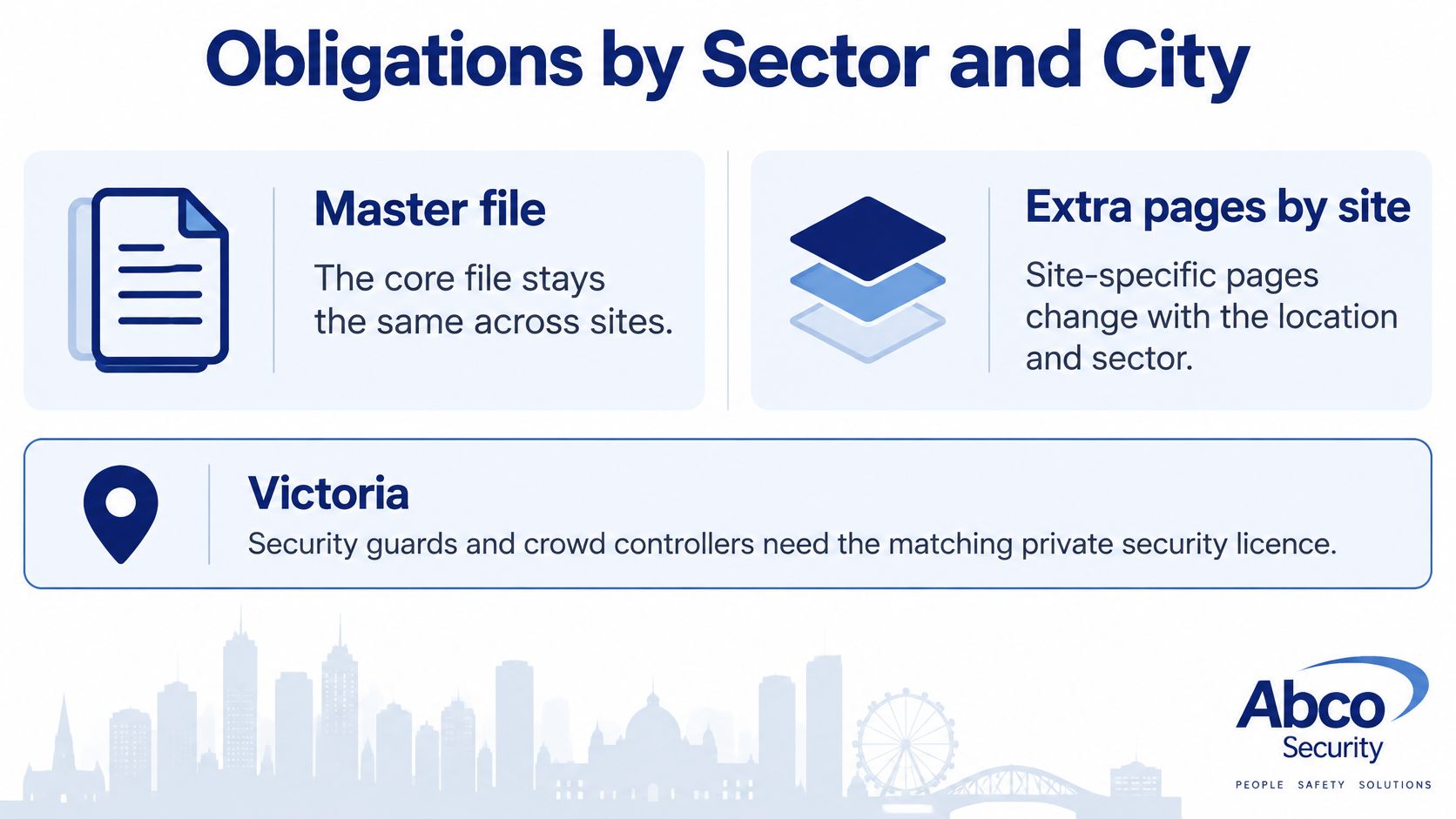
Obligations by Sector and City
Extra records by security sector
Keep the master catalogue consistent, then add the pages needed for the site, sector and jurisdiction. The table is a pre-start planning aid, not a statement that every listed document is legally mandatory everywhere.
| Sector | Extra records | Planning trigger | Where it bites |
|---|---|---|---|
| Construction Security | Relevant SWMS, site induction, gatehouse log, licence matched to duty | High-risk work and any notifiable incident | Sites in Melbourne, Sydney, Brisbane, Perth and nearby cities |
| Event Security | Crowd-controller licences, event plan, CCTV plan, post-trading roster | Applicable WA late-trading, attendance and liquor-licence conditions | Perth and WA events; Victorian crowd-control deployments |
| Retail and Shopping Centre Security | Aggression procedure, peak-time assessment, cash and delivery notes, police-call rule | Public-facing peaks, cash handling and isolated car parks | Shopping centres in the major capitals |
| Strata and Concierge Security | Applicable by-law authority, visitor log, after-hours patrol report | Common property, foyers and car parks | Strata schemes and shared car parks in Melbourne, Sydney, Brisbane and Perth |
For Construction Security, connect the guard's instructions to the principal contractor's actual site arrangements. A gatehouse officer needs to know who can authorise entry, where induction status is checked and how an emergency changes vehicle access.
For Retail Security and Shopping Centre Security, translate the aggression procedure into usable escalation instructions. Identify delivery entrances, cash-handling interfaces and isolated parking areas rather than issuing a generic instruction to “remain vigilant”.
Strata managers should record the authority for common-property instructions. A concierge shouldn't have to guess whether a resident's request is consistent with the scheme's approved access arrangements.
Match Victorian licences to the assignment
For a Security Company Melbourne account manager, the critical question is whether each officer's licence covers the assigned activity. Under the Victoria Police private security licence application requirements, applicants must be at least 18, have Australian residency or current visa work rights, provide fingerprints, satisfy fit-and-proper requirements, submit 100 points of certified identification, and provide approved registered-training-organisation training valid within 12 months of the application.
These are application requirements, not a reason for every client to retain unnecessary copies of identity documents. The deployment register should establish the licence, authorised activity, validity and check outcome, with supporting information restricted appropriately.
For hypothetical planning across Melbourne and surrounding Victorian cities within a 200 km service radius, don't treat distance as a licensing rule. Check the jurisdiction and duty for each assignment, including temporary event personnel.
Build Perth event conditions into the roster
The Western Australian security licensing conditions describe additional requirements generally applying to nightclubs, venues trading after 1 am and large events expecting more than 1,000 people, potentially including licensed crowd controllers, RSA marshals and CCTV; relevant monitoring generally runs from 8 pm, or later opening, until one hour after trading stops.
The event manager should confirm the actual liquor-licence conditions before rostering. An officer's shift ending when service stops may leave the required departure-monitoring period uncovered.
- Before doors open: Confirm projected attendance, licensed duties and the event escalation plan.
- Before mobilisation: Check the site's surveillance arrangements and applicable privacy requirements.
- Before changing cities: Verify local requirements rather than copying a Melbourne pack into Sydney, Brisbane or Perth unchanged.
Use the Construction Security, Retail Security and Event Security service overview to define the proposed scope, and check workplace surveillance laws in Victoria when planning Victorian monitoring arrangements.
Audit Readiness Checklist for Tomorrow
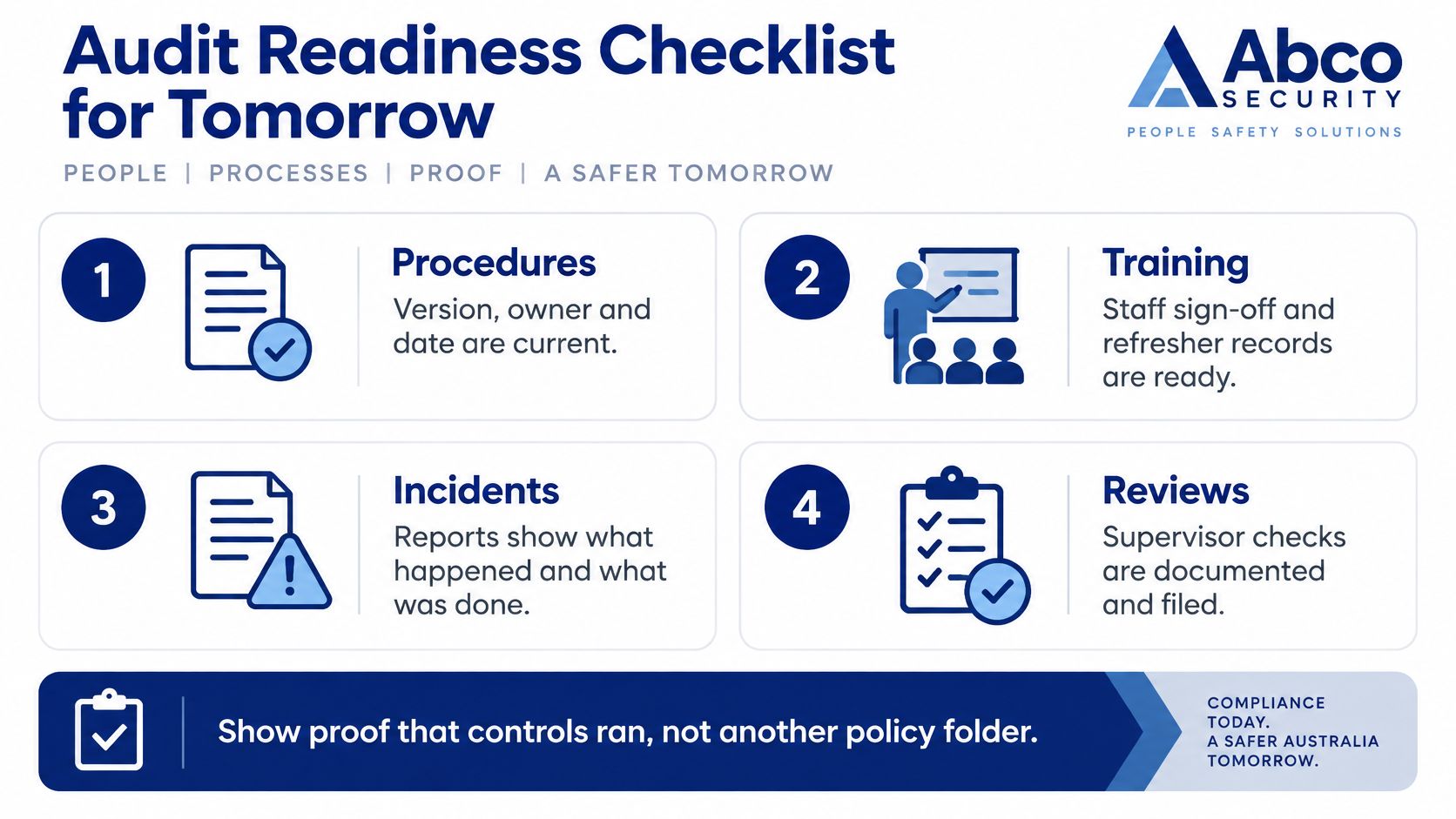
An audit should test whether controls operated, not whether someone assembled a polished policy folder. Choose a recent completed shift and follow its people, instructions, exceptions and evidence through to supervisor review.
Run the supervisor's evidence tests
Check procedure control. Every current procedure should have a version, owner, approval and review date. Confirm the officer could access the version that applied during the selected shift.
Match the roster to actual work. Compare planned hours with actual starts, finishes, breaks and changes. Safe Work Australia's fatigue code of practice recommends records covering working hours, breaks, consultation, hazards, controls, training, monitoring and subsequent actions. A signed fatigue policy alone doesn't show whether a supervisor responded to a missed break.
Open the exception log. Find a missed patrol, equipment fault or late licence renewal. There should be an assigned action, responsible person and evidence of closure, not merely an acknowledgement email.
Find the control approval. Identify who accepted the risk treatment and when it must be reviewed. If staff changed the task after a hazard emerged, check that the instruction changed too.
Test an export and a footage gap. Retrieve a preserved recording and check its provenance, storage and access history. For missing footage, look for a contemporaneous gap note and a fault or recovery action. “Camera unavailable” doesn't explain whether the camera failed, the recording expired or the requested area was outside its view.
Trace a suspected privacy breach. The OAIC's breach reporting guidance requires all reasonable steps to complete an assessment within 30 days where there are reasonable grounds to suspect an eligible breach. Check discovery and containment timestamps, the information affected, serious-harm analysis, remedial action, decision approval and notification wording. Where notification wasn't required, preserve the reason.
Verify the engagement model. The Victorian Labour Hire Authority's security-industry guidance identifies the Security Services Industry Award 2020, rather than the clubs award, for the described security labour-hire arrangements, and states that security independent contractors need both a private security business licence and an individual operator licence. Check the actual arrangement, award assessment, licences, timesheets and payroll evidence.
Reconcile the escalation story. Compare the client contract, site instruction and incident report. If they name different contacts or approval pathways, establish what staff followed and correct the conflict.
Give each finding an operational outcome
Missing evidence or an unmanaged breach assessment can compromise an active investigation. Prioritise those failures over a missing acknowledgement on an obsolete handbook, while still recording both accurately.
Summarise findings using pass, fix this week, or do not deploy until fixed. Attach an owner and completion evidence to each action; use a security audit checklist to keep the review repeatable.
Sample Wording and Who Owns the File
Safe Work Australia reported 53,139 accepted workers' compensation claims for assaults by one or more persons and 12,721 for exposure to workplace or occupational violence during the ten-year period examined in its work-related violence and aggression report. A shopping-centre file should therefore document an aggression response, not merely confirm that a guard was present.
The following wording is a hypothetical example. Its times and camera reference illustrate how to write an account, not a reported incident.
Write observations in sequence
At 19:42 at the east mall entrance, the officer observed a visitor shouting and stepping towards retail staff. The officer asked the visitor to step back and called the supervisor by radio at 19:44. Police were requested at 19:46 after the visitor refused to step back. No force was used.
The related evidence entry could read:
Camera 14 footage covering 19:40 to 19:55 was exported by the control room at 20:10. The export location, operator and access permissions are recorded against the incident reference.
Avoid labels such as “dangerous person” unless the report explains the observed conduct supporting the assessment. Distinguish what the officer saw from what a retailer or witness later reported.
Record gaps and boundaries plainly
If the camera wasn't recording, use an alternative entry rather than suggesting that an export exists:
Sample gap line: Camera 14 was not recording. The fault was logged at 19:50, and the patrol account is the primary record; available witness accounts and adjacent-camera coverage are indexed separately.
Sample contract line: Footage is retained for the agreed lawful operational period, then deleted unless an authorised incident, insurer or regulator hold applies.
Sample licence line: Licence sighted before shift; authorised activity matches the assigned crowd-control duty.
These sentences do different jobs. The incident account describes conduct, the gap note explains unavailable evidence, the contract line defines the disposal boundary and the licence entry supports deployment.
Assign ownership to the same incident
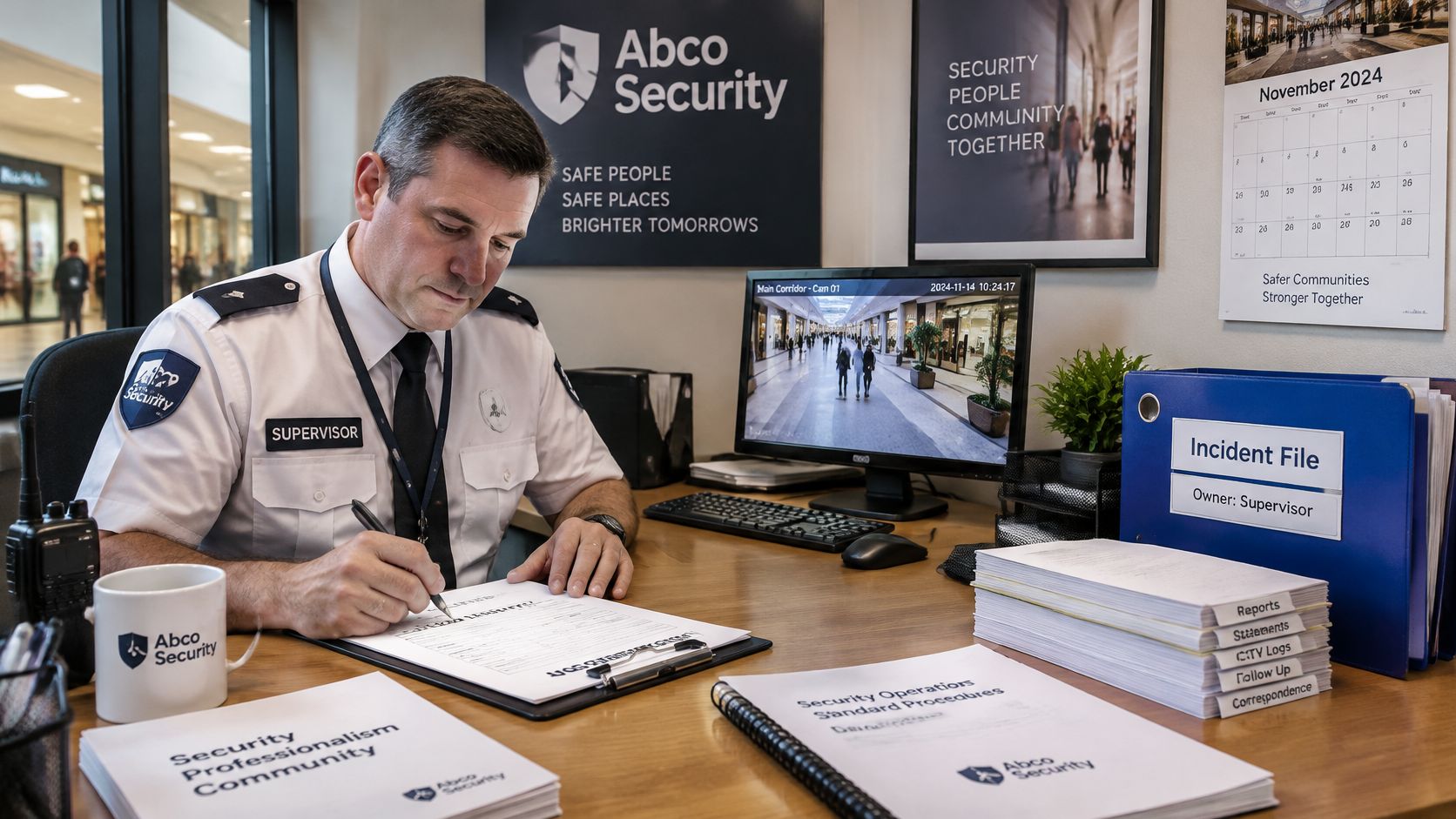
- Officer: Writes the first account before leaving and identifies witnesses without speculating about motive.
- Supervisor: Reviews it during the shift, checks escalation and assigns follow-up.
- Control room: Preserves the export, records transfers and confirms any recording fault.
- Privacy lead: Assesses suspected unauthorised access, disclosure or loss of personal information. Personal information appearing in footage doesn't alone make an event a suspected eligible breach.
- Client facilities manager: Coordinates the client-side preservation instruction under the agreed authority, with legal or privacy approval where needed.
An integrated guarding and monitoring arrangement can connect these contributions through one incident reference. Keep responsibility explicit even when the same provider performs several roles.
For the incident report, include date and time, location, people involved, observed facts in sequence, actions and actors, camera or log references, any police reference, hold status and supervisor review.
For the licence register, include officer name, licence number, class, authorised activity, expiry, check date and checker. Apply document-control principles through an ISO 9001 approach to security records so revisions remain traceable rather than replacing earlier accounts.
Digital Records and the Next Compliance Step
A digital platform cannot fix unclear ownership. Before connecting CCTV, access control, patrol software and rostering, decide who controls each dataset and what each role may do with it.
For organisations covered by the Privacy Act, the OAIC's guide to securing personal information explains the reasonable security steps expected under Australian Privacy Principle 11. These include destroying or de-identifying personal information when it is no longer needed, unless an applicable exception requires retention. A shared drive with no disposal rules is not a retention strategy.
Map the system before adding permissions
| System | Data owner | Controlled actions | Destruction trigger |
|---|---|---|---|
| CCTV | Appointed surveillance or facilities owner | Viewing, export, sharing and deletion | Approved retention expiry with no active hold |
| Access control | Facilities or authorised security manager | Credential changes, entry-log access and export | Operational and applicable retention purposes end |
| Patrol reporting | Operations manager | Report creation, review and amendment | Approved contract and incident purposes end |
| Rostering | Operations with HR or payroll | Scheduling, attendance correction and reporting | Applicable employment and operational purposes end |
| Breach file | Privacy lead | Investigation access, decision approval and disclosure | Matter closure and approved retention requirements met |
Use unique logins, role-based permissions and audit trails for exports and amendments. Apply supported system controls to encrypt stored footage and reports, with key-management responsibilities separate from general viewing access.
A guard may need to submit a report without permission to delete it. A client may need incident evidence without access to unrelated visitor or employee records. Set those boundaries in the system permissions.
Maintain controlled instructions and recoverable evidence
For document control aligned with ISO 9001, identify the current version, its approval and how obsolete instructions are withdrawn. For risk work aligned with ISO 31000, use an ongoing cycle to identify, treat, monitor and review risks. A risk assessment should remain usable as site conditions change, not sit untouched as a PDF.
- Review access regularly: Set quarterly permission reviews as an internal operating choice, and review sooner when personnel, sites or risks change.
- Protect recovery copies: Back up the breach file separately from routine footage and test whether authorised staff can retrieve it.
- Preserve amendments: Correct factual errors through a traceable amendment rather than overwriting the original account.
- Separate event categories: Link physical-security and information-security records where useful, while keeping their assessment pathways distinct.
Professional-development records should show what learning occurred and which licence renewal requirement it supports. An attendance entry alone may not establish either point. Record the training completed and the requirement it relates to, so the evidence can be understood during a later review. For comparison, documenting ethics CEUs for license renewal also concerns how learning is recorded against a renewal requirement.
Test the next deployment
Before adding another site, check whether operations can show an officer's licence and authorised activity before the last shift, preserve relevant camera footage and explain any unavailable recording. If footage is missing, record which camera or time period is affected, when the gap was identified, and what steps were taken to check for an export or recovery copy. If a legal hold applies, preserve the relevant material rather than allowing automatic deletion to proceed.
Commercial, construction, retail, event and strata managers can use their site instructions, system ownership map and a recent incident file to check whether those steps are clear. Across Melbourne, Sydney, Brisbane, Perth and Adelaide, guarding, mobile patrols and monitoring need to produce a connected evidence trail.
ABCO Security Services Australia offers guarding, mobile patrols, event security and electronic monitoring that can be coordinated around clear reporting and escalation responsibilities. Visit ABCO Security Services Australia to discuss site licence checks, CCTV preservation and incident handovers before mobilisation or a contract review.
about
avada factory
Sempery ultricies nibh at dolor cras urna eleifend nec. Atiam efficitur tempor.