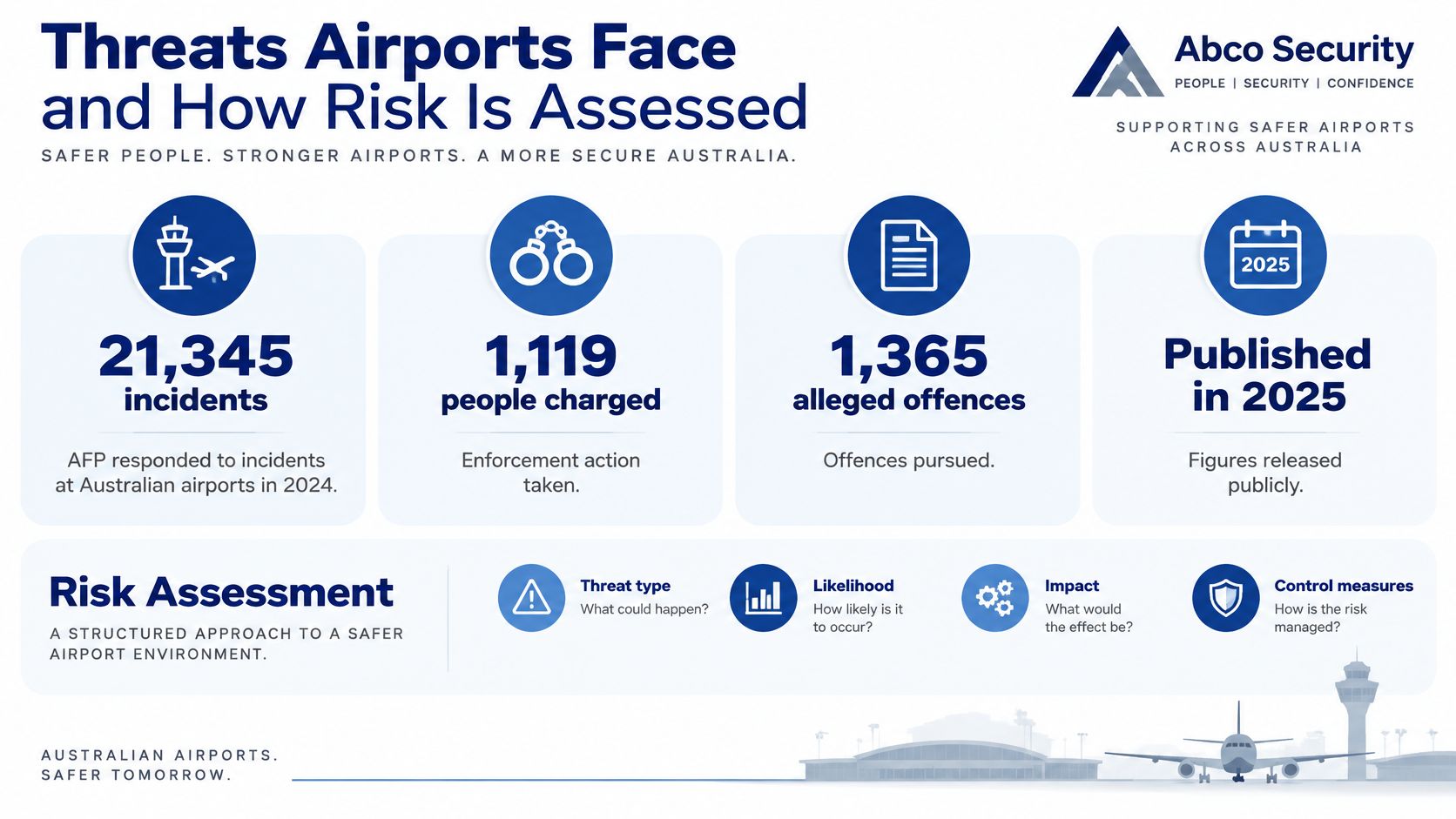
The Australian Federal Police responded to 21,345 incidents at Australian airports in 2024 and charged 1,119 people with 1,365 alleged offences, publishing those figures in 2025. Airport security planning therefore needs to address everyday incidents and access failures, not just deliberate attacks on aircraft.
For aviation security in Australia, the central question is accountability: whose approved program governs each control, and who can prove it was followed? A contractor's procedure only counts as compliant when it matches the airport's approved arrangements and the applicable Aviation Screening Notice.
Who Regulates Aviation Security in Australia
Aviation security is a regulated national system with split responsibility: the Commonwealth sets requirements, while aviation operators and their contractors implement controls.
Aviation security regulators and who they bind
| Body or instrument | Role | Who it applies to |
|---|---|---|
| Aviation Transport Security Act 2004 | Legal framework for security-controlled airports and zones | Airports, airlines and other regulated entities |
| Aviation Transport Security Regulations 2005 | Operational rules, including approved transport security programs | Regulated aviation participants |
| Department of Home Affairs | Defines required security outcomes and issues Aviation Screening Notices | Airports and aviation security providers |
| Office of Transport Security, created December 2004 | Established to administer and oversee the Act | Regulated participants and the Department |
| Airports and their contractors | Deliver screening and access controls on the ground | Screening staff, guards and contract teams |
| Australian Federal Police | Respond to incidents and offences at airports | Airport workers, passengers and visitors |
| ICAO Annex 17, Chicago Convention | International security standard implemented through Australia's framework | Contracting states and their aviation operators |
The Department of Home Affairs traveller-screening guidance explains the operational division: government establishes security requirements, while airports and their contractors deliver screening. The Office of Transport Security entry describes the framework's establishment, not a separate present-day screening provider.
Where split accountability breaks down
Buying a scanner doesn't establish compliance. The operator also needs documented procedures, competent personnel, equipment controls, escalation arrangements and quality assurance suited to its screening configuration.
The vulnerable point is often an interface between organisations. An airport may control credentials, a contractor may staff the gate, and another team may monitor CCTV. Unless the instructions specify who checks permission, who resolves a discrepancy and who records the outcome, each team can assume another has completed the control.
Consider a maintenance contractor arriving outside normal working hours. A recognised company logo on the vehicle isn't entry authorisation. The gate officer needs an approved method for checking the person, vehicle, destination and any escort conditions, plus an escalation contact who can make the decision.
Practical rule: A contract can allocate tasks, but it doesn't make an unapproved local shortcut acceptable.
Map controls to an accountable party
Start with the site's actual activities rather than its organisation chart. List screening, vehicle admission, visitor management, restricted-door monitoring and incident handover, then identify:
- Program owner: The aviation participant whose approved arrangements govern the activity.
- Delivery owner: The team performing the task and its supervising officer.
- Evidence owner: The person responsible for retaining records and resolving omissions.
Run that check this week. Any control without an identifiable program owner needs clarification before staff receive their next instruction.
How 2001 Shaped Aviation Security in Australia
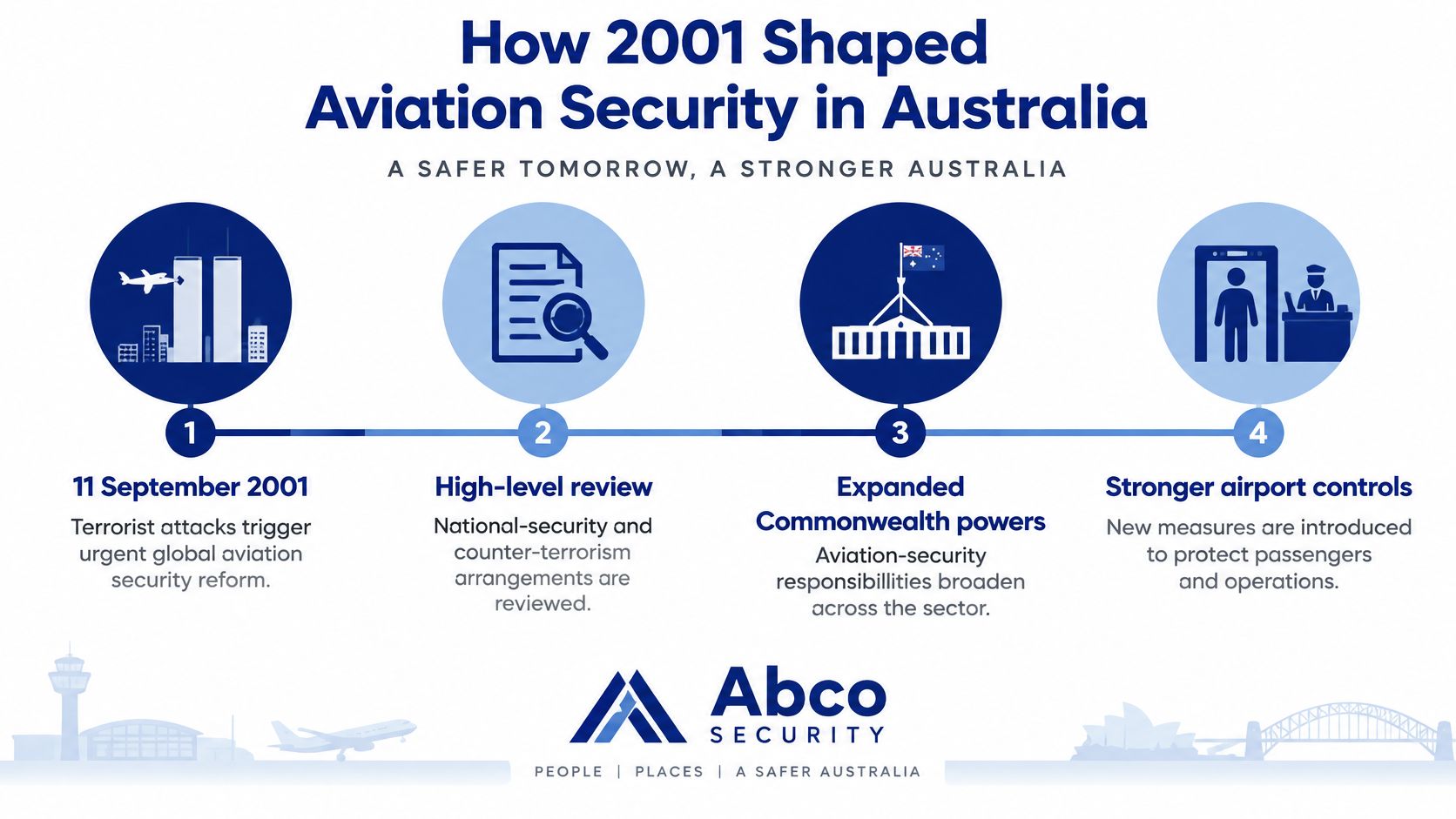
The terrorist attacks of September 2001 prompted Australia to review national-security and counter-terrorism arrangements and expand Commonwealth aviation-security administration and investment.
The legislative sequence is recorded in the Aviation Transport Security Act framework:
- 3 March 2004: Parliament passed the Aviation Transport Security Act 2004.
- 10 March 2004: The Act received Royal Assent.
- December 2004: The Office of Transport Security was created.
- March 2005: The supporting regulations commenced the framework's main operational phase.
The transition established a national approach to protecting civil aviation.
What that history means for contractors
The change replaced a fragmented approach with explicit Commonwealth regulation. Airports, airlines and other regulated participants became responsible for developing and following approved transport security programs.
That's why an auditor asks for more than a guard roster. Instructions, authorisations and completed records demonstrate how the regulated obligation becomes an operational task.
Say a contractor introduces its standard gate procedure at a regional airport. Even a well-written template needs reconciliation with that airport's approved arrangements before use. A familiar process isn't necessarily an authorised process, particularly where local zones, access permissions or escalation responsibilities differ.
Threats Airports Face and How Risk Is Assessed
The AFP's airport incident workload demonstrates the breadth of response demands, but an aggregate incident total doesn't identify the likelihood of a particular attack. Don't treat every police attendance as terrorism, or assume a quiet incident register proves that perimeter controls work.
A useful assessment combines threat, likelihood, impact and control effectiveness. Review the evidence associated with each exposure rather than assigning ratings from intuition.
Threat categories and the evidence to review
| Threat category | Typical example | Evidence to review |
|---|---|---|
| Unlawful interference | Weapons or prohibited articles reaching airside | Screening detection and alarm-resolution records |
| Unauthorised airside access | Staff or visitors entering without required credentials | Access logs, CCTV and breach reports |
| Insider threat | Misuse of legitimate credentials | Induction records and access audits |
| Perimeter intrusion | Entry through fencing, gates or car park boundaries | Patrol logs, alarm history and CCTV coverage gaps |
| Disruptive behaviour | Conduct that delays operations | AFP incident figures and local incident reports |
| Operational occurrences | Procedural or equipment failures exposing a control | ATSB occurrence records and internal safety reports |
The distinction between a hazard, a threat and the resulting exposure matters when writing a threat and risk assessment. A damaged gate is an observed condition; unauthorised entry through it is a scenario requiring assessment.
The incident figures and assessment elements are summarised below.
Use safety occurrences without mislabelling them
The Australian Transport Safety Bureau's year-in-review states that 7,636 aviation safety occurrences were processed and added to its database in 2025, with searchable records extending from July 2003. These are safety occurrences, not a measure of airport crime or deliberate security threats.
They can nevertheless help managers test assumptions. An occurrence involving a procedural failure may justify examining contractor induction or emergency coordination, without proving that a security breach occurred.
Use a monthly review cycle:
- Search relevant records for the airport, activity or operating environment.
- Classify contributors as human, procedural, equipment-related or access-related.
- Assign corrective action to a named owner, with evidence required for closure.
- Keep reporting categories separate, distinguishing safety events, security breaches, suspicious activity and workplace incidents.
Build the risk register around the scenario, location, existing control, evidence reviewed, remaining exposure and action owner. Don't close an action merely because somebody issued a revised procedure. Check that staff received it, understood it and can perform it under operating conditions.
Screening, Zones and Access Rules That Apply
Screening is compulsory before entry to the secure terminal area, including for passengers, visitors, aircrew, airport workers, assistance animals and pets. Home Affairs' airport-screening guidance also explains that regional airports use a mixture of body scanners and walk-through metal detectors.
Different equipment doesn't automatically mean weaker security. It means the local procedure, passenger instructions and contingency arrangements must suit the installed configuration.
Screening layers and when each applies
| Screening layer | When it applies | What it detects |
|---|---|---|
| Primary screening, body scanner or walk-through metal detector | Everyone entering the secure terminal area, using the applicable screening process | Weapons and prohibited articles, with capability determined by the method |
| Explosive trace detection, complementary | Metal-detector configurations, with random selection at the prescribed minimum rate | Explosive traces that metal detection cannot identify |
| Explosive trace detection, secondary | Following a primary-screening alarm | Explosive traces, supporting documented alarm resolution |
Apply the notice, not an improvised sampling routine
Under the Home Affairs explosive trace detection requirements, where body scanners don't screen 100% of eligible people, airports must randomly and unpredictably select at least the prescribed minimum percentage for ETD. The applicable Aviation Screening Notice governs that requirement.
ETD is a complementary or secondary layer, not a universal substitute for primary screening. Operators need maintained instruments, competent sampling, controlled handling and a clear alarm response.
A supervisor shouldn't replace random selection with an easily predicted queue pattern. Nor should staff treat a test result as permission to bypass the remaining required screening process.
Explain liquids restrictions accurately
For flights subject to liquids, aerosols and gels restrictions, the Home Affairs permitted-items guidance sets a maximum container capacity of 100 mL or 100 g, with containers fitting in one transparent resealable bag per passenger, whose sealed area totals no more than 80 cm around its four sides. Under that container-capacity rule, a 150 mL bottle containing only a little liquid still fails.
Don't turn that into blanket advice for every domestic checkpoint. Passenger-facing instructions need to identify the flight context and applicable restrictions, including any permitted exceptions, before staff advise someone to surrender an item.
Identify the zone before authorising access
The Aviation Transport Security Act's zoning provisions distinguish airside and landside areas and allow airside security zones, airside event zones, landside security zones and landside event zones. A temporary function or works activity therefore needs more precision than a general airport address.
For spatial context, Waymap's guide lets managers explore airside airport operations. It supplements orientation, not airport authorisation.
Before drafting an induction, confirm the zone boundary, screening configuration and permitted movement route. Translate those into site-specific access control policies that tell staff what to check and what to do when entry can't be authorised.
Service Options for Airports and Aviation Operators
Match the service to the risk and zone, not to a default post. A visible officer at the wrong location can leave the actual entry route unprotected.
Security services matched to aviation gaps
| Service | Best suited to | Core controls |
|---|---|---|
| Static guarding | Checkpoints and fixed posts | Licensed guards checking credentials and logging entries |
| Mobile patrols | Perimeters, car parks and landside areas | Scheduled and random patrols with recorded reporting |
| Gatehouse security | Vehicle access to airside roads and works areas | ID checks, permits and vehicle logs |
| Access control and CCTV | Restricted doors and zones | Credential systems and monitored footage |
| Rapid response | Alarm activations and escalated incidents | Attendance, containment and handover to airport or police |
| Construction security | Airport works and contractor sites | Site access, contractor induction and materials control |
| Event security | Airport functions and visitor events | Entry control, ID verification and incident reporting |
Compare coverage against the actual task
Consider a fenced maintenance yard at a regional airport. If vehicles arrive throughout operating hours and the fence line extends beyond the gate officer's view, gatehouse security plus mobile patrols may be more suitable than an isolated static post.
The gatehouse controls admission. Patrols inspect the fence, parked vehicles and doors away from the entrance. Asking the gate officer to walk the boundary leaves the entry point unattended unless the procedure provides relief or closes access.
There's a trade-off. Static guarding provides continuity at a fixed point but limited geographical coverage; patrols cover more ground but aren't continuously present everywhere. CCTV supports verification and investigation, but someone still needs responsibility for assessing alarms and initiating action.
Don't buy patrol visits to solve a problem that requires continuous admission control.
Specify the outcome before comparing prices
For each gap in the risk register:
- Name the service and zone: Identify exactly where the officer or system operates.
- Describe the control: Specify what must be checked, recorded or escalated.
- Test the alternative: Explain why a cheaper or default arrangement would leave exposure unresolved.
ABCO Security Services Australia delivers static guarding, mobile patrols, gatehouse security, construction security and event security. Each relevant service needs a scope tied to the site's zone map rather than a generic deployment description.
Use service delivery standards to make acceptance measurable through completed checks, reporting quality and escalation performance. Don't confuse a rostered presence with a completed control.
Physical security also has digital dependencies. Where guest connectivity forms part of the operating environment, Purple Shield's airport WiFi threat prevention resource offers a separate consideration for IT and procurement teams. Keep network-security responsibilities explicit rather than assuming a guarding contract covers them.
Compliance Checks for Commercial Tenders
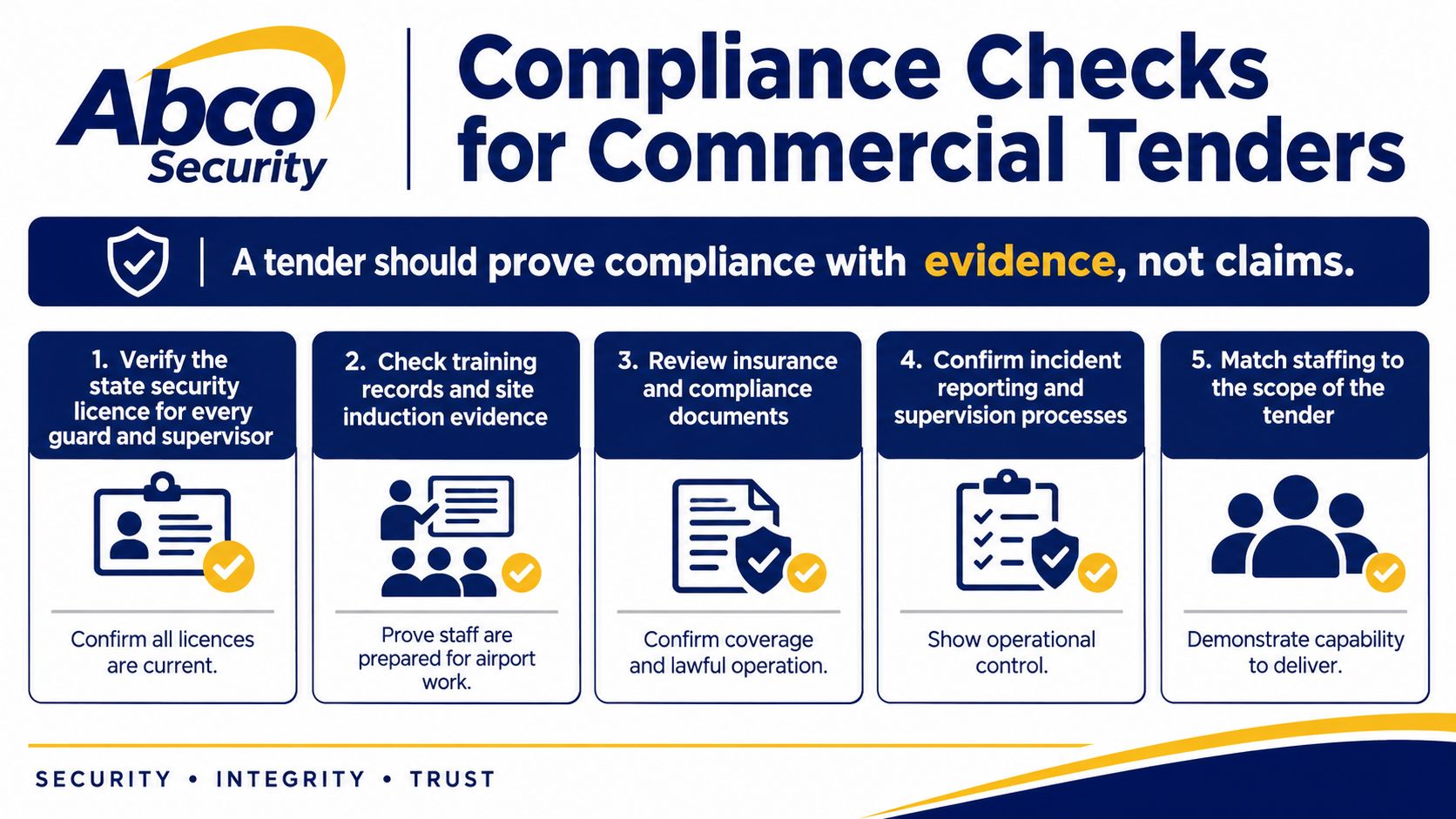
A tender should prove compliance with evidence, not claims. A low price isn't comparable with another bid until both cover the same posts, operating conditions, supervision and reporting duties.
Require evidence against each check
Verify licences for every guard and supervisor. For a Melbourne site, check the relevant Victorian licence and authorised activities rather than accepting a company-wide assurance.
Examine training and induction records. Confirm preparation in conflict resolution, first aid, OH&S, customer service and emergency response, then check the airport-specific induction separately.
Review airport-specific procedures. Require alignment with the approved program and applicable Aviation Screening Notice, including instructions for unavailable equipment and unresolved alarms.
Test the escalation path. Identify the airport's authorised screening authority and police referral arrangements, including who can make decisions outside normal business hours.
Inspect sample operational records. Request patrol logs, access logs and incident reports, plus ETD selection and alarm records where those activities fall within scope.
Check professional care, insurance and supervision. Establish how the provider will exercise the duty of care and skill expected in the relevant state and demonstrate operational oversight.
Require a site-specific risk assessment before pricing. A bidder must understand the access routes, zone boundaries and task conflicts before proposing staffing.
The visual checklist provides a procurement cross-check.
Score demonstrated capability
An equipment-heavy bid with no airport-specific operating instructions should score poorly. A scanner list doesn't explain who handles a failed check, how access remains controlled or where the incident record goes.
Use Home Affairs traveller-screening requirements as the authority reference in the specification, then organise the supporting regulatory compliance documentation by requirement. Mark each tender response as evidenced, incomplete or unsupported, with mandatory failures resolved before price comparison.
Our guards are fully licensed under relevant Australian state regulations and receive ongoing training in conflict resolution, first aid, OH&S, customer service and emergency response. Our licensed and vetted guards are Security Licence VIC compliant.
For Sydney, Brisbane and Perth sites, verify the matching NSW, QLD or WA licence and authorised activities before award. A Victorian credential isn't a substitute for checking the requirements where the work occurs.
Where procurement also includes connectivity, Purple's airport WiFi RFP considerations can help structure that separate technical workstream. Define the interface with security operations without blurring accountability between the guarding provider and network contractor.
Book a Site Risk Review Before Your Next Audit
Test your arrangements against the applicable rules before the next audit or tender. A contractor's control only counts as compliant when it matches the airport's approved program and the applicable Aviation Screening Notice, so the review has to trace each site practice back to its governing requirement. Start with the documents staff use, not just the policy folder.
A document review should connect written instructions with operational evidence.

Bring the records that reveal control gaps
- Approved arrangements: The transport security program or relevant authorised procedures.
- Site context: A current zone map and the contract or specification.
- Operational evidence: Recent incident reports, access records, patrol logs and unresolved corrective actions.
That evidence shows where a control exists on paper but breaks down in practice. The review should map each control to its governing requirement, identify gaps against zone and screening arrangements, and produce a short corrective-action list with named owners. Set the next review around operational changes as well as the audit calendar, using a considered security risk review frequency.
We provide a free on-site risk assessment, then develop a customised security plan around your environment, industry and budget. We operate across Australia, including Melbourne, Sydney, Brisbane and Perth; confirm whether your specific site falls within our service area when you book, as coverage varies by location.
This company video provides further context before you arrange the discussion.
Call (03) 9001 0024 or email info@abcosecurity.com.au with your site location, operating scope and next audit date.
ABCO Security Services Australia offers a free on-site risk assessment and customised planning for airport and aviation-related security requirements. Visit ABCO Security Services Australia to request a review before your next audit date and identify which controls, records and responsibilities need attention.
about
avada factory
Sempery ultricies nibh at dolor cras urna eleifend nec. Atiam efficitur tempor.