Adding more barriers can make a crowd less safe, not more. When a barrier line narrows an exit, creates a dead end, or pins people against a stage, you've increased pressure while reducing escape options. That's why crowd control barrier hire isn't a counting exercise. It's a crowd-flow and egress decision, and it needs licensed staffing, accessible routes, and a written layout planned before you compare prices.
Crowd Control Barrier Hire Options at a Glance
Start with the spread, because hire prices use different units and don't compare cleanly at first glance.
Crowd control barrier hire options and reported rates
| Option | Typical use | Reported hire price |
|---|---|---|
| 1 m alloy crowd barrier (BJs Sound & Lighting, Brisbane) | Queues and pedestrian separation | $70.00 per night |
| Crowd control barrier event hire (Cheema Hire, Sydney) | Event queuing and access lanes | $12.00 to $24.00 (unit not stated) |
| Temporary fencing, pedestrian barrier category (iseekplant, Australia) | Perimeter and controlled access | $7 to $10 per metre per week |
| Crowd control barrier (Flexihire, Australia) | Short-term event hire | Price not stated, minimum 24-hour term |
| Stage-front barrier with 7 kN/m rating | Stage pressure and pit separation | Quote required |
| Hostile-vehicle barrier | Vehicle exclusion at major events | Quote required, licensed installation |
What each reported rate actually tells you
BJs Sound & Lighting Hire in Brisbane lists a 1-metre alloy crowd barrier at $70.00 per night. That's a clear unit for a single-night event. Use it as a budgeting anchor for short, staffed events, not for a week-long perimeter.
Cheema Hire in Sydney lists crowd control barrier event hire at $12.00 to $24.00, but the page doesn't state the unit. Before you budget, confirm whether that's per barrier, per day, or per hire period. A low headline figure means little until the unit is pinned down.
For longer runs, iseekplant's temporary fencing rates report $7 to $10 per metre per week in Australia, with crowd-control barriers described as a pedestrian-barrier category for event management and controlled access. That weekly per-metre basis suits construction perimeters and multi-day sites better than a per-night rate.
Flexihire's crowd control barrier page states a minimum duration of 24 hours and no price on the cited page. Treat that as a term to confirm, then request the rate in writing.
Stage-front and hostile-vehicle barriers are quote-only for good reason. Load rating, pit components, delivery, and licensed installation drive the cost, and none of that fits a flat per-panel price. Rates also shift across Melbourne, Sydney, Brisbane, Perth, and surrounding cities, and by hire period.
If you're coordinating barriers alongside marquees, staging, and site services, it helps to plan your event equipment rentals as one schedule so deliveries don't block the lanes you're trying to keep clear.
Comparison checklist: unit of measure, minimum term, delivery, installation, and whether GST is included. Confirm all five before you compare totals.
Every figure above is a budgeting starting point, not a quote. For our part, we only provide estimates, not quotations or binding indications of charge, and all amounts stated, orally or in writing, are exclusive of GST.
Why Barrier Layout Matters More Than Barrier Count
More barriers don't equal more control. Australia learned that the hard way.
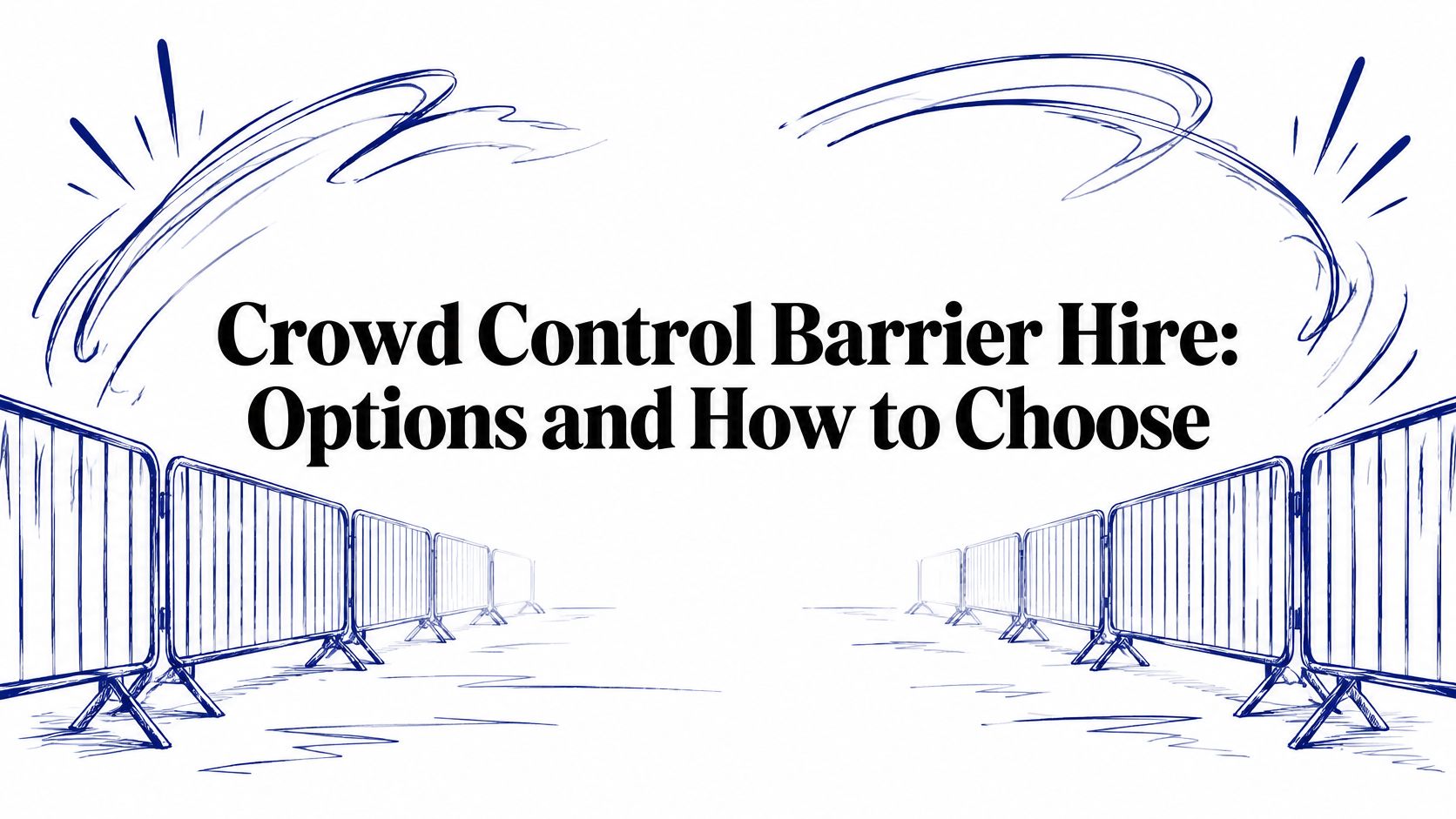
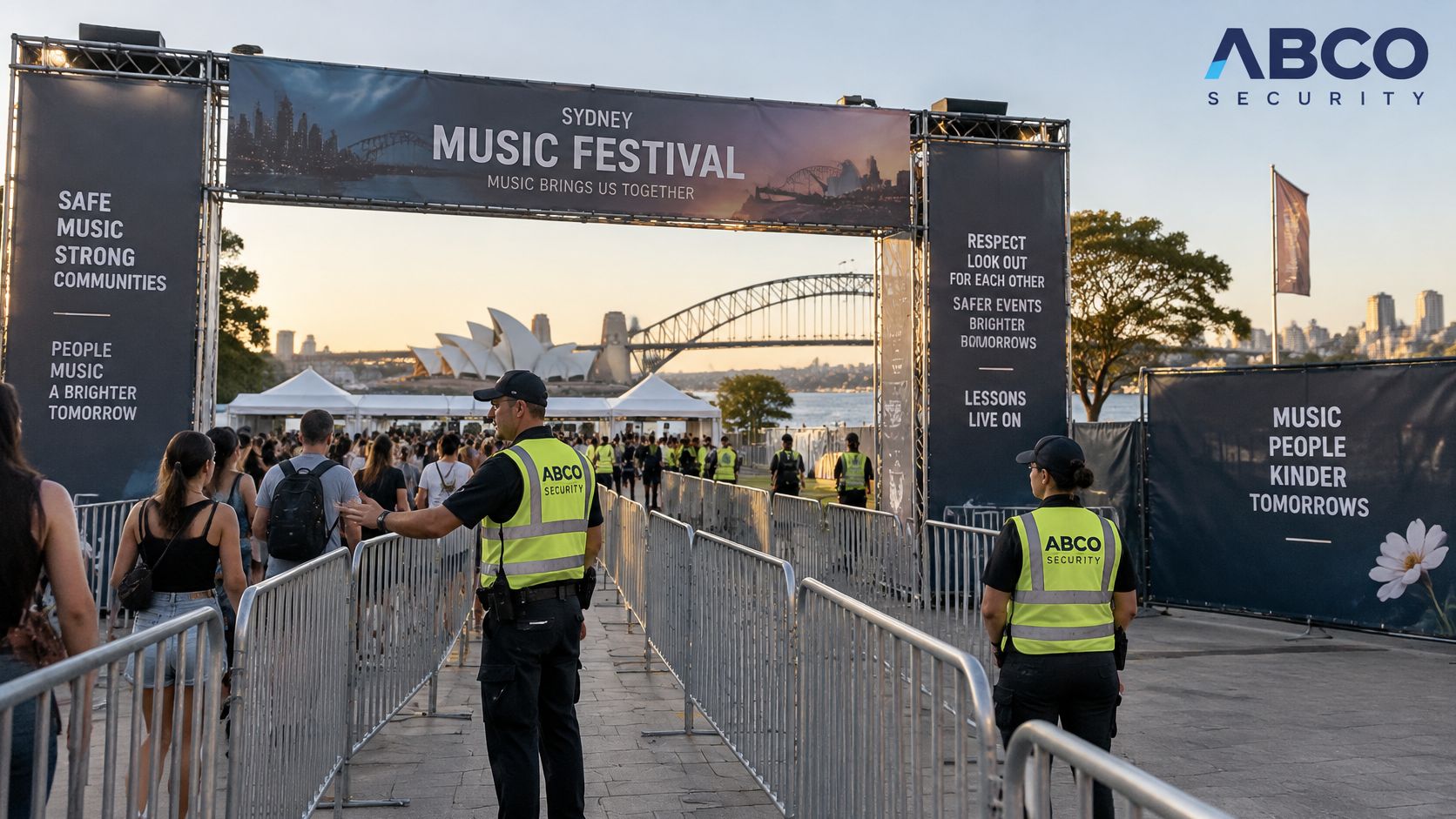
This entry-point image shows the basic job barriers do well, separating an arriving crowd into managed lanes before pressure builds.
The case that changed Australian planning
The ABC's history of crowd crush in Australia records that 16-year-old Jessica Michalik died after being crushed during Limp Bizkit's performance at the 2001 Big Day Out in Sydney, and a coronial inquest concluded organisers had not done enough to prevent a dangerous crowd crush. The lesson still shapes event planning. Barriers can create confined spaces, restrict movement, and place people against a stage-front line. In response, Big Day Out introduced controls including a D-shaped barrier to separate the mosh area from the wider audience.
The two numbers that govern layout
WA Health's public event guidelines state crowds should not be held at densities closer than 4 persons per square metre for longer than six minutes, and recommend queue flow no slower than 0.5 m/s. Those are operating limits, not background trivia. If flow drops below that pace, you open more lanes, remove unnecessary restrictions, or deploy staff to regulate arrivals.
I would measure your entry lanes against those figures at peak arrival, not at a quiet rehearsal. A layout that works with staff walking through it can fail when patrons arrive in a bunch from one train or car park.
The short video below is useful background on how entry design and staff positioning interact once real crowds arrive.
Layout rules that prevent pressure traps
- Keep egress lanes clear: never let a queue barrier borrow width from an emergency exit route.
- Separate opposing flows: inflows and outflows that mix create turbulence and slow both directions.
- Avoid dead-end pens: any enclosed area needs a relief point before pressure builds.
- Plan break-through points: mark where barriers open in an emergency and who staffs each point.
People follow the straight line rule. They take the quickest route and resist barriers or signs that redirect them, so your layout must guide movement along routes people already want to take. Fighting that instinct with extra panels just concentrates pressure at the corners.
Our guidance on crowd management techniques covers how stewards monitor density and open lanes before a pinch point becomes dangerous. The deliverable you should demand is a barrier plan showing capacities, access points, emergency gates, and steward positions. A delivery quantity on an invoice isn't a plan.
Stage and Pedestrian Barrier Specifications to Check
A hire order that lists panel counts but not test values leaves the highest-risk part of the job undefined. Before accepting a barrier for a crowd-pressure point, ask the supplier to complete this specification sheet for the exact panel system being delivered.
Barrier specification values to request from the hire company
| Requirement | Reference value | Applies to |
|---|---|---|
| Temporary fence height | Height suited to the site risk, stated in the supplier's specification | Temporary fencing |
| Climb resistance test | Documented test load, hold time and pass criteria | Temporary fences |
| Stage barrier load capacity | 7 kN/m right-angle load | Stage-front barriers |
| Audience-side barrier height | Preferably 1.2 m, never less than 1.1 m | Stage-front barriers |
| Distance from stage | At least 1.5 m | Intervention pit |
| Pit entry and exit width | At least 1.1 m, unobstructed | Intervention pit |
Temporary fencing basics
For perimeter fencing, assess the system as it will be installed: height relative to site risk, footing stability, bracing, connection strength and climb resistance. Height alone does not create control when the feet can be shifted or the couplers worked loose. Confirm those details on the delivered panels rather than relying on a catalogue photograph.
Where mesh panels form part of the perimeter, explore wire mesh fence applications to compare how aperture, rigidity and frame construction affect visibility, climbing resistance and wind behaviour. Our guide to security fencing types can then help match the panel style to the setting.
Stage barriers are a different product
WA Health's event guidelines, section 7 set the stage-front values: a right-angle load of 7 kN/m, an audience-side height of preferably 1.2 m and never less than 1.1 m, a stage separation of at least 1.5 m, and unobstructed pit entry and exit widths of at least 1.1 m.
That separation creates the intervention pit where crowd controllers can observe distress, reach a patron and move them out without forcing an extraction through the audience. The guidance also calls for a raised observation platform and rules out sharp protrusions, finger traps and thoracic-compression hazards. Those components belong in the barrier plan alongside controller positions and accessible routes, because a correctly rated line can still fail if the pit cannot be reached or used.
What to ask for in writing
- Load documentation: the test figure and pass criteria for the exact assembled barrier system.
- Audience-side measurements: the height at the point where crowd pressure reaches the torso.
- Hazard inspection: confirmation that panels have no sharp protrusions, finger traps or entrapment points.
- System compatibility: panels, feet, couplers, access sections and pit components that connect as one rated system.
- Installation limits: the surfaces, bracing and configurations covered by the supplier's specification.
A lightweight pedestrian fence is not a stage-rated barrier, even if it looks similar from ten metres away.
An unrated barrier can deform when pressure concentrates near the stage. That deformation is where falls, compression injuries and uncontrolled access start.
Barrier Choices for Events, Retail and Construction Sites
The same panel does different jobs in different settings, so the setting sets the plan. Staffing sits alongside the barriers, not behind them.
Barrier and staffing needs by setting
| Setting | Main barrier need | Staffing or add-on |
|---|---|---|
| Festival or sporting event | Stage-rated barriers, pit, queue lanes and emergency gates | Licensed crowd controllers and event security |
| Shopping centre or retail precinct | Pedestrian queue barriers and entry lanes | Retail security and shopping centre security patrols |
| Construction site | Perimeter fencing and controlled gates | Gatehouse security, visitor logs and 24-hour guarding |
| Corporate office or concierge entry | Lobby queue barriers and reception routing | Concierge security and reception |
| Residential estate or strata | Gate and pedestrian access control | Gatehouse security and mobile patrols |
One example per setting
Say you're running a festival main stage. You need the rated stage barrier, an intervention pit, entry queue lanes, and emergency gates, with Event Security staff at each pressure point. Our Events Security covers crowd control, asset protection, and high-risk industrial environments, with bespoke security strategies designed for each, because a festival crowd and an industrial shutdown don't behave the same way.
Now picture a shopping centre running a major sale. Pedestrian queue barriers shape the entry lanes, but Shopping Centre Security and Retail Security patrols manage the flow, watch for queue jumping disputes, and keep fire exits clear. The barrier guides, the patrolling officer decides.
On a construction site, perimeter fencing and a controlled gate do the heavy work. Our construction site guards handle gatehouse access control, equipment and material protection, visitor and contractor log-in management, fire watch and safety inspections, and 24-hour static guarding and response. Our gatehouse officers also manage vehicle and personnel entry, monitor delivery logs, and verify work permits, which is Construction Security and Gatehouse Security working as one system.
A corporate lobby needs a lighter touch. Queue barriers route visitors through reception where Concierge Security staff verify appointments and issue passes. Heavy pedestrian fencing would look wrong and work worse.
A residential estate spread across severalentries combines gate control with Mobile Patrols covering the gaps between fixed points. One static officer can't watch three pedestrian gates at once.
Before comparing prices, ask which barrier types suit your setting. Our comparison of temporary fencing versus hoarding is a useful starting point for construction and redevelopment sites. A low-cost pedestrian barrier placed at a stage front won't meet stage load requirements, whatever the saving.
Who Must Staff and Install Hired Barriers
Hired barriers don't manage a crowd on their own. They hold a line. People manage behaviour, watch pressure, and open gates at the right moment.
Crowd control is a defined role
The Fair Work Security Services Industry Award 2020 defines a crowd controller as a person principally employed to maintain order in a public place, including a licensed venue or event, with duties including screening entry, monitoring or controlling behaviour, and removing people. Checking tickets, invitations, or passes is excluded from that definition.
That exclusion matters for your roster. Ticket scanners and crowd controllers are different roles, costed and rostered separately. A staff member scanning passes at a barrier gap isn't performing crowd control, and treating them as interchangeable leaves the pressure points unwatched.
Award coverage also extends to crowd, event, or venue control carried out through physical or electronic means, plus patrolling, protecting, screening, watching, or guarding people and property. Check your obligations against the current award text and your state or territory licensing rules before you finalise numbers.
Who stands at the barrier
Where barriers form queues, exclusion zones, or stage-front separation, allocate trained and appropriately licensed personnel to monitor behaviour, manage pressure points, and support emergency procedures. Our event security officers are RSA-qualified and crowd-control-licensed. They manage entry and access control, ID verification and wristband management, crowd behaviour monitoring, VIP protection and backstage management, and alcohol compliance and incident reporting.
Our guide to event security staffing explains how to match officer numbers to entry points and crowd profile. Security Guarding at a fixed gate and crowd controlling at a stage pit are both licensed work, but they need different briefings and different supervision.
Roster the person to the function, not to the gap in the fence.
Vehicle barriers carry licensing obligations
Hostile-vehicle protection is a separate discipline. NSW Police hostile vehicle mitigation guidance states suppliers of specialist security products must hold a master security licence, installers of specified security equipment must hold a Class 2C licence and work under a master security licensee, and installing such equipment without the required licence is an offence.
Standard pedestrian barricades must never be presented as tested vehicle-security barriers. If your risk assessment identifies a vehicle threat, you need security-rated equipment installed through appropriately licensed providers, not extra bike-rack panels.
Accessible and Multilingual Crowd Design
Barrier layout decides whether disabled guests, multilingual audiences, and the end-of-event surge can move safely. Hire pages rarely cover this, which is exactly why layouts fail these patrons first.
Design the whole pedestrian journey
NSW event safety and security guidance requires crowd plans to consider people with disability and people who may not speak or read English, with signage visible from different heights and clear directions to accessible entrances, viewing areas, exits, toilets, first aid, and meeting points.
Apply that at barrier level. An accessible entrance that sits behind a general queue lane isn't accessible. A viewing area reached through a pinch point isn't either. Keep accessible routes continuous, wide enough for wheelchairs and prams, and free of pinch points from arrival to viewing position to exit.
Signage that works at crowd height
- Mount signs at varied heights: a seated patron's sightline sits well below a standing crowd's.
- Use pictograms and plain words: symbols cross language barriers faster than paragraphs.
- Mark the essentials: accessible entrances, viewing areas, exits, toilets, first aid, and meeting points.
- Check sightlines from inside the lane: walk the barrier line at patron height before opening.
Plan for the surge, not the average
Space exit points apart to reduce crush risk. People take the quickest route and resist redirection, so two exits close together behave like one crowded exit. At closing time, thousands leave at once, and exit lanes must empty the venue without merging into arrival flows or vehicle movements.
Site map check: accessible route marked, signage in the languages your audience uses, exit separation measured, and a steward assigned to every surge point.
Record those checks in the written barrier plan and verify them on the ground before opening. If a steward has to move a barrier mid-event to free a wheelchair user, the layout was wrong on paper first. Identify drop-off areas and routes for disabled people, taxis, and public transport in the same plan, so arriving patrons aren't crossing the exit surge to reach the gate.
Plan and Confirm Your Barrier Hire Order
Work through these steps in order. Each one changes what you hire, so skipping to quantities guarantees rework.
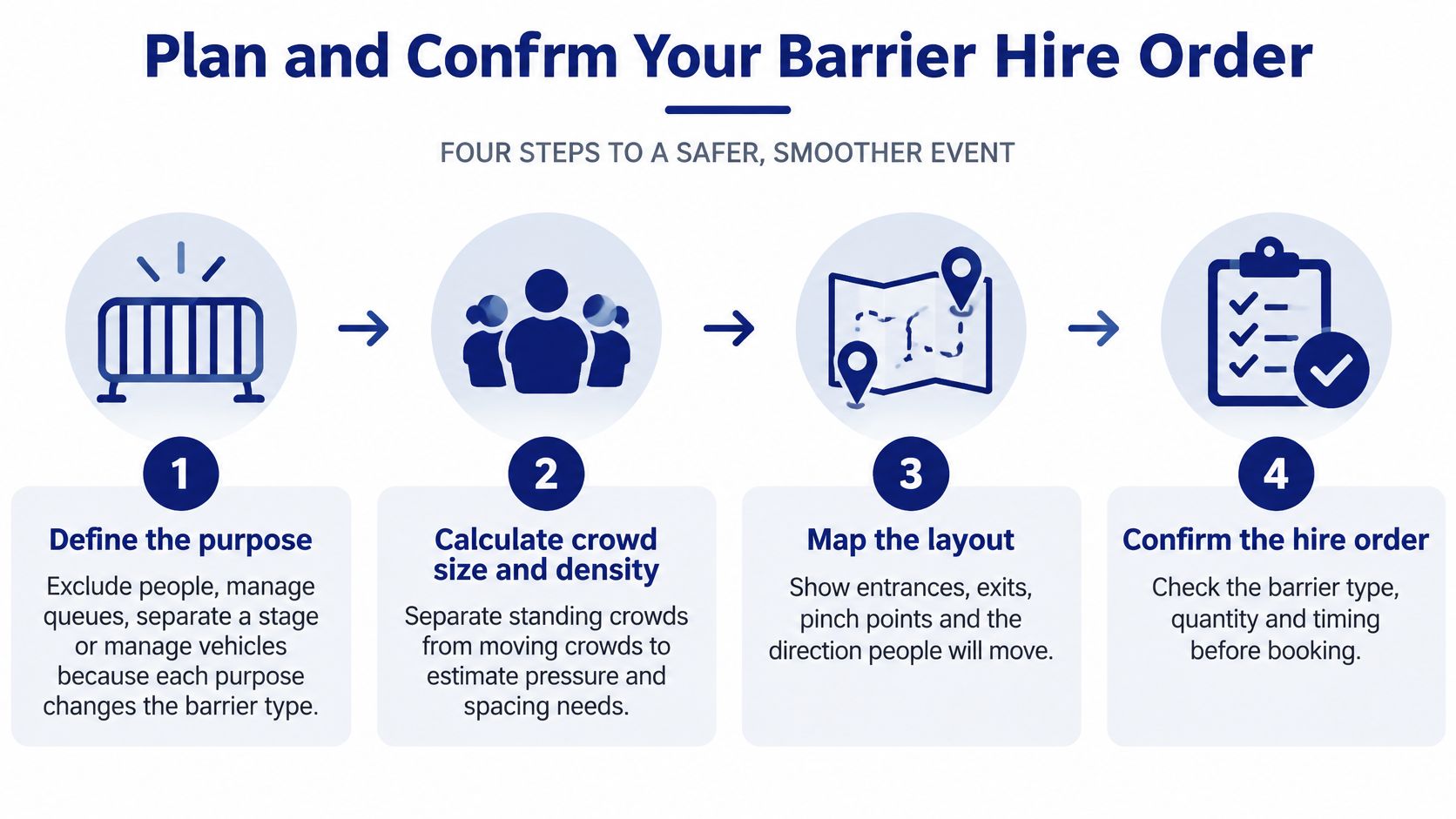
Steps 1 to 3 define the problem
1. Define the purpose. Are you excluding people, managing queues, separating a stage, or managing vehicles? Each purpose changes the barrier type. A psychological barrier such as a rope line suits orderly crowds only. A physical barrier must withstand crowd surges.
2. Calculate crowd size and density. Separate standing crowds from moving ones. Standing crowds build pressure, moving crowds build flow problems, and each demands a different layout. Events expecting large patron numbers need emergency planning proportionate to that risk, documented before barriers arrive.
3. Map egress and access. Mark emergency break-through points, accessible routes, and sightlines on the site plan. Keep pedestrian routes separate from vehicle routes wherever vehicles operate near entries and exits.
Our event risk assessment template gives you a structure for recording these decisions. If you're running a corporate function rather than a public festival, these practical tips for impactful corporate events cover the broader planning discipline that barrier layout sits inside.
Steps 4 to 6 select and install
4. Select against the specification sheet. Match height, load rating, and anti-entrapment design to the pressure each location will face. Don't let a supplier substitute a lighter panel at delivery.
5. Plan staffing and traffic. Assign steward positions and licensed crowd controllers to pressure points. Where vehicles operate near pedestrians, add traffic management so delivery trucks and patron queues never share a lane.
6. Confirm competent installation. South Australian government safety guidance on temporary fencing states temporary fences must be installed, moved, or altered by a competent and trained person following the supplier's instructions, remain stable and erect, and withstand a 65-kilogram load for three minutes in a simulated climbing test while remaining difficult to climb or crawl under. That guidance sits within the AS 4687 series, revised in June 2022, covering temporary fencing and pedestrian barriers at events and worksites. Check stability and connections on site, because incorrectly weighted or poorly connected equipment undermines both safety and compliance.
Step 7 confirms the commercial terms
7. Confirm everything in writing. Hire unit, minimum term, delivery and collection windows, installation scope, GST treatment, damage and reinstatement terms, and insurance. Then inspect the installed layout against the plan before you open.
Your finished written barrier plan should show capacities, access points, emergency gates, and steward positions, matched to the crowd map on the day. Our service booking form asks for the number of security officers required, so have your steward count ready when you enquire, along with any need for temporary guarding, ongoing patrols, or a surveillance system on the site.
ABCO operates from offices in Melbourne, Sydney, Adelaide, Perth and Brisbane, providing Event Security, Security Guarding, and Mobile Patrols for events and sites across Australia. We'd rather review your barrier plan before delivery than fix a layout after gates open. Send us the purpose, expected crowd size, and site map, and we'll assess staffing against the layout you've drawn.
If you're hiring barriers for an event, retail precinct, or construction site and want the layout, licensing, and staffing checked as one plan, contact ABCO Security Services Australia for a site assessment and estimate. Tell us your crowd size, site map, and the number of officers you think you need, and we'll confirm whether the barrier plan and roster will hold up on the day, wherever the job sits nationally.
about
avada factory
Sempery ultricies nibh at dolor cras urna eleifend nec. Atiam efficitur tempor.