A delivery driver is idling at your gate, a new subcontractor is looking for the site office, and plant is already moving inside the fence. Nobody has time to hunt for instructions. That's the test for construction site safety posters. If a person can't see the hazard, the required action, and the boundary at the moment of choice, the poster isn't controlling anything. It's decoration.
Posters Australian Construction Sites Must Display
A delivery driver at a Sydney gate and a rigger beside a Perth crane both make decisions in seconds. Each needs the hazard named, the action or ban stated, and the sign standing at the point of choice. Apply that three-part rule before you discuss colours, logos, or artwork.
In Australia, these posters aren't optional reminders. They're part of legally recognised hazard communication. The Work Health and Safety Regulations 2011 require signs for specific risks, including confined spaces and hazardous chemicals, and that link is your external authority reference for the federal requirements.
For confined spaces, signage must go up immediately before work begins and stay in place through preparation, the work itself, and completion. It must identify the space, warn that entry is prohibited without a confined-space entry permit, and sit clear and prominent beside every entry. For hazardous chemicals, a sign must warn of the particular hazard or state a person's responsibilities, placed next to the hazard.
Start With the Order List, Not the Artwork
Use the table below as the list you hand to a signwriter today. Confirm local wording with your state regulator before ordering, because principal contractors still need site-specific wording, contact details, and zone names filled in correctly.
| Poster | Must say | Where it goes | When it applies |
|---|---|---|---|
| Principal contractor board | Name, phones including after hours, site office | Readable from outside the workplace | Projects costing $250,000 or more |
| Confined space | Name the space; do not enter without a permit | Beside every entry | Immediately before preparation until completion |
| Hazardous chemicals | The chemical hazard or the person's duty | Next to the hazard | Whenever hazardous chemicals are kept or used |
| Gate PPE and conduct | PPE required; no smoking; no public access | Main entrance and visitor path | Occupied construction workplaces |
| Exclusion zone | Authorised personnel only, plus the zone name | With barricades at the danger | Falling objects, loading, unloading or mobile plant |
| Overhead electrical assets | Nature of the risk and how to avoid it | On the approach to every hazardous location | Work near overhead power; sign is not the only control |
| Public road interface | Changed conditions, pedestrian diversion, site vehicles | Public access points, matching the traffic plan | High-risk work on or next to a public road |
Projects costing $250,000 or more must show the principal contractor's name, telephone numbers including an out-of-hours contact, and the site-office location, visible from outside. Generic wording that doesn't identify who's responsible fails visitors, emergency services, and guards at the gate.
Prioritise falls, vehicles, falling objects, and electricity. That ordering matches the harm profile, because Safe Work Australia key WHS statistics recorded 41 construction-worker fatalities in 2025. A poster about housekeeping shouldn't crowd out a fall or plant-separation message at a live work front.
Before you print, check your planned set against the site's duties in construction site security regulations for Australian projects. If you're still choosing substrates, compare materials for construction safety signs from Evright Industrial to match gate, hoarding, and plant-route exposure before you commit the whole order.
Place Posters Where Decisions Actually Happen
A visitor reaches a side gate while a delivery truck approaches the same opening. The poster needs to give both a clear instruction before either enters the work area. Place signs along the route where workers, visitors and drivers make access and movement decisions, not on whatever wall has space.
From the Gate to the Work Front
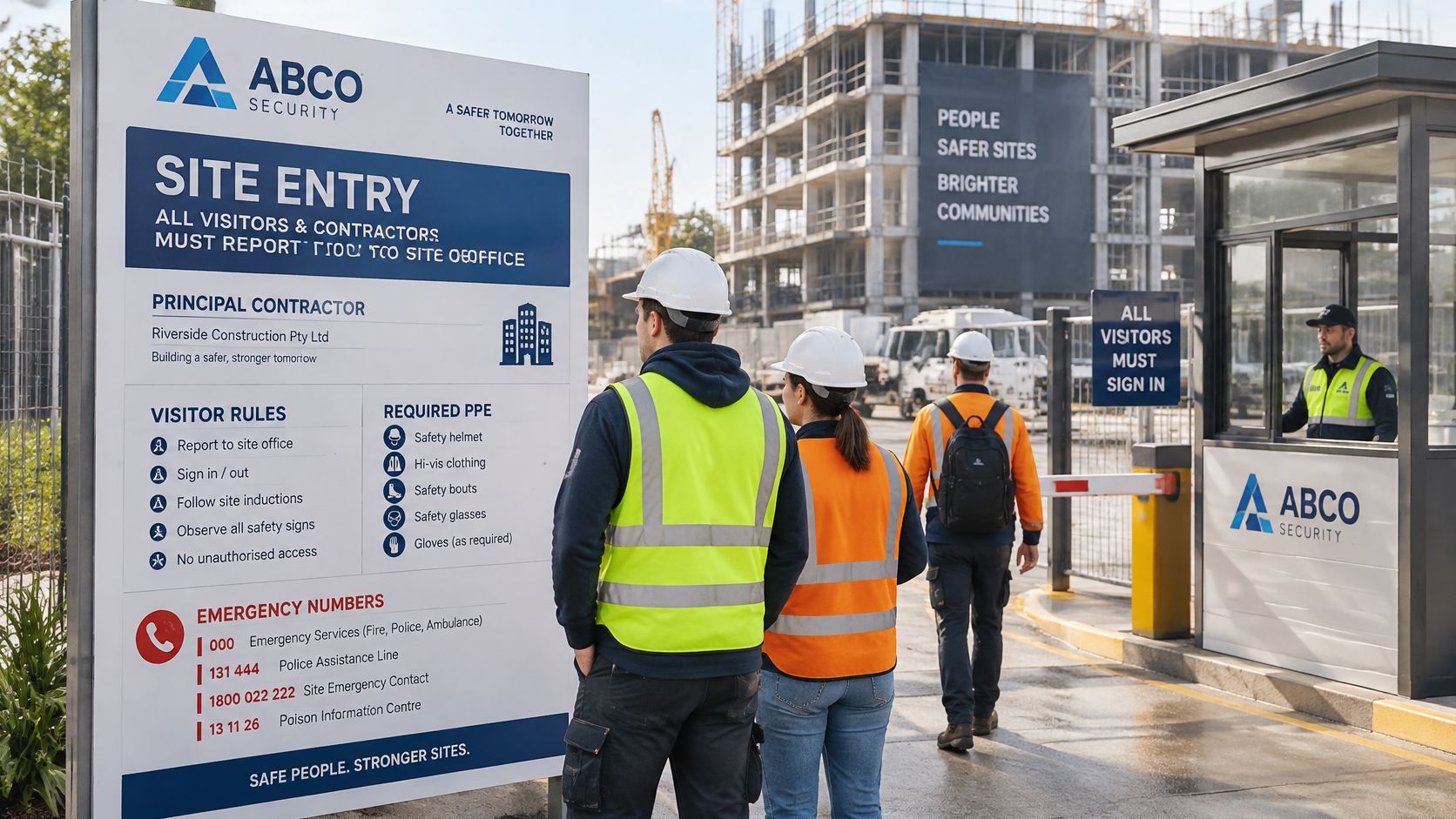
The main-gate board should give gatehouse staff, workers and subcontractors one consistent reference for site identity, visitor rules, PPE requirements and emergency numbers. Position it so people can read it before they enter or approach plant routes.
Repeat no-entry and authorised personnel only messages at each pedestrian and vehicle opening, including side gates, delivery entries and breaks in hoarding. A rule posted only at the main gate does not guide someone arriving through another access point.
At crane slew areas, loading zones and demolition faces, place exclusion-zone posters on the barricades. Remove them when the hazard ends. A sign left in place after the restriction has ended can weaken attention to active warnings.
The Safe Work Australia construction work code describes access control through clearly identified and separated work areas, with signage and barricades identifying exclusion zones during loading or unloading. A poster supports the boundary; it does not replace the physical barrier.
Face plant-route separation and speed messages towards both drivers and pedestrians. Set driver-facing signs where they can be read from the cab, and pedestrian-facing signs where people approach crossings. A sign aimed at only one group leaves the other without a clear instruction.
Use the video below to brief gatehouse staff on how access control and signage work together.
Public Roads and Overhead Power
At public-road frontages in Melbourne, Sydney, Brisbane, Perth and regional areas, display changed-condition, pedestrian-diversion and site-vehicle warnings that match the approved traffic plan. Work on or next to a public road is high-risk construction work and requires a safe work method statement before it starts. The poster should reinforce the approved arrangement, not introduce a different route or instruction.
Place overhead-line warnings on the approach, where operators and workers can act on them before reaching the hazard. State the risk and the stay-clear action, and make clear that barriers and permits still apply. If plant can reach the asset before the operator sees the sign, the sign is too late to serve as a warning.
If the person cannot see the poster at the moment of choice, it is in the wrong place.
Include missing, reversed or plant-blocked posters in Security Guarding and Mobile Patrols defect checks. Where guards hold a boundary, put the same exclusion-zone instruction in the Construction Security brief before mobilisation. The poster, permit conditions and gatehouse direction should agree.
How to Choose Design and Produce Each Poster
Run production from the risk register, not from a sign catalogue. A catalogue sells you everything. Your register tells you what's on this site, this month, with this crew.
The process below sets out the sequence from hazard list to installed, reviewable poster.
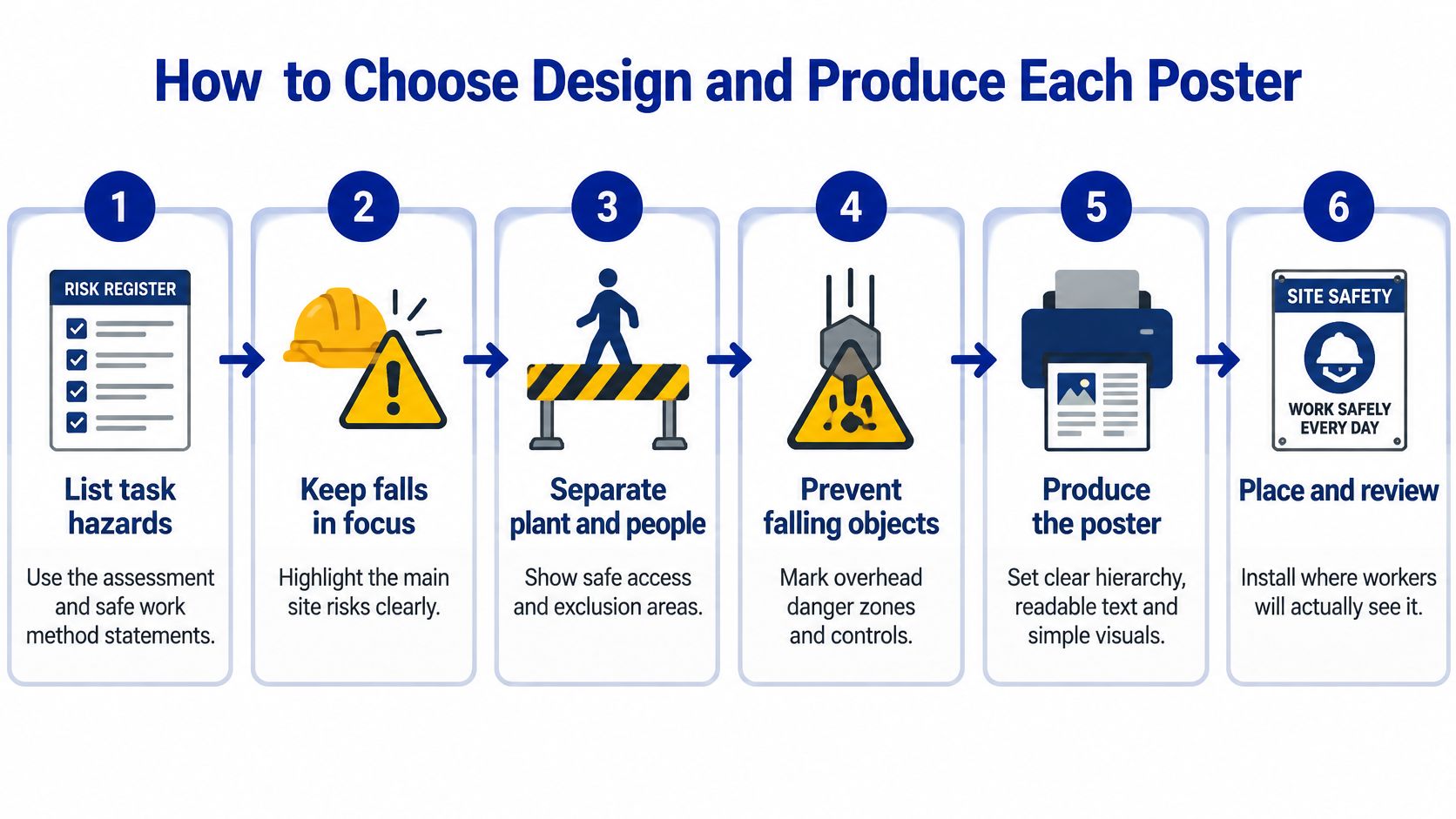
Five Production Steps
List task hazards first: Pull them from the risk assessment and safe work method statements. Keep falls, plant and pedestrian separation, falling objects, electricity, confined space, and emergency contacts at the top. The usual slip is starting with what the printer has on special.
Cap the wall set: Limit hoarding and amenities walls to those high-consequence topics. Twenty posters on one fence panel means none of them gets read.
Write one action, add one pictogram: Use plain English such as "Hard hat, boots, hi-vis, no entry without them" at the gate, or "Confined space, do not enter without permit" at each opening. Two actions on one poster usually means neither is followed.
Match material to exposure: Specify UV-stable correx or aluminium composite on gates, laminated vinyl on hoarding, photoluminescent panels on egress routes, and reflective faces on night plant paths. Aim for high contrast and text about 100 mm high where people read from 10 metres.
Give every poster an ID: Link it to induction and the pre-start, and record who owns it. Refuse any design offered as the only control for overhead power, falls, or plant movement.
The WorkSafe Victoria guidebook on powered mobile plant near overhead assets states signs should alert workers and remind them of requirements but must not be relied on as the only control for contact with overhead electrical assets. WorkSafe Victoria also distinguishes responsibilities among principal contractors, supervisors, contractors, tradespeople, labourers and apprentices, which supports role-specific posters. An apprentice ladder poster isn't the same message as one for a mobile-plant operator working near lines.
| Location | Material | Finish requirement |
|---|---|---|
| Main gate | UV-stable correx or aluminium composite | Survives sun, rain and dust |
| Hoarding | Laminated vinyl | Holds legibility through weather and dust |
| Egress route | Photoluminescent panel | Readable in low light |
| Night plant path | Reflective face | Visible to drivers and people on foot |
Templates a Signwriter Can Set Today
- Exclusion zone: "Authorised personnel only, [zone name], hard hat and hi-vis required beyond this line"
- Public boundary: "No public access, site vehicles and plant operating, use marked pedestrian route"
- Overhead power: "Overhead power, keep [distance] clear, barriers and permit apply"
- Principal contractor board: Organisation name, phone numbers including after hours, and site office location
Give each template an ID, install date, and owner so your audit log can match it to a hazard location. Tie the fall-risk posters to your documented controls when you review SWMS records and fall risk access requirements, because the poster should repeat what the safe work method statement already requires.
Your printer acceptance line is simple. Correct wording, correct pictogram, site name, install date, and a finish that survives sun, rain, and dust. I'd reject anything that fails one of those five, whatever the discount.
Make Posters Work for Every Worker on Site
At the gate, a worker reads a poster about a permit-controlled area but cannot explain what action it requires. The panel is clean and correctly installed. The message has not been understood.
A 2025 study of ethnic-minority construction workers and managers in Australia found workers rated language ability as the most important factor in effective safety communication, while managers emphasised enough communication time and an appropriate management style. That difference matters: displaying a message does not confirm the worker has understood it.
Multilingual communication is a national WHS task, not a niche extra for large projects. Build poster checks into induction and gatehouse routines, especially where permits, barriers or changing work fronts affect what workers can do.
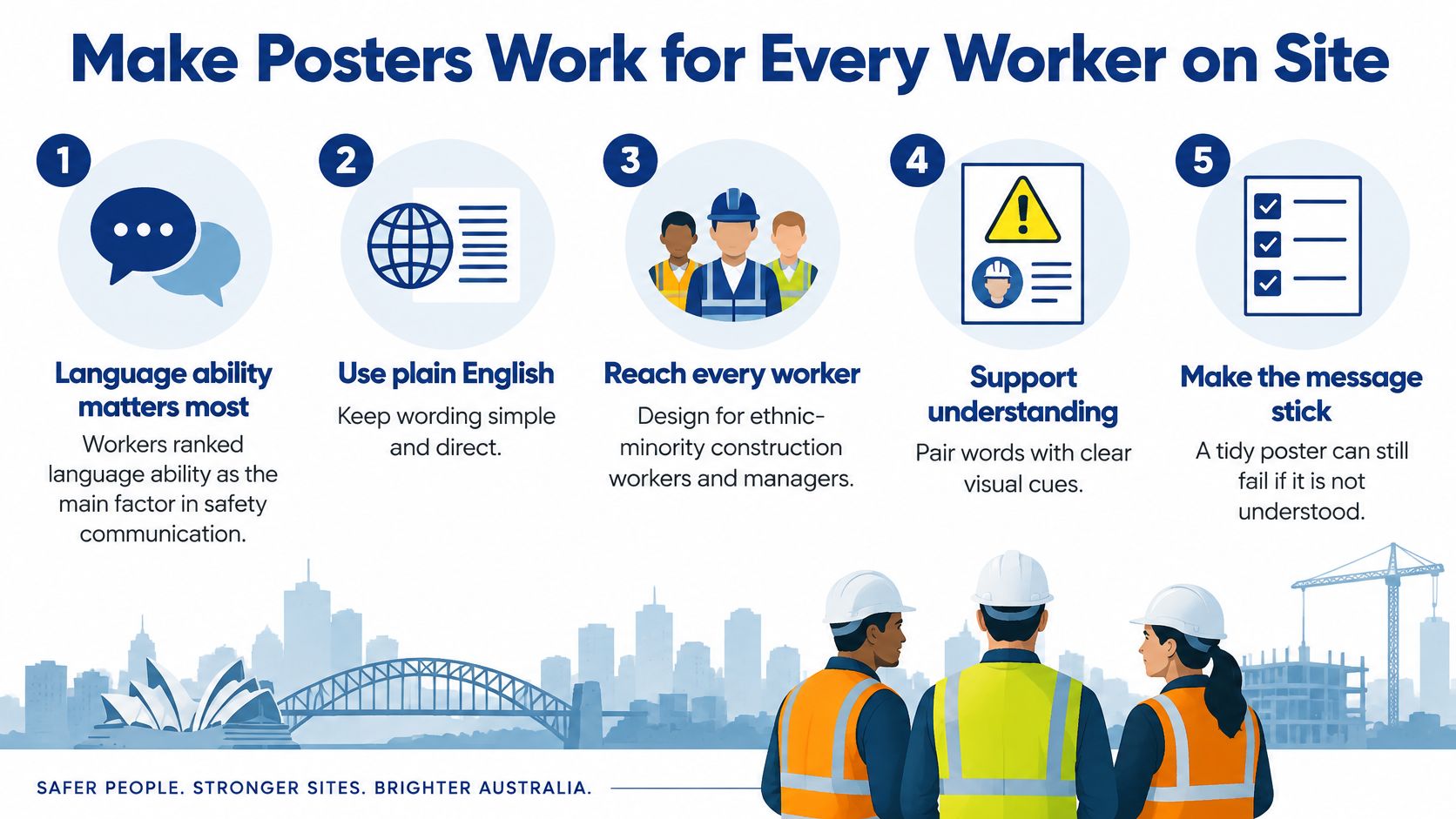
Build for the Crew You Actually Have
Before subcontractors start, establish the languages and literacy needs of the crew mobilised on site. A national assumption can miss the needs of workers on a particular project, and the crew mix can change over time.
For each critical message, use plain English, one clear pictogram and, where useful, a photo of the actual task or location. A QR code can link to a short audio explanation in relevant languages. Keep translated text legible, and avoid carrying jargon into translations that workers may not understand.
Check Understanding Without Embarrassing Anyone
Use a private “show me” check. Ask the worker to identify the hazard and demonstrate the required action one to one with a supervisor. Run the check at induction and when a worker moves to a new work front.
Symbols and a clear layout can help workers with low literacy or hearing impairment. If someone cannot demonstrate the required action, explain it again and confirm understanding before they proceed. Security awareness training for site personnel can help supervisors practise consistent checks.
A poster cannot control a moving exclusion zone or replace a physical barrier. When the zone shifts, work runs at night, or a sign alone cannot control the risk, brief the crew and use the required physical controls. If a visitor is confused, gatehouse staff should pause access and contact the supervisor rather than assume the board was understood.
Inspect Replace and Record Poster Condition
A supervisor or mobile patrol can close the loop on one walk. You don't need software to start. You need a one-page sheet, a pen, and a fixed weekly route.
Log the hazard location, poster ID, install date, visibility condition, responsible owner, and corrective action for every poster in active zones. Run the walk weekly on capital-city and regional sites alike, and again after any layout change, storm, or new work front opening.
When to Replace and When to Remove
Replace a poster when UV fade, graffiti, stored materials, or a moved haul road hides the message. Replace it again when the language mix or work sequence changes, even if the panel itself looks fine.
Take the old poster down rather than stacking a new one beside it. Two versions of a PPE rule side by side give workers a choice you never intended to offer.
Safe Work Australia reporting on sources of WHS information found 78% of construction employers provided WHS information to full-time workers, while only about one-third of employers overall reported providing it to contractors or subcontractors. That gap sits exactly where construction risk concentrates, so issue the visual induction set at contractor mobilisation and have the supervisor confirm understanding at site entry.
Keep the topic list small during inspections. Check vehicle and pedestrian separation, falls, overhead services, manual handling, emergency response, and PPE first, and make sure emergency posters still match your current emergency evacuation procedures for the site and muster point location.
| Indicator | What to count | Useful signal |
|---|---|---|
| Zone coverage | Active work zones with a current, readable poster | Any gap is raised at the next pre-start |
| Teach-back | Sampled workers who state the required action unaided | A low share means rewrite or brief, not another poster |
| Defects found | Obsolete, faded, blocked or wrong-facing posters per walk | A rise after a layout change triggers a re-hang |
| Close-out time | Days from defect logged to poster replaced or moved | Slow close-out leaves a false sense of control |
Don't credit posters with fewer injuries unless exposure, training, supervision, and barriers are reviewed together. Australian evidence supports posters as information and reminder tools, not as a stand-alone success measure you can quote in a tender.
Audit standard: If the poster is faded, blocked, out of date, or facing the wrong way, log it as a defect with an owner and a close-out date.
Align Posters with Gatehouse and Patrol Checks
Decide this week whether your posters and the people at the gate tell the same story. If the gate board says PPE is mandatory and the guard waves through a visitor in runners, every worker watching learns which instruction is real.
A night patrol in Perth or a gatehouse in Melbourne should confirm three things on each round. The principal-contractor board is readable from outside, confined-space signs match live permits, and every exclusion zone still has both a poster and a barricade standing.
Who Does What on Each Check
- Security Guarding: Stops unauthorised entry at pedestrian and vehicle openings and challenges anyone past a no-entry poster without authority.
- Mobile Patrols: Log missing, blocked, faded, or wrong-facing posters as defects with location and poster ID, not as general comments.
- Gatehouse Security: Uses the same visitor, PPE, and emergency wording workers see on the gate board, and calls the supervisor when a visitor clearly hasn't understood it.
Consistency matters more than volume. Align your gate script with documented gatehouse security procedures for controlled sites so a guard on night shift gives the same instruction as the poster a worker read at dawn induction.
Name one owner for the poster register and set the weekly walk in the site diary. Adopt the required-posters table and the four-indicator log before the next mobilisation, brief supervisors on both, and drop any poster that fails teach-back.
I would start with the gate. Stand outside it as a first-time delivery driver, read only what you can see from the footpath, and fix whatever you'd have to guess. Then walk every exclusion zone and confined-space entry the same way.
Builders and principal contractors across Melbourne, Sydney, Brisbane, Perth, and surrounding cities within 200 km face the same test. A Security Company Melbourne crews trust, or a supervisor running a regional job two hours out, still needs posters, permits, barriers, and gate checks that agree with each other. Services such as Event Security, Retail Security, Concierge Security, and Shopping Centre Security run on different sites, but the discipline is identical. The message, the person, and the boundary must match.
A poster nobody can teach back is clutter, whatever the artwork looks like.
If your gate boards, exclusion zones, and patrol checks don't yet tell one consistent story, ABCO Security Services Australia provides licensed Construction Security, Security Guarding, Gatehouse Security, and Mobile Patrols across Melbourne, Sydney, Brisbane, Perth, and surrounding areas, with guards briefed to enforce your site rules, log poster defects, and escalate access problems to your supervisors. Visit ABCO Security Services Australia to arrange coverage aligned with your construction site safety posters, permits, and access controls before your next mobilisation.
about
avada factory
Sempery ultricies nibh at dolor cras urna eleifend nec. Atiam efficitur tempor.