A customer is raising their voice at a Melbourne store counter. The refund has been refused, a queue is forming, and the sales assistant is looking towards the guard. A calm acknowledgement and a genuine choice can settle that dispute before it becomes a threat, provided the guard also knows when to stop talking.
Effective de escalation techniques connect communication to operational decisions. I recommend assigning each stage a lead responder, a clear action and a handover point, so nobody mistakes staying in the conversation for keeping people safe.
The Escalation Ladder and the Technique for Each Stage
Say the guard approaches that refund dispute without challenging the customer in front of the queue. They acknowledge the frustration, offer to contact the store manager and indicate a suitable waiting area. The customer now has a practical next step rather than another person to argue with.
The need extends beyond difficult customer service. Safe Work Australia's workplace-violence reporting identifies approximately 176,100 workplace-violence incidents over a ten-year period, with only approximately 46% formally reported as workplace or on-the-job incidents. Recorded incidents therefore don't capture the full operational exposure.
Match the response to the behaviour
I would use this ladder as a decision aid, not a prediction. Someone can move directly from quiet behaviour to violence, so responders shouldn't wait for every stage to appear.
Early agitation calls for acknowledgement and choice. The frontline guard notices pacing, a raised voice or a clenched jaw. They acknowledge the concern without promising a refund, then offer a realistic choice. If agitation persists, the supervisor becomes the next point of contact.
Verbal hostility calls for a boundary. The guard identifies unacceptable behaviour, maintains distance and offers a supervised waiting area. They notify the supervisor rather than repeatedly defending store policy.
Threats or aggressive movement call for withdrawal. Once someone threatens harm, squares up or obstructs an exit, the guard moves towards safety and activates the duress procedure. The control room coordinates the second responder.
Imminent violence calls for emergency action. Engagement stops when it compromises escape or emergency assistance. During an armed robbery, complying with demands may be safer than confrontation; immediate danger requires calling 000.
Afterwards, responsibility moves to the site manager. The guard preserves incident details and identifies unresolved hazards. The manager coordinates review with the health and safety representative where applicable.
The visual below provides a quick reminder of the communication and support actions.
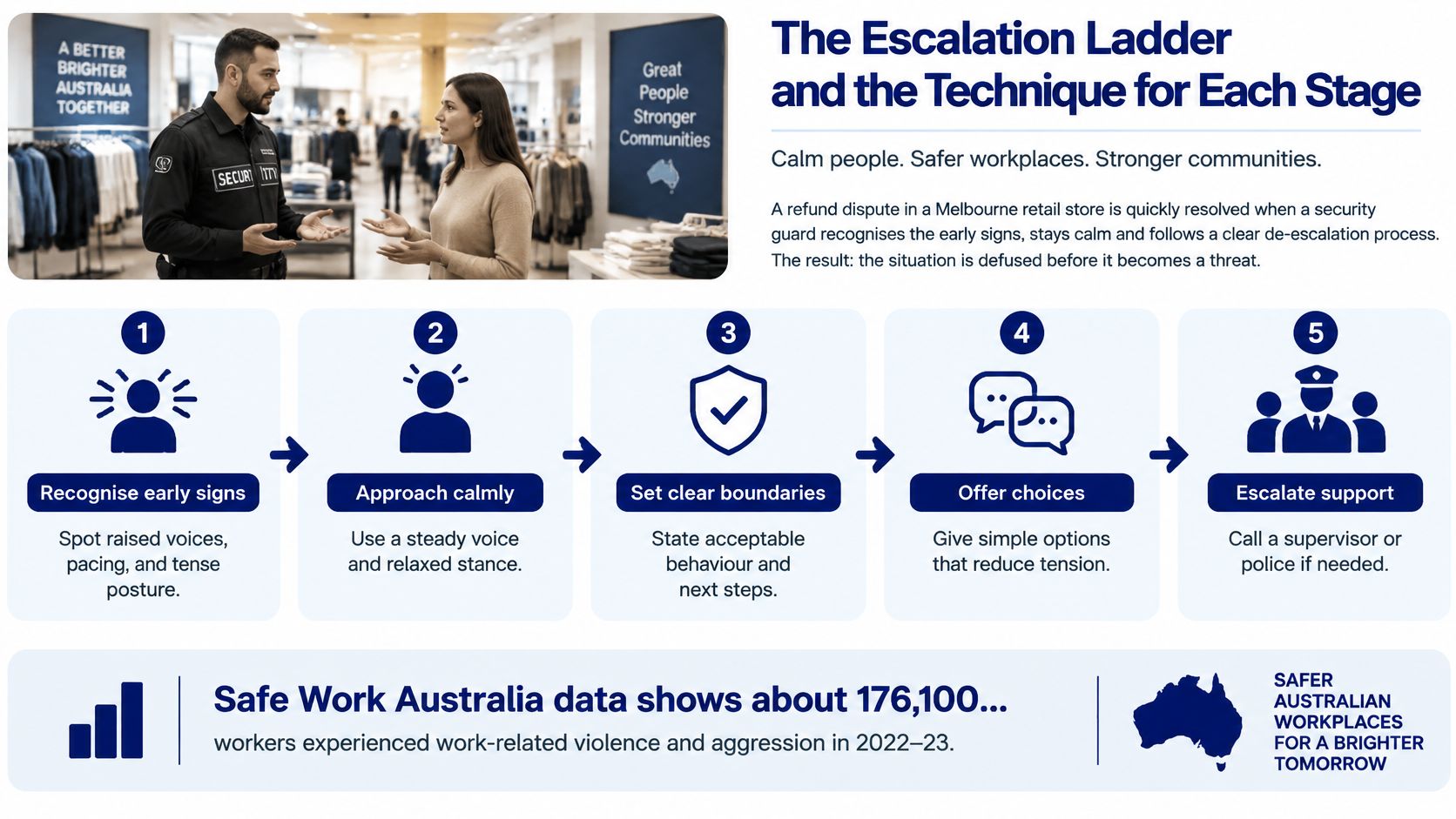
Escalation stages, techniques and responders
| Stage | Warning signs | Technique | Who responds |
|---|---|---|---|
| Early agitation | Raised voice, pacing, clenched jaw | Calm tone, acknowledge the concern, offer a choice | Frontline guard |
| Verbal hostility | Abusive language, repeated demands, invading personal space | State the behaviour is unacceptable, hold distance, offer a supervised waiting area | Guard, with supervisor notified |
| Threats or aggressive movement | Threats of harm, squaring up, blocking exits | Withdraw to a safe area, activate duress alarm, request backup | Control room and second responder |
| Imminent violence or armed robbery | Physical assault, weapon visible, armed demands | Stop engaging, comply with demands in an armed robbery, call 000 | Police and emergency services |
| After the incident | Injury, property damage, unresolved threat | Preserve details, debrief, review controls | Site manager and health and safety representative |
The trade-off is between giving someone processing time and allowing exposure to increase. Talking continues only while risk indicators remain low. De-escalation must never delay emergency assistance.
Verbal and Nonverbal Scripts for Each Situation
Verbal de-escalation reduces stimulation and buys time. It isn't an exercise in winning an argument or persuading someone that the guard has greater authority.
The Safe Work Australia worker information sheet supports calmly identifying unacceptable behaviour, explaining that it creates an unsafe environment and asking the person to stop, when it's safe to engage. Acknowledging frustration doesn't mean accepting abuse or agreeing with a disputed claim.
The guard's posture should support that message rather than contradict it.
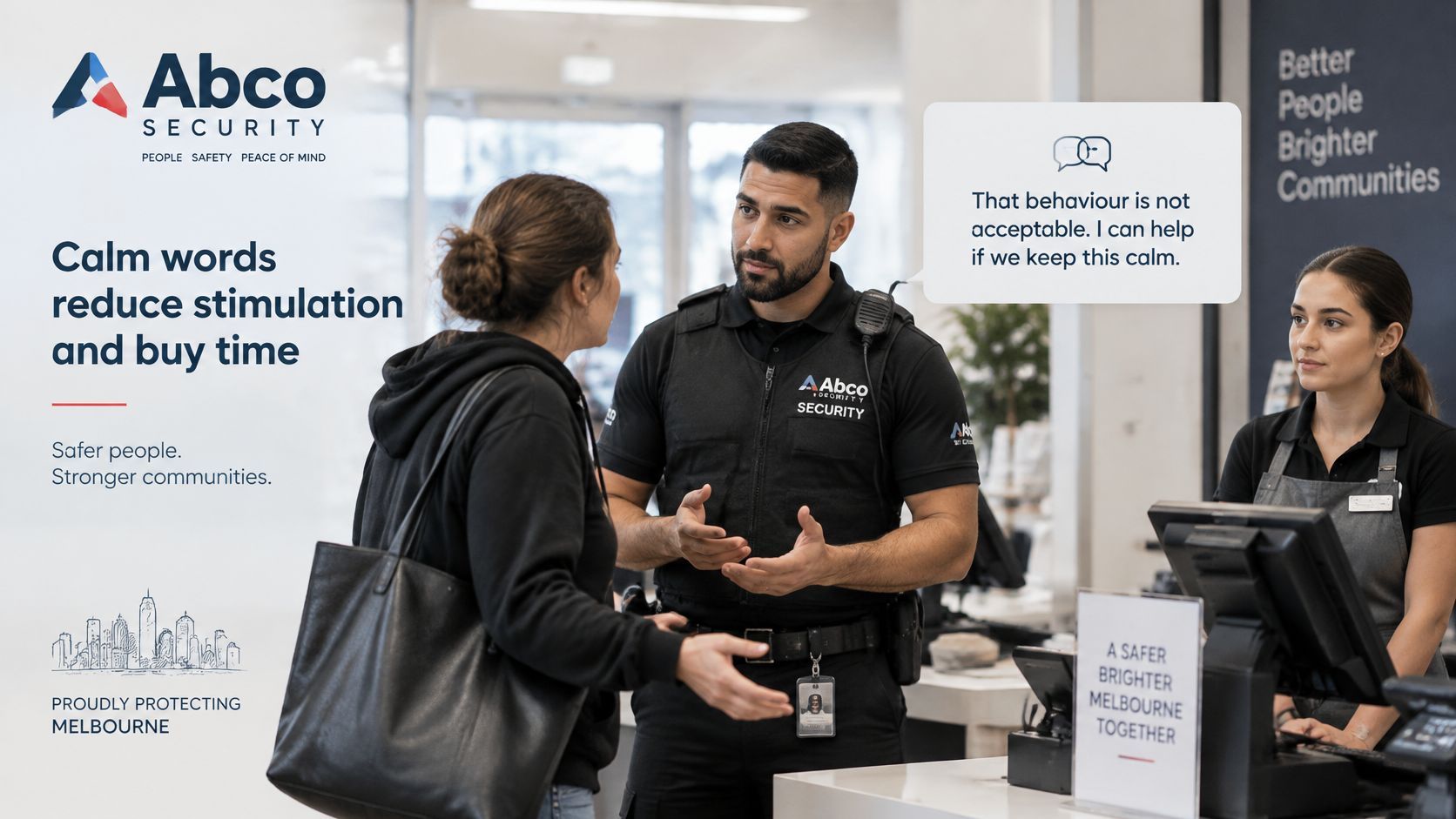
Scripts and phrases to avoid by situation
These are suggested opening words, not compulsory lines. I would practise them aloud so staff can deliver them naturally under pressure.
| Situation | Say | Avoid |
|---|---|---|
| Person raising their voice | I can hear you're frustrated. Let's sort this out together. | Calm down or stop shouting |
| Person refusing to leave | You can wait in the supervised area while I contact management. | Ultimatums you can't enforce |
| Person demanding a manager | I'll get my supervisor now. Can I take your name? | That's not my job |
| Person under the influence | Let's find a quieter spot so we can talk. | Arguing about facts or logic |
| Person in distress | What would help you most right now? | Touching them or standing over them |
Don't ask for a name if that request is becoming another point of conflict. Likewise, only offer a quieter location if the route and destination are safe, observable and appropriate.
Make body language consistent
- Stand at an angle. Avoid squaring up directly opposite the person, while maintaining awareness of their movements.
- Preserve space. Start at arm's length or further where practicable, increasing distance when behaviour warrants it.
- Keep hands visible. Use relaxed, low gestures rather than pointing, folded arms or clenched fists.
- Slow the delivery. Speak evenly, leave pauses and avoid matching the other person's volume.
- Move predictably. Don't step suddenly towards someone or reach across them.
At an event gate, an attendee disputes a denied entry decision. I would offer a genuine choice between waiting in a supervised area while the supervisor attends and leaving voluntarily. The guard shouldn't promise admission or crowd the attendee towards either option.
For alcohol-related situations, intoxicated patron management should connect communication with the venue's entry, welfare and escalation procedures.
Use the following video alongside discussion and supervised practice, not as a substitute for site instruction.
Scripts need adapting to language, cultural context and recognised disability or communication needs. Don't assume someone is defiant because they need more time to respond.
Practical rule: If engagement becomes unsafe, call for help, activate duress, retreat or end the phone interaction. Finishing the script isn't the objective.
Scenario Playbook for Retail, Events and Construction Sites
At a Sydney construction site, a worker disputes their access status and refuses to leave an exclusion zone. The guard maintains the stop-work boundary from a safe position, states the access rule and calls the site supervisor before considering any physical contact.
The supervisor resolves the work-authorisation question. The guard controls access and reports the hazard, rather than debating employment arrangements beside moving equipment.
Opening moves and escalation points by site
| Setting | Common trigger | Opening move | Escalate when |
|---|---|---|---|
| Retail | Refused returns or shoplifting confrontation | Calm approach, distance, bring in a store manager | Physical contact or threat |
| Event | Crowded queues, denied entry, intoxication | Separate the person from the crowd, use the radio team | Crowd pressure or weapon seen |
| Construction site | Unauthorised entry, access disputes | Hold the stop-work area, state site rules | Injury risk or equipment interference |
| Shopping centre | Loitering, harassment, tenant disputes | Confirm identity where appropriate, offer a calm exit | Assault or repeated threats |
| Gatehouse | Denied access, vehicle blocking entry | Hold the gate, call the manager | Driver becomes aggressive or violent |
In Retail Security, a suspected shoplifting confrontation shouldn't become a contest over who can stand closest. I would maintain distance and bring the store manager into the conversation, keeping allegations, observations and store decisions distinct. A threat or physical contact changes the response immediately.
For Event Security, consider an intoxicated attendee arguing in a packed queue. Invite them towards an observable, supervised space only if they can move there safely and voluntarily. Another team member manages the queue, preventing the lead guard from having to watch both the attendee and the crowd.
Practical crowd management techniques should account for audience effects, circulation routes and the pressure created by people gathering to watch.
Assign the problem to the right person
In Construction Security, equipment interference or entry into an active work area needs operational intervention from the site supervisor. Communication alone doesn't make the exclusion zone safe.
For Shopping Centre Security, a tenant dispute may need centre management, while harassment requires a safety response. Confirm identity only where appropriate to the task and the guard's authority; don't turn a request for information into an unnecessary confrontation.
At a Brisbane gatehouse, a driver blocks the entrance after being denied access. I would keep the gate controlled, contact the manager and use the radio team to manage approaching traffic. The guard shouldn't approach the vehicle alone or stand in its path.
Mobile Patrols and Concierge Security staff need the same role clarity when they're first on scene away from a control room. They should identify who will attend, who will maintain access control and who will receive the handover.
A quieter conversation isn't safer if it moves the responder into an isolated location.
When crowd pressure builds or a weapon appears, prioritise moving bystanders away, controlling access with existing barriers where safe, and summoning the radio team and emergency services. Don't approach a weapon-holder to arrange a better conversation.
Risk Triggers to Check Before and During a Shift
Violence and aggression belong in the workplace risk-management process, not just the complaints register. Safe Work Australia's hazard guidance sets out identifying hazards, assessing risks, implementing controls and reviewing effectiveness in consultation with workers and health and safety representatives where applicable.
For a Security Company Melbourne property managers engage, that means translating the assessment into shift instructions. A generic instruction to remain calm doesn't tell a guard whether backup is available or where they can retreat.
Pair each trigger with a usable control
- Alcohol or drug impairment: Provide trained support and a clear welfare and escalation pathway. Respond to observed behaviour rather than assuming a diagnosis.
- Long queues: Adjust staffing at peak demand, maintain circulation space and communicate delays before frustration builds.
- Denied access: Give guards current entry criteria and a named decision-maker for disputed authorisations.
- Isolated work areas: Check radio coverage, CCTV visibility and access to a safe retreat area.
- Cash handling: Review exposure during transfers and closing tasks, including access controls and assistance.
- Repeated customer complaints: Brief the incoming team on unresolved issues and who can authorise a practical resolution.
- Unauthorised entry attempts: Use visitor screening, controlled gates and clear escalation contacts rather than relying on a lone guard's judgement.
The checklist below supports a consistent assessment before deployment and while conditions change.
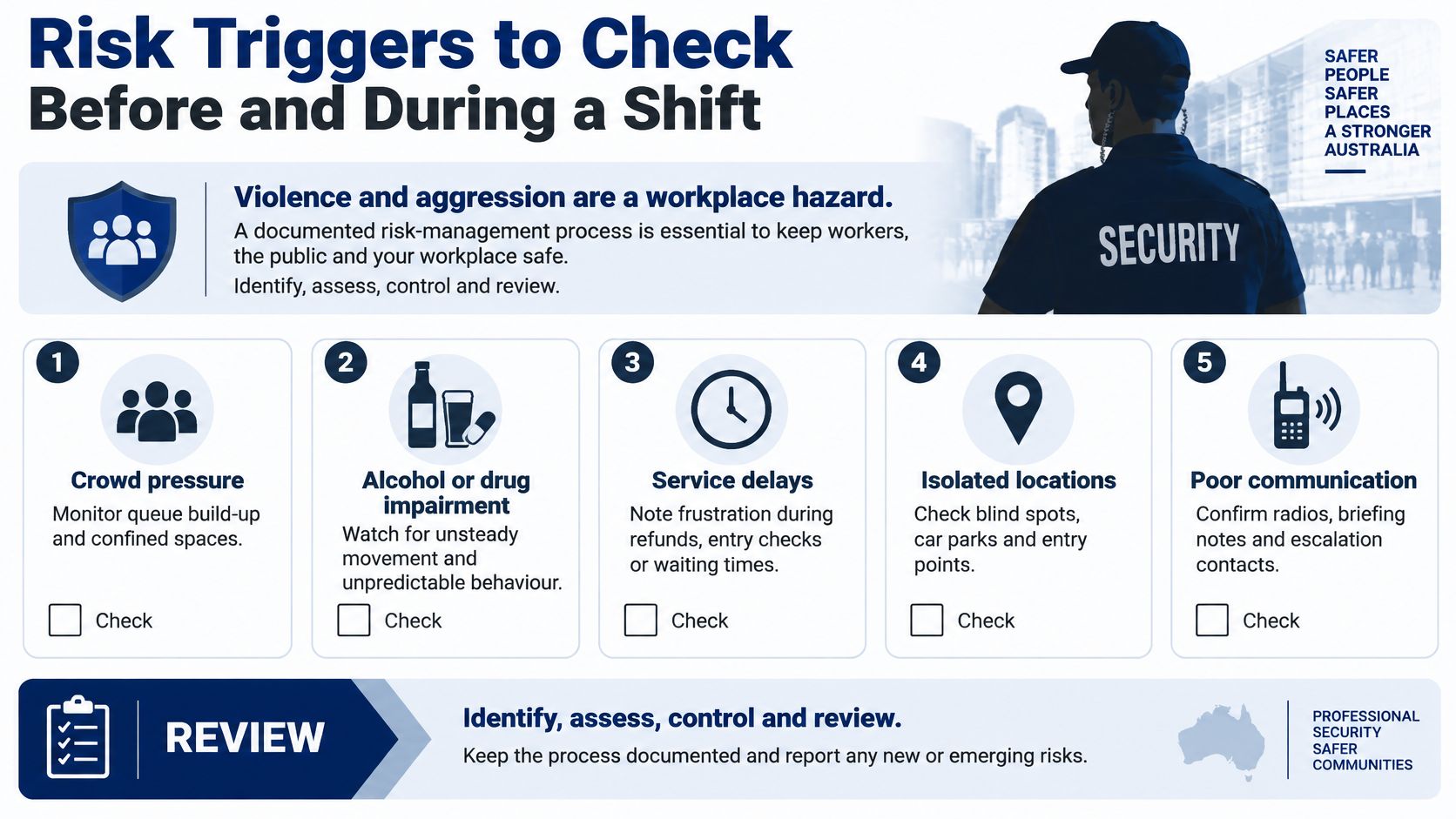
Check readiness, then changing exposure
I recommend using a security risk assessment checklist during the briefing, with responsibility assigned for unresolved defects. Recording a failed duress device without providing an alternative leaves the responder exposed.
| Check point | Questions for the shift team |
|---|---|
| Before deployment | Are staffing levels suitable for expected activity? Are radios and duress alarms working? |
| At each work area | Are retreat routes clear? Can responders access barriers and safe areas without approaching the hazard? |
| During an interaction | How many people are involved? Are exits obstructed? Has another person joined the dispute? |
| While support attends | Has the second responder acknowledged the request? Who is maintaining access and watching bystanders? |
Sufficient workers should be available to recognise escalating behaviour early. I would assign a second trained responder to observe, communicate and protect access, not just add another voice to the dispute.
Review these checks after an incident and at the next shift briefing. Don't leave a recurring queue problem, radio blind spot or access dispute unresolved until the annual audit.
Legal, Safety and SOP Requirements for Training
De-escalation training is one preventive control within a wider safety system. Employers need to identify, assess and control workplace risks under the applicable Australian WHS or occupational health and safety framework. Security licence holders must also work within their jurisdiction's licence conditions, lawful authority and site instructions.
I would check those requirements for the deployment location rather than assume that identical powers apply across Australia. A uniform, client request or completed training course doesn't create additional authority to detain, search or use force.
Practise decisions as well as words
The Safe Work Australia harmful behaviours report describes an Australian study finding fewer violence-related emergency security responses when more staff had trained within the preceding 90–150 days, but not when training was older. On that basis, I recommend planning refresher practice every three to five months, adjusted to site risk rather than treating that interval as a legal requirement.
Scenario training should require staff to recognise warning cues, consider the other person's perspective and practise their response. It should also test whether they can stop an unsuccessful approach without feeling obliged to secure compliance.
For example, a retail drill can begin as a disputed return and introduce an obstructed exit. The assessor should examine the guard's changed decision, radio message and handover, not just whether they remembered an empathetic phrase.
Put the response into the SOP
I would integrate the following into the site's standard operating procedures and emergency response procedures:
- Written duress instructions: Specify activation methods, who receives the alert and what happens if acknowledgement fails.
- Induction practice: Walk new staff through actual work areas, communications equipment and available assistance.
- Documented retreat routes: Identify safe destinations and alternatives when normal access is obstructed.
- Incident forms: Make the reporting method accessible to guards during the shift.
- Named review ownership: Assign a manager to investigate control failures and communicate resulting changes.
- Handover thresholds: State the behaviour or hazard that transfers responsibility to supervisors, security support or emergency services.
Training doesn't guarantee the elimination of aggression. Staffing, safe egress, communications and reporting must remain available when a well-delivered conversation doesn't work.
Assessment standard: Reward a timely withdrawal and accurate handover, not persistence in an unsafe interaction.
A useful SOP answers a difficult operational question plainly: at what point does this guard stop de-escalating, and who takes over? If staff give different answers, I would resolve that uncertainty before the next deployment.
Handover Notes, Reporting and Monitoring
Complete the handover note before going off shift, after immediate safety and medical needs have been addressed. The incoming team needs enough detail to identify what remains unresolved without reconstructing events from radio traffic.
Record observable behaviour separately from interpretation. For example, state that someone struck a counter or obstructed a doorway rather than relying on a broad label such as “difficult” or “aggressive.”
Handover note fields
| Field | What to record |
|---|---|
| Time and location | Exact time and site area of the incident |
| People involved | Names, roles and descriptions of everyone involved |
| Trigger | What started the escalation, such as a refused exit or queue dispute |
| Technique used | Which stage and script was applied |
| Outcome | Whether the situation settled, was handed over or required police |
| Who was notified | Supervisor, control room, police and any emergency services called |
Record who was contacted and who accepted responsibility. A radio transmission without acknowledgement is not a completed handover.
This image illustrates the documentation task that needs protected time after the immediate response.
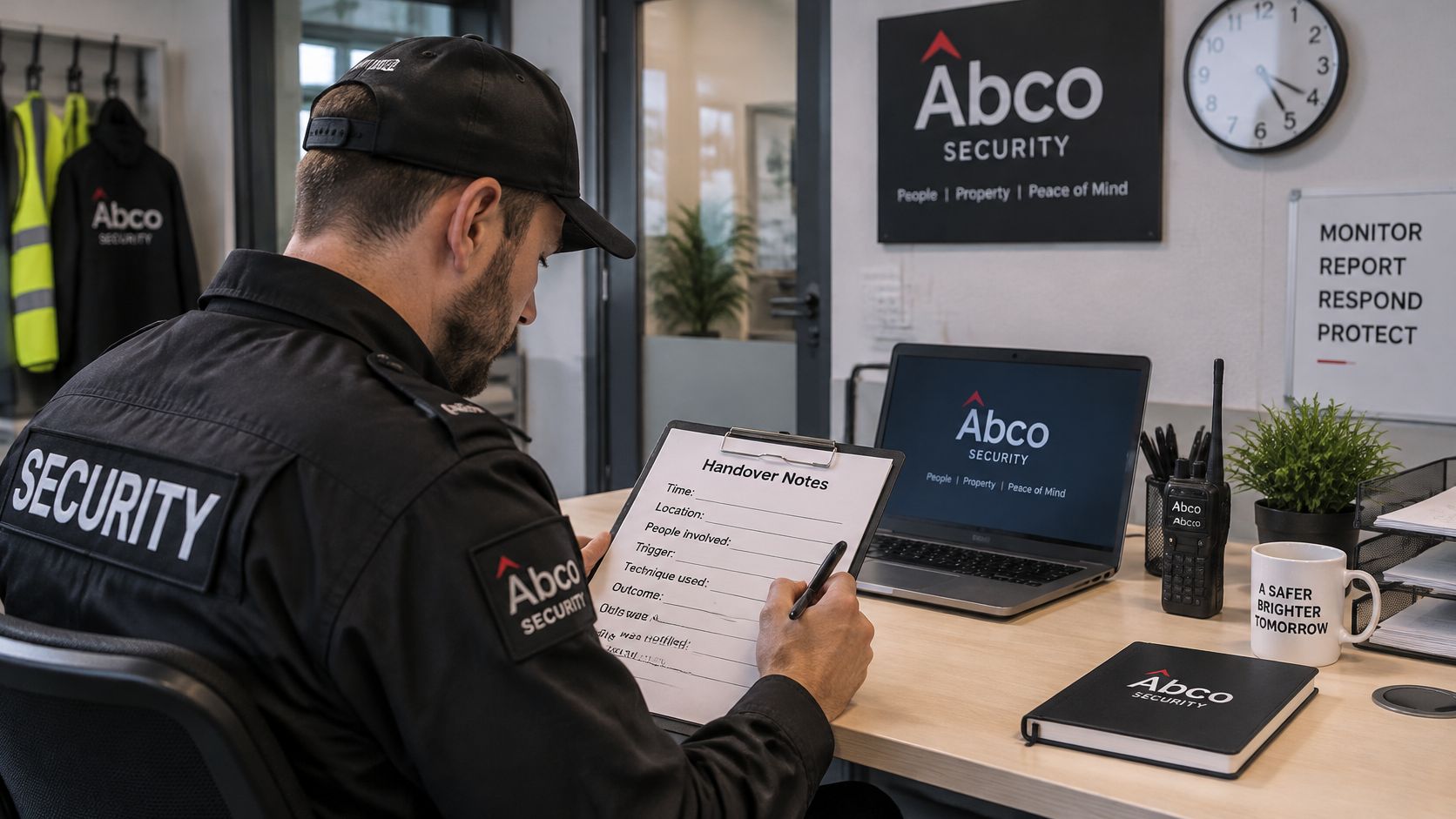
Close the incident properly
Safe Work Australia's prevention guide calls for processes covering immediate medical attention, reporting, debriefing and post-incident support. Apply those requirements through a clear site workflow:
- Arrange medical attention. Address injuries before administrative tasks.
- Report within the shift. Use the site form and preserve relevant incident references through the approved process.
- Debrief together. Have the guard and supervisor review the trigger, response and operational difficulties without turning the discussion into blame.
- Offer support. Explain available post-incident assistance and arrange follow-up.
- Update controls. Feed findings into the next risk check and assign an owner to corrective action.
A consistent security incident reporting process helps supervisors compare recurring triggers. Monitor notification delays, missing warning-sign records, repeat incidents, injuries, police attendance and physical intervention. These indicators show where the response or site controls may need attention.
Keep the control room in the handover chain
ABCO offers A1 Grade CCTV and alarm monitoring with immediate escalation, rapid-response teams and mobile patrols, with offices in Melbourne, Sydney, Adelaide, Perth and Brisbane. Confirm the response arrangements for each site, including who receives alerts and what assistance is available.
When a guard is occupied, the control room can coordinate notifications and preserve the operational record. Service planning for Event Security, Retail Security, Construction Security, Gatehouse Security and Mobile Patrols should state who owns each step.
Check the handover chain against the actual roster. Confirm who is responsible at each stage and schedule the next refresher within the recommended cycle. Each person on duty should know when to act, when to stop and who takes over.
ABCO Security Services Australia offers licensed security personnel, monitoring and coordinated response options for workplaces, retail premises, events and construction sites. Arrange a site-specific review of de-escalation thresholds, backup arrangements and handover responsibilities, then plan refresher training around the risks your team faces.
about
avada factory
Sempery ultricies nibh at dolor cras urna eleifend nec. Atiam efficitur tempor.