The familiar advice to review the recovery plan and run a tabletop isn't enough. A discussion can establish who should make decisions, but it can't prove that CCTV returns, alarm signals reach an operator or guards can control entry while systems are unavailable. Disaster recovery testing should demonstrate measured recovery of safe operations, not just record that an exercise occurred.
Why Written Recovery Plans Still Fail
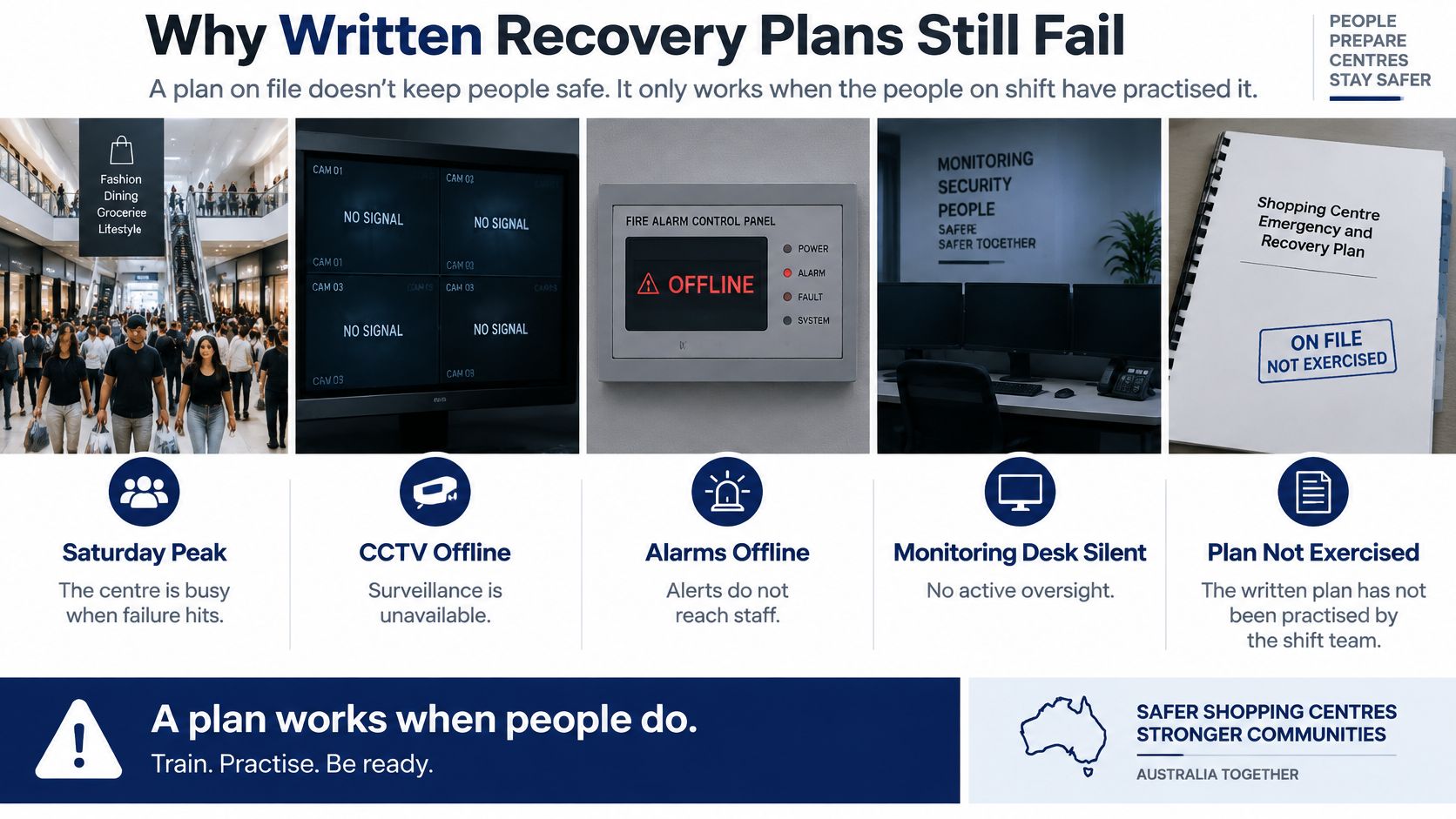
Consider a Saturday peak at a Melbourne shopping centre. CCTV screens go dark, alarms stop reaching the monitoring desk and the duty manager discovers that the recovery plan has never been exercised with the people on shift.
The document lists a technology supplier, but nobody knows whether its after-hours number reaches an engineer. Guards can use radios, yet the team hasn't agreed which entrances need staffing or who can authorise restricted access. Restoring a server won't resolve those decisions.
Written preparedness and operational readiness are distinct.
A completed discussion isn't a restored service
In 2023, 92% of NSW agencies reviewed had tested cyber incident response plans, but only 10% of those tests were functional, according to the NSW Auditor-General's Cyber Security Insights report. The remainder were tabletop exercises.
That finding concerns government agencies, not a survey of shopping centres. Its practical significance is the distinction between discussing recovery and attempting it: a high exercise-completion rate doesn't necessarily provide technical proof.
The shopping-centre scenario makes that distinction visible.
Disaster recovery testing is a timed demonstration that personnel, technology and approved manual workarounds can deliver a minimum safe service. Evidence should include restoration records, operational checks and business acceptance, rather than attendance alone.
For retail, construction, event, commercial-property and strata teams, the starting point is a realistic operating requirement. A shopping centre might need controlled public entry and effective incident escalation before trading can continue. A construction site might instead need secure perimeter access and reliable contact with the responsible supervisor.
Build around the site, not the document
Operators in Melbourne, Sydney, Brisbane, Perth and surrounding cities within about 200 kilometres need arrangements that reflect local staffing, supplier availability and travel constraints. A recovery resource available in a capital-city office shouldn't automatically be assumed available at a regional site.
Use business continuity planning to connect technology recovery with decisions about staffing, restricted operations and temporary closure. Where communications infrastructure is a dependency, Southern Tier Resources' wireline and wireless network maintenance is a useful resource when preparing questions about maintenance responsibilities and restoration support.
A workable programme gives operators:
- A suitable test level, matched to what remains unproven.
- A controlled run order, from discussion through technical recovery.
- Pass evidence, including timings and operational acceptance.
- Supplier participation, covering physical and digital dependencies.
- A repeatable calendar, with corrective work between exercises.
Finishing a discussion doesn't prove that a site can trade, receive visitors or remain secure.
Choose the next exercise by the evidence it can produce, not by how impressive its name sounds.
Test Levels and the Evidence That Counts
Disaster recovery test levels and pass evidence
The effort estimates below are suggested booking allowances, not prescribed standards. Adjust the window to the service scope without weakening the acceptance criteria.
| Test level | What it proves | Typical effort | Pass evidence |
|---|---|---|---|
| Discussion tabletop | Roles, contacts and decisions under a named scenario | Plan 60 to 90 minutes | Priority contacts named and an owner recorded for every gap |
| Procedure walkthrough | Whether written steps match how people actually work | About half a day, no production changes | Checklists completed and unclear steps rewritten before any technical test |
| Isolated simulation | Restore of data, applications and settings to one point in time | About one day in a non-production environment | Actual RTO and RPO recorded, login works and integrity checks are clean |
| Full failover or rebuild | End-to-end minimum safe service, including security systems | Booked window of several hours to a day | Business owner confirms safe operations and recovery is inside the approved RTO |
Pass rule: measured results meet the approved recovery objectives, and the business owner confirms operations can continue safely.
A tabletop or walkthrough can pass its own limited criteria without proving recoverability. Don't label the whole service recovery-ready until technical and operational evidence supports that conclusion.
Choose realism without creating unnecessary risk
The WA Auditor General's disaster recovery planning report recognises test levels from desktop exercises through full-system recovery and calls for recovery time and recovery point objectives in business priority order.
Start with the lowest level that addresses an unresolved question. If nobody can identify who authorises a monitoring-centre transfer, a full failover is premature. Resolve authority and communications first, then test the technology.
For a discussion tabletop, involve the duty manager, monitoring operator and site supervisor. Ask them to work through decisions using their actual contact lists, not a facilitator's assumed answers.
A walkthrough goes further without changing production. Staff locate the emergency keys, retrieve approved procedures and demonstrate where they would record manual admissions. Stop before an action could affect live access, alarms or occupant safety.
An isolated simulation tests restoration without exposing production to the same disruption. A full failover adds operating pressure and supplier handovers, but requires stronger change control, rollback arrangements and site supervision.
Define what recovered means
For every critical service, record:
- Maximum allowable outage, the longest interruption the business can tolerate.
- Recovery time objective, or RTO, the target time to restore the agreed service.
- Recovery point objective, or RPO, the acceptable age of recovered information.
- Dependencies and ownership, including power, identity, communications, responsible personnel and escalation contacts.
The RTO must fit inside the maximum allowable outage. An application target that exceeds the business's tolerable interruption is a planning defect, even before testing begins.
Use a security audit checklist to identify operational dependencies that an infrastructure inventory might miss. Include CCTV viewing, access permissions, alarm receipt, radio coverage and available power.
Record elapsed time to minimum service and complete service separately. Also capture data age, transaction reconciliation, manual-workaround duration and unresolved defects.
Ad hoc restores aren't a substitute for this chain. The Australian National Audit Office's incident-management audit found that AUSTRAC's occasional requested restores weren't regularly performed as formal disaster recovery exercises.
When results miss an objective, name the defect, assign a deadline and schedule the retest. A rewritten checklist alone doesn't close a failed technical result.
Include Security Systems Vendors and Sites
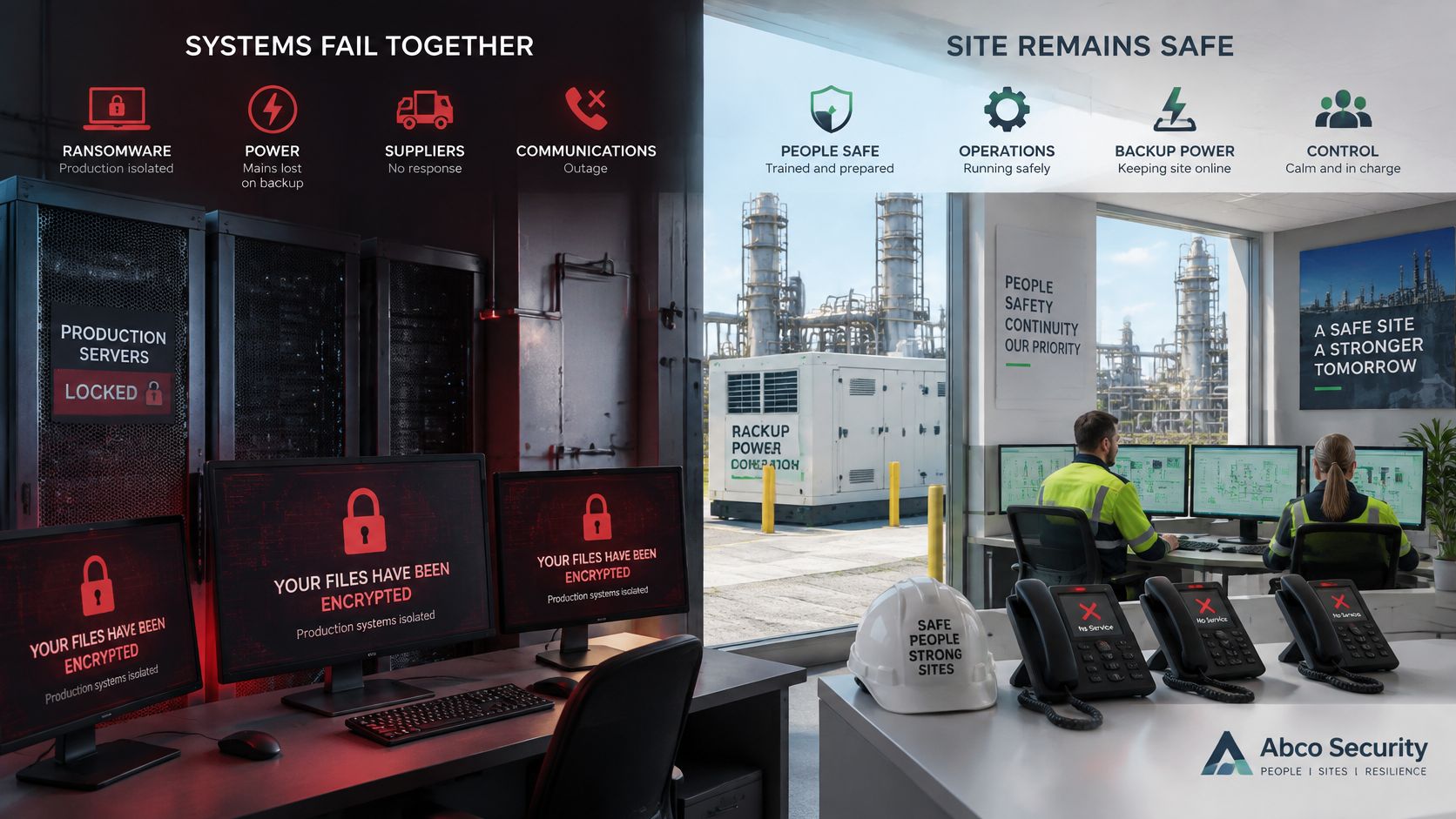
Test a combined disruption rather than giving every supplier an independent, convenient failure. For example, ransomware isolates production, mains power becomes unstable, the monitoring centre can't be reached and a telecommunications fault coincides with a request for extra Mobile Patrols.
The operational question is whether the site can remain safe while those dependencies are unavailable together.
The ACSC Annual Cyber Threat Report records more than 42,500 cyber-security hotline calls and over 1,200 incidents responded to in FY2024–25. Those figures describe ACSC activity, not the likelihood of an incident at an individual property, but they reinforce the need for practical response arrangements.
Translate the disruption into site tasks
Assign each location an operating problem, then observe whether staff can perform the necessary work.
- Construction Security: Verify worker and contractor entry against an approved offline register. Preserve emergency access and prevent uncontrolled vehicle movements when electronic gates are unavailable.
- Shopping Centre Security: Reallocate guards to priority entrances and incident-prone areas. Confirm how tenants report emergencies without the normal monitoring desk.
- Event Security: Test radio instructions, crowd-management authority and the decision to pause admission. Don't assume ticketing restoration also restores safe crowd flow.
- Concierge Security: Practise visitor verification and tenant contact without the reception application. Keep temporary records secure and reconcile them after recovery.
- Gatehouse Security: Demonstrate vehicle logging, delivery approval and safe queuing when access control is offline.
Manual operation has limits. A guard recording admissions can't simultaneously watch every camera view, answer the reception phone and manage a vehicle queue. Set a reduced operating scope rather than assigning impossible workloads.
Make suppliers perform their part
Include the landlord, utility liaison, technology vendor, monitoring provider and patrol provider. Ask each to demonstrate the relevant handover, identify its decision-maker and explain what happens when normal support channels fail.
Test after-hours numbers and contractual escalation arrangements through an agreed exercise process. Don't place simulated emergency calls to emergency services without prior coordination.
Use documented communication protocols to distinguish exercise traffic from a real incident. Record whether the recipient understood the location, hazard, required action and acknowledgement request.
Keep a clear distinction between talking through a handover and demonstrating it. The following video can support the team briefing, but it doesn't replace a site-specific drill.
When choosing who can validate physical and electronic controls together, ABCO is one option for static security guarding, event, retail and construction coverage, mobile patrols and monitored alarms, with offices in Melbourne, Sydney, Adelaide, Perth and Brisbane. Discuss operational scope through its security and site-response services, and check applicable state or territory licence requirements alongside ASIAL's industry resources.
Finish with a simple minimum-service scorecard:
- Controlled entry: Pass only when authorised entrants can be admitted and unauthorised entry can be managed safely.
- Alarm escalation: Pass only when a test signal or approved substitute reaches the responsible operator and receives acknowledgement.
- Response contact: Pass only when the patrol or response contact is reached and accepts the task.
A clean restore still fails operationally if the people needed to protect the site can't be contacted.
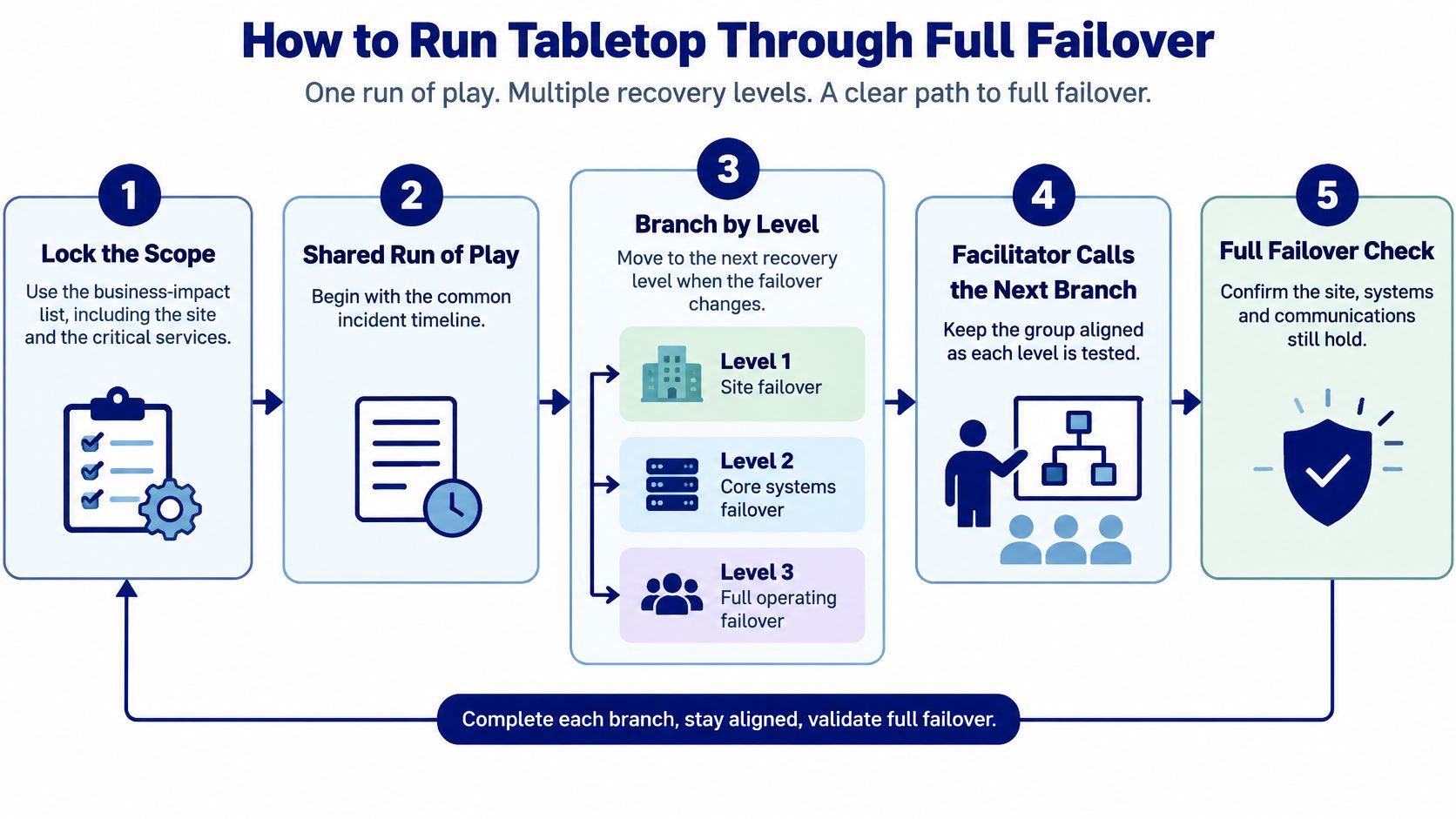
How to Run Tabletop Through Full Failover
Use a shared incident timeline, then take the branch appropriate to the booked exercise. Don't turn a discussion into an unapproved production change because participants want to see what happens.
The ACSC Information Security Manual's system-management guidance.pdf) identifies ISM-1515, requiring restoration of data, applications and system settings to a common point in time during disaster recovery exercises. The practical requirement is coordinated recovery, not a collection of unrelated successful backup jobs.
Establish the common run of play
Lock the scope. Select the site and critical service from the business-impact list. Name exclusions explicitly, such as live public-address activation or changes to occupied-building access. The evidence is an approved scope that participants can use to reject unsafe improvisation.
Write assumptions and stop conditions. Record the simulated trigger, selected backup timestamp, available staff and assumed supplier availability. Identify who can stop the exercise if live safety, security or service deteriorates. Confirm rollback authority before starting the clock.
Run the tabletop branch. Have the facilitator declare the incident and ask the duty manager for the first decision. Inject an unreachable vendor and record the decision time, attempted contact and alternative action. Participants should use their own documents rather than receive answers from the facilitator.
Run the walkthrough branch. Ask each role to read and demonstrate its checklist using the actual site documents and equipment. Mark inaccessible keys, ambiguous instructions and steps that don't match the building. Keep production unchanged and record each mismatch as a defect.
The branching sequence should remain visible to everyone participating.
Execute and validate the technical branch
Restore the isolated simulation. Establish required infrastructure and identity services, then restore related data, applications and settings in dependency order. Use an isolated environment so test systems can't interfere with live operations. Confirm that an authorised user can authenticate, perform a representative task and retrieve the expected records.
Execute the approved failover or rebuild. Switch to the recovery environment or rebuild the defined service using the authorised runbook. Bring monitoring and access control into the test scope, with a manual gatehouse or patrol arrangement ready. Check that restored permissions haven't granted inappropriate access or prevented essential entry.
Capture service milestones. Record incident declaration, minimum viable service, complete service and the newest valid restored record. Preserve logs and screenshots that demonstrate those milestones. Keep the clock running through troubleshooting, supplier delays and unsuccessful login attempts.
Obtain business acceptance. Ask the nominated business owner to accept or reject continued operation against the pre-agreed safety criteria. The technical team supplies evidence, but it shouldn't unilaterally decide that a site can reopen. Record restrictions, residual risks and any decision to remain closed.
Assign defects and retests. Give each finding an owner, due date and specific validation action. Clean up temporary accounts, test data and recovery resources, then confirm the live environment is in its intended state. Close a finding only when evidence supports closure or an authorised person formally accepts the residual risk.
Align the operational decisions with the site's emergency response procedures. Recovery staff must know when the scenario requires escalation into evacuation, restricted access or another protective action.
Worked alarm-monitoring timing example
Suppose an exercise sets a two-hour recovery objective for alarm monitoring and demonstrates minimum service after 45 minutes. These are hypothetical exercise values, not an industry benchmark.
That result passes the timing test only if the agreed minimum service works in practice: a test event arrives, the correct location displays and the operator completes the required escalation. A dashboard loading after 45 minutes isn't enough if signals remain queued elsewhere.
If signals arrive but the patrol contact doesn't answer, record technical restoration and operational failure separately. Don't stop measuring at the most favourable milestone or redefine minimum service afterwards.
Clock discipline: Count the waiting time. Missing credentials and unanswered supplier calls are part of recovery performance.
The useful outcome of a failed exercise is a precise correction. Replace “improve communications” with an action such as validating the alternate patrol contact and demonstrating acknowledgement during the retest.
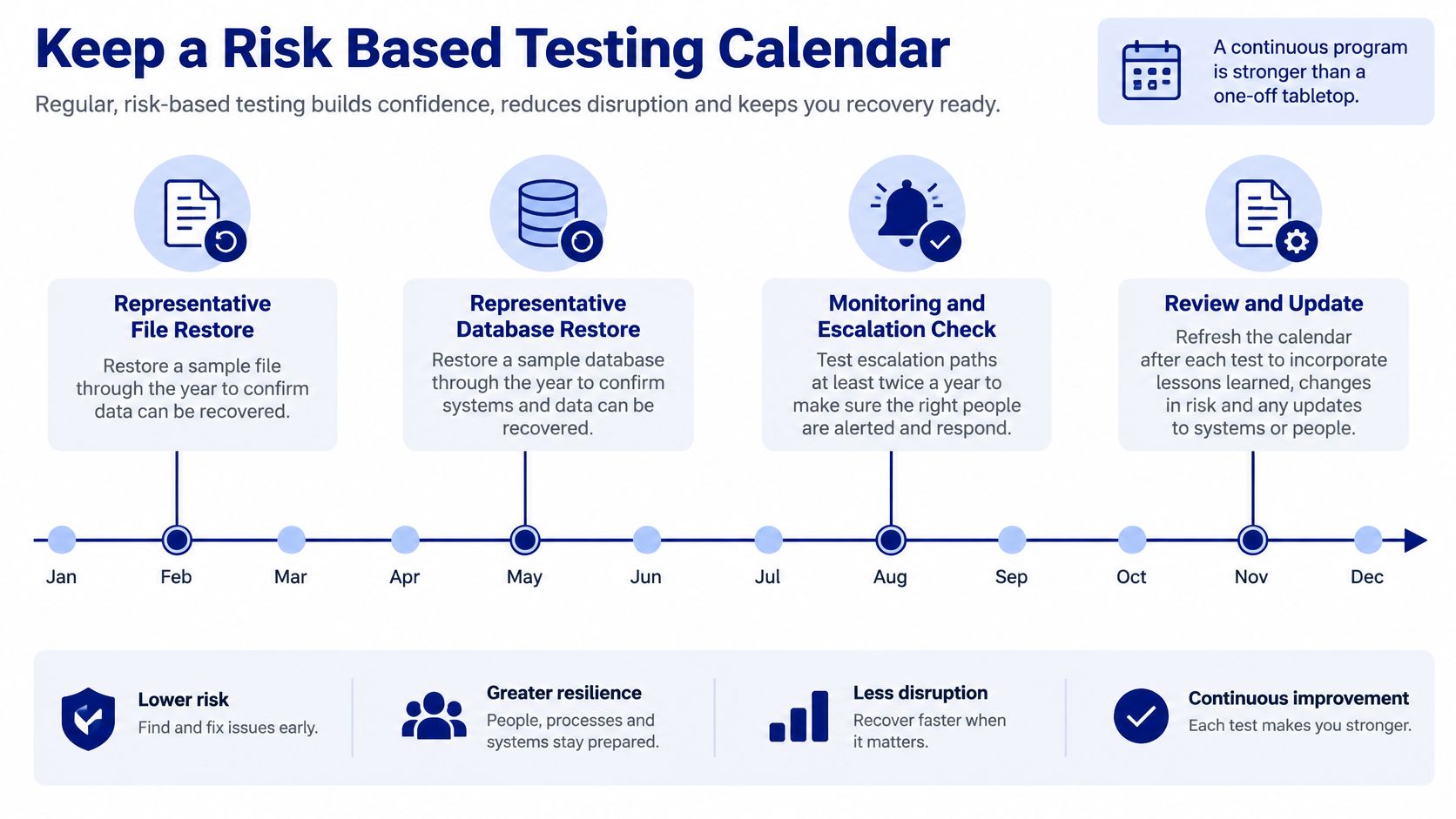
Keep a Risk Based Testing Calendar
Build the calendar around service criticality and change, not a single convenient annual meeting. Use the following as a recommended operating schedule, then increase coverage where failure would leave people or property exposed.
| Calendar entry | Recommended timing | Purpose |
|---|---|---|
| Representative file and database restores | Through the year, prioritised by business impact | Detect unusable backups and recovery drift |
| Monitoring and escalation checks | At least twice a year | Validate notification and response handovers |
| Combined operational scenario | At least annually | Exercise technology, people and suppliers together |
| Change-triggered exercise | After major architecture, supplier, staffing or premises changes | Validate changed dependencies |
| Defect retest | On the assigned remediation date | Demonstrate that the correction works |
The South Australian Auditor-General's disaster recovery planning report identified inadequate testing and missing formal schedules. Treat the calendar as a managed control, with named participants and protected booking windows.
What each disaster recovery test record must show
| Record | What to capture | Benchmark |
|---|---|---|
| Scenario and assumptions | Trigger, exclusions and sites involved | Approved before the exercise starts |
| Systems and backups | In-scope list and backup timestamp | Related components from one common point in time |
| Actual RTO and RPO | Time to minimum service and age of restored data | At or inside the approved objectives |
| Integrity and security | Reconciliation, access checks and alerting | Zero critical data-integrity defects |
| Communications | Notification paths and vendor or guard contacts | 100 percent of priority paths completed |
| Defects | Owner, deadline and retest date | Closed or formally accepted before the next cycle |
These benchmarks are proposed acceptance criteria. Record security-control status, deviations and full-service timing alongside the table's minimum-service result.
A visible annual schedule helps staff reserve time for recovery work rather than repeatedly postponing it.
Match calendar entries to obligations
For APRA-regulated entities, the prudential framework requires an annual business continuity exercise covering critical operations and severe but plausible disruption, including material service providers; book provider loss and primary-facility unavailability into the scenario programme according to the entity's material risks.
Allocate the coordinated restore entry to demonstrating the ISM's common-point-in-time recovery control. For organisations assessing Essential Eight alignment, the Essential Eight Maturity Model.pdf) requires backups to be restored during disaster recovery exercises, so retain restoration evidence against that calendar entry.
Use the business impact analysis to adjust priorities when a new tenant, operating model or site layout changes the consequences of disruption.
Read the failures, not just the completion rate
Trend missed objectives by system, cause and age. Repeated delays may require more recovery capacity, different backup frequency, additional staffing or simpler manual procedures, rather than another document revision.
Avoid these shortcuts:
- Backup-job confidence: A completed backup job isn't a passed recovery test.
- Mixed recovery points: Don't assemble related components from incompatible timestamps.
- Skipped reconciliation: Require a business user to confirm that transactions and operational records agree.
Review workarounds for new hazards. Propping doors open or sharing a master code may make an exercise appear faster while weakening the site's security.
A formally accepted defect remains a risk. Acceptance needs an accountable decision-maker, operating restrictions where necessary and a review date.
Book the Next Exercise With Clear Owners
This week, name the person accountable for the next exercise and give them authority to secure staff and supplier participation. Choose the lowest test level the site hasn't passed with evidence, then book it before the next retail peak, construction shutdown or event.
Don't begin by commissioning a larger recovery document. Start with a one-page scope that identifies the service, approved recovery objectives, operational contacts and in-scope security systems.
Make the booking operationally credible
The owner needs more than a calendar invitation. They need confirmation that the duty manager, relevant technician and site representative can participate, and that someone will maintain normal protection during the exercise.
For a smaller site, a tightly scoped test of alarm escalation and controlled entry may be more useful than an ambitious rebuild that keeps being deferred. For a complex property, agree which operating restrictions apply while the exercise is underway.
- Name the owner: Make one person accountable for collecting evidence and closing findings.
- Protect the date: Confirm participation before the site's next high-demand period.
- Define acceptance: Require measured results within approved objectives and business-owner confirmation of safe operations.
Buy evidence rather than reassurance
If the exercise fails, resist the pressure to soften its conclusion. A clear failure with an assigned correction is more useful than a qualified pass that leaves the next shift exposed.
For operators in Melbourne, Sydney, Brisbane, Perth and surrounding cities, local response arrangements matter as much as the recovery platform. Establish who can attend, what they're authorised to do and how site management will confirm the handover.
Where degraded systems require licensed personnel on the ground, discuss the practical interface between guarding, patrol response and electronic monitoring before the test. Finish the booking with a named owner, an agreed date and a defined decision about whether operations can safely continue.
ABCO Security Services Australia offers 24/7 security guarding, mobile patrols and electronic monitoring to support protection while normal systems are degraded. Visit ABCO Security Services Australia to discuss your site's next recovery exercise, including the personnel, escalation contacts and temporary operating arrangements it needs.
about
avada factory
Sempery ultricies nibh at dolor cras urna eleifend nec. Atiam efficitur tempor.