
Your keypad starts chirping at 2 am. You silence it, tell yourself the alarm still arms, and plan to grab a battery on Saturday. That delay is the risky part, because a flat backup only exposes itself when mains power drops, often during the storm or fault when you need signalling most.
Done well, home security system battery replacement is a controlled change and test. Done as a quick swap, it can leave you with the wrong chemistry, a charger that cannot maintain it, or a panel that looks healthy until a blackout.
Match the Battery Before You Buy a Replacement
A Melbourne terrace owner hears the chirp, opens the cupboard, and buys any 12 V battery that looks close on a hardware shelf. I would not start there. Most Australian residential control panels use a sealed 12 V valve-regulated lead-acid backup, often about 7 Ah, while wireless sensors, keyfobs and some cameras carry their own separate cells.
Gorilla Security states standard residential security-alarm batteries typically last 3–5 years. That's a panel guide, not a promise for every device in the house. Heat in a roof cavity, repeated outages and a charger fault can shorten life, so a low-battery warning overrides the calendar.
Read What Is Already Fitted
Work through the old battery and the device label in order. Don't rely on physical size or a brand name.
- Voltage and capacity: Record volts plus Ah for a panel battery, or mAh where a small pack uses that rating.
- Chemistry printed on the case: Note sealed lead-acid, lithium, lithium-ion or alkaline exactly as marked.
- Terminal type and polarity: Check spade width, plug shape and which side is positive.
- Physical size: Measure length, width and height so the cabinet door closes without pressure on cables.
- Fitted date: Look for a date handwritten inside the cabinet or on the battery itself.
The same nominal voltage isn't enough. A replacement can be 12 V and still fail because the charger regime is wrong, the terminals don't seat, or the capacity can't deliver the standby time the panel, communicator and siren need. A lithium pack must not replace a lead-acid battery unless the manufacturer approves both the charger and the protection circuit for that chemistry.
For owners comparing a full upgrade while they sort power issues, this guide to choosing a home security system in Australia helps separate panel capability from battery condition. Treat that as system planning, not a reason to delay a low-battery fault.
Home Security Battery Types and Replacement Intervals
| Device | Typical battery | Replace about | Fit yourself only if |
|---|---|---|---|
| Control panel backup | Sealed 12 V VRLA lead-acid, often 7 Ah | 3–5 years, or on a low-battery fault | Same voltage, equal or greater Ah, charger-approved chemistry, system not monitored |
| Door or window sensor | CR2032 coin cell or CR123A lithium cell as marked | 1–3 years or at the low-battery chirp | Identical chemistry and voltage, tamper switch reseated |
| PIR or motion detector | CR123A lithium cell as marked | 2–4 years | Polarity correct and cover screws returned |
| Keyfob or pendant | CR2032 coin cell as marked | 1–2 years | Cell not swollen and clip undamaged |
| External siren | Manufacturer sealed backup pack | 3–5 years | Weather seal and polarity confirmed; otherwise use a technician |
| Battery camera, smart lock or accessory | Device lithium-ion or lithium pack | When runtime falls or the pack swells | Pack is OEM or listed equivalent and not damaged |
Don't import smoke-alarm habits into security gear. A replaceable 9 V smoke-alarm battery follows its own routine, but a sealed 10-year life-safety unit should not be opened for a battery change. Equally, don't assume a panel backup is an annual item when its normal service window is measured in years.
If you're also adding cameras, good camera planning for unmonitored venue entrances matters for the same reason battery matching matters. Placement, power and recording have to work as one design, not as separate purchases.
Practical rule: Keep one log line per device with device, chemistry, rating, fitted date and next due date.
Safety Checks Before You Open the Cabinet
The cabinet may contain mains-powered equipment, a charged backup battery and tamper circuits that signal when the cover is lifted. Treat opening it as a controlled task. Stop if you are unsure how your model should be isolated.
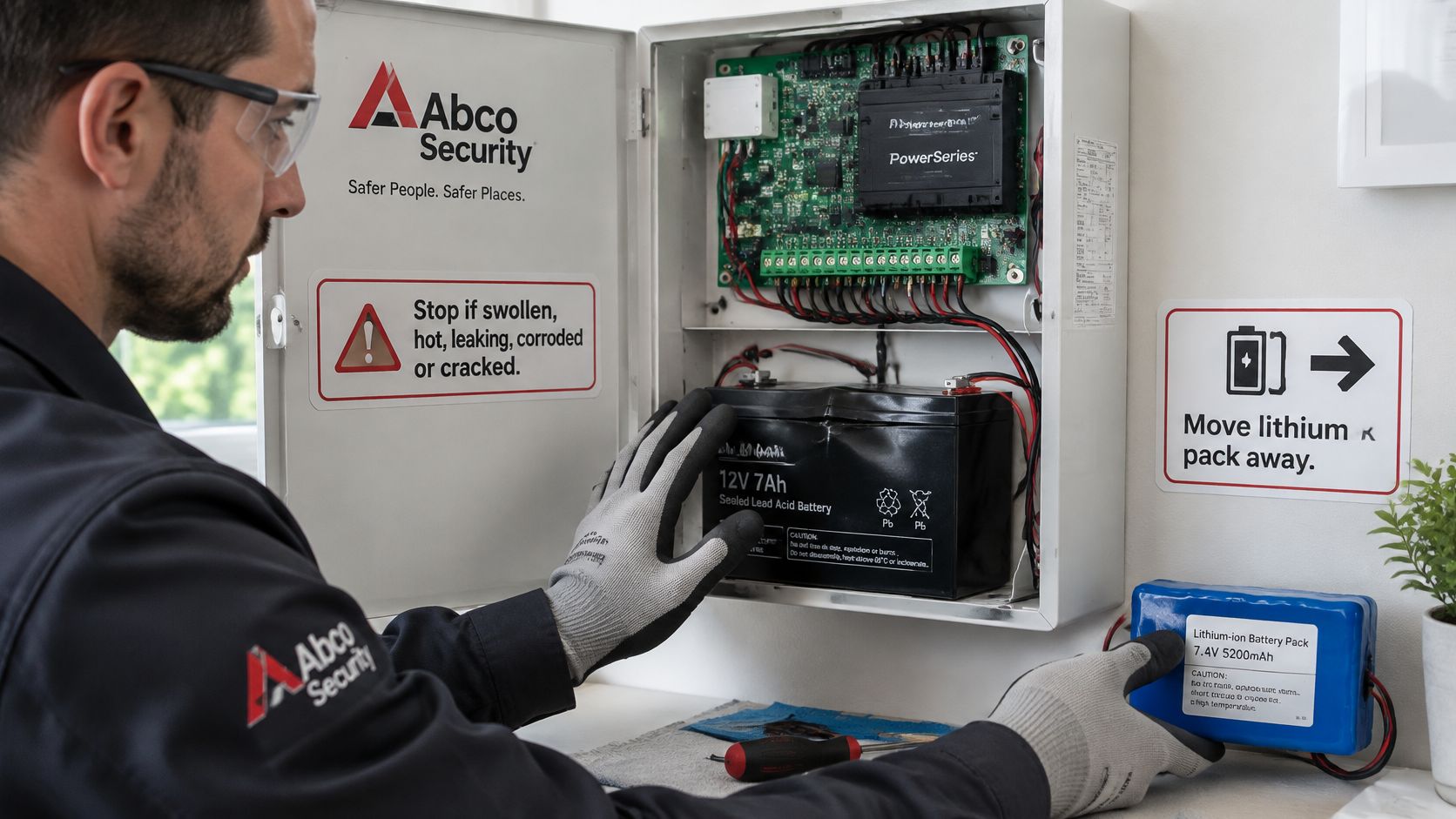
Stop before disconnecting a battery that is swollen, hot, leaking, corroded or cracked. Do not prise out a swollen lithium pack, squeeze it into a charger, or leave it on bedding, curtains or other combustible material.
Why Chemistry Changes the Risk
A sealed 12 V lead-acid battery in an alarm panel and a lithium-ion pack in a camera or smart lock pose different hazards. Fire and Rescue NSW recorded 318 lithium-ion fires in 2024, compared with 272 in 2023 and 165 in 2022. These figures do not mean every alarm battery is dangerous. They reinforce the need to handle damaged lithium packs carefully and use reputable replacements.
Choose the original manufacturer battery or a reputable listed equivalent. Reject any cell with a crushed case, torn wrapping, bent terminal or unclear specification.
Pre-Start Checks
- Check the manual: Confirm whether your model permits mains isolation and identify the correct breaker or plug pack.
- Put monitoring on test: Have the account details ready and place a monitored system on test before opening the cabinet, so a tamper signal does not trigger an unwanted response.
- Record the wiring: Photograph the red and black leads, terminal positions and cable route before removal.
- Clear the area: Keep children and pets away, particularly if an external siren could sound.
- Keep lithium packs away from combustibles: Charge or store them away from combustible materials, with a working smoke alarm nearby.
Follow the manufacturer's power-down order. Switching off at the breaker when the model does not permit it can create extra faults or lose time settings.
Larger or non-sealed battery banks need different precautions. Charging can produce flammable hydrogen, and the environment can be corrosive. Leave those cabinets to a qualified technician.
Do not put batteries in general waste or mix old and new cells in one bank. Do not work on a hard-wired 240 V circuit without a licensed electrician.
If the panel is hard-wired, inaccessible, monitored or integrated with access control and CCTV, stop at identification. A clear photo of the label and fault display can help the technician bring the correct replacement. Accept the job only after the system passes a mains-fail test. A voltage reading alone does not prove the backup works.
Replace the Battery on Each Device
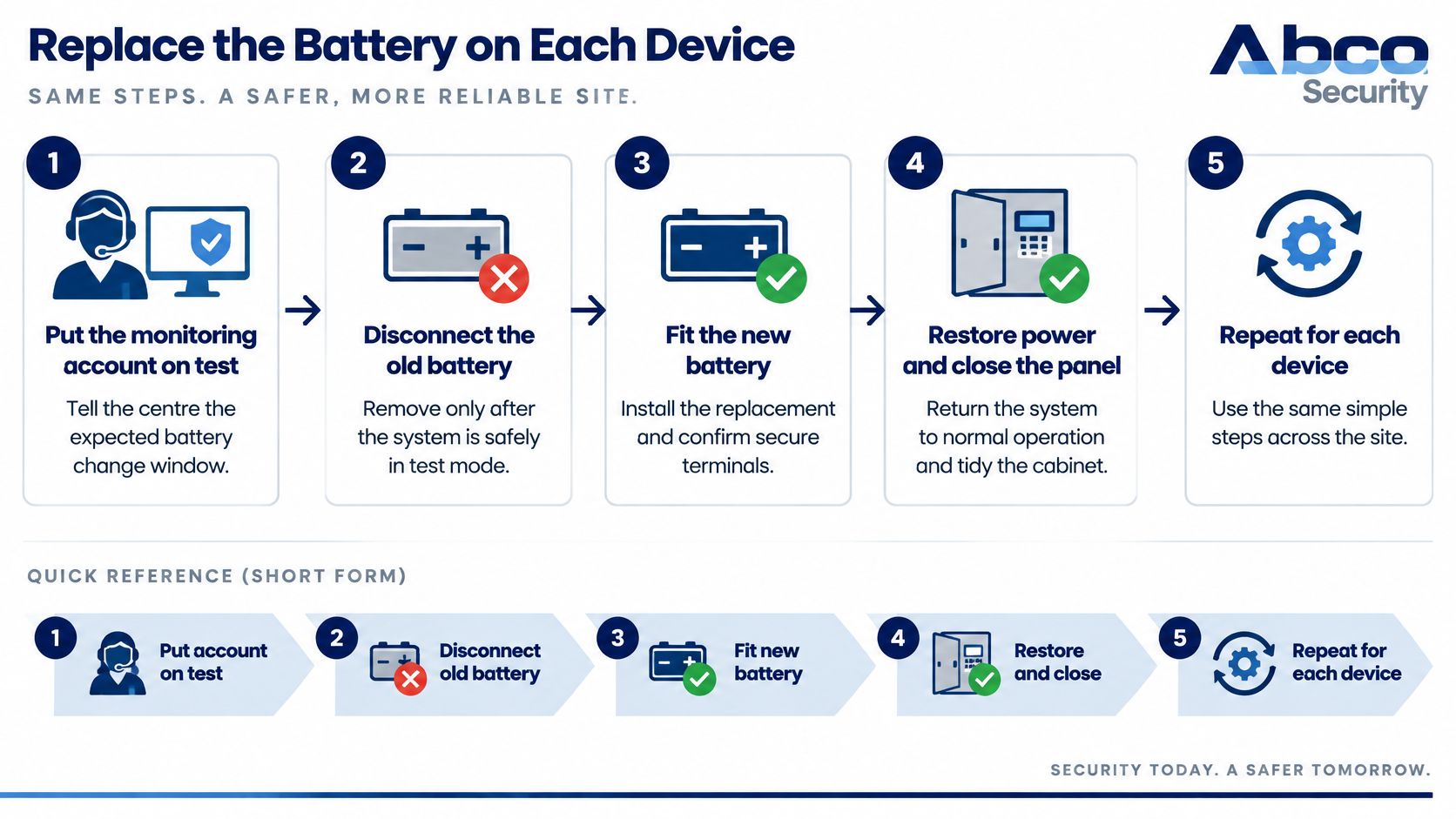
Change one device, test it, then move to the next. Changing the panel, three sensors and a siren in one rush makes a new fault hard to trace.
Control Panel Workflow
- Put monitoring on test. Tell the centre the expected window and confirm how you'll restore the account afterwards.
- Record the old setup. Note open-circuit voltage if you can measure it safely, plus the Ah rating, connector polarity and installation date.
- Isolate mains only if permitted. Follow the manual's order, then disconnect the old sealed 12 V battery without reversing the spade connectors or leaning on the tamper switch.
- Fit the approved replacement. Use the same nominal voltage and an equal or greater ampere-hour rating that the charger is approved to charge. Seat each terminal firmly.
- Restore mains and wait. Confirm the panel shows charging or float voltage, then let the automatic battery test run before you judge the result.
That sequence reflects the maintenance logic in AS/NZS 2201.1 through Standards Australia, including requirements for low-battery reporting, automatic battery testing and fault reporting, and battery capacity. The standard is useful because it frames the battery as part of reporting performance, not as an accessory.
For help finding a licensed technician when the system is monitored or integrated, ASIAL provides an Australian security industry starting point. If you're checking whether the underlying alarm design still suits the house, review the options for a home intruder alarm system after the immediate fault is stable.
Sensors and Keyfobs
- Note the zone. Write down the room or zone name before opening the cover, so the expected tamper is easy to identify.
- Remove the cell gently. Slide out the coin or cylindrical cell without bending the retaining clip.
- Fit the identical cell. Match chemistry and voltage, then place the positive side exactly as marked.
- Close until the tamper clears. Press the cover home evenly and confirm the zone restores at the keypad.
Don't substitute a rechargeable cell for a primary lithium cell because the size looks the same. Voltage under load and discharge behaviour can differ, which can create repeated low-battery reports.
External Siren
Treat an external sounder as technician work unless the manufacturer provides a clear user hatch and safe ground-level access. If it does, match the pack, keep the weather gasket intact and don't let the sounder run continuously while the cover is off.
High mounting, brittle plastic, insect nests and water damage change the job quickly. A siren that has filled with water needs more than a battery.
Say a Brisbane strata unit has two wireless door contacts and the panel due together. Change the panel first, confirm charging, then do one contact at a time and walk-test each zone. That order separates a panel charger fault from a sensor that still reports low.
Before you close the cabinet: Check the charger-fail and low-battery indicators with mains restored. A tidy cabinet with an active charger fault is not a finished job.
Write the fitted date on each new battery with a permanent marker where the maker allows it. Future troubleshooting gets much faster when age isn't a guess.
Prove the Backup During a Mains Failure
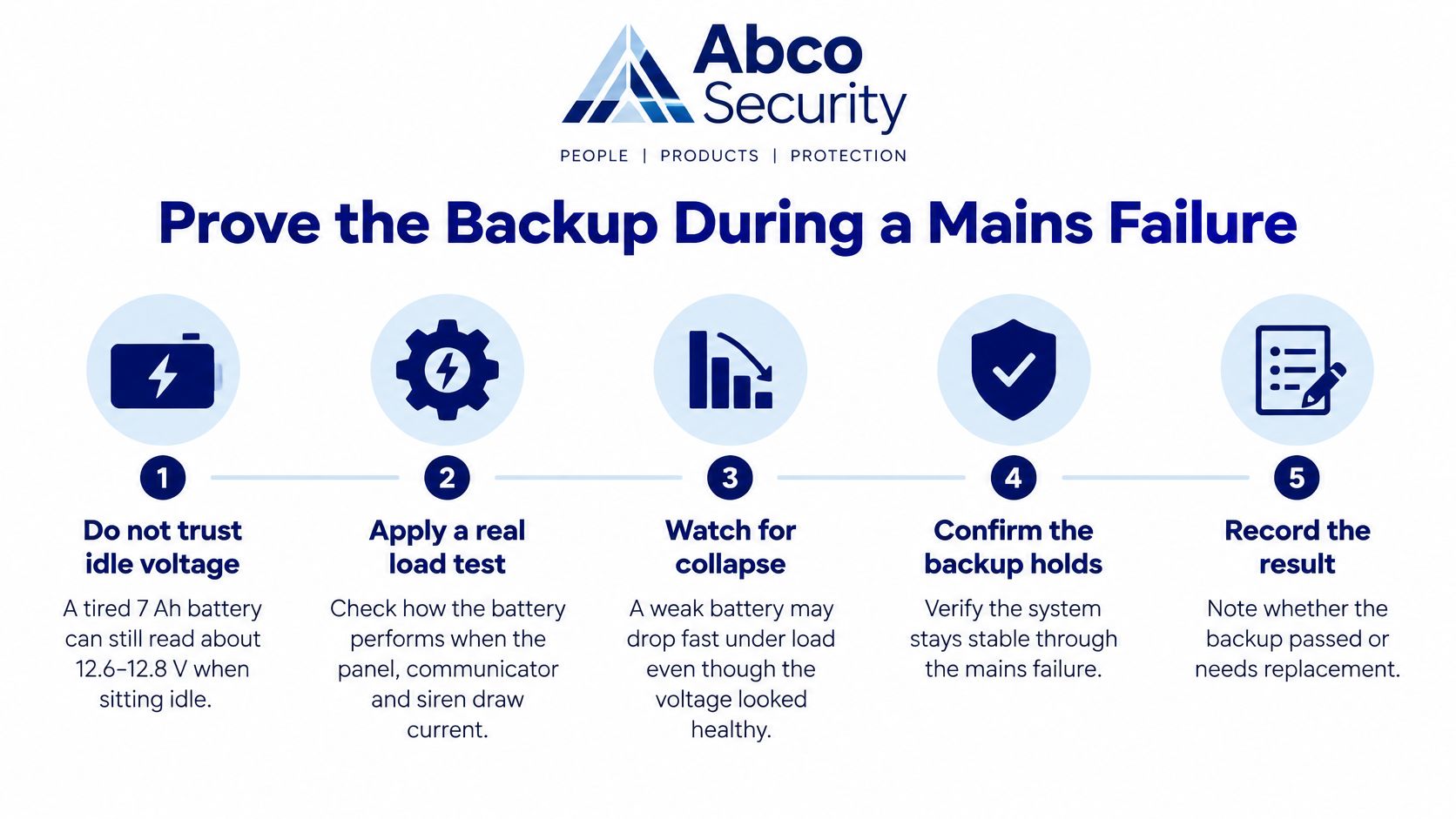
A panel can show a healthy idle voltage and still fail during a blackout. A tired 7 Ah battery may read about 12.6–12.8 V at rest, then lose voltage when the panel, communicator and siren draw power together.
Accept the replacement only after a mains-fail test. Sealed valve-regulated lead-acid batteries need less upkeep than flooded types, but their connections still need to be corrosion-free and the battery inspected periodically.
Acceptance Record
Record the results while the cabinet is open and the test window is active:
- Open-circuit voltage: The battery reading before connection, if measured.
- Charger or float voltage: Confirmation that the panel charges the battery after mains power returns.
- Load result: The automatic battery-test result or a technician's load-test result.
- Outage behaviour: Whether the keypad, communicator and siren operated with mains power off.
- Centre acknowledgement: Whether the alarm-receiving centre received the test signal.
- Fault-clear time: How long low-battery or charger-fail indications took to clear.
Nominal voltage alone is not enough to establish compatibility. Check charging requirements, dimensions, terminals, polarity, temperature conditions and required standby duration. A lithium replacement for a sealed lead-acid panel battery needs compatible charging and protection; a normal power-up does not prove it is safe or reliable.
Short Test for an Unmonitored House
Restore mains power and wait for the charge indication. Arm and disarm the system, then trip one door contact in test conditions. Confirm the keypad and siren respond as expected.
If the manufacturer permits a breaker-off test, switch off the relevant breaker for a brief, supervised outage. The keypad should remain on, zones should report, and the panel should not reset when the siren or communicator draws from the battery. If the manufacturer does not permit this test, stop and arrange an approved test method.
For a monitored home, keep the centre on test and ask it to confirm receipt before restoring the account. A strata panel connected to CCTV or access control may also need a maintenance record for several lots. Security systems monitoring matters because a local siren does not confirm off-site reporting.
For routers or recorders, HighFlow Energy explains UPS systems and the difference between broader equipment backup and panel standby. A UPS does not replace a failed panel battery.
Check for false signs of success: reversed spade terminals, an open tamper, old and new batteries mixed together, a swollen battery left in the cabinet, or a wireless siren with its own flat cell. A quiet keypad alone does not confirm that every device is working.
After the test passes, check disposable sensor-cell status through the keypad or app and replace cells when a chirp starts or at the maker's interval. Record the panel battery's replacement date and track it over its multi-year service window.
The job is finished when the system signals during a blackout, not when the cabinet is closed.
Clear a Low Battery Alert That Returns
The most common leftover chirp doesn't mean the new cell is faulty. The panel may still be charging it, the automatic test may not have run, or a second device may be low and reporting through the same keypad.
Read the exact message before you open anything else. A zone name, device number or charger warning points to different work, and guessing usually means replacing a good battery twice.
Low-Battery Symptoms, Causes and Fixes
| What you see or hear | Likely cause | Next action |
|---|---|---|
| Panel shows normal voltage but drops on test | Capacity too small or battery worn despite open-circuit voltage | Fit the approved Ah rating and repeat the mains-fail test |
| Charger-fail or AC-fail lamp stays on | Mains not restored, fuse open, or charger incompatible with the new chemistry | Restore power; stop if the charger is not approved for that battery |
| One zone stays in low battery | That sensor or keyfob cell was not changed, or polarity is reversed | Open only that device and match the original cell |
| Tamper or case fault after the swap | Cover, gasket or tamper spring not seated | Reseat the cover; do not ignore it to silence the chirp |
| Outdoor siren beeps while the panel is quiet | Siren has its own pack | Replace the siren pack or book a technician for a high or sealed unit |
| Monitoring centre missed the test signal | Account not on test, communicator battery flat, or path failed | Call the centre before another test; do not assume local siren means off-site reporting |
A chirp every 30–60 seconds at the keypad often needs a different response from a named zone message. The first may clear after a full charge and automatic test cycle. The second usually means you should open only that sensor, check polarity and confirm the cover tamper has seated.
Don't mute an intermittent chirp overnight and forget it. Investigate it the same day, because repeated silencing trains everyone in the house to ignore the one warning designed to be annoying.
Say a Perth townhouse gets a new panel battery, but the garage reed switch still reports low that evening. The panel work may be sound. The remaining fault is the unnamed contact nobody opened, and changing the panel battery again won't clear it.
If repeated alerts are part of a wider nuisance-alarm problem, structured false alarm reduction starts with identifying the exact reporting device. Battery faults, loose tampers and genuine zone triggers shouldn't be lumped together.
Dispose of the Old Battery Separately
Keep disposal separate from diagnosis so old cells don't sit beside the panel for months. Tape lithium terminals, keep damaged packs away from heat and combustibles, and take lead-acid and lithium batteries to a council collection point or B-cycle drop-off rather than household rubbish.
Place a leaking lead-acid battery upright in a sturdy bag or container for transport. Don't leave it in a hot car boot, and wash your hands after handling corrosion.
Stop DIY troubleshooting if the fault returns after a correct battery and a passed charge test. Also stop if a monitored centre didn't receive the test, the cabinet smells hot or of rotten eggs, or the panel resets during the outage test. At that point the battery may be revealing a charger, communicator or wiring fault rather than causing the whole problem.
Book a Technician When DIY Should Stop
A fresh battery does not prove the alarm will work during an outage. Continue a DIY change only when the device is user-accessible, the replacement matches its label, the system is not monitored, and the mains-fail test passes. If any condition fails, book a technician to check the fault without risking damage to the charger or a missed alarm signal.
Clear Stop Points
- Hard-wired or shared equipment: The panel is hard-wired, mounted out of reach, locked, or shared with other lots.
- Monitored account: The monitoring centre needs to manage test mode, confirm the signal and restore the account.
- Integrated systems: Alarm, CCTV, access control or intercom faults may affect one another.
- Compliance record required: An insurer, tenancy, strata manager or workplace needs documented maintenance.
- Battery damage: The case is swollen, leaking, hot, cracked or heavily corroded.
Compare service quotes by what they include. Security Wholesalers lists an indicative total of $330–$950 or more for battery-and-communications security-system service in Australia, including panel, siren or wireless batteries and communications testing. A mismatched battery can leave the communicator unable to report, so a low quote that covers only a battery swap may not address the fault.
For homes in Melbourne, Sydney, Brisbane, Perth or Adelaide, compare local providers' stated service areas and the work included. ABCO Security's Night Owl plan offers unlimited 24/7 CCTV monitoring and coordinated patrol response for homeowners seeking ongoing coverage rather than a battery change alone.
ABCO also provides mobile patrols and security guarding for strata, retail and construction sites. Those services address site coverage and response, while electronic maintenance addresses faults such as a failed charger. Keep the roles clear when choosing what your property needs.
If camera coverage is part of the same review, plan home security camera installation around entrances, power supply and monitoring paths. A camera that loses power during an outage may not provide useful footage when needed.
Record the replacement date and keep the mains-fail test result with the maintenance log. If the alert, charger indicator or monitoring signal remains faulty, stop troubleshooting and book a service visit.
If a panel battery, sensor cell or monitored test signal still is not right, ABCO Security Services Australia can assess the electronic fault and discuss monitoring, patrol response or on-site cover for a home, strata building or commercial premises.
about
avada factory
Sempery ultricies nibh at dolor cras urna eleifend nec. Atiam efficitur tempor.