Hope Island recorded 215 reported thefts in 2025, compared with 58 burglary or break-and-enter cases, according to RedSuburbs' Hope Island crime summary. That distinction matters: Hope Island security shouldn't start with the assumption that every property needs a guard at the perimeter. It should start with what can be stolen, how someone could reach it, and who will act when something happens.
A residential estate, marina-adjacent property and construction compound need different coverage. The practical choice is a combination of people, cameras and access controls matched to the site, with written duties and records that let the property manager check whether the arrangement works.
Which Security Service Fits Your Hope Island Site
Hope Island site types and the services that fit them
| Site type | Main risks | Core services | Monitoring |
|---|---|---|---|
| Gated residential estate or strata complex | Vehicle and pedestrian access, theft from car parks, common-area damage | Gatehouse security, mobile patrols | Gate and car park cameras, access logs |
| Detached home or small business | Opportunistic entry, theft from vehicles | Residential monitoring, patrol response | Monitored alarms and external cameras |
| Shopping centre or retail site | After-hours entry, theft from cars, loading bay incidents | Shopping centre security, retail security | Car park and loading bay cameras |
| Office tower or corporate building | Unauthorised visitors, after-hours access | Concierge security, reception security | Access control and entry cameras |
| Construction site | Equipment and material theft, unauthorised entry | Construction security, gatehouse control, patrols | Temporary CCTV and site patrols |
| Marina-adjacent property | Boat and equipment theft, misuse of shared facilities | Mobile patrols, static guarding | Dock and car park cameras |
| Event or venue | Crowd control, entry disputes, alcohol incidents | Event security, static guarding | Temporary cameras and incident logs |
The table is a shortlist, not a prescription. A staffed entrance makes sense when someone must continuously check access, but it's an expensive way to cover a quiet property whose main exposure is an unattended rear boundary.
Likewise, an alarm subscription doesn't resolve unrestricted contractor access. Match the service to the task rather than buying the most visible option.
Choose coverage by exposure
A strata manager might identify tailgating through the vehicle gate and theft from an isolated parking area as the principal concerns. Gatehouse Security addresses entry decisions, while Mobile Patrols and camera coverage support checks away from the entrance.
For a small business, monitored detection and a defined patrol response may be more proportionate than permanent guarding. A marina-adjacent site needs particular attention to the boundary between publicly accessible areas, docks and private storage.
We operate around the clock across Australia. Our sector coverage includes residential and strata, retail, commercial property, construction, aviation and marina environments, so Hope Island properties sit within our usual client mix.
We also serve residential estates, shopping centres and car parks, warehouses and logistics facilities, construction developments, schools, colleges, training facilities, local government and public spaces. For organisations managing properties in Melbourne, Sydney, Brisbane, Perth and surrounding cities within a 200 km radius, confirm the actual deployment and response arrangements for each address rather than assuming identical local coverage.
Build your service shortlist
- Identify the site type. Include secondary uses, such as retail tenancies beneath residential apartments.
- List the biggest risks. Choose concrete problems, such as uncontrolled deliveries or exposed equipment, rather than writing theft.
- Select the services that answer them. Shortlist a small combination with a clear job for each component.
How Guarding, Patrols and CCTV Work Together
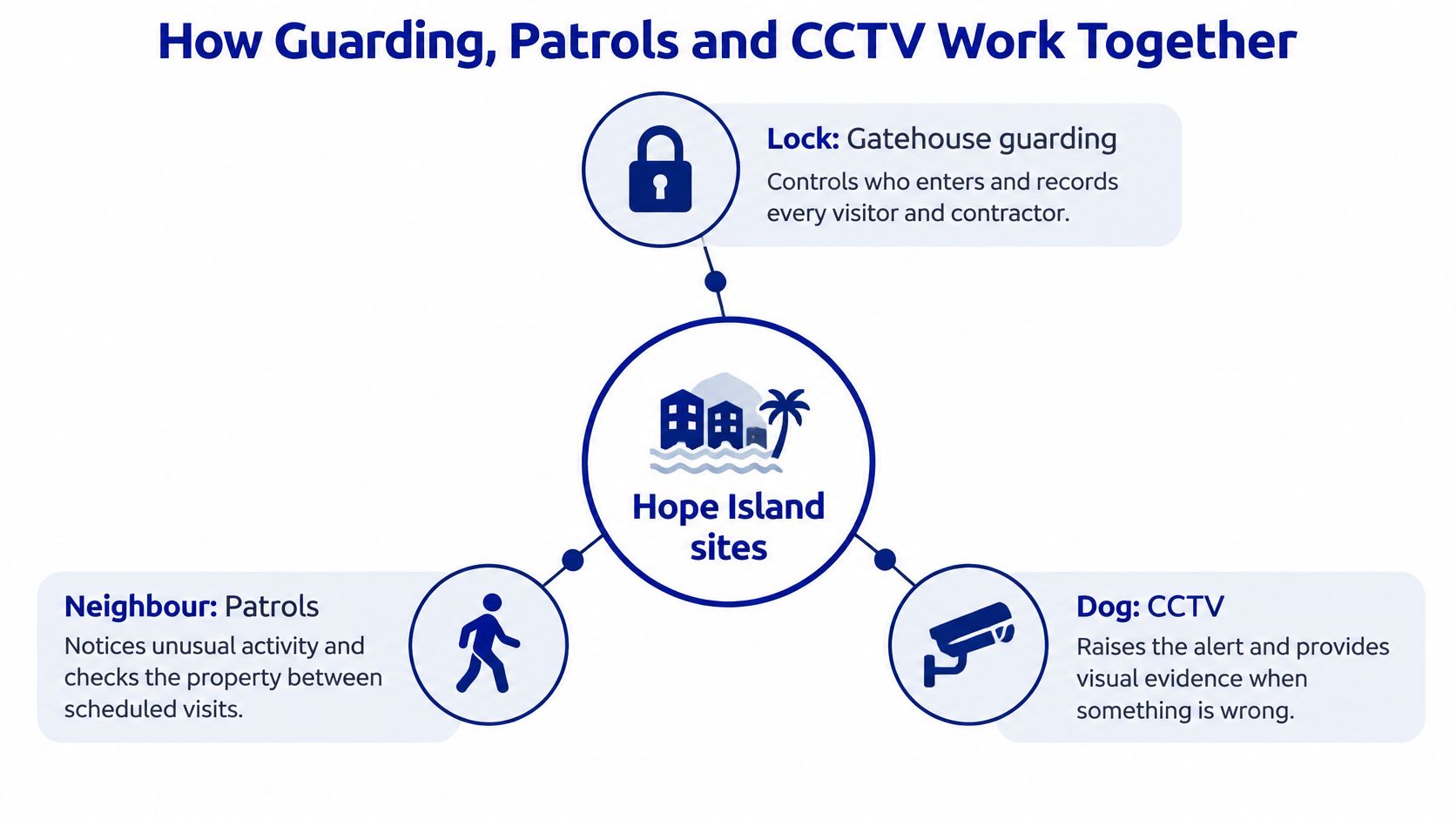
A house has a lock, a neighbour who notices unusual activity and a dog that barks. Each contributes something different. On a managed property, access controls restrict entry, officers notice and investigate, and monitored cameras help raise and verify an alert.
Guards deter, cameras detect, patrols respond. Those roles overlap, but the distinction is useful when deciding where to spend money.
Hope Island isn't a small resort precinct: the Australian Bureau of Statistics' 2021 Census recorded 14,665 usual residents, 6,891 private dwellings, an average household size of 2.35 people and a median age of 50 years. Coverage must accommodate homes, visitors, shared facilities and everyday access, not just secure an empty building overnight.
The diagram shows how those complementary roles fit together.
Give each layer a defined job
Deterrence is the visible presence at the gate, reception desk or property boundary. An officer can challenge an unexpected visitor and resolve an access question before someone enters, but can't simultaneously watch every entrance and inspect the entire site.
Detection comes from CCTV, intrusion alarms and access records. These help establish where an event occurred and what happened, but a recording system alone doesn't send someone to secure a damaged door.
Response means a person takes an agreed action. That might involve a patrol inspection, contacting a key holder or escalating an active offence to police, depending on the circumstances.
Practical rule: Every alert needs an owner, and every owner needs an action they're authorised to take.
Test the gaps between layers
A camera without monitored escalation may provide useful evidence only after a loss. A patrol without accessible footage may arrive unable to distinguish an intrusion from an innocent alarm activation.
A single guard can also become a bottleneck. If the officer leaves the gate to investigate a noise, who handles arriving visitors, and does the entrance remain controlled?
We provide 24/7 security operations across Australia, but a workable site design still needs explicit responsibilities outside business hours. Continuous operations don't replace a clear instruction about who receives an alert or who has keys.
Before requesting quotes, sketch your property and mark:
- Deterrence points: Where an officer's presence would influence access or behaviour.
- Detection points: Which entrances, assets and movement routes require visibility.
- Response arrangements: Who attends, how they enter and who authorises further action.
That sketch will expose missing connections more effectively than a list of cameras or guard hours.
Matching Coverage to Hope Island's Property Crime Risk
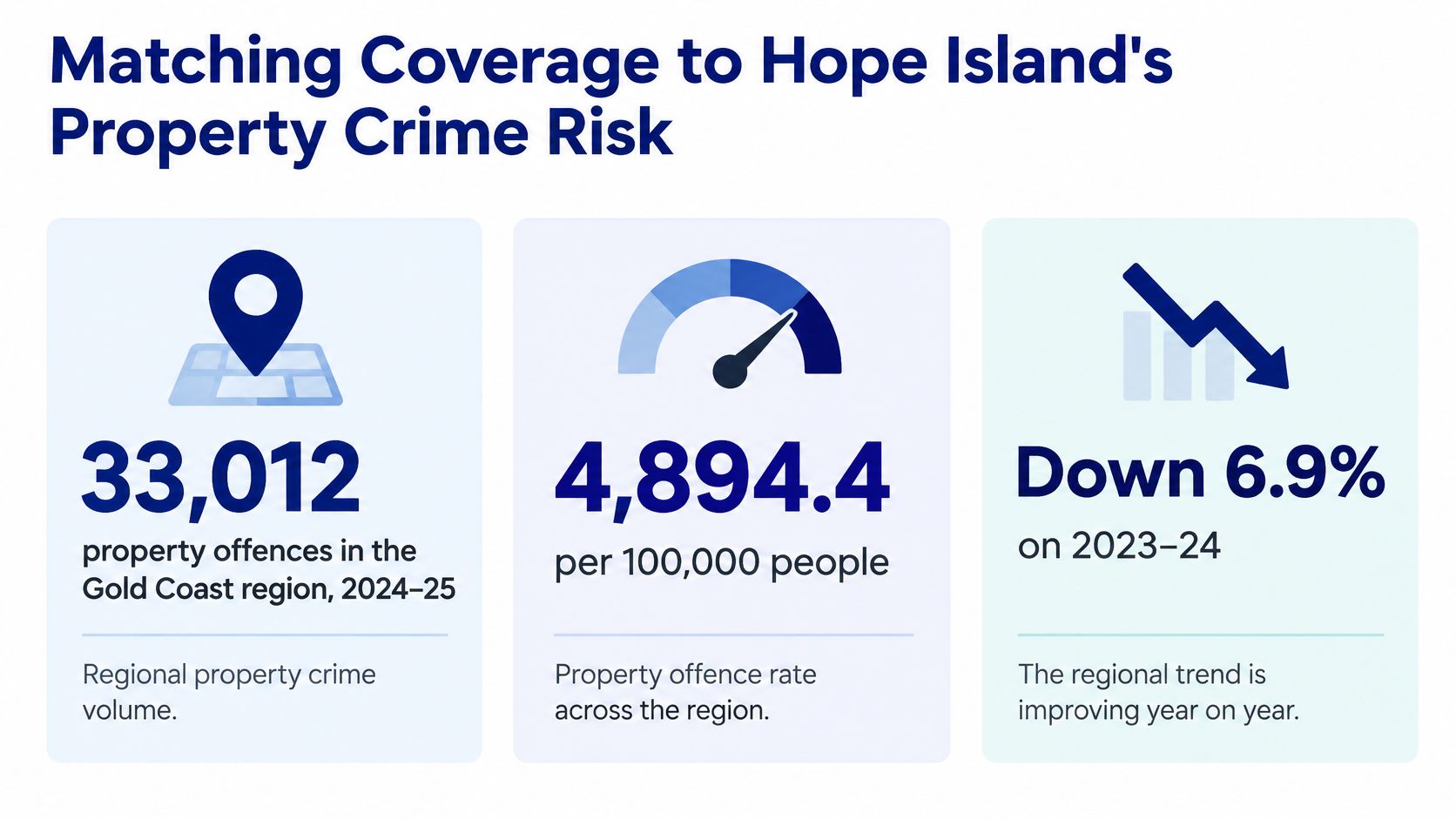
The Gold Coast recorded 33,012 offences against property in 2024–25, a rate of 4,894.4 per 100,000 people, down 6.9% from the previous year, yet it still had the highest property-crime volume among Queensland SA4 regions in the Queensland Government Statistician's Office crime report. These are regional figures, not a measure of an individual Hope Island property's likelihood of an incident.
A falling trend doesn't justify removing controls without checking local exposure. Equally, regional crime totals aren't a sound reason to describe every residential street or marina precinct as unsafe.
The regional picture provides context for a site assessment.
Divide the property into operating zones
The suburb's theft-led pattern makes accessible assets a sensible starting point. It doesn't establish where every offence occurred, so use incident records, resident reports and a walk-through to identify the actual weak points.
A structured security vulnerability assessment helps turn those observations into a coverage plan.
| Zone | What to inspect | Practical allocation |
|---|---|---|
| Externally accessible areas | Street entrances, visitor parking, loading bays and dock approaches | Entry cameras, usable lighting and after-hours checks |
| Shared areas | Strata car parks, corridors and communal facilities | Controlled access, camera coverage and targeted patrol inspections |
| Plant and equipment storage | Construction compounds, maintenance stores and boat equipment storage | Gate control, locked storage and checks for interference |
| High-value internal areas | Offices, stockrooms, communications rooms and key storage | Restricted permissions, intrusion detection and entry records |
For a strata car park, check whether a camera can show useful detail at the pedestrian entrance, not merely provide a wide view of parked vehicles. Repairing failed lighting and a latch that doesn't close may deserve priority over adding another camera.
A construction compound needs a different allocation. Gate control should establish who is authorised to enter, while locked storage limits access to portable plant and materials after contractors leave.
At a retail loading bay, delivery procedures matter as much as surveillance. After-hours patrols and monitored alarms should support a clear rule for closing doors and removing temporary access once deliveries finish.
Measure outcomes rather than appearances
A uniform at the entrance is easy to see. Its contribution is harder to judge unless the manager keeps useful records.
- Repeat incidents: Record recurring locations and methods so controls can be adjusted.
- Response times: Distinguish alarm receipt, verification, dispatch and attendance.
- False alarms: Investigate recurring causes instead of accepting unnecessary call-outs.
- Resident disruption: Track access disputes, noise complaints and avoidable interruptions.
Don't treat a quiet reporting period as proof that every control is effective. Check whether faults, near misses and access exceptions are being recorded consistently.
Specifying Mobile Patrols and Guarding Duties
Patrol specification elements and examples
| Patrol element | What to specify | Example |
|---|---|---|
| Locations | Name every checkpoint and the order it is checked | Construction site perimeter fence, plant compound, site office |
| Frequency | Number of checks per shift, with timing varied to avoid a predictable pattern | Commercial car park checks within agreed overnight intervals |
| Access | Keys, gate codes and door access the officer needs | Locked plant room and after-hours gate code issued for the shift |
| Observations | Doors, lighting, fencing, signage and signs of forced entry | Pried loading dock door or failed light over a car park |
| Handover | Unresolved risks passed to the next shift in writing | Open gate logged for maintenance and checked again at the next patrol |
A patrol is a defined job, not a drive-by. The national competency unit CPPSEC2107, Patrol premises to monitor property and maintain security, links the activity to standard operating procedures, workplace policies and work health and safety responsibilities.
That distinction matters when comparing quotations. An attendance at the front gate isn't equivalent to an inspection of the perimeter, plant compound and site office.
Make the patrol brief usable
The officer needs an annotated site plan, current access instructions and a clear escalation list. Identify areas they must not enter alone and hazards that require a supervisor or emergency service rather than a routine inspection.
Set a contractual number of checks and suitable attendance windows, but avoid making the sequence unnecessarily predictable. The discussion of security patrol frequency is useful when balancing coverage gaps against cost.
Our construction-site officers monitor entry points, manage visitor access and perform perimeter patrols day and night. Our access-control training includes monitoring visitor movements, issuing passes, recording entries and exits, and operating digital or manual systems.
The brief should distinguish those responsibilities. An officer checking contractor passes at a busy gate can't be assumed to be inspecting distant fencing at the same time.
Use a construction patrol checklist
- Confirm the perimeter fencing is intact. Look for displaced panels, damaged gates and openings that allow unnoticed entry.
- Check that plant and materials are locked. Record unsecured storage and follow the agreed procedure for securing it.
- Inspect lighting and signage. Failed lights affect visibility, while damaged signs can leave visitors unclear about access restrictions.
- Look for signs of forced entry. Don't disturb a suspected scene or enter a potentially occupied building without an appropriate safety assessment.
- Log findings with time and initials. Identify the checkpoint, observation and action so the entry can be understood later.
- Pass unresolved issues to the next shift. Name the responsible contact and record whether repair, reinspection or escalation remains outstanding.
A patrol report should tell the next person what still needs doing, not merely prove that someone attended.
Request a timestamped patrol-log sample and an anonymised incident report before agreeing to the reporting format. Look for specific observations, actions and unresolved risks rather than repeated entries saying everything was satisfactory.
CCTV Monitoring, Escalation and Privacy Rules
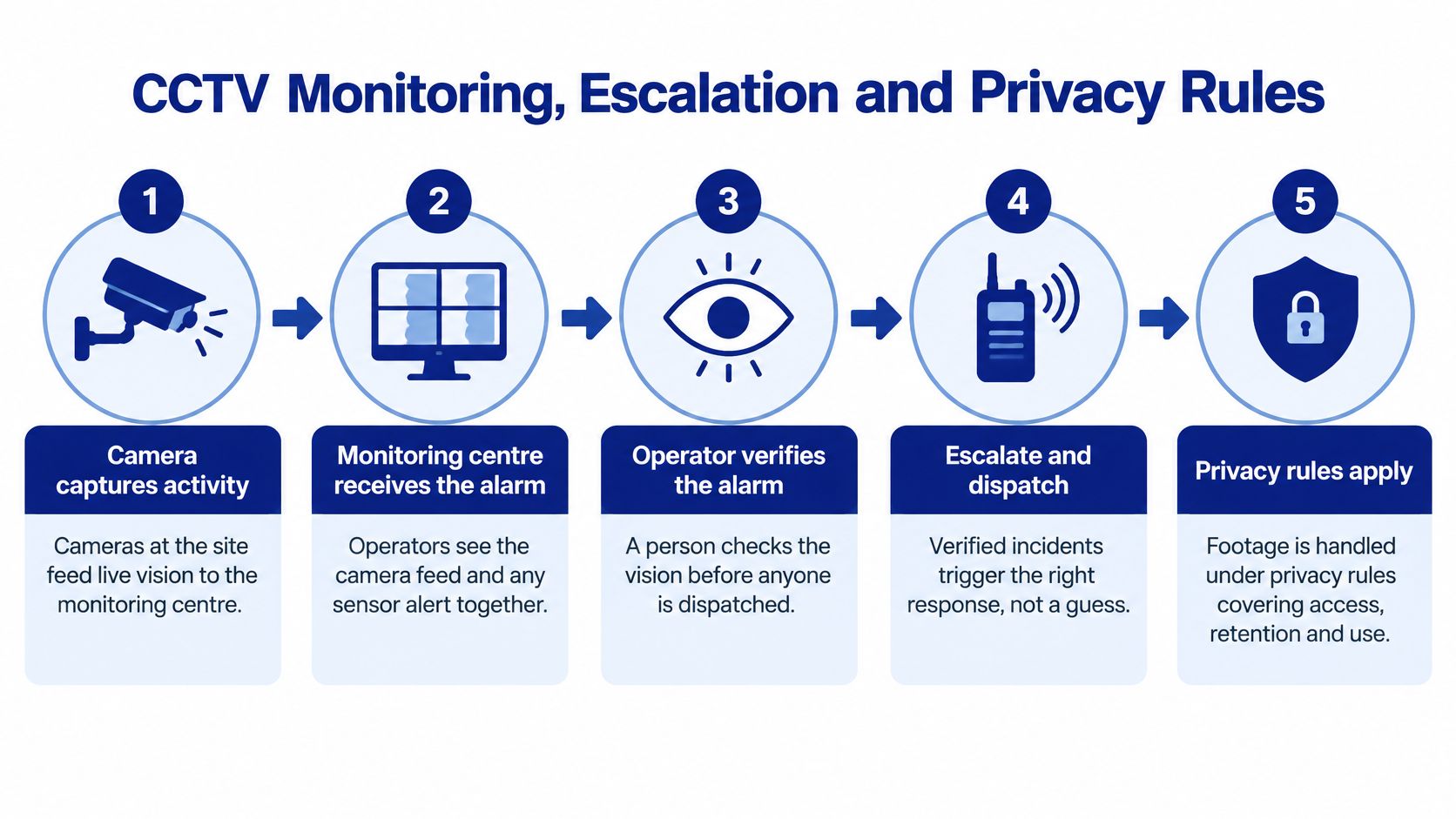
Monitored CCTV connects an alert to a decision. Cameras provide vision to an operator, who checks the event before taking the action specified in the site's response instructions.
That can help distinguish a genuine intrusion from a sensor triggered by a passing animal. It isn't a reason to dismiss an alarm when the camera view is blocked or inconclusive.
Set the escalation sequence
A practical response procedure should establish the following sequence, with urgent threats escalated immediately rather than delayed by unanswered calls.
- Receive the trigger. Identify the alarm zone or camera event and the affected property.
- Verify available evidence. Check live vision and recent footage for activity, direction of travel and immediate danger.
- Contact the site representative. Seek relevant context from the nominated contact or key holder when appropriate.
- Dispatch the agreed response. Send a patrol officer for a confirmed event or where the response instructions require attendance.
- Contact police when warranted. Escalate an active offence or immediate threat without making patrol attendance a prerequisite.
- Complete the incident record. Record decisions and preserve relevant footage through an auditable export process.
We maintain 24-hour communication channels between site supervisors, security officers and our operations centre. Site instructions must still identify who can authorise access, repairs and emergency expenditure.
The process below connects monitoring with responsible information handling.
Protect footage as well as property
The Office of the Australian Information Commissioner's security-camera guidance states that organisations covered by the Privacy Act 1988 generally need to notify people before recording, secure recorded personal information, and destroy or de-identify it when no longer required. The Act doesn't fully regulate workplace surveillance, so check applicable Queensland laws as well.
- Visible signage: Notify people at entrances before they enter recorded areas.
- Proportionate camera views: Avoid unnecessary capture of private windows and neighbouring spaces.
- Role-based access: Limit live viewing, playback and exports to authorised people.
- Documented retention: Establish deletion rules and controlled exceptions for incident evidence.
- Export records: Record who released footage, to whom and for what purpose.
- Separate monitoring purposes: Don't repurpose security footage for employee-performance monitoring.
For a practical illustration of how physical restrictions and surveillance complement each other, Admiral's Yard Self Storage provides CCTV and access control explained. It's an operational example, not Australian legal guidance.
Use the discussion of CCTV retention periods in Australia to frame your policy questions. Specify authorised viewers, incident preservation, deletion responsibilities and a complaint contact before commissioning the system.
Gatehouse, Concierge, Retail and Event Security in Practice
Specialist coverage works when the officer's action produces a record the client can inspect. These Hope Island scenarios show what that means beyond a service name.
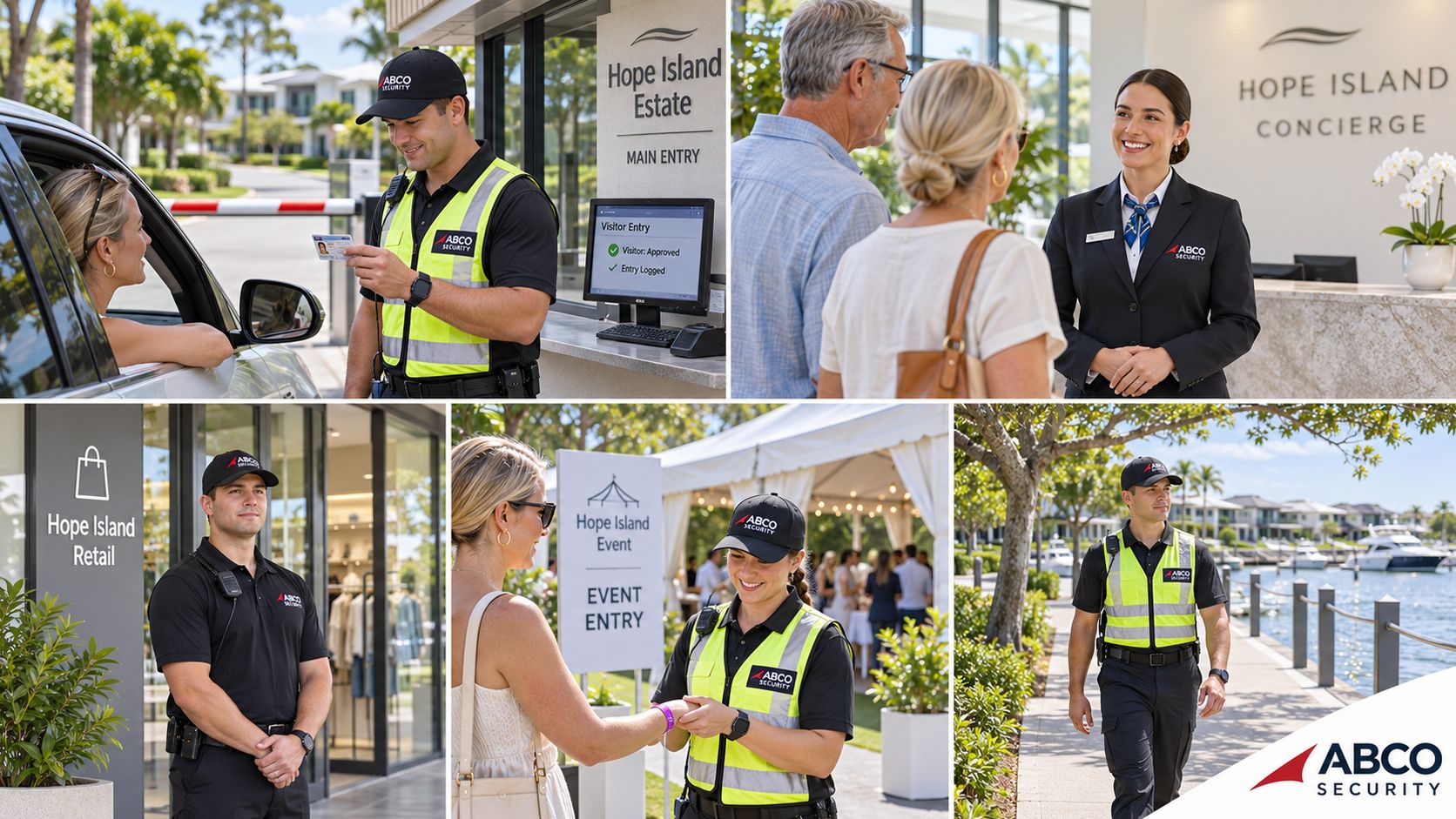
The image illustrates the range of visitor-facing and monitoring duties involved.
Gatehouse and concierge access
At a Hope Island residential estate, a gatehouse officer checks visitor and contractor identification against the approved access procedure. Entries, exits and unexpected arrivals go into the gate log, with unresolved access issues carried into the shift handover. The manager's check is whether an exception can be traced to a decision and authorisation.
In an office or residential tower, Concierge Security combines reception coverage with visitor sign-in and pass control. A visitor register and pass record should distinguish welcomed guests from people permitted beyond reception. Use the scope of concierge security guards to define which doors, hours and visitor categories the role covers.
Retail and construction operations
At a shopping precinct, an officer checks the loading bay after deliveries and inspects the car park after trading. The record should identify unsecured doors, lighting defects and any incident verified through camera footage. The client should ask to see how a defect becomes a maintenance task rather than remaining an isolated log entry.
On a construction site, our access protocols use ID verification systems and digital visitor tracking. A workable shift also covers gate control, equipment protection and assigned fire-watch duties, with visitor records and safety observations kept separately. The site manager should inspect outstanding exceptions, not just the list of people admitted.
The following video provides additional context for the personnel-based side of security operations.
Event entry and crowd management
At a Gold Coast community event, officers screen entry, monitor crowd behaviour and document refusals, disturbances and interventions. Our event security officers are RSA-qualified and crowd-control-licensed; where alcohol is served, the organiser must also clearly allocate service and alcohol-compliance responsibilities. Check the roster, credentials and incident-log format before opening.
For planning the interface between venue operations, suppliers and guest movement, organisers can compare event logistics support options through Texas Old Town. That resource supports logistics planning, not Queensland licensing advice.
Across these roles, use a consistent audit trail:
- Visible identification: Let authorised managers establish who is working.
- Duty register: Record attendance, post allocation and handover.
- Incident ownership: Name who follows up each unresolved matter.
Confirm Licensing, Rates and Limits Before You Sign
All our security guards are fully licensed under relevant Australian state regulations. They receive ongoing training in conflict resolution, first aid, OH&S, customer service and emergency response.
Credentials establish a baseline, but the quotation must also support the proposed roster. A low total means little if overnight duties, supervision or relief arrangements are missing.
Compare labour assumptions honestly
The following employee minimums are the schedule figures referenced by the Fair Work Security Services Industry Award summary, not a current client quotation.
Security Officer minimum hourly rates under the Award
| Work type | Security Officer Level 1 (per hour) | Security Officer Level 3 (per hour) |
|---|---|---|
| Ordinary day work | $28.42 | $29.73 |
| Night work | $34.59 | $36.18 |
| Saturday | $42.63 | $44.60 |
| Sunday | $56.84 | $59.46 |
| Public holiday | $71.05 | $74.33 |
Award rates change, so check Fair Work's current schedule before relying on these figures. Client pricing also covers items such as supervision, insurance, vehicles, technology and administration; the guide to security guard costs in Australia helps frame that distinction.
Put responsibilities in writing
Request written answers covering:
- Licensing: Relevant licence numbers, authorised duties and expiry dates.
- Reporting: Sample patrol logs and incident reports.
- Privacy: CCTV access, retention and disclosure policies.
- Continuity: Battery or generator arrangements, cellular backup and manual gate procedures.
- Escalation: The operational contact and authority to act after hours.
A property management contract template from Royal LePage Brookside Realty can help identify responsibility headings. It isn't an Australian security contract and requires local adaptation and appropriate legal review.
Contract boundary: Security services are a deterrent and cannot guarantee prevention of all theft, loss or damage.
Shortlist two providers and compare their written answers against the same duties and roster. Contact our team on (03) 9001 0024 or info@abcosecurity.com.au with your site plan, operating hours and priority risks.
ABCO Security Services Australia offers licensed guarding, mobile patrols, monitored surveillance and access-control solutions for residential, strata, retail, marina and construction environments. Visit ABCO Security Services Australia to discuss a Hope Island security plan with defined duties, reporting requirements and escalation arrangements suited to your property.
about
avada factory
Sempery ultricies nibh at dolor cras urna eleifend nec. Atiam efficitur tempor.