The loading dock door at a Melbourne warehouse has been propped open since 5:40 pm. The camera above it works. The recording is sharp. Nobody has watched the feed in three weeks, the closing checklist still lists a fire door that was bricked up during the last fit-out, and the after-hours alarm code is the same one issued to a cleaning contractor whose contract ended in March.
None of that is a camera failure. It's an assessment failure. Every one of those gaps was findable in a single walk-through by someone who knew what to look for, and each carries more real risk than most items on the site's maintenance schedule.
This is the work a vulnerability assessment does. Not a scan report, not a compliance certificate, but a connected map of where physical, digital and process gaps meet, which failures stop operations, and what to fix first with the money and people you have.
What a Vulnerability Assessment Covers and Its Three Types
A vulnerability assessment is a structured review that identifies where a site, system or process could fail or be exploited, rates each finding, and recommends fixes in priority order. It's descriptive rather than adversarial. Nothing gets exploited during the review; the output is a ranked picture of exposure that a facilities manager can act on.
Think of it as a pre-purchase building inspection. A competent inspector checks the structure, the wiring, the drainage and the roof space, not just the front door. A poor one walks the perimeter, photographs some cracked render and sends an invoice.
Every assessment answers three questions. What could go wrong here. How likely it is, given who can reach the asset and what they'd need to get to it. And what it would cost the business if it did, in safety, downtime, stock loss or contractual exposure. The difference between a threat and a risk matters here, because a threat you can't reach isn't a risk you need to fund this quarter.
The three types and where they meet
Most sites need all three types, and the discipline is in keeping them separate long enough to assess each properly before you merge the findings.
| Type | Assets Examined | Typical Weakness Found |
|---|---|---|
| Physical | Fences, gates, doors, lighting, loading bays, guard posts | Unlocked loading doors after hours, lighting gaps, blind spots at perimeters |
| Cyber-physical | CCTV, access control, alarms, building-management systems | Default camera passwords, unpatched door controllers, alarms not monitored |
| Process | Shift handovers, visitor logs, key registers, contractor onboarding | Passes never reconciled, no after-hours key register, untested alarm response |
The physical assessment walks the fence line, the car park ramp, the bin room and the roof access. The cyber-physical assessment follows the network into the camera, the door controller and the building-management system, where a default password on a camera is simultaneously a digital hole and a physical one. The process assessment reads the paperwork nobody reads: handover sheets, the key register, contractor inductions, the visitor log that stops being completed after 9 pm.
Most serious gaps sit between the types. A camera works, records clearly and has current firmware, but the alert it generates goes to an inbox nobody monitors on weekends. The technology passed. The system failed.
How to Run a Vulnerability Assessment Step by Step
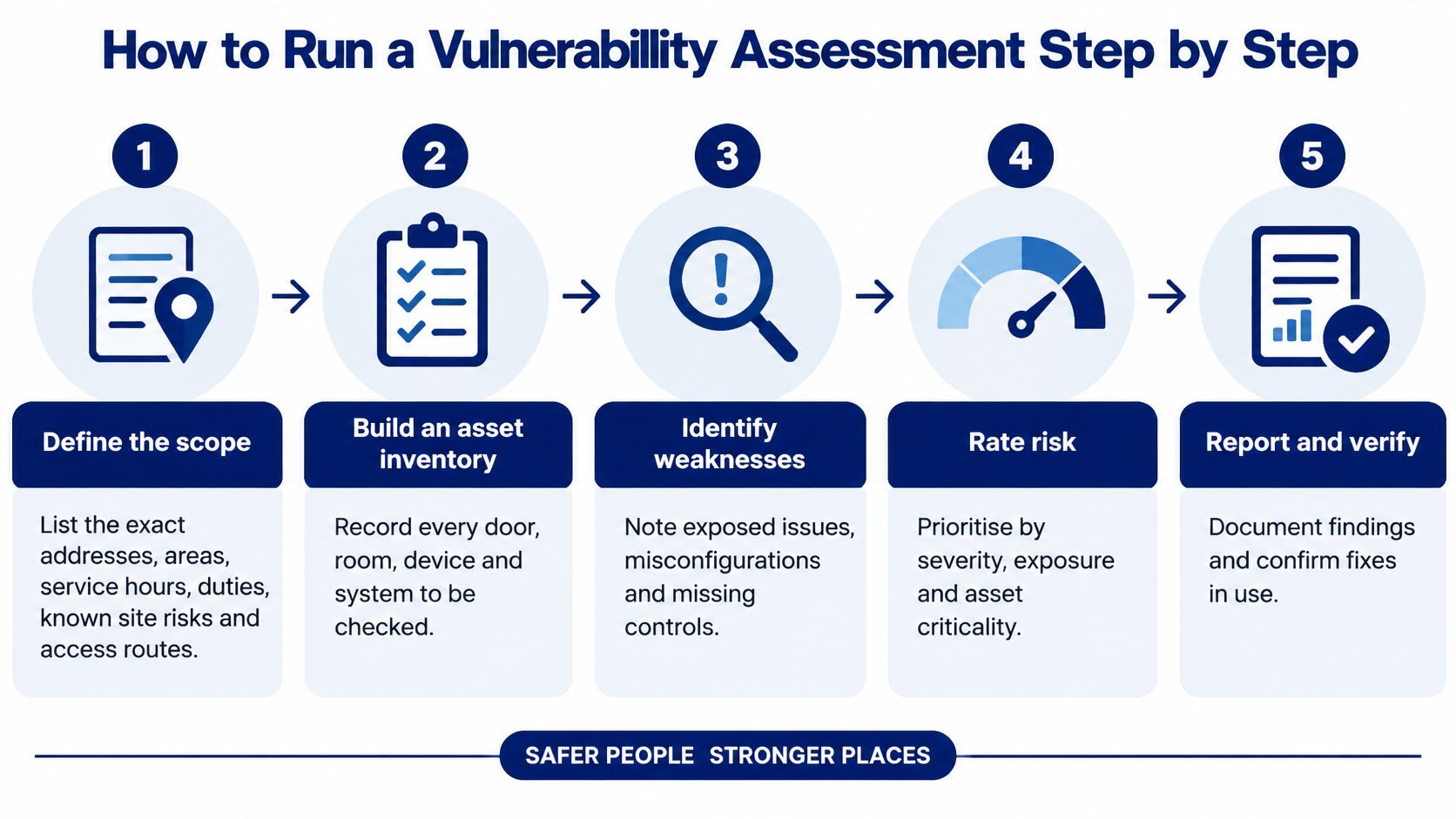
Seven steps run in sequence, and the order matters more than the tools used. The Essential Eight maturity model FAQ.pdf) sets out four stages, Maturity Level Zero through Maturity Level Three, representing increasing levels of adversary tradecraft and targeting. Level One may generally suit small to medium enterprises, Level Two may suit large enterprises, and Level Three may suit critical infrastructure providers or organisations in high-threat environments. Nominate the level in the scope and say why it fits, because it sets the cadence the later steps have to meet.
Define the scope in writing. List the exact addresses, the specific areas to be covered, service hours, detailed duties, site-specific risks, and access and logistics details. An unscoped assessment drifts towards whatever the assessor happens to notice. The common slip is omitting night-shift access, roof plant and basement parking. When site conditions or risks change materially, update the scope in writing rather than relying on what was true at kick-off.
Build the asset inventory. Record every door, camera, controller, alarm point, network device and business system that matters. An unlisted device cannot be assessed, so it drops out of the risk picture entirely. The usual mistake is building the list from the IT asset register and never reconciling it against what is physically bolted to the wall.
Identify threats and weaknesses. Combine a night walk-through, a peak-hour walk-through, structured interviews with staff and contractors, and automated scanning. The Essential Eight maturity model.pdf) gives a cadence rather than a vibe: automated asset discovery at least fortnightly at higher maturity levels, daily scanning for internet-facing services, and weekly scanning for applications that routinely handle untrusted internet content. The slip is treating a single quarterly scan as coverage.
Validate every finding on site. Confirm it exists, confirm it is reachable, and remove the false positives before the report goes out. Validation needs safe, unobstructed access to the areas in scope, so arrange keys, escorts and any required permits before the visit. An unvalidated finding costs credibility with the very people needed to fix it.
Rate each finding. Apply one method across physical, cyber-physical and process findings, so a broken gate latch and an unpatched door controller can be compared on the same page.
Record results in a register. One row per finding, with the evidence used, a named owner and a due date. "The facilities team" is not an owner.
Remediate, then retest before closing. A finding closes when someone has verified the fix in use, not when a work order is raised.
The register that makes the assessment usable
A complete register has one row per finding and enough columns that a stranger could action it. Finding reference and description. Assessment type. Asset and location. Rating and the reason for it. Evidence, whether that is a photograph, a configuration export or a signed interview note. Owner. Due date. Retest date and result.
A finished row reads something like this: VA-014 records the loading-dock door closer that fails to latch, rated high because the dock sits unattended during deliveries, a photo attached as evidence, a named maintenance contractor as owner, a due date, and a retest entry marked closed after the closer was replaced and checked.
If a row cannot be actioned by someone who was not in the room, the row is not finished.
Rating Risk to Decide What to Fix First
A camera covering a bin store and a controller managing every door in a tower can carry an identical flaw and still deserve opposite positions on the fix list. Four factors set priority, and a scanner's severity score is only one of them.
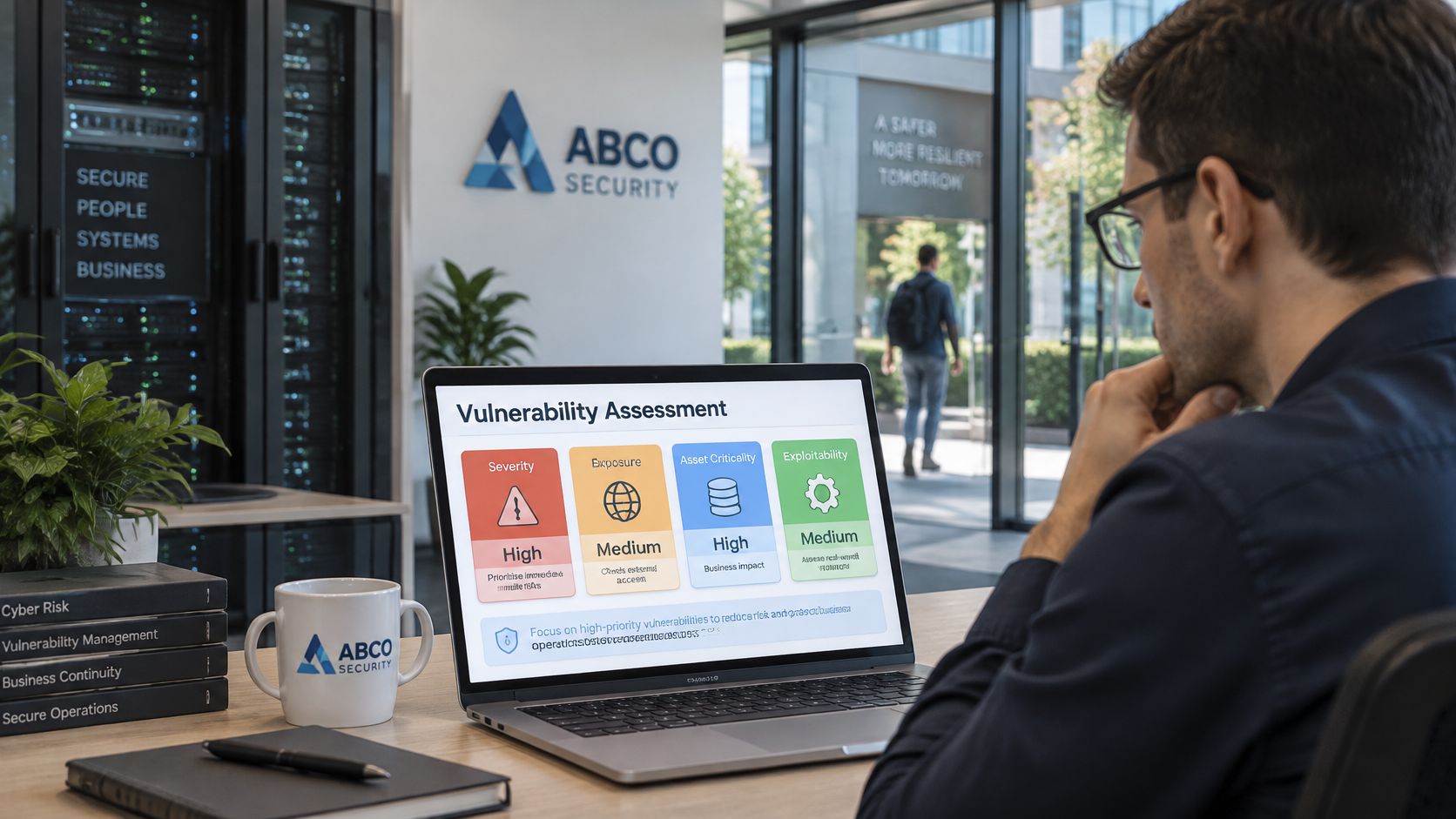
- Severity of the weakness. How much damage does exploiting it allow on its own, without any other step succeeding?
- Exposure. Can it be reached from the internet, from a shared tenancy corridor, from a loading dock during deliveries, or only by someone already inside with a staff pass?
- Asset criticality. Does it touch life safety, revenue or core operations? A failed lock on a cleaner's cupboard and a failed lock on the pharmacy door are not the same finding.
- Exploit or active threat. Is there a working exploit, a published proof of concept, or evidence someone has already tried it?
The third and fourth factors break ties. A severe weakness with a public exploit outranks an equally severe weakness nobody has weaponised, and a moderate flaw on a safety-critical system outranks a dramatic one on a decorative display.
| Rating | Criteria | Target Response |
|---|---|---|
| Critical | Public exploit or active threat, affects life safety or core operations | Act within 24 hours |
| High | Severe weakness on a critical asset, no known exploit yet | Within 7 days |
| Medium | Weakness with limited exposure or an effective compensating control | Within 30 days |
| Low | Minor gap with no realistic path to harm | Next scheduled review |
Treat these windows as planning values. A hospital, a chemical store or a live-event venue may compress them. A quiet storage yard with little of value may reasonably stretch the Low band.
When one weak control drags the whole site down
Averaging hides failures. Australia's Essential Eight maturity model rates an organisation at its least-mature mitigation strategy, so strength in one area does not offset a critical weakness in another, as set out in the ACSC Essential Eight guidance.
The same logic applies to a single site. A Sydney office tower can hold crisp 4K coverage of every lobby and a monitored alarm, yet still run a shared administrator password on its access-control system that three former contractors remember. The building's systemic rating is the password's rating. The cameras do not lift it.
Notice what that finding is. A shared password is a process failure, recorded in a digital system, that leaves a physical door open. One weak link crosses all three assessment types, which is why a connected map of gaps beats three separate reports: it shows which single fix closes the largest chain.
Rate each control area individually, then report the lowest score as the site's systemic exposure. That single line usually gets budget approved, because it describes a whole-of-site failure rather than a list of chores. From there, hand the owner a ranked list short enough to action this week. A composite score on a board slide moves nothing.
Practical rule: if the top three findings can't be fixed by the end of the month, they're rated wrong or the remediation plan has no owner.
Sector Checklists for Property, Construction, Events, Retail and Strata
Depth should match the site. A two-office professional firm and a 24-hour distribution centre carry very different consequences of failure, so they shouldn't get the same checklist depth or the same review frequency. A regional site can start with asset discovery, access checks and patch evidence, while a national logistics operator or an industrial facility needs stronger controls and a shorter reassessment cycle.
| Sector | Priority Assets | Key Checks |
|---|---|---|
| Commercial property | Lobbies, car parks, plant rooms, access cards | Visitor sign-in, card revocation for former tenants, after-hours lighting |
| Construction | Site gates, plant, materials, temporary cameras | Contractor ID checks, night perimeter coverage, site office access |
| Events | Entry points, backstage areas, cash and merchandise | Wristband controls, crowd flow at peak times, emergency exits clear |
| Retail and shopping centre | Stockrooms, loading docks, point-of-sale systems, customer zones | Staff access to back-of-house, CCTV blind spots, delivery schedule checks |
| Strata and residential | Gates, intercoms, car parks, bin rooms | Intercom and gate codes changed after handover, lighting, key register |
Commercial property. Pull the access-card list against the tenancy schedule and revoke every card belonging to a departed tenant or a finished fit-out contractor. It takes an afternoon and closes more real exposure than most equipment upgrades.
Construction. Site gates, plant compounds and temporary cameras move weekly, so the assessment should track the build stage. Contractor ID checks and night perimeter coverage matter most in the weeks when high-value plant is on site, and temporary cameras are only useful if someone watches the feed. This guide to construction site security by build stage in Melbourne explains how the priorities shift across a project.
Events. Walk the venue with the crowd in place, or as close to it as you can get. Emergency exits that look clear at 2 pm disappear behind queues, merchandise racks and signage by 8 pm. Wristband and pass controls mean nothing if the backstage door is propped for smokers.
Retail and shopping centre sites. The stockroom door held open with a trolley during trading hours is the classic finding. Check who can reach back-of-house, where the CCTV blind spots fall along the loading dock, and whether delivery schedules are known to people who shouldn't know them.
Strata and residential. The most common gap is a gate or intercom code that carried over from a previous committee handover and was never changed. Pair that with a working key register and lighting checks on the path from the car park to the lobby.
Where a finding needs a human layer, that's the point at which Event Security, Construction Security, Retail Security or Shopping Centre Security becomes part of the treatment plan rather than a separate conversation.
Mitigations and the Controls That Keep Them Working
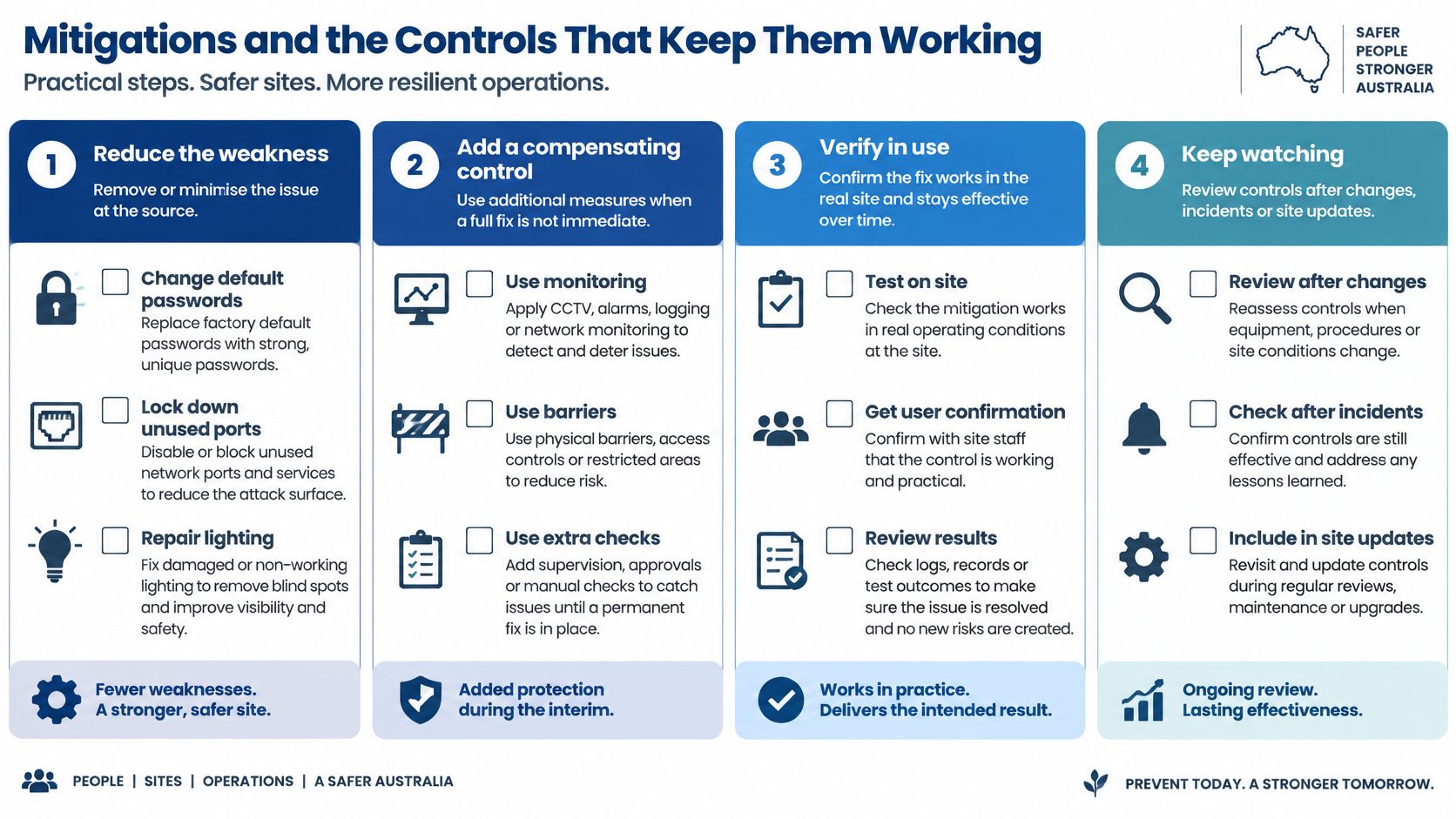
A fix isn't finished until someone has verified it in use. Work in three layers, because most sites can't close everything at once.
Reduce the weakness. Change default credentials, lock down unused network ports, repair the lighting over the bin store, remove the propped trolley and fix the checklist that still lists a demolished wall.
Add a compensating control while the full fix waits. A patrol at the affected gate until the door controller is replaced. A temporary barrier. A second signature on key issue. Compensating controls buy time, provided the register records that the underlying weakness is still open.
Plan for failure. A manual fallback for access control, so staff can still open doors and log visitors if the network drops or the controller is compromised. Guidance on continuity planning is common; the 2025 Commonwealth cyber security posture report shows cyber security disruptions were included in 92% of Commonwealth entities' business-continuity and disaster-recovery plans in 2025, yet only 34% had multi-factor authentication and 46% restricted administrative privileges in FY2024–25.
That gap is the useful question for any site. Not "do we have a plan", but can a compromised access-control, CCTV, alarm or building-management system be isolated while physical operations continue?
A worked example at a Brisbane retail site
Say the card reader at the staff entrance fails or is suspected of compromise on a Saturday morning. The fallback is a trained officer with a printed staff list, a logged key register and a radio to the control room. Doors open, entries are recorded, and nobody props the door for convenience.
That fallback only works if it was rehearsed on a quiet Tuesday first. Run the exercise with facilities, IT, security personnel and the business owner in the same room, and write down what stopped working.
Modular and temporary buildings bring their own access and siting problems, and this guidance on security concerns in mobile office buildings from Pacific Mobile Structures is a sensible read before you site a temporary office on an active construction compound.
Design decisions made at the start cost far less than retrofits, which is why security by design belongs in the assessment rather than after the tender. Where a manual layer is required, options run from Mobile Patrols for night perimeter checks to Concierge Security or gatehouse coverage for controlled access points.
Security services are a deterrent and cannot guarantee the prevention of all theft, loss or damage. Record that residual risk in the register, name who accepted it, and date it.
Australian Standards, Licensing and Compliance Obligations
A scope of work that names no standard and no licence class is hard to defend after an incident. Four obligations belong in every written scope, and each gives the assessment a legal or regulatory anchor.
- Risk management. AS/NZS ISO 31000 provides the shared vocabulary of likelihood, consequence and treatment. Naming it in the scope means your rating method can be defended to a board, an insurer or a regulator without re-arguing definitions. Ask providers what standards they work to: ABCO Security, for instance, is committed to ISO 30000 risk management and ISO 9001 quality management.
- Work health and safety. The duty of care under state and territory WHS laws covers physical hazards and security-related harm to workers, visitors and contractors. Findings about lighting, egress, isolated work and cash handling belong in the WHS conversation alongside the security report.
- Critical infrastructure. Sites in designated sectors may carry obligations under the Security of Critical Infrastructure Act 2018 (Cth), so confirm status before scoping. The sector has been targeted at scale for years: Infrastructure Australia's national study of infrastructure risk recorded more than 2,000 cyber-security incidents in 2019, with over 1,000 targeting government and critical-infrastructure providers.
- Licensing. Security personnel must hold the licence required in their state or territory, and the scope should state the licence class for each role. In Victoria, guards need Security Licence VIC compliance, and the client must obtain any permits or licences the provider's personnel need to perform their duties. Camera placement, signage and recording carry their own rules, summarised in this overview of CCTV laws in Australia.
A compliant scope also needs operational detail: exact addresses and the specific areas to be secured, service hours, detailed duties, site-specific risks, and access and logistics. Once work starts, keep the scope accurate, notify the provider in writing of material changes to site conditions or risks, and maintain safe, unobstructed access. ASIAL, the industry association for Australian security providers, publishes practice and licensing material that helps when drafting, and your legal or compliance adviser should check the final version.
Insurance sits alongside compliance. Underwriters often want evidence that controls were checked and maintained after installation, so keep maintenance records with your installation certificates. Other trades run on the same logic: insurance requirements for grounds crews tie cover to documented maintenance rather than good intentions.
Reassessment Triggers and Timing for Each Site
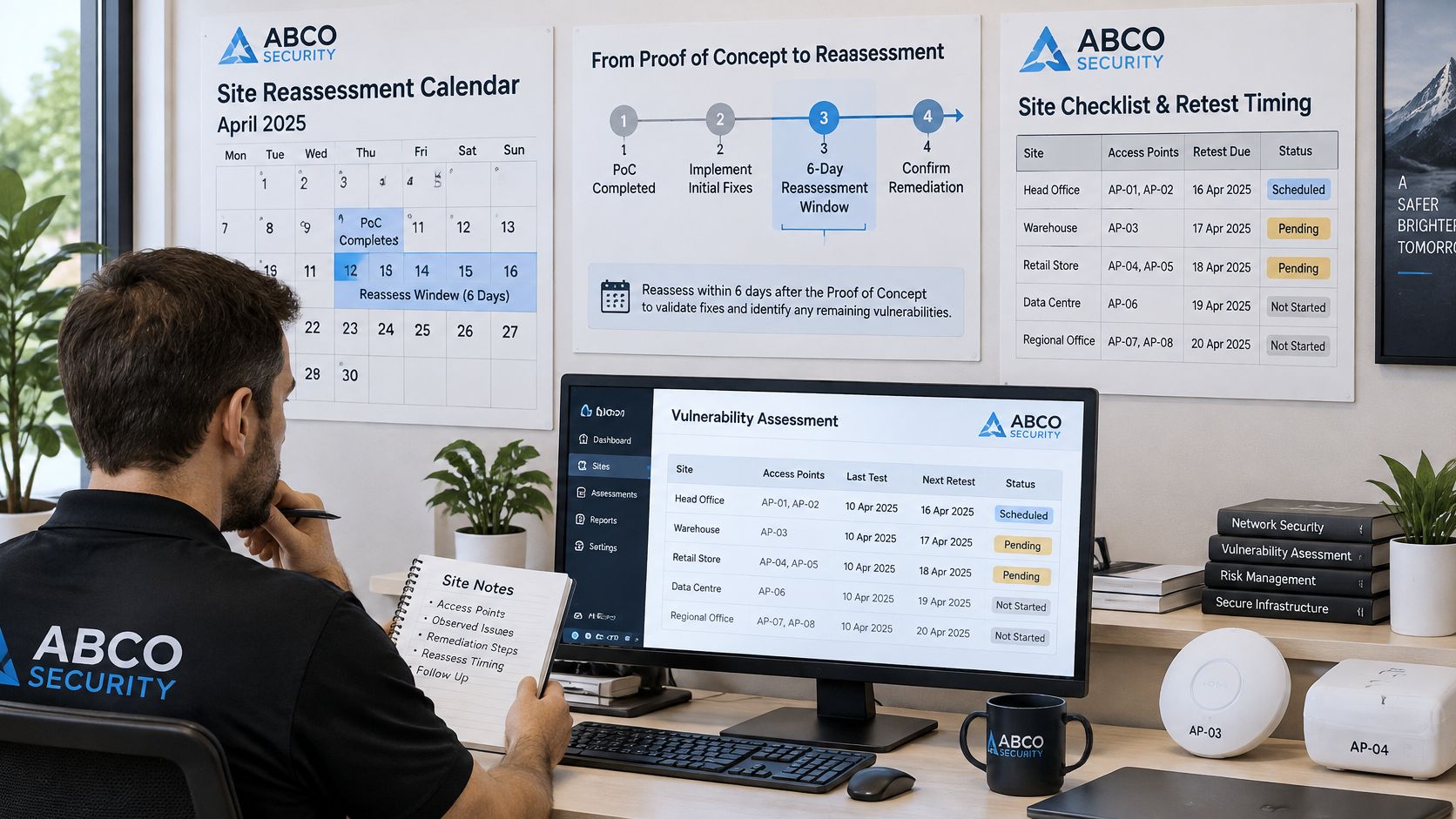
The case for continuous review isn't theoretical. In the 2021–22 financial year the Australian Cyber Security Centre reported that more than two-thirds of the cyber-security incidents it handled involving a major vulnerability occurred during the first six days after a proof of concept became available, per the ACSC Annual Cyber Threat Report 2022. Six days. An annual review is a photograph of a site that no longer exists.
Volume adds its own pressure. The ASD/ACSC received more than 42,500 calls to Australia's Cyber Security Hotline in FY2024–25, a 16% increase on the previous year, according to the Annual Cyber Threat Report 2024–2025.
Set triggers that force a reassessment outside the calendar.
- A new device on the network. A camera, controller, intercom or sensor that isn't in the asset register hasn't been assessed.
- A change of tenant, contractor or cleaning provider. Access rights travel with people, not contracts.
- A construction stage change or major event. Layout, hoarding, gates and crowd flow all move.
- A new vulnerability disclosed for equipment on site. Match vendor advisories against your inventory, not the news cycle.
- Any incident, near miss or unexplained alarm. Treat it as evidence the model was wrong somewhere.
The rhythm that holds up: a full assessment each year, a physical walk-through each quarter at night and during peak use, and a register review each month to chase overdue items. Suppliers and monitoring providers should give written notice of material changes, and the client must keep the scope of work accurate and notify the provider in writing of any material changes to site conditions or risks. Without that, the provider is assessing a site that changed six months ago.
Frequencies and triggers by site type are set out in this explanation of security risk review frequency.
When a trigger fires, the register shows it. The trigger, the date, the new owner and the changed rating sit beside the original entry, so anyone picking up the file can see what moved and why.
Book a Free Site Review
ABCO Security Services Australia provides a free on-site risk assessment, then develops a customised security plan to suit your environment, industry and budget. To get started, contact ABCO by phone or email for a free consultation, after which the team assesses your needs, recommends a solution and mobilises coverage. Free quotes are also available through the quote request form.
The more detail you send up front, the more the walk-through finds. Before services start, the provider needs a complete and detailed Scope of Work: the exact addresses and specific areas to be secured, service hours, detailed duties, site-specific risks, and access and logistics details. Include access routes and any permits or licences your personnel will need on site. That level of detail is what lets the assessment reach the loading dock, the roof plant and the night shift, not just the front counter. Keep that scope accurate afterwards and notify the provider in writing of any material change to site conditions or risks, because an assessment built on an outdated site map rates the wrong gaps.
ABCO operates across Melbourne, Sydney, Brisbane, Perth and Adelaide. Findings map directly to services: Security Guarding for on-site coverage, Mobile Patrols for night perimeter checks, Construction Security for active build sites, Event Security for crowd and entry control, Retail Security for trading environments, and Concierge Security for managed access and reception points.
Request your free site review at ABCO Security Services Australia.
A vulnerability assessment earns its cost when it ends in a ranked list someone can act on. Walking the site with people who read physical, digital and process gaps as one connected map is the fastest route to that list, because they can see which single failure would stop operations and which controls sit behind it. Book your review at ABCO Security Services Australia and start closing the gaps that matter first.
about
avada factory
Sempery ultricies nibh at dolor cras urna eleifend nec. Atiam efficitur tempor.