A licensed security guard in Australia is someone who holds a current licence from the state or territory where they work, for the type of work they are doing. There is no national security licence. Each jurisdiction runs its own regime, with its own regulator, classes and conditions. If you hire guards for a site, the job is to confirm that each guard’s licence is current, issued in the right state and covers the duties you need.
This guide explains what a licence authorises, what guards must complete to get one, how to check a licence, and what to look for in a provider.
TL;DR
- Security licensing is a state and territory matter, so a guard needs a licence from the jurisdiction where the site is.
- A licence covers specific classes of work. Unarmed guarding, crowd control and cash-in-transit are separate activities.
- Applicants face age, identity, police check and training requirements before they are licensed.
- Verify every guard on the regulator’s public register, and record the licence number, class and expiry date.
- A good provider rosters only guards whose licences match the work, and backs them with monitoring and supervision.
Table of Contents
- What a licensed security guard is allowed to do
- There is no national licence: how the states differ
- What guards must complete to get licensed
- How to check that a guard’s licence is current
- Limits and responsibilities on site
- What to look for in a licensed guarding provider
- Perspective
- How ABCO Security can help
- FAQ
- Sources
What a licensed security guard is allowed to do
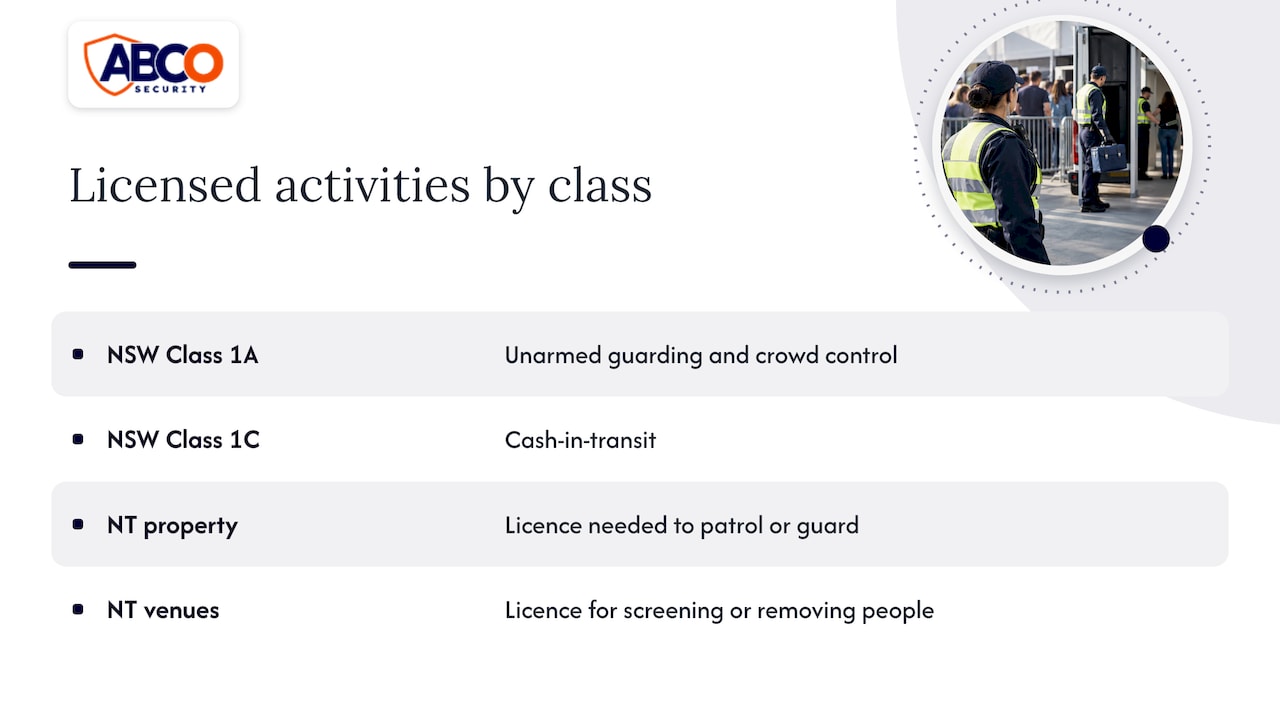
A licence is permission to carry out defined security activities. In New South Wales, for example, Class 1A covers unarmed guarding and crowd control, while Class 1C covers cash-in-transit. Other states divide the work differently, but the principle is the same: the licence names the activity.
In the Northern Territory, you need a licence to patrol or guard another person’s property. You also need one to control or monitor behaviour, screen people at entry or remove people at licensed venues, public places and functions. Security firms themselves must be licensed as well as the individual officers and crowd controllers.
The national award for the industry points the same way. The Security Services Industry Award 2020 covers guarding people or property, crowd and event control, bodyguard services, monitoring centres and loss prevention. It also says employers must make sure employees hold the appropriate licence for their classification or work.
In practice, this means a guard licensed for static guarding is not automatically cleared for every task you might want. A site that needs a guard on the gate, a crowd controller at a function and someone monitoring cameras may need people with different authorisations.
There is no national licence: how the states differ
Each state and territory licenses security work under its own law, through its own regulator, with its own classes and conditions. That matters when you operate across borders. A construction company with projects in Victoria and Queensland, or a healthcare group with facilities in several states, needs guards licensed in each place.
Some mutual recognition arrangements let a licence holder apply for an equivalent licence in another state, but NSW and WA do not apply automatic mutual recognition to security licences. Treat every interstate deployment as a licensing question to settle in advance, not an afterthought.
If your organisation also thinks about the physical side of security, such as access control systems for offices, it helps to remember that technology and guarding work together, but the licensing of the people stays tied to the state where the site operates.
| Jurisdiction | Regulator or authority | Example of what the official page says |
|---|---|---|
| New South Wales | NSW Police, Security Licensing and Enforcement Directorate | Class 1A unarmed guarding and crowd control; Class 1C cash-in-transit |
| Victoria | Victoria Police | Applicants must be 18 or over, fit and proper, and have fingerprints taken |
| Queensland | Queensland Government | Unarmed security officer licence requires CPP20218 and a criminal history check |
| South Australia | Consumer and Business Services | Register lists security agents, including guards and crowd controllers |
| Northern Territory | NT Government | Licences for officers, crowd controllers and firms |
For the full details of any jurisdiction, go to the regulator’s own page, because classes, fees and conditions change.
What guards must complete to get licensed
Requirements differ, but they share a shape: minimum age, identity, work rights, a police check and approved training.
New South Wales
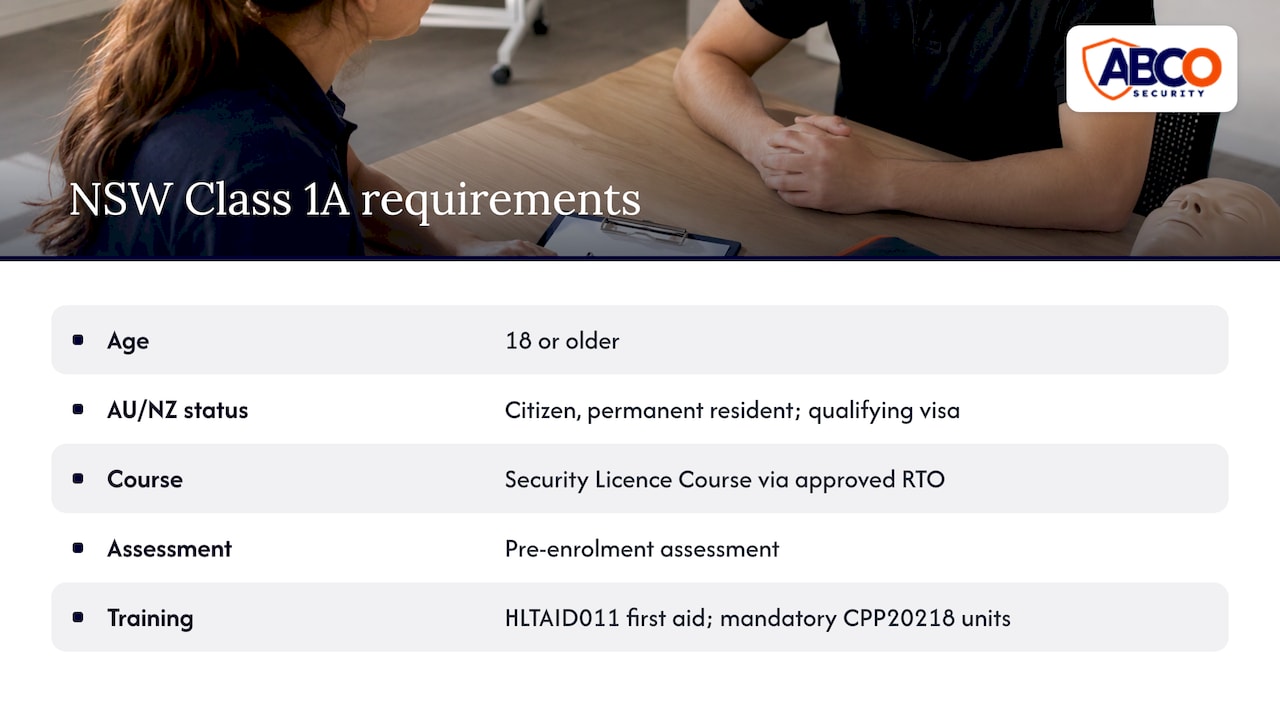
For the Class 1A unarmed Security Officer licence, applicants must be 18 or older and be Australian or New Zealand citizens, permanent Australian residents, or hold a qualifying visa. Most Class 1 applicants must complete the Security Licence Course through an approved registered training organisation. That includes a pre-enrolment assessment, first aid (HLTAID011 for 1A and 1C) and the current mandatory CPP20218 units.
Victoria
Victoria Police sets out that applicants must be 18 or over, an Australian resident or hold a current visa with working rights. They must also have fingerprints taken, not be a prohibited person, be fit and proper, and provide 100 points of certified identification. Certified overseas police checks are needed for qualifying periods of residence overseas.
Queensland
To get an unarmed security officer licence in Queensland, you need to be 18 or older, have 100 points of identity, have your fingerprints taken by police in Queensland and pass a criminal history check. The training requirement is all modules of the Certificate II in Security Operations (CPP20218) through a registered training organisation. The older CPP07 course code is no longer accepted.
Why this matters to a buyer
These checks are the reason a licence is worth asking about. A licensed guard has passed identity and probity screening and completed nationally recognised training. If you want a deeper walk-through of the path guards take, our guides on how to get a security licence in Australia and the private security guard licence cover it step by step. For the national capital, see getting a security licence in Canberra.
How to check that a guard’s licence is current
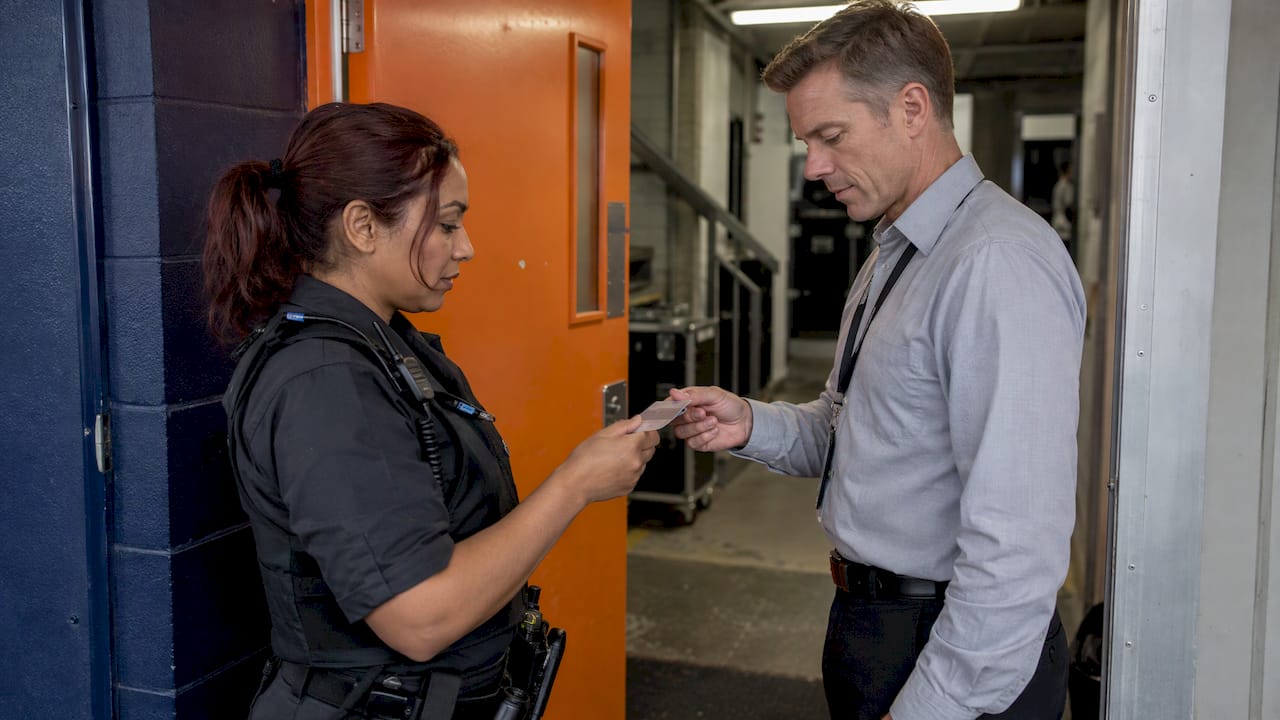
Never rely on a card shown at the gate or a line in a tender response. Use the regulator’s public register.
- NSW: verify security operative and Master licences on the Public Register of licences.
- South Australia: the Consumer and Business Services register lists security agents, including guards, crowd controllers and system installers, so you can check whether a person or company is licensed to do the work.
- Other states: use the equivalent register run by the licensing regulator in that jurisdiction.
Checking the name is only half the job. TDS Workforce notes that each state divides security work into classes or activities, and a guard can hold some and not others. So check the class against the duties on your site.
A simple routine for keeping licences current
The same guide recommends a four-part routine, which works whether you hire guards directly or manage a provider:
- Record the licence number, class, issuing state, expiry date and a scan of the card.
- Verify it on the register, then mark it verified.
- Warn early: remind the guard about a month before expiry and again closer to the date.
- Enforce at the roster: a site that requires a licence should not accept a guard without a current, verified one.
When you contract a provider, ask how they run this routine themselves. A provider that manages licence expiry as part of its rostering takes this administrative load off your facility team.
Limits and responsibilities on site
A licence defines what a guard may do, and site policy narrows it further. Different environments set different boundaries.
Healthcare
NSW Health’s Protecting People and Property policy describes licensed security officers as protecting people, property and information. They may take part in patient restraint or apprehending absconding patients only under direct instruction from clinical professionals. For a hospital or aged care administrator, that means guards need to be briefed on clinical protocols, not just general security procedures.
Crowds and venues
Owners and operators of crowded places have primary responsibility for protecting their sites, including taking steps to protect people from foreseeable threats. Queensland best-practice guidance for licensed venues recommends active supervision of crowd controllers by a nominated head of security, with clearly defined duties. If you are planning an event, our guide to hiring event security in Australia goes into numbers, briefing and licensing.
Proportionate protection
The national strategy for crowded places advises that protective security should be proportional: it should preserve public enjoyment of a place while concentrating on the highest-risk areas. Good guarding follows the same logic. Put licensed people where the risk is, with clear instructions, rather than adding bodies everywhere.
What to look for in a licensed guarding provider
When you buy guarding as a service, you are buying more than a licence number. These are the questions that separate providers:
- Are the guards licensed in the state where your site is? Ask for the licence class and expiry for each guard rostered, and check the register yourself.
- Is the company itself licensed? In places such as the Northern Territory, firms need licences as well as individuals.
- Does the provider understand your sector? A construction site, a ward and a retail centre need different post orders.
- What backs up the guard? Patrols, camera monitoring and alarm response extend coverage beyond a single post.
- How is quality managed? Look for recognised management standards and documented procedures.
Our own guide to onsite security guards and compliance covers the compliance questions in more detail, and Your Guide to Security Guard Services in Australia explains the service types side by side.
Matching guard type to the site
| Site | Typical need | Supporting options |
|---|---|---|
| Construction site | After-hours guarding, access checks, theft deterrence | Mobile patrols, CCTV and alarm monitoring |
| Healthcare facility | Visible presence, escorts, incident support under clinical direction | Access control, camera monitoring |
| Corporate office | Reception and concierge security, after-hours checks | Electronic security, alarm monitoring |
| Event | Licensed crowd controllers, entry screening | Supervisors, briefing and incident reporting |
| Retail | Loss prevention, visible deterrence | CCTV, alarm monitoring |
Perspective
We see the same mistake again and again: a site treats a licence as a box ticked at the start of a contract. A licence is the minimum. What protects your people and property is a guard who holds the right class for the work, understands your site, and is backed by a team that can see problems before they become incidents.
That is why we pair licensed guards with mobile patrols, CCTV and alarm monitoring, and electronic security, and why we work to ISO 9001 and ISO 30000 standards. Over more than 15 years we have found that the clients who get the best results ask about licensing, supervision and response together, not one at a time.
Our approach is proactive. We want to anticipate threats on a construction site, in a ward or at a venue, so that guards are deployed where they matter and the client is not just reacting after the fact.
Abco
How ABCO Security can help
We provide licensed static guards, mobile patrols, CCTV and alarm monitoring, electronic security, concierge and reception security, crowd control and loss prevention for construction, healthcare, corporate, retail, education, industrial and government sites across Australia. Our operations run 24/7, and we can tailor a mix of guarding and technology to your site.
For after-hours coverage, our Night Owl Service starts from $5.45 per day, with 12-month and 24-month plan options. For a standing post, see our security guarding service, and for building sites, our construction site security services.
Tell us the site, the hours and the risks, and we will propose the right mix of licensed guards, patrols and monitoring. Start at abcosecurity.com.au.
FAQ
Is there a national security guard licence in Australia?
No. Each state and territory licenses security work under its own law, through its own regulator. A guard working in a new state generally needs a licence for that state, and NSW and WA do not apply automatic mutual recognition. Check the rules before you roster interstate.
How do I check whether a guard is licensed?
Search the public register run by the regulator in the state where the guard works. In NSW, use the Public Register of licences, and in South Australia, the Consumer and Business Services licence search. Confirm that the class matches the work and that the licence has not expired.
What training does a security guard need?
In NSW and Queensland, applicants complete the Certificate II in Security Operations (CPP20218) units through a registered training organisation, and NSW also requires first aid. Applicants must also pass identity and police checks. Requirements vary by state, so confirm them with the regulator.
Can a licensed guard restrain someone?
Only within their licence and site policy. In NSW Health settings, security officers may take part in patient restraint only under direct instruction from clinical professionals. Brief guards on your site’s rules before the first shift.
Do crowd controllers need a different licence from guards?
It depends on the state. In NSW, Class 1A covers both unarmed guarding and crowd control, while the Northern Territory licenses crowd controllers as their own category. Always check the class against the duties.
Sources
- Class 1 Licences, NSW Police (activities)
- Class 1 Licences, NSW Police (eligibility and training)
- Verify a Security Licence, NSW Police
- Security licences, NT.GOV.AU
- Security Services Industry Award 2020, Fair Work Commission
- Eligibility requirements and training for private security, Victoria Police
- Apply for an unarmed security officer licence, Queensland Government
- Training required to be an unarmed security officer, Queensland Government
- Find a licence holder, Consumer and Business Services SA
- Protecting People and Property, NSW Health
- Australia’s Strategy for Protecting Crowded Places from Terrorism
- Towards Best Practice for Licensed Venues
- Security licence requirements by state in Australia
- Australian security licences by state, TDS Workforce
Recommended
about
avada factory
Sempery ultricies nibh at dolor cras urna eleifend nec. Atiam efficitur tempor.