The usual advice is to compare hourly rates and choose a company offering round-the-clock coverage. That's the wrong starting point. When comparing security companies in Cairns, first establish whether the firm and its officers are licensed for your actual duties, who covers subcontracted shifts, and whether monitoring leads to a documented response.
A guard roster isn't a security plan. You need controls matched to your site, evidence that they work, and contract terms that make responsibility clear when something goes wrong.
Match Your Security Needs to Your Site
Common Cairns site types, exposures and services to ask about
| Site type | Main exposure | Controls to prioritise | Service to ask about |
|---|---|---|---|
| Shopping centre or retail | Theft, car park incidents, after-hours access | CCTV with alarm escalation, patrols, lighting | Retail Security, Shopping Centre Security |
| Construction site | Plant and fuel theft, unauthorised after-hours entry | Gate management, temporary CCTV towers, mobile patrols | Construction Security, Mobile Patrols |
| Event or festival | Crowd incidents, entry screening, unlicensed staff | Licensed crowd controllers, entry control, documented escalation | Event Security |
| Office tower or corporate site | After-hours entry, visitor management, access control | Access control, concierge desk, CCTV | Concierge Security |
| Residential estate or strata | Unauthorised vehicle and pedestrian entry | Gatehouse control, patrols, CCTV monitoring | Gatehouse Security, Mobile Patrols |
| Warehouse or industrial site | Break-ins, vehicle crime, unattended stock | Lighting, alarm monitoring, scheduled patrols | Security Guarding, Mobile Patrols |
Start with the site type, the incident you most want to prevent and the hours requiring cover. A concierge officer managing visitors during business hours solves a different problem from a patrol checking an empty warehouse.
Build a workable site assessment
Use a marked-up site plan and an incident register rather than a service brochure. Our security risk assessment checklist provides a practical starting point.
- Map access and assets. List pedestrian doors, vehicle gates, loading docks, keys, valuable stock and vulnerable time windows.
- Review incident history. Record incidents from the past year, including after-hours entry, vehicle crime, missing fuel and theft from unattended stock. Include attempted entry and near misses.
- Record overnight occupancy. Identify whether the site is occupied, empty or partly occupied, including cleaners, maintenance contractors and late-working staff.
- Allocate controls. Decide where people must intervene, where electronic detection is sufficient, and where both are necessary.
Say a warehouse loses stock during deliveries. An overnight guard won't address an uncontrolled loading dock during trading hours. Start with delivery permissions, stock handover records and camera coverage of the transfer point.
Read Cairns crime figures carefully
The Queensland Government crime report recorded 5,888 offences against the person in Cairns in 2023–24, equivalent to 2,238.7 per 100,000 residents, and 2,362 property offences, equivalent to 898.0 per 100,000 residents. These measures describe different exposures, not a single risk that every property shares.
Queensland Police crime statistics guidance cautions that offence counts aren't counts of individual offenders. Use them to set priorities, not to label a suburb unsafe.
For retail planning without site-level records, the Australian Bureau of Statistics recorded 152,421 victims of other theft in Queensland in 2024, with 54%, or 81,892 victims, at retail locations. Use that statewide baseline to prioritise retail-facing areas, loading docks, car parks and unattended storage, not to predict your losses.
At ABCO Security Services Australia, we serve residential estates, shopping centres and car parks, warehouses and logistics, construction sites, education facilities, and local government and public spaces. Our services include static guards, patrols, concierge and gatehouse security, construction and mining security, corporate and retail security, events and loss prevention.
Practical rule: Choose the service that addresses your most likely incident during the hours you can afford to cover.
Verify Licences and Shortlist Providers
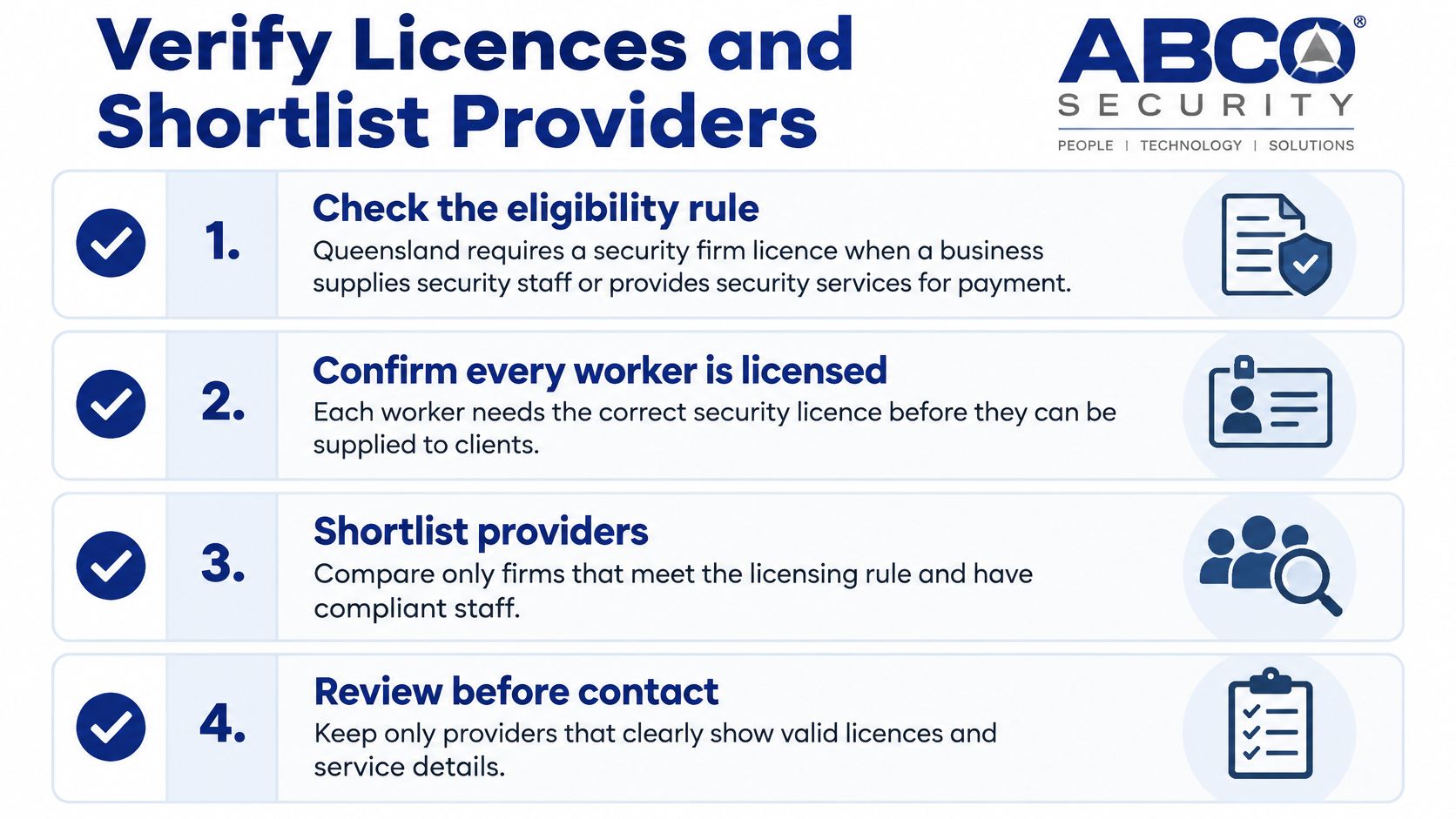
Queensland's eligibility rule comes before price. The Queensland Government security firm licensing guidance requires a security firm licence when a business supplies security staff or provides security services for payment, and supplied personnel must hold licences for their work.
A valid business licence doesn't establish that every officer can perform every quoted duty. Licence class, current status and subcontractor coverage belong in your procurement file.
Follow the licence trail
- Search the registered entity. Use the free Queensland public register and match the registered name to the contracting entity. A familiar trading name isn't enough.
- Inspect the complete record. Record the licence number, status, classes, expiry date and conditions. Save a dated register extract rather than relying on a logo or licence number in an email signature.
- Match permissions to duties. Check the relevant authorisation for crowd control, unarmed guarding, monitoring, dog patrol or equipment installation. Don't accept a general statement that the business is licensed.
- Check rostered personnel. Request licence details for the officers allocated to your site, including relief officers. Make replacement approval part of the mobilisation process.
- Identify subcontractors. Obtain the supplying entity's details and current worker licences. State who checks replacements, supervises their work and retains incident records.
Our guide to obtaining a security licence explains the licensing pathway, but a guide doesn't replace checking the live register. All our guards are fully licensed under relevant Australian state regulations. Apply the same verification process to that statement as you would to any competitor's claim.
Consider an event organiser who books a firm with valid guarding permissions but receives officers without the required crowd-control class. The organiser can't treat the firm's general credentials as proof that those officers are authorised for the shift; the arrangement creates a serious compliance and liability exposure.
Make the shortlist auditable
Keep register extracts, the approved officer list and current insurance certificates with the contract. For subcontracted work, record the contracting chain and make the principal provider responsible for notifying you of changes.
Then compare a small shortlist using a common scope:
- Staffing origin. Where are primary and relief officers rostered from?
- Alarm handling. What is the alarm-to-dispatch process, and who owns it?
- Charges. Which after-hours, public-holiday, call-out and mobilisation charges apply?
- Exclusions. What duties, equipment and reporting sit outside the proposed price?
Score three providers against the same compliance, delivery and cost criteria. Request written proposals itemising every service, rate and exclusion, while checking whether each document is a quotation or only an estimate.
You can request our service information by phone on (03) 9001 0024 or email at info@abcosecurity.com.au. Keep only providers whose documents establish eligibility and accountability, not merely those with polished websites or low headline rates.
Compare Providers and Test Their Evidence
Two providers can present identical licence extracts and still deliver very differently on a Cairns site. The difference sits in monitoring practice, local rostering and the quality of the evidence behind each claim, so test each criterion before comparing price.
Provider criteria, what good looks like and what to ask
| Criterion | What good looks like | Question to ask | Red flag |
|---|---|---|---|
| Technology integration | Access control, CCTV and alarms run as one tested system | Which systems do you monitor, and how is camera coverage verified? | Cameras installed but coverage never tested |
| Monitoring and escalation | 24/7 live monitoring with a written escalation path | Who is called at each stage, and how long does each step take? | No written escalation path |
| Response times | Dispatch targets stated and logged for every alarm | What is your average attendance time in Cairns, and how are breaches recorded? | Vague claims such as fast or immediate |
| Sector experience | Current clients in the same site type | Which similar sites do you service today, and can you provide a reference? | Generic portfolio with no comparable sites |
| Local mobilisation | Officers and relief staff rostered from or near Cairns | Where are officers based, and how quickly can you deploy after an alarm? | Staff based only in another city with no deployment plan |
| Reporting and KPIs | Monthly review of response, incidents and false alarms | Which metrics do you report, and how often do we review them together? | Reporting limited to guard hours |
Every cell in that table should be answerable with a document, a log or a named role. A confident verbal answer is a starting point for the request, not the evidence itself.
Separate equipment from operational capability
For technology integration, request a camera coverage plan and test images from vulnerable areas. A camera may show a doorway without producing useful images of someone entering it, particularly when backlighting, shelving or parked vehicles obstruct the view.
For monitoring, identify who receives the alert, who verifies it and who authorises dispatch. Our A1 CCTV & Alarm Monitoring provides 24/7 live monitoring of premises, alarms and camera feeds, with immediate response and incident escalation. The site agreement should still define what that response involves.
Distinguish dispatch time from attendance time. An operator can dispatch promptly while the responding vehicle remains some distance away. Request local attendance records with the measurement period and missed-target explanations rather than a national average, which can be inflated by dense metropolitan runs that say nothing about Far North Queensland.
Sector experience needs similar scrutiny. An effective event supervisor may have little experience managing industrial keys, contractor access or construction shutdowns. A comparable reference should confirm the duties performed, not only that the provider supplied guards.
Confirm Cairns mobilisation and useful reporting
A metropolitan office doesn't demonstrate local response capacity. A provider operating across several cities needs a separate mobilisation plan for each location, because coverage in Brisbane or Sydney says nothing about who attends a Cairns alarm.
For Cairns, establish where officers start their shifts, where relief staff come from and who responds when the usual patrol is unavailable. Ask whether the officers rostered to your site are directly employed or supplied through a subcontractor, and who checks each officer's licence class against the register before a shift starts. A staffing plan built around a southern depot is not evidence of Cairns attendance.
Our service delivery standards are a useful document to examine alongside the site-specific operating instructions. Contract reporting should cover:
- Detection-to-escalation time. When did the system detect the event, and when did someone act?
- Response compliance. Which agreed targets were met or missed?
- Repeat incidents by zone. Where should controls change?
- False alarms and recovered-loss value. Which alerts consumed resources, and what outcomes can be substantiated?
Review these monthly. Guard hours confirm attendance, but they don't show whether the deployment addressed the exposure.
Test monitoring before signing
Run a controlled exercise with approval from the site manager and monitoring operator. Don't create an uncontrolled emergency or an unnecessary emergency-service call-out.
- Obtain the escalation tree. Require a named role and agreed time limit at each stage.
- Trigger a supervised after-hours alarm. Record the trigger, acknowledgement, verification and dispatch timestamps.
- Request the evidence package. Obtain time-synchronised footage and the corresponding alarm log.
- Test verification tools. Confirm two-way audio and how operators distinguish an incident from authorised activity.
- Assess the result. Compare the record with contractual targets and resolve failures before mobilisation.
Our construction monitoring uses solar-powered camera towers and motion detection alerts, and our monitoring centre can dispatch patrols or security officers within minutes. That capability still needs to be translated into a documented arrangement for the particular site, with the escalation tree and timestamps agreed before mobilisation.
A monitoring subscription is only useful if someone can explain what happens after the alert.
Include cyber controls in the acceptance test
The Australian Bureau of Statistics reports that 21% of Australian businesses experienced a cyber-security incident during 2024–25, while 28% reported having no preventive measures. Compromised cameras or access panels can affect both physical access and evidence integrity.
Inventory connected recorders, panels, intercoms and remote accounts. Require segmented networks, unique credentials, multi-factor authentication where supported, firmware maintenance, encrypted remote access and individual audit logs.
Define safe operation during power, internet or recorder failure, and test restoration quarterly. For governance teams assessing synthetic-media risks alongside these controls, AI Video Detector's resource on addressing AI threats in the boardroom offers a complementary discussion, not a substitute for operational testing.
Event and Construction Security Requirements
An event entrance and a construction gate can both require access control, but the operating instructions shouldn't be interchangeable. Event teams manage people, crowd movement and escalation; construction teams manage changing boundaries, contractors, deliveries and exposed assets.
The Australian Institute of Criminology's discussion of security licensing identifies crowd or venue controlling as a distinct licensable activity alongside general guarding and other security functions. For Event Security, don't assume general guarding credentials authorise crowd-control duties.
Event Security needs a deployment plan
Before approving the event roster, resolve the questions that determine whether the plan can be delivered:
- Crowd-control permissions. Which assigned officers hold the relevant class, and does the register confirm it?
- Supplied personnel. Are workers coming through another firm, and who verifies their current licences and authorisations?
- Entry incidents. How will staff record refused entry, prohibited items and disputes?
- Escalation ownership. Who directs the response when entry queues, crowd pressure or disorder exceed the planned deployment?
Say an event has a licensed bar, a public entrance and a separate contractor gate. Assign responsibilities by zone and specify who can leave a post to assist elsewhere. Otherwise, an officer responding to a dispute may leave an access point uncontrolled.
Include emergency communications, medical escalation, lost-child procedures and post-incident reporting. Test radio coverage with the event layout in place, because temporary structures and equipment can change how staff communicate.
Construction Security needs changing coverage
Construction plans must account for plant and fuel theft, unauthorised after-hours entry and gate control. Review relevant local offence categories alongside site incidents, then position controls around the actual assets and access routes.
For example, a site with previous fuel theft needs patrol timing aligned with the incident window, temporary CCTV towers covering the gate and fuel area, and written escalation for after-hours alarms. A generic drive-by check won't establish whether someone has entered behind a temporary building.
Our construction site security services include after-hours guarding, access gate management, mobile patrol support, temporary CCTV and solar towers, plus site safety inspections and reports. The scope should identify which combination applies as the build progresses.
- Patrol zones. Mark gates, fencing, fuel storage, plant parking and temporary offices on the patrol plan.
- Verification. Specify checkpoint records, photographs and checks for forced entry.
- Frequency. State how often each zone is checked and how shutdown coverage changes.
- Handover. Update officers when fencing, storage or delivery routes move.
Lighting also needs deliberate design. Black Rhino Electric's commercial exterior lighting electrician resource provides context for discussing exterior lighting work; use a suitably qualified local electrician for the Cairns installation.
Avoid directing bright lights into cameras or neighbouring properties. Test the finished night-time image and walking route rather than judging the installation by brightness alone.
Costs, Contracts and Hidden Charges
Published minimum hourly rates for Security Officer Level 1 and Level 5
The Security Services Industry Award 2020 published schedule lists the following Level 1 minimum hourly rates, with a Level 5 ordinary rate of $31.20 per hour.
| Work type | Level 1 rate per hour |
|---|---|
| Ordinary hours | $28.42 |
| Weekday night work | $34.59 |
| Saturday | $42.63 |
| Sunday | $56.84 |
| Public holiday | $71.05 |
These are employee pay benchmarks, not customer charge-out rates. Confirm the applicable schedule at procurement and commencement, because a provider's selling price must also accommodate the employment and service costs of delivering the contract.
Compare the roster, not the headline rate
Two proposals for the same apparent coverage can include different classifications, supervision, relief arrangements and equipment. A flat hourly figure is difficult to assess unless the provider shows how it applies across the roster.
Consider a warehouse requiring a Level 1 officer from 10 pm Friday until 6 am Saturday. The provider must assess the night-work and Saturday penalty provisions against the roster and applicable award rules, rather than multiplying the whole shift by an ordinary daytime rate.
Don't add penalties together yourself. Require the provider to explain the applicable treatment and show the resulting customer charges clearly.
A low price doesn't prove non-compliance, but an unexplained price that ignores classification or penalty hours requires clarification. Equally, a higher rate doesn't establish better supervision or faster attendance unless those services are included.
Commercial check: Compare the total cost of the agreed operating roster, including foreseeable exceptions, rather than the cheapest displayed hourly rate.
Put service and pricing assumptions in writing
The contract needs enough detail for a property manager to reconcile an invoice and for a supervisor to run the shift:
- Employment basis. Identify the applicable industrial instrument and officer classification.
- Supervision. State who manages performance and handles operational questions.
- Reporting. Define incident notifications, report content and delivery requirements.
- Relief. Explain breaks, absences, replacements and uncovered-shift escalation.
- Additional charges. List after-hours call-outs, penalty periods, equipment and mobilisation costs.
- Exit arrangements. Record termination notice, equipment removal and return of keys, credentials and records.
Read the security service contract terms alongside the proposed scope. Don't assume a document called a proposal fixes the final amount payable.
We provide estimates, not quotations or binding indications of what we will charge. Establish which changes in staffing, operating hours, site conditions or requested duties can alter the eventual charge, and require an approval process for variations.
All amounts we state, orally or in writing, are exclusive of GST. Our mobile patrol services can also include parking and traffic management as an optional add-on, so confirm whether those duties appear in your scope or require a separate allowance.
Before approval, reconcile the roster, service inclusions, exclusions and estimate against the same site plan. A low hourly rate can conceal a more expensive arrangement when penalty hours, optional duties and unclear exclusions reach the invoice.
ABCO Security Services Australia offers licensed guarding, mobile patrols, event and construction security, and integrated CCTV and alarm monitoring. Visit ABCO Security Services Australia with your Cairns site plan, required coverage hours and incident history to request a scoped estimate, then verify the licences, local mobilisation arrangements and response evidence before committing.
about
avada factory
Sempery ultricies nibh at dolor cras urna eleifend nec. Atiam efficitur tempor.