
It's 9.40 pm and your site manager has just sent you a photo. The compound gate's open, a cable drum's gone, and there's no usable camera image because nobody aimed a camera at the entry point. Or it's a Friday in your store, staff are handling an aggressive customer alone, and the rostered officer is a patrol driver who only calls in twice a night. That's usually when buyers start comparing Security Companies Hobart providers in a hurry, and it's also when they buy the wrong thing. Don't start with a company name. Start with your site, your risk, and then define response as something you can measure.
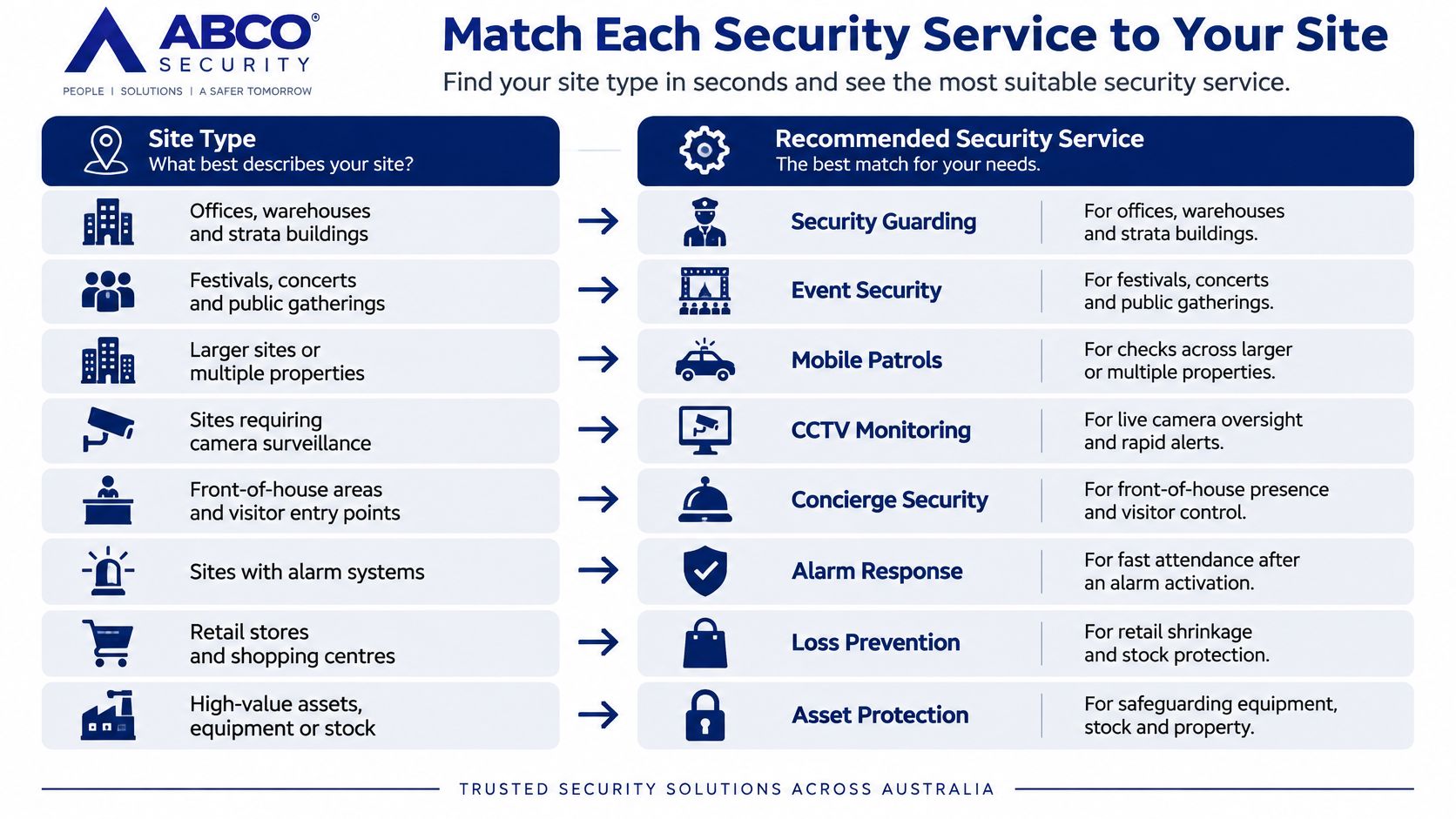
Match Each Security Service to Your Site
Use this nine service mapping first. Find your site type, then check whether a provider's proposal delivers that service, not just a similar sounding one.
| Service | Best suited to | What you get |
|---|---|---|
| Security Guarding | Offices, warehouses and strata buildings | Licensed officers on site for access control and patrols |
| Event Security | Festivals, corporate functions and licensed venues | Crowd control, entry screening and asset protection |
| Construction Security | Building sites and compounds | After-hours guarding, gate management and temporary CCTV |
| Mobile Patrols | Sites needing scheduled checks | Timed visits with signed patrol records |
| CCTV and Alarm Monitoring | Sites with after-hours risk | Remote alarm verification and escalation to a patrol |
| Shopping Centre Security | Malls and car parks | Patrols, car park checks and incident response |
| Retail Security | Shops and single-tenancy stores | Loss prevention and a visible customer-facing presence |
| Concierge Security | Office towers and residential buildings | Reception, visitor management and access control |
| Gatehouse Security | Estates and business parks | Vehicle and pedestrian access checks at the gate |
Guarding Is Presence and Monitoring Is Verification
These two get mixed up constantly. Security Guarding means a licensed person is physically there to control entry, patrol, challenge trespassers and act immediately. Monitoring means someone remote checks an alarm or camera alert, verifies it, and escalates it. That's useful, but nobody has intervened on your site until a patrol or officer arrives.
Say a construction compound in Hobart's northern suburbs loses tools overnight. Cameras alone may record a hooded figure at a distance. After-hours guarding plus temporary CCTV at the gate, and remote verification paired with a patrol response, gives you deterrence, evidence and intervention. Our remote guarding services work on that same logic, technology verifies, people respond.
Perimeter choice affects whether either model can work. A climbable fence with blind corners forces guards into constant foot patrols just to cover gaps, so it's worth taking time to compare security fence materials before pricing staffing for a large compound.
Pick the Combination Your Site Actually Needs
Most Hobart sites need more than one line from the table. We offer static guards, mobile patrols, concierge security, gatehouse services, construction and mining site security, corporate and retail security, event security and loss prevention, and we provide sector-specific protection across Australia for industries including aviation and marina, commercial properties, education, government, healthcare, industrial and manufacturing, events, retail, and residential and strata.
Before you request a price, answer three questions in writing:
- Who enters: employees only, customers, delivery drivers, residents, or ticketed patrons?
- When is the site empty: overnight, weekends, or never, and who holds keys then?
- What must be proven afterwards: a signed patrol record, an incident report, or identification quality footage?
If you can't answer those three questions, a provider can't roster the right officer, licence class or hours for you.
Hobart Risks That Should Shape Your Security Brief
Tasmanian figures give you a benchmark, not a Hobart suburb by suburb risk score. The Tasmania Police Crime Statistics Supplement 2024-25 recorded 34,609 total offences in 2024-25, a 4% decrease from the previous year, although the total remained above the state's previous five-year average. Offences against property fell by 5%, offences against the person declined by 2%, fraud and similar offences fell by 16%, and Tasmania Police cleared 18,362 offences, producing a 53% clearance rate.
Don't read that 2% fall as proof that aggression risk is dropping for venue and retail staff. The police figures cover the 2024-25 financial year, while Australian Bureau of Statistics victim data covers calendar 2024. The ABS recorded crime victims release reports Tasmania recorded 4,412 victims of assault in 2024, an 8% increase from 2023. The ABS media release on theft reports Tasmania's 2024 increase in victims of other theft was 11%, the second-largest state or territory rise nationally.
Different measures, different periods, different offence groupings. A responsible brief uses both as statewide context, then gets specific about your site. Our risk assessment process starts from that site level view.
| Site type | Main risk | Control to request |
|---|---|---|
| Construction site | Theft of plant and materials, after-hours trespass | After-hours guarding, gate management, temporary CCTV with motion alerts |
| Retail premises | Theft, fraud and aggression toward staff | Loss prevention, visible presence and incident logging |
| Event or venue | Crowd disorder and intoxication | Crowd controllers with the correct endorsement and an entry screening plan |
| Office or corporate building | Unauthorised after-hours access | Concierge reception, visitor management and access control |
| Strata or residential estate | Vehicle theft and unauthorised entry | Gatehouse checks, mobile patrols and camera monitoring |
Turn Statewide Data Into a Site Brief
List your last three incidents, near misses included. Classify each one as property, personal safety, fraud or public order, then attach one control you can audit. A smashed storeroom window needs entry point coverage and patrol timing. Abuse at the counter needs a trained, visible officer and a clear escalation procedure for staff.
That discipline extends to building basics that security officers rely on during evacuations. Officers can't manage an orderly exit if exit doors fail, so meeting legal duties for fire doors belongs in the same site file as patrol routes and keyholder lists.
How to Verify Licences, Training and Insurance
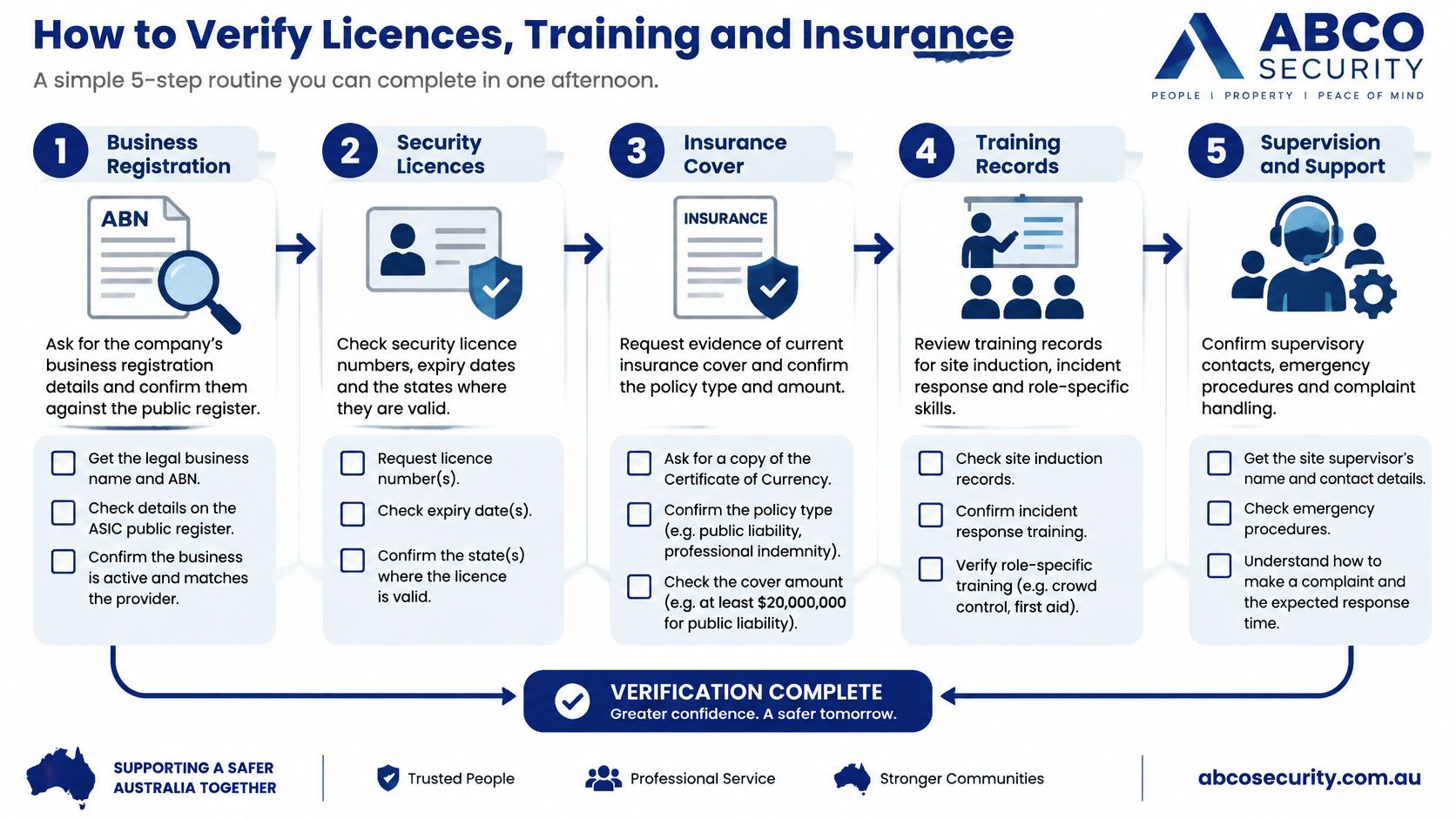
You can verify a provider properly in one afternoon if you ask for officer level documents, not a company profile. All our guards are fully licensed under relevant Australian state regulations and receive ongoing training in conflict resolution, first aid, OH&S, customer service, and emergency response. Expect the same standard of proof from anyone you shortlist, and use our guide on how to get a security licence to understand what's behind a licence number.
- Confirm the business: Ask for the company's business registration details and confirm them against the public register, so you know who is contracting with you.
- Check every named officer: Request the licence number of every officer who'll attend your site and check each one with the Tasmanian licensing regulator before the first shift. Licences are personal and can be suspended, a company assurance doesn't cover that.
- Match licence class to task: Confirm the licence covers the duty. Checking tickets is not the same authority as managing crowd behaviour or removing a person, and Event Security rosters fail when this distinction is ignored.
- Review dated training records: Ask for proof of current training in conflict resolution, first aid, OH&S, customer service and emergency response. Dates matter, an undated list of topics proves nothing.
- Check insurance currency: Request a certificate of currency for public liability insurance and a workers compensation certificate, and confirm the policy term covers your contract period.
- Take up two references: Choose sites of similar size and risk. Ask each referee about missed shifts, report quality and how replacements were handled.
What a Compliant Pack Looks Like
You'll finish with named officers, their licence numbers and expiry dates, a dated training record, and current insurance certificates in one file. That's auditable. A glossy capability statement with no names isn't.
The same evidence first approach applies to any supplier, and the Procright guide to vendor due diligence sets out a useful structure for verifying claims before a contract exists.
Common slip: accepting proof that a company exists as proof that the officers rostered to your Hobart site are licensed for the tasks they'll perform.
Response Times and What They Really Promise
24/7 rapid response tells you almost nothing. It doesn't say who noticed the alert, who verified it, who travelled to site, or when they arrived. Treat every such claim as unverified until the provider defines response as measured on-site arrival.
Define the Four Stages
- Detection: an alarm, sensor or camera generates an alert.
- Verification: an operator confirms the alert using video or audio, which filters out many false alarms.
- Intervention: a patrol officer or guard arrives on site, secures the area and hands over to you or police.
- Police attendance: police attend as a public service, on their own priority assessment.
The Tasmania Police Annual Report 2024-25 reported a median response time of 18 minutes for high-priority incidents and 26 minutes for low-priority incidents in 2024-25. Those are police figures, not private alarm response times. They matter because they show the interval your own procedures must cover between an alert and help arriving.
Plan for the Interval
Write down what happens in that gap. You need verified video assessment, an escalation tree with keyholder contacts, safe sheltering instructions so staff don't confront intruders, evidence preservation, and a documented handover to police. A retail manager should know not to re-enter a storeroom to check stock. A strata manager should know who authorises access for a patrol officer at 2 am.
Remote monitoring can't safely replace trained on-site personnel where crowd disorder, violence or a complex evacuation is likely. A camera doesn't separate two patrons, and an operator interstate can't open a fire stair. Ask where responding officers are based, because a Hobart site served from another state won't meet an arrival claim. Our service delivery standards describe how these expectations should be documented.
| Metric | Define it as | Evidence to request |
|---|---|---|
| Alarm verification time | Minutes from alert to a confirmed video or audio check | Monitoring log with timestamps |
| On-site arrival time | Minutes from verified alert to an officer at the site | Dispatch record with arrival time |
| Patrol frequency | Number of visits per night at set times | Signed patrol records |
| Incident report turnaround | Hours from incident to written report | Sample report and report log |
| Coverage gaps | Shifts with no officer or no response available | Roster and vacancy record |
Contract Terms and the Real Cost of Guarding
Award minimums set the floor under any compliant price. The Fair Work Commission Security Services Industry Award summary lists, for the first full pay period beginning on or after 1 July 2025, an adult Security Officer Level 1 minimum of $27.13 per hour, rising to $40.70 on Saturday, $54.26 on Sunday and $67.83 on a public holiday. The same classification includes a Monday-to-Friday night-span rate of $33.02 and a permanent-night-work rate of $35.27, while Security Officer Level 5 is listed at $29.79 per hour, $44.69 on Saturday, $59.58 on Sunday and $74.48 on a public holiday.
Work One Roster Before You Compare Prices
Take a Level 1 officer on a 12-hour Sunday night shift for Construction Security. At the Sunday rate, that's $54.26 x 12, which equals $651.12. The same 12 hours on a Monday to Friday night span at $33.02 comes to $396.24. That's a $254.88 difference for identical hours, before allowances, loadings, superannuation, insurance, supervision, vehicles or margin.
Now you can see why a single hourly quote is meaningless. A cheap Sunday price usually means the penalty period hasn't been costed, the classification is wrong, or the provider expects to absorb it through understaffing and late substitutions. None of those protect your site.
Require each estimate to state, in writing:
- Classification and hours: which award level, which days, and which hours attract night, weekend or public holiday rates.
- Penalty and allowance treatment: how each period is priced, plus add-ons such as parking and traffic management.
- Replacement process: who fills the shift when an officer is absent, how you're notified, and what happens if nobody's available.
- Service levels as schedules: verification time, arrival time, patrol frequency and report turnaround attached to the contract, not left in an email.
Our security service contract terms explain the terms that govern engagements. We only provide estimates, not quotations or binding indications of how much we will charge, and all amounts stated, whether orally or in writing, are exclusive of GST. Those two points should be explicit in any proposal you accept.
Compare estimates on identical hours, classifications and penalty periods. If two providers price different rosters, you aren't comparing prices, you're comparing guesses.
This applies equally to Retail Security, Concierge Security and Gatehouse Security, where rosters routinely cover nights, weekends and public holidays. Properly funded rosters reduce fatigue, unplanned substitution and coverage gaps in patrols, access control and incident response.
Shortlist Providers With This Decision Checklist
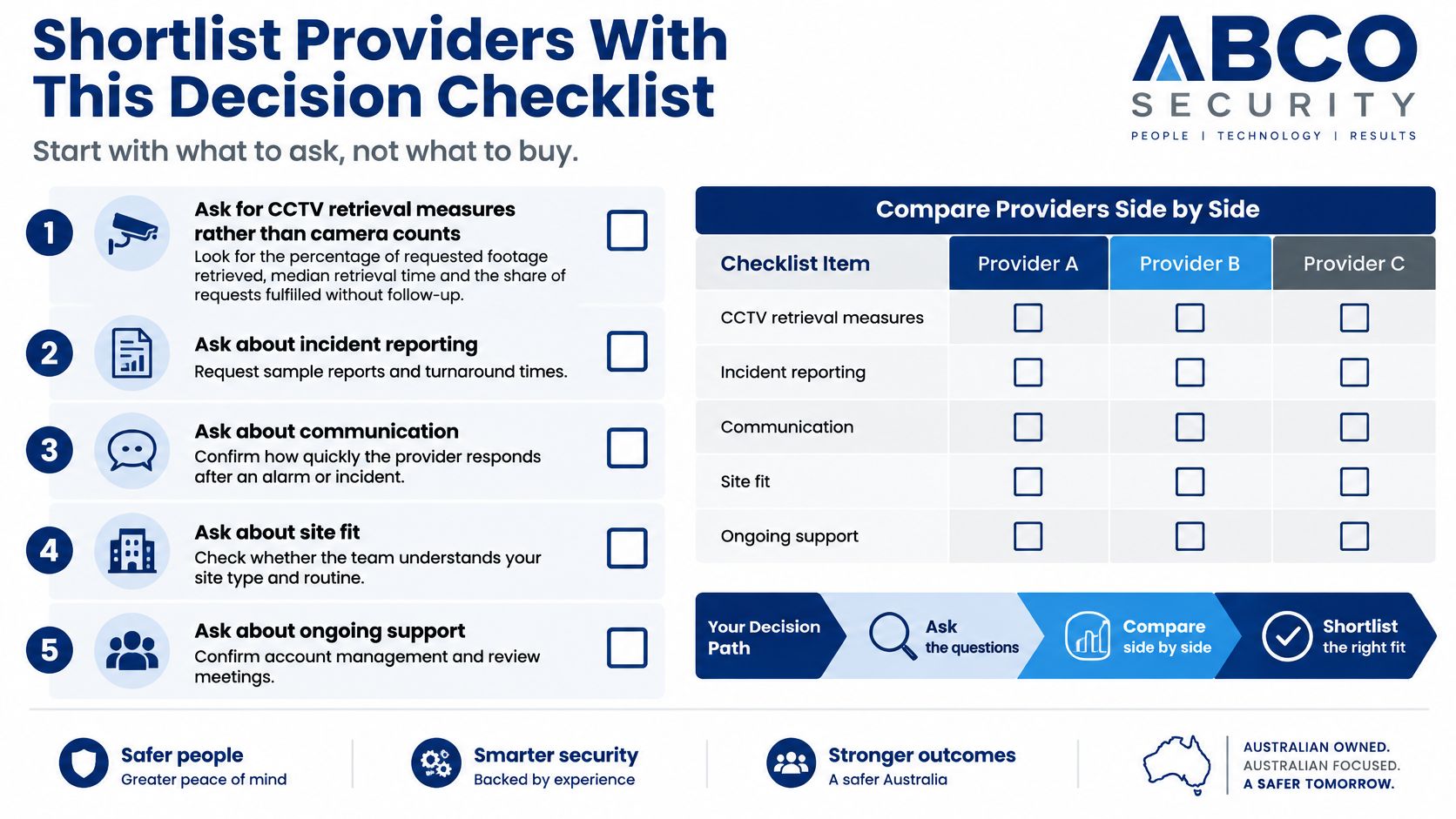
Start with what to ask, not what to buy. Camera counts are a sales metric. Retrieval performance is an operational one.
The Australian Institute of Criminology study on whether CCTV helps police solve crime found 24.8% of matters were solved where police requested CCTV footage, compared with 21.0% where footage was not requested, an 18% relative increase in clearance. That's a real but modest benefit, and Australian evidence that cameras independently prevent crime is limited.
So ask providers for the percentage of requested footage successfully retrieved, median retrieval time, usable-image rate, and proportion of incidents producing an evidentiary lead. Then ask how cameras are positioned to capture identification quality facial and clothing imagery at entry points, how illumination and glare are handled, and whether the provider runs quarterly retrieval tests on randomly selected dates. If nobody's tested retrieval, you'll discover the storage failed on the night you need it.
| Question | Good answer | Red flag |
|---|---|---|
| Which named officers will attend, and what are their licence numbers? | Named officers with licence numbers and training records | Only a company name or a general promise |
| What is the arrival time from verified alert to on-site officer? | A measured time with a dispatch record | A vague 24/7 or instant response claim |
| How do you retrieve CCTV footage, and how fast? | Retrieval rate, median retrieval time and usable-image rate | Camera count only, with no retrieval data |
| Which hours and classifications does this quote cover? | Written classification, penalty rates and allowances | A single hourly figure with no detail |
| Are the service levels written into the contract? | Schedules for arrival, patrols and reports | Verbal commitments only |
Build a Three Provider Shortlist
Send the same site brief, hours and risk notes to three providers, then compare written answers against the table. Identical inputs are the only way prices become comparable, and reluctance to answer in writing is itself an answer.
I'd include us as one of the three, and put us through every question above. You can contact us by phone on (03) 9001 0024 or by email at info@abcosecurity.com.au, and ask which services operate in Tasmania for your site type. For independent reference points, check award rates with the Fair Work Commission and industry licensing standards through ASIAL, the Australian Security Industry Association.
If your Hobart site needs guarding, mobile patrols, event or construction security, or CCTV monitoring tied to a measured on-site response, send us your site brief, hours and recent incidents and we'll respond against the checklist above. Visit ABCO Security Services Australia to start that conversation and ask which services operate in Tasmania for your site type.
about
avada factory
Sempery ultricies nibh at dolor cras urna eleifend nec. Atiam efficitur tempor.